
On this page
Start here
Quick answer
A Panasonic microwave that begins a loud or high-pitched buzz exactly when an air conditioner starts should be treated first as a power-supply, shared-circuit, interference or appliance-fault question—not as proof of a bad magnetron or inverter. Stop both appliances and note whether the sound stops with the microwave unplugged. Panasonic says microwave power requirements vary by model, the oven should use a properly grounded dedicated outlet/circuit, and a loud buzz that remains when tested on another direct dedicated line is a microwave-operation problem requiring service. Do not use an extension cord, change breaker size, open the microwave, or keep testing if there is burning odor, smoke, sparking, a hot plug/cord, or a tripped breaker.
Before you begin
Safety first
- Do not open the microwave or breaker panel, touch high-voltage parts, change a breaker, remove the ground pin, use an adapter, use an extension/power strip, or repeatedly run both appliances to reproduce the buzz. Stop use for smoke, burning odor, sparks, hot/discolored wiring, unexpected operation or repeated trips.
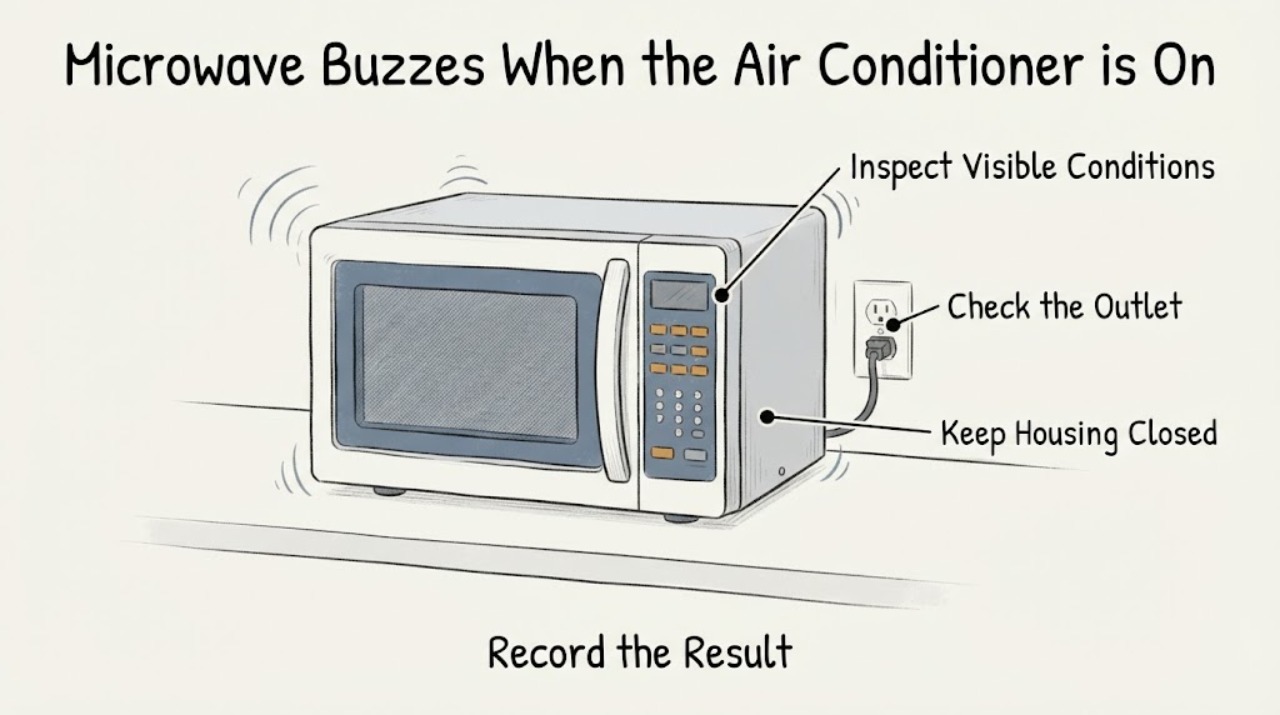
Work through in order
Diagnostic checks
Use only checks that match the exact appliance or system and its official guide.
-
Check 1
Stop the microwave and air conditioner. From a dry position, look for smoke, sparks, a burning or electrical odor, a hot or discolored plug/cord, visible outlet damage, repeated breaker trips, or a microwave that starts operating unexpectedly. If any of these is present, do not run either appliance again; disconnect the microwave only if the plug and outlet are dry and safe to touch.
Expected result: There is a smell, smoke, sparking, heat, damage, repeated protection trip or unexpected operation, or none of those signs is present.
Next step: For any warning sign, keep the microwave out of service and arrange qualified appliance/electrical service. If no warning sign is present, continue with one controlled isolation check without opening the appliance or altering wiring.
Why this matters
Why: These signs raise an immediate fire or electrical-safety concern and cannot be cleared by changing outlets or repeating the test. No visible warning sign lowers urgency but does not prove the circuit or microwave is healthy.
-
Check 2
With both appliances stopped, unplug the microwave from its dry, accessible outlet and turn the air conditioner on only under its normal safe operating conditions. Do not use the microwave while it is unplugged and do not repeatedly cycle the air conditioner just to reproduce the noise.
Expected result: The buzz disappears with the microwave unplugged, or the buzz continues even though the microwave is disconnected.
Next step: If the buzz disappears, leave the microwave unplugged until the dedicated-circuit and model-power checks are completed. If it continues, stop attributing it to the microwave and have the air-conditioner or electrical source assessed.
Why this matters
Why: A sound that disappears when the microwave is disconnected points to the microwave, its supply path or an interaction under load, but it does not identify the failed part. A sound that continues with the microwave disconnected is not coming from the microwave and should be assessed as an air-conditioner or building-noise issue.
-
Check 3
Read the microwave's complete model and electrical rating from its label or operating manual, then identify from outside the panel whether its outlet is a properly grounded dedicated receptacle. Do not open the breaker panel, replace a breaker, remove the ground pin, use an adapter, or run the microwave through an extension cord or power strip.
Expected result: The model-specific instructions confirm the required supply and the receptacle is known to be the dedicated grounded circuit, or the circuit/voltage/grounding arrangement is unknown or shared with the air conditioner or another appliance.
Next step: If the supply is unknown or shared, keep the microwave out of service and ask a qualified electrician to assess the circuit and an authorized Panasonic service route to assess the appliance. If the supply is confirmed correct, perform no internal repair; use the service decision in the next action.
Why this matters
Why: Panasonic states that requirements vary by model and that the oven should use a dedicated grounded supply. An unknown or shared arrangement is not evidence that the microwave is defective and should not be corrected by an improvised cord or breaker change.
-
Check 4
Only if the microwave can be moved safely and a second outlet is already known to be a correctly grounded, model-compatible dedicated line, test it once with no extension or adapter. Otherwise skip this test and use service. Observe whether the same loud buzz returns when the air conditioner starts and whether the microwave heats normally without warning signs.
Expected result: The buzz remains on the separate direct dedicated line, or it disappears there; the microwave also shows no heat, arcing or other abnormal operation.
Next step: If the buzz remains or any other abnormal operation appears, stop using the microwave and use warranty/qualified service. If it disappears on the confirmed separate line, have the original circuit reviewed before returning both appliances to simultaneous operation; do not install a guessed surge protector or modify wiring as a workaround.
Why this matters
Why: Panasonic's guidance treats a loud buzz that remains on another direct dedicated line as a microwave-operation problem. Disappearance on a confirmed separate line makes the original supply arrangement a stronger suspect but does not prove a harmless condition. No heat, arcing or other abnormal operation increases the need to stop use.
Use your observations
Decision map
Find the observation that best matches what you see, then follow the next safe action.
-
PATH 01Next step
What you see
The microwave has smoke, sparks, burning odor, a hot/discolored plug or cord, repeated breaker trips, unexpected operation, or visible outlet damage.
Do this next
Stop using the microwave, disconnect it only if the connection is dry and safe, keep clear of damaged equipment, and arrange qualified appliance/electrical service.
Why this path and its safety boundary
Why it matters: This is an electrical or fire-safety stop condition, not a noise that can be diagnosed through more user testing.
-
PATH 02Next step
What you see
The buzz stops when the microwave is unplugged and the original receptacle/circuit is shared with the air conditioner or cannot be verified as a dedicated grounded supply.
Do this next
Leave the microwave unplugged and have a qualified electrician verify the circuit, grounding and load arrangement; use Panasonic's model-specific service route for the appliance if needed. Do not use an extension cord, adapter or larger breaker.
Why this path and its safety boundary
Why it matters: The timing is consistent with a supply or load interaction, but neither the circuit fault nor a microwave component fault is proven.
-
PATH 03Next step
What you see
The microwave is on a confirmed dedicated grounded supply but the loud buzz returns when the air conditioner starts, or it remains on another direct dedicated line.
Do this next
Stop using the microwave and arrange Panasonic warranty or qualified appliance service. Do not open the cabinet or attempt to test the inverter, magnetron, capacitor, relay or interlock.
Why this path and its safety boundary
Why it matters: Panasonic's troubleshooting boundary treats a persistent loud buzz on another direct dedicated line as a microwave-operation problem; a model-specific internal cause remains unconfirmed.
-
PATH 04Next step
What you see
The buzz disappears on a confirmed separate dedicated line, with no heat, odor, sparks or breaker symptoms.
Do this next
Keep the microwave on the confirmed compliant supply and have the original circuit assessed before using the microwave and air conditioner together; follow the exact Panasonic manual for the model.
Why this path and its safety boundary
Why it matters: The original circuit or electrical environment remains a plausible contributor, but disappearance alone does not establish that the original setup is safe for simultaneous operation.
Helpful context
Understand the symptom
What the report establishes
The opened original post says the user had just received a Panasonic inverter flatbed microwave and heard a high-pitched, unnerving buzz whenever the air conditioner was turned on; the sound was reported near the control-panel side. It does not provide the microwave model, air-conditioner type, supply voltage, circuit arrangement, whether the microwave was cooking, or whether the sound stopped after isolation. The timing is useful evidence of an electrical interaction or a load-sensitive condition, but it does not identify a component or prove that the air conditioner caused damage.
Why the supply arrangement matters
Panasonic's official troubleshooting page says power requirements vary by model, tells owners to follow the model's operating and grounding instructions, and states that the microwave should be on a separate dedicated circuit. It also says a loud buzzing noise that remains when the microwave is plugged into another direct dedicated line indicates a microwave-operation problem and calls for stopping use and warranty/service handling. Those instructions support a safe supply check, not a user diagnosis of the inverter, magnetron, relay or other internal part.
When checks do not resolve it
Need a professional?
Call a qualified electrician for an unknown/shared/incorrectly grounded supply or simultaneous-load concern. Call Panasonic or qualified microwave service if the loud buzz persists on another direct dedicated line or any heating, arcing, odor, smoke, hot plug, unexpected operation or breaker symptom appears.
Safety scope: Do not open the microwave or breaker panel, touch high-voltage parts, change a breaker, remove the ground pin, use an adapter, use an extension/power strip, or repeatedly run both appliances to reproduce the buzz. Stop use for smoke, burning odor, sparks, hot/discolored wiring, unexpected operation or repeated trips.
Have this ready
- Provide the complete Panasonic model, rating-label voltage/current information, the microwave outlet and circuit arrangement if known, when the buzz starts/stops, whether it occurs only during cooking, whether it disappears unplugged, and any odor, heat, sparks, breaker or heating symptoms.
Common questions
FAQ
Is the air conditioner definitely damaging the Panasonic microwave?
No. The exact post establishes timing, not causation. Shared or unsuitable supply conditions, electrical interference, the microwave's own operation or another nearby source remain possibilities until the model-specific supply is verified and the microwave is assessed.
Can I put the microwave on a surge protector or extension cord?
Do not use that as a generic fix. Panasonic says to use the model's power instructions and a grounded dedicated supply; its troubleshooting page warns against shared appliance circuits and directs service when a loud buzz persists. Have the circuit and model requirements checked instead.
Can I open the microwave to find the buzzing part?
No. The task has no model-specific service procedure, and Panasonic's public troubleshooting boundary directs stop-use and warranty/service handling for persistent loud buzzing. Do not access the cabinet or high-voltage components.
Read the exact guide
Official sources
- New microwave making buzzing sound when air con is turned onReddit r/Appliances · Opened the exact supplied Reddit permalink. The post identifies a new Panasonic inverter flatbed microwave, a high-pitched buzz that occurs when the air conditioner is turned on, and the reported sound location near the control panel. It does not establish a model, circuit, voltage, cause or repair outcome.
- Troubleshooting - Microwave power, fan or motor problemsPanasonic North America Support · Opened Panasonic’s official troubleshooting page. It states that power requirements vary by model, requires model-specific operating/grounding instructions, says a microwave should use a dedicated grounded supply, and directs stop-use/service handling for a loud buzz that remains on another direct dedicated line. It does not identify the assigned microwave’s model or prove an internal component fault.
Community feedback
Share a repair observation
Share a plain-text repair observation. Accepted observations are published automatically; this page may take a moment to update.