
On this page
Start here
Quick answer
The Panasonic NE-1025F is a light-duty commercial, dial-control microwave, not a consumer touch-panel model with a universal Defrost menu. Its opened owner manual identifies a timer, control panel, door safety lock, and air vents, and its operating instructions tell the operator to place food inside, close the door, and set a heating time; the manual does not provide a Defrost button or a user-selectable power-level sequence. Do not import the P3/Defrost steps from Panasonic's general consumer page, because that page says procedures and images vary by model and its examples list other model families. For frozen food, use the food or supplier's safe thawing instructions outside the oven when the NE-1025F manual does not specify a defrost program. If the concern is that the oven does not heat, first distinguish a missing feature from a real fault using a normal microwave-safe food load only when the oven is otherwise safe; never test it empty. Stop for sparks, smoke, damaged door/latches, a damaged cord, abnormal heat, or a unit that is not working properly, and use qualified commercial-microwave service rather than opening the cabinet.
Before you begin
Safety first
- The user boundary ends at confirming the model/panel, following the documented timer sequence with a normal food load when safe, and checking visible cord, door, latch, vents, and control-surface conditions. Do not operate empty, remove the outer panel, tamper with door interlocks, perform live tests, or access stored-voltage areas.
Work through in order
Diagnostic checks
Use only checks that match the exact appliance or system and its official guide.
-
Check 1
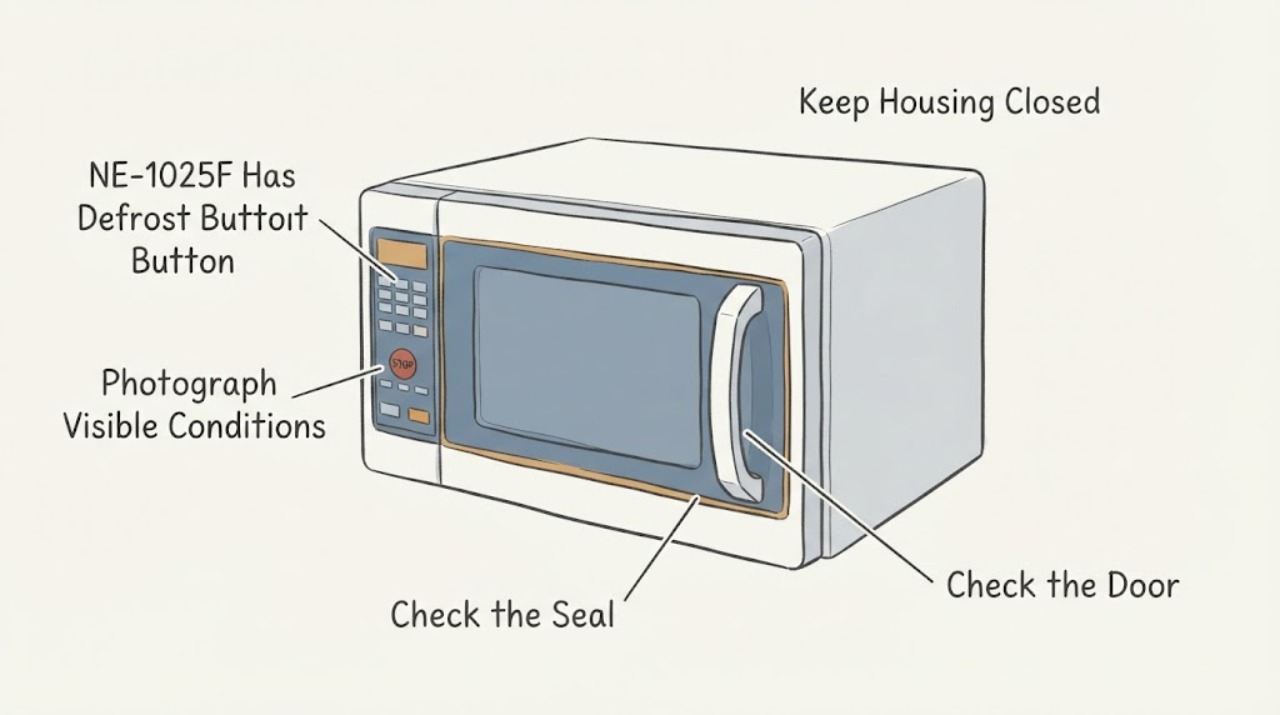
Read the identification plate and confirm every character is NE-1025F, then photograph the front panel. Count the controls actually present—Panasonic's manual identifies a timer and control panel—and do not search for a touch-screen Defrost menu that this commercial layout does not document.
Expected result: The label is NE-1025F and the panel has a timer-only layout, the label is a different NE-series model, or the model/panel cannot be confirmed.
Next step: Use the manual for the confirmed model. If the identity is uncertain, stop button experimentation and obtain the correct Panasonic manual or authorized service information.
Why this matters
Why: A confirmed NE-1025F supports the timer-only interpretation. A different or incomplete identity could have different controls and cannot safely inherit this article's conclusion.
-
Check 2
Compare the requested operation with the NE-1025F manual's actual sequence: place a microwave-safe food container inside, close the door securely, and set a heating time with the timer. Do not hold undocumented buttons or apply a P3/Defrost sequence from another Panasonic model.
Expected result: The manual sequence matches the panel, a desired Defrost control is absent, or the timer/door sequence cannot be completed.
Next step: Use the food supplier's approved thawing method outside the oven when no NE-1025F defrost procedure is specified. If the documented heating sequence will not run, record the exact behavior and arrange service.
Why this matters
Why: An absent Defrost key is consistent with the documented commercial control design. Failure to start after the documented food-plus-door-plus-timer sequence is a separate operating fault and should not be solved by inventing a power mode.
-
Check 3
If the concern is no heating rather than the missing feature, use only a normal microwave-safe food load and the ordinary timer sequence after confirming the door, cord, and cavity appear undamaged. Never run the oven empty or with metal, sealed containers, or unsafe packaging.
Expected result: The timer starts and food warms, the timer runs but food remains cold, the door will not latch, or sparks/smoke/abnormal heat occur.
Next step: Stop using the oven for no heat, door damage, arcing, smoke, or abnormal heat and contact an authorized commercial-microwave service provider. Do not repeat the test to obtain a stronger symptom.
Stop if: Do not perform an empty-cavity test, open the cabinet, bypass the door interlock, or make live measurements.
Why this matters
Why: Heating with a normal load supports that the absence of a Defrost key is a feature issue, not a no-heat fault. No heat with normal operation or any door/arcing/overheating symptom requires service; it does not identify a magnetron or control part.
-
Check 4
Check the installation from outside the oven: it is on a flat stable surface, air vents are not covered, the cord and plug are intact, and the outlet is the grounded dedicated circuit described by the manual. Do not move the oven while connected or alter the circuit yourself.
Expected result: A vent is blocked, the surface is unstable, the cord/plug or outlet is damaged or shared, or the external installation looks normal.
Next step: Correct only a plainly visible placement or obstruction with power safely isolated. Have a qualified electrician or service person address grounding, outlet, circuit, or cord concerns.
Stop if: Do not open the panel, change wiring, bypass grounding, or continue operation when the cord, plug, outlet, or housing is damaged.
Why this matters
Why: Panasonic warns that blocked vents can overheat the oven and requires a properly grounded dedicated circuit. A normal exterior does not rule out an internal heating or control fault, but it removes only those visible installation possibilities.
-
Check 5
Record whether the food is frozen solid, partially thawed, packaged, or being handled in a commercial service workflow, and follow the food manufacturer's or supplier's thawing instructions rather than improvising a microwave program absent from the NE-1025F manual.
Expected result: The food instructions specify a non-microwave thaw, specify a microwave method for a different wattage/control type, or provide no method.
Next step: Use the supplier's validated method or ask the food-service operator/qualified Panasonic support for an NE-1025F-specific procedure. Do not compensate by using an undocumented low-power sequence or unattended heating.
Why this matters
Why: Food thawing depends on starting temperature, mass, packaging, and the supplier's validated process. The NE-1025F's commercial timer and 1000 W output do not prove that a generic household defrost schedule is safe or suitable.
-
Check 6
If the oven is not working properly, inspect only the external door, latch, cord, plug, air vents, and control surface for damage or contamination. Wipe a wet control panel with a soft dry cloth only with the door open and timer at zero, as the manual directs; do not remove the outer panel.
Expected result: The door/latch or cord is damaged, the control panel is wet or unresponsive, vents are blocked, or all external areas appear normal while the oven remains faulty.
Next step: Keep the oven out of service and contact an authorized service center for any damage, persistent no-heat, or unresponsive control. Provide the model, serial number, control behavior, and the exact load and timer sequence.
Stop if: Do not remove panels, tamper with interlocks, access stored-voltage areas, or reconnect the oven if parts are not reassembled.
Why this matters
Why: Panasonic treats damaged doors, latches, cords, and unsafe operation as service conditions and reserves internal base/control-area work for qualified personnel. A clean exterior with persistent no-heat or control trouble leaves an internal diagnosis unresolved.
Use your observations
Decision map
Find the observation that best matches what you see, then follow the next safe action.
-
PATH 01Next step
What you see
The confirmed NE-1025F has the documented timer/control-panel layout, starts with a normal food load, and heats normally but has no Defrost button.
Do this next
Use the food supplier's validated thawing method or obtain Panasonic commercial guidance for this model. Do not borrow P3/Defrost instructions from a different Panasonic model.
Why this path and its safety boundary
Why it matters: The missing Defrost setting is a feature/control-layout limitation, not evidence of a no-heat failure. Panasonic's exact manual does not establish a user-selectable power-level workaround.
-
PATH 02Next step
What you see
The timer runs with a normal load but the food remains cold, or the timer/door sequence cannot start despite an intact external setup.
Do this next
Stop using the oven and arrange authorized commercial-microwave service with the model, serial, load, timer setting, and observed behavior.
Why this path and its safety boundary
Why it matters: This is a separate no-heat or start-control problem. It cannot be diagnosed as a missing Defrost feature and does not identify a magnetron, relay, timer, or interlock part.
-
PATH 03Safety boundary
What you see
The door, latch, cord, or plug is damaged; sparks, smoke, unusual odor, or abnormal heat occur; or the oven was operated empty.
Do this next
Turn the timer to zero, keep the door closed for an internal fire, disconnect power only if safe, and contact qualified service or emergency help as appropriate. Do not restart the oven.
Why this path and its safety boundary
Why it matters: The unit has crossed the microwave fire, electrical, or radiation-safety boundary. Panasonic specifically prohibits damaged or empty operation and tampering with door safety systems.
Safety stop: No empty-cavity test, cabinet removal, interlock bypass, live test, or unqualified repair.
-
PATH 04Next step
What you see
The model is not exactly NE-1025F, the panel includes different controls, or a generic Panasonic page conflicts with the exact manual.
Do this next
Stop using this procedure, photograph the identification plate and panel, and retrieve the exact Panasonic manual or contact commercial support.
Why this path and its safety boundary
Why it matters: The feature and power procedure are model-specific. The generic P3/Defrost table cannot resolve an identity conflict.
-
PATH 05Next step
What you see
The only issue is thawing frozen food and the NE-1025F manual gives no dedicated thawing control or method.
Do this next
Follow the food manufacturer's or commercial supplier's validated thawing process, or ask Panasonic commercial support for a model-specific procedure; do not improvise low-power operation or leave food unattended.
Why this path and its safety boundary
Why it matters: The manual does not support a safe appliance-side Defrost workaround. A consumer microwave recipe may not match this commercial oven's timer-only control or the food-service product.
Helpful context
Understand the symptom
The missing button may be a feature difference
Panasonic's exact product page calls the NE-1025F a light-duty commercial microwave with a dial control and a six-minute electronic timer. The owner manual's outline lists a timer and control panel, and its operating section describes placing food in the cavity, closing the door, and setting the heating time. It does not present a consumer-style Defrost menu or a power-level key. That is a control-layout finding, not evidence that the oven is broken.
Why a generic Panasonic Defrost recipe is unsafe here
Panasonic's general page for manually programming power and time includes P3 (medium-low)/Defrost examples, but it also says the image and procedure vary by model and presents multiple model-specific tables. Those instructions are not the NE-1025F manual. Do not invent a hidden power setting or convert the timer into a defrost program unless Panasonic supplies an instruction for this exact model. Use the food manufacturer's or food-service supplier's approved thawing method when the commercial manual is silent.
Do not confuse no Defrost key with no microwave heating
The NE-1025F can lack a dedicated Defrost control and still be operating as designed. A separate no-heat concern needs its own observation: whether the timer operates, the door closes and latches, the interior light behaves normally, and a normal food load heats under the manual's ordinary instructions. Never use an empty cavity as a test. Any damaged door, latch, cord, unusual arcing, or abnormal heat moves the case directly to qualified service.
When checks do not resolve it
Need a professional?
Use authorized Panasonic commercial service for a genuine no-heat or control fault, door/latch or cord damage, sparks, smoke, overheating, or any internal inspection. Use Panasonic commercial support or the food supplier for a model-appropriate thawing method rather than importing a consumer Defrost sequence.
Safety scope: The user boundary ends at confirming the model/panel, following the documented timer sequence with a normal food load when safe, and checking visible cord, door, latch, vents, and control-surface conditions. Do not operate empty, remove the outer panel, tamper with door interlocks, perform live tests, or access stored-voltage areas.
Have this ready
- Provide NE-1025F, serial number, country/site type, panel photograph, whether the timer starts and resets, door/latch behavior, load and packaging, heating result, vent/cord/outlet observations, and any smoke, spark, odor, or heat event.
Common questions
FAQ
Does the Panasonic NE-1025F have a Defrost button?
The opened NE-1025F manual documents a timer and control panel and gives a timer-based heating sequence; it does not document a dedicated Defrost or user-selectable power-level control. Confirm the exact label before applying that conclusion to another NE-series model.
Can I use Panasonic's P3/Defrost instructions anyway?
Not as a generic workaround. Panasonic's general power/time page says procedures vary by model and shows P3/Defrost tables for other model families. Use the NE-1025F manual or a commercial-support instruction for this exact model.
How should I thaw food if this oven has no Defrost setting?
Use the food manufacturer's or commercial supplier's validated thawing process, or request Panasonic commercial guidance for NE-1025F. Do not invent a low-power sequence, use a household recipe without checking the model, or leave food unattended.
How do I tell a missing feature from a no-heat failure?
A missing Defrost key with normal operation is a feature/layout issue. A timer that runs but does not heat a normal microwave-safe food load, a door that will not latch, sparks, smoke, or abnormal heat is a separate safety or service issue. Never test an empty cavity or open the cabinet.
Read the exact guide
Official sources
- Panasonic - How to manually program the power and time on a Microwave Oven.Panasonic · Official Panasonic general guidance opened only to establish the model-variation boundary: it shows P3/DEFROST examples for other model families and says the procedure/image varies by model. It is not evidence that NE-1025F has a power-level or Defrost control.
- Panasonic - NE-1025Panasonic · Official Panasonic support page opened to confirm the NE-1025 professional product family and its manuals/troubleshooting support path; it is not used to invent a Defrost procedure.
- Panasonic Light Duty Commercial Microwave Oven 1000 Watts - NE-1025FPanasonic · Official Panasonic product page opened for the exact NE-1025F identity, commercial use, 1000 W output, dial timer, and product configuration; it does not establish a Defrost control or internal fault.
- NE-1025F_AUH_OI.inddPanasonic · Exact Panasonic NE-1025F owner manual opened for the timer-only operating sequence, safety restrictions, no-empty rule, door/vent/grounding requirements, and qualified-service boundary.
Community feedback
Share a repair observation
Share a plain-text repair observation. Accepted observations are published automatically; this page may take a moment to update.