
On this page
Start here
Quick answer
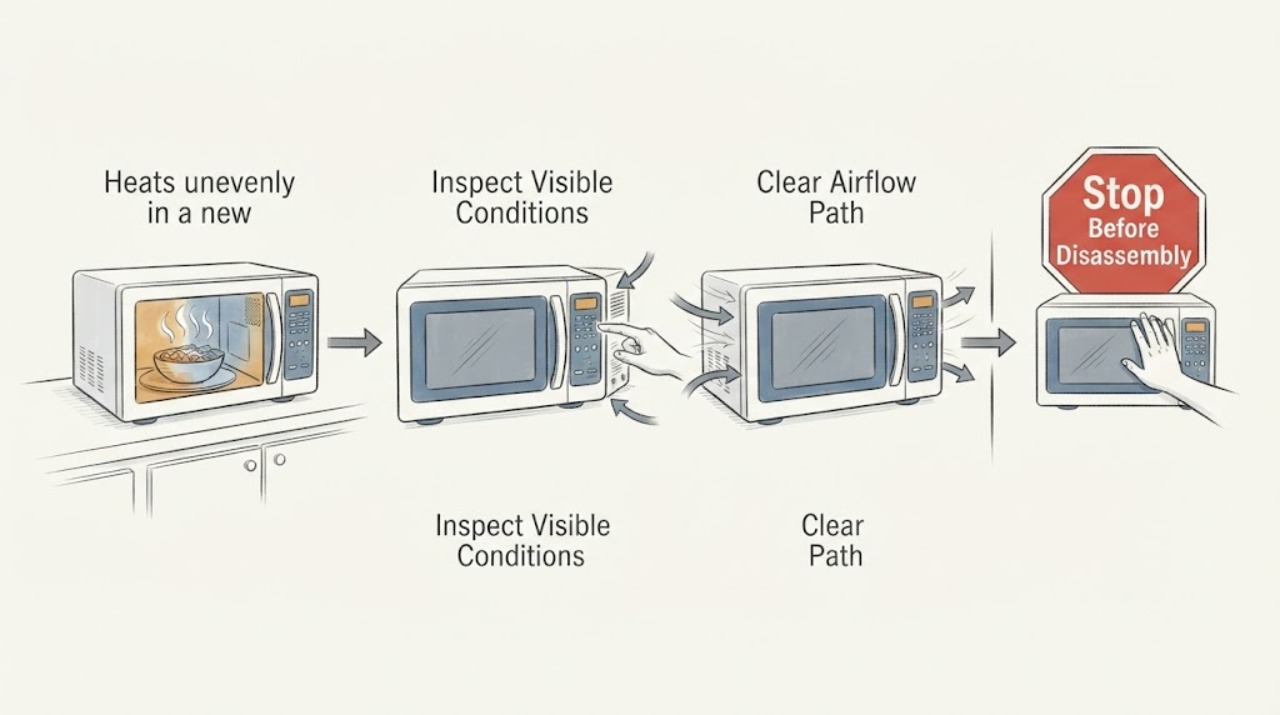
With a Panasonic NN-SD671S that heats one part of a dish more than another, first separate a food-distribution or turntable problem from a true no-heat problem. Confirm the new-apartment installation is stable, ventilated, grounded, and on the required separate circuit; verify the glass tray and roller ring; then use one supervised microwave-safe cup-of-water test at the intended high setting. If the cup warms and the tray rotates, adjust food placement and stirring. If the cup stays cold, an H-code appears, or there is arcing, smoke, a damaged door, or a damaged cavity, stop using the microwave and arrange qualified Panasonic service.
Work through in order
Diagnostic checks
Use only checks that match the exact appliance or system and its official guide.
-
Check 1
Classify the symptom before running another cycle: note whether some areas are hot and others are cool, or whether everything is cold; record the power setting and any displayed message. From outside, check that the door closes normally and look for smoke, arcing, a burning smell, a bent door, or a damaged cavity surface.
Expected result: The dish has a repeatable hot/cold pattern with no hazard, or the entire load stays cold, a message appears, or damage or smoke is visible.
Next step: For any smoke, arcing, burning smell, damaged door, damaged cavity, or repeated all-cold result, stop use and arrange qualified service. Otherwise continue with the installation and tray checks below.
Why this matters
Why: A hot/cold pattern is compatible with food thickness, placement, power selection, or tray behavior; an all-cold result or visible damage needs the no-heat or safety path instead. A closed door is necessary for heating but does not prove the internal microwave circuit is healthy.
-
Check 2
With the microwave unplugged only if the plug is safely accessible, inspect the new-apartment placement from the outside: it should be stable, have the manual's required airflow, have no blocked vents, and use a properly grounded separate circuit rather than an adapter or a circuit shared with another appliance. If it is set into cabinetry, confirm the installation uses an approved arrangement for this model rather than sealing the countertop oven into a generic opening.
Expected result: The oven is stable and ventilated on the documented grounded circuit, or vents are blocked, the outlet/grounding is uncertain, the circuit is shared, or the cabinet installation is improvised.
Next step: Do not change wiring, defeat the ground, use an adapter, or modify the cabinet. Ask the landlord, installer, qualified electrician, or authorized service provider to correct an uncertain outlet or cabinet installation before further diagnosis.
Why this matters
Why: A new-apartment installation issue can affect operation or cause overheating without proving an internal heating-part failure. The NN-SD671S specifications identify the model and its compatible trim-kit families, while the model manual requires proper placement, airflow, grounding, and a separate circuit.
-
Check 3
After the oven is cool and the controls are safe to use, confirm that the model-specific glass tray is fully seated on its roller ring and drive hub, the cavity floor and ring are clean, and the container does not touch the cavity walls. Place a microwave-safe cup of water in a dish, select the intended high setting (P10 is the model's maximum), heat it for the official one-to-two-minute check, and watch only from outside for tray rotation.
Expected result: The water warms and the tray rotates smoothly, the water warms but the tray does not rotate, or the water remains cold while the oven appears to run.
Next step: Stop if the tray does not rotate correctly, the water stays cold, or any arcing, smoke, or abnormal odor occurs; arrange qualified service. Never run the microwave empty, with metal, without the tray and roller ring, or with the door or cavity damaged.
Why this matters
Why: Warm water with a rotating tray makes a food pattern or loading issue more likely than a total no-heat fault. A stationary tray can cause uneven results and is a service boundary if correct seating and cleaning do not restore rotation. Cold water at the intended setting is a repeatable no-heat symptom, not evidence that a particular internal part is bad.
-
Check 4
If the water test passes, repeat the food test with a microwave-safe dish that is not crowded: put thinner portions toward the center and thicker pieces toward the edge, cover where appropriate, and stir liquid foods once or twice during cooking. Keep the container clear of the walls and compare like-sized portions rather than comparing a cold dense center with a thin edge.
Expected result: The hot/cold pattern improves when thickness, placement, covering, or stirring changes, or the same pattern persists despite a rotating tray and consistent loading.
Next step: Use the corrected loading method for ordinary cooking. If a consistent pattern remains across controlled portions, stop repeated testing and give the service provider the model, power setting, food amount, tray behavior, and installation details.
Why this matters
Why: Improvement with distribution or stirring supports normal microwave field and food-characteristic effects described by Panasonic, not a confirmed failed component. Persistence after controlled loading shifts attention back to power, installation, tray operation, or service.
-
Check 5
Compare the selected power level with the intended recipe or test and record whether the problem occurs only on a low setting or also at P10. The NN-SD671S has ten microwave power levels and inverter power control, so a lower setting is not a valid comparison with maximum-power heating.
Expected result: Heating becomes consistent at the intended high setting, or the same portion remains partly or entirely cold at P10 after the tray and installation checks pass.
Next step: Use the exact manual's power controls for normal cooking. Do not open the cabinet, enter an undocumented service mode, bypass door interlocks, or test high-voltage parts; arrange qualified service for persistent weak or absent heating.
Why this matters
Why: A change that follows the selected power level points to settings or food response rather than a code-specific component diagnosis. A repeatable cold result at P10, especially with a secure door and rotating tray, remains a service condition.
Use your observations
Decision map
Find the observation that best matches what you see, then follow the next safe action.
-
PATH 01Next step
What you see
The cup of water warms, the glass tray rotates, there is no smoke or arcing, and only thicker or poorly distributed food has cool spots.
Do this next
Use thinner portions toward the center, thicker portions toward the edge, a cover where suitable, and stirring for liquids; stop treating the food pattern alone as proof of a failed part.
Why this path and its safety boundary
Why it matters: The evidence favors a cooking-distribution or food-characteristic effect rather than a complete heating failure.
-
PATH 02Next step
What you see
The tray wobbles, stops, does not rotate, or is not seated on the roller ring, or the container touches the cavity wall.
Do this next
When cool, correct only the accessible tray, ring, floor-cleanliness, and container-position issues documented by Panasonic. If rotation remains abnormal, stop use and arrange service; do not operate without a rotating tray.
Why this path and its safety boundary
Why it matters: Tray-path setup can produce uneven cooking and is distinct from an internal heating diagnosis.
-
PATH 03Next step
What you see
The problem began after moving into the apartment and the oven is in a generic cabinet opening, has blocked vents, an uncertain ground, or a shared circuit.
Do this next
Stop modifying the appliance and have the landlord, installer, qualified electrician, or authorized Panasonic service verify the model-specific placement, airflow, grounding, and circuit before further use.
Why this path and its safety boundary
Why it matters: The change in environment is a credible installation variable, but it does not identify an internal component or make an improvised cabinet installation safe.
-
PATH 04Next step
What you see
The cup remains cold at the intended high setting, an H-code returns, the door or cavity is damaged, or there is arcing, smoke, or a burning smell.
Do this next
Stop use, disconnect power only if it is safe to do so without approaching a hazard, and arrange qualified Panasonic service. Do not repeat tests, remove the outer panel, bypass an interlock, or attempt high-voltage repair.
Why this path and its safety boundary
Why it matters: This is no longer an ordinary uneven-cooking adjustment. Panasonic treats persistent no heat and H97/H98-style messages as service matters, and its manual reserves cabinet, door, interlock, and other repairs for qualified personnel.
Helpful context
Understand the symptom
Why a new-apartment move matters
The NN-SD671S is an inverter microwave with ten microwave power levels and a rotating glass tray. A new installation can add a placement, ventilation, grounding, or shared-circuit variable, while food thickness and tray movement can produce normal hot and cool areas. Treat those as separate observations; do not infer a failed magnetron, inverter, or control part from uneven food alone.
When checks do not resolve it
Need a professional?
Stop using the microwave for smoke, arcing, burning odor, a damaged door or cavity, a returning H-code, a tray that will not rotate correctly, or a cup of water that stays cold at the intended high setting. Do not open the cabinet, bypass an interlock, run it empty, use metal, or perform energized electrical or high-voltage work.
Common questions
FAQ
Does uneven heating prove the inverter or magnetron failed?
No. If a supervised cup-of-water test warms and the tray rotates, Panasonic's food-distribution guidance should be checked first. Persistent cold water, a returning message, smoke, arcing, or damage requires service rather than a guessed part.
Can an apartment cabinet cause uneven heating?
An installation can change airflow, stability, grounding, or circuit conditions, but it cannot be safely diagnosed by modifying the cabinet or wiring. Verify the exact model's documented placement and approved installation arrangement with the installer or qualified service provider.
Is it safe to test the microwave empty or with a metal cup?
No. Panasonic's NN-SD671S manual warns against empty operation and metal containers. Use only the supervised microwave-safe cup-of-water check, and stop immediately for arcing, smoke, or burning odor.
Read the exact guide
Official sources
- Panasonic - Troubleshooting Questions related to Cooking, Heating and Programing operation.Panasonic · Panasonic microwave cooking-performance and uneven-cooking guidance
- Panasonic - No Heat, Low HeatPanasonic · Panasonic microwave no-heat and low-heat troubleshooting
- operating instructions microwave ovenPanasonic Canada Inc. · Panasonic NN-SD671S operating, installation, grounding, tray, and microwave safety instructions
- Panasonic - Features and Specifications - Microwave Oven - NN-SD671SPanasonic · Panasonic NN-SD671S microwave model identity, inverter power, P1-P10 levels, glass tray, 13-inch turntable, and compatible trim-kit families
- Panasonic - Troubleshooting - Physical problem with your Microwave Door, Cavity, Cabinet, Tray (Turntable) or other physical pieces.Panasonic · Panasonic microwave tray, roller-ring, cavity-contact, and turntable troubleshooting
Community feedback
Share a repair observation
Share a plain-text repair observation. Accepted observations are published automatically; this page may take a moment to update.