
On this page
Start here
Quick answer
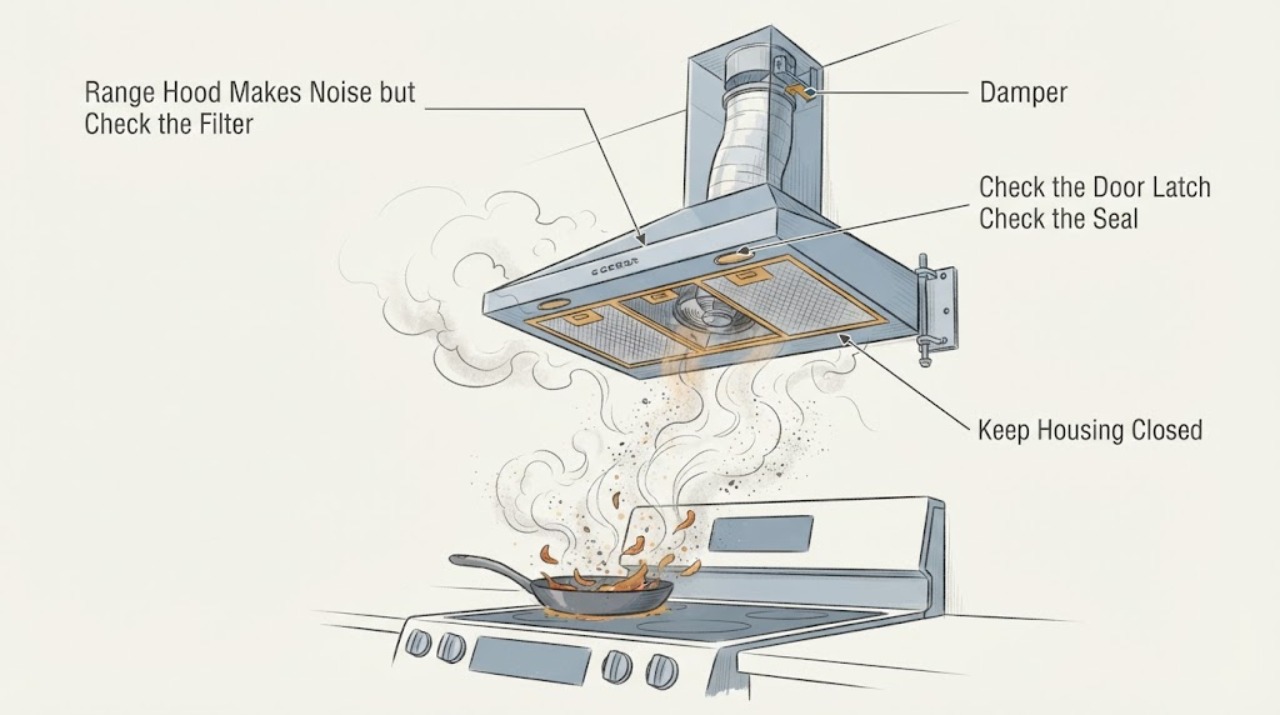
A noisy range hood with weak smoke or odor capture is often moving air against a restriction rather than proving that its motor has failed. First turn the hood off and let it cool, then identify whether it is ducted outdoors or recirculating. Clean a washable grease or baffle filter, replace a saturated charcoal filter only with the model-approved type, and inspect visible duct and exterior-cap openings for blockage, backflow, loose panels, or vibration. Do not open the motor housing or alter wiring. If the hood still rattles, scrapes, vibrates, or fails to move air after safe external checks, stop using it for heavy frying and arrange qualified ventilation service.
Work through in order
Diagnostic checks
Use only checks that match the exact appliance or system and its official guide.
-
Check 1
Turn the hood off, let the cooking surface and filters cool, and identify the ventilation mode from the model instructions and visible duct path. Look in the cabinet above or around the hood for ducting, and from outside check for a wall, soffit, or roof outlet without climbing or removing panels.
Expected result: An exterior outlet and duct are present, no duct or exterior outlet is visible, or the configuration is uncertain.
Next step: For a ducted hood, continue with filter and visible outlet checks. For a recirculating hood, confirm the charcoal-filter requirement in the exact manual and do not expect outdoor exhaust performance from a filter that only recirculates air.
Why this matters
Why: PNNL says an exterior outlet and connected duct indicate an exhaust path; without one, the hood is likely recirculating. Broan explains that recirculating filters return humidity, smoke, and heat to the room, so weak removal may be a configuration limit rather than a failed fan.
-
Check 2
Inspect the cool, owner-removable grease, mesh, or baffle filter for heavy grease, blocked openings, damage, or an incomplete latch. Clean a washable filter using the manufacturer's instructions and replace a charcoal filter only when the manual specifies it and the replacement matches the hood model.
Expected result: The filter is visibly greasy or blocked, a charcoal filter is overdue or saturated, the filter is damaged, or the filter is clean and properly seated.
Next step: Clean and fully dry a washable filter before reinstalling it, or install only the model-approved charcoal filter. If the filter is clean, seated, and airflow is still weak, continue to the duct and outlet check rather than guessing a motor fault.
Why this matters
Why: Broan and PNNL explain that grease filters capture particles and that buildup restricts airflow. A clogged filter can make the blower work harder, increasing noise and reducing capture; charcoal filters cannot be washed and must be replaced according to the model guidance.
-
Check 3
With the hood off, inspect only visible duct joints, the exterior wall or roof cap, and any accessible backdraft damper for grease, nests, debris, crushing, gaps, or a flap that cannot open. Do not enter the duct or dismantle the blower.
Expected result: The duct is kinked, undersized, unusually long, full of sharp bends, blocked at the cap, leaking at a visible joint, or visibly clear and correctly routed.
Next step: Correct only a safe, visible obstruction or reseat an accessible cap or filter as the manual permits. Have a qualified ventilation installer assess concealed duct sizing, a blocked roof or wall cap, or any required duct modification.
Why this matters
Why: Broan says duct length, size, bends, type, and static pressure affect real airflow; Electrolux links whistling or high-speed noise with restriction, gaps, backflow, and duct layout. A clear visible path makes an internal or concealed installation issue more likely but still does not identify a motor failure.
-
Check 4
After the filter is dry and correctly seated, run the hood briefly at low and high settings with no active cooking. Observe the airflow at the filter and, for a ducted hood, at the exterior outlet; listen for rattling, scraping, whistling, vibration, or a sudden change with speed.
Expected result: Airflow improves after filter maintenance, air reaches the exterior but the hood vibrates, little or no air reaches the exterior, or a persistent mechanical noise remains.
Next step: Use the hood only within the safe operating instructions if it is quiet and captures normally. If the noise is scraping, grinding, strongly vibrating, or airflow remains poor, stop using it for heavy frying and request qualified service without opening the motor housing.
Why this matters
Why: Improvement after filter maintenance supports a restriction at the filter. Air at the outlet with vibration points toward mounting, panel, or duct resonance; no outlet airflow points toward a restriction, damper, duct configuration, or concealed fault. A persistent mechanical sound can indicate a worn component but is not enough to name one.
-
Check 5
Check the hood's model label and manual before ordering a filter or changing the duct configuration. Record whether it is ducted or recirculating, filter type and condition, fan setting, sound type, visible outlet airflow, and any loose or damaged mounting for the service request.
Expected result: The manual identifies the correct filter and ventilation setup, or the manual is unavailable and the hood remains noisy or ineffective after external checks.
Next step: Follow only the matching manual for user-removable parts. If the issue persists, arrange qualified appliance or ventilation service; do not buy a motor, rewire the hood, or enlarge a duct based on sound alone.
Why this matters
Why: Filter type, duct diameter, damper arrangement, and permitted maintenance vary by model. Broan says specifications should control duct size and filter choices, while Electrolux advises authorized service when noise persists or a motor issue is suspected.
Use your observations
Decision map
Find the observation that best matches what you see, then follow the next safe action.
-
PATH 01Next step
What you see
The hood is recirculating, the fan runs, and smoke or frying odor returns to the room without a duct or exterior outlet.
Do this next
Verify the exact charcoal-filter requirement and keep that filter maintained. If outdoor exhaust is required, ask a qualified installer whether the building and hood support a compliant conversion.
Why this path and its safety boundary
Why it matters: The configuration is returning filtered air indoors; it cannot provide the same smoke, humidity, and heat removal as a ducted outdoor exhaust path.
-
PATH 02Next step
What you see
The filter is greasy, blocked, damaged, or not fully seated, and noise or weak airflow improves after cleaning or replacement.
Do this next
Keep the filter maintained at the model's interval and monitor airflow. Replace only the filter type approved for that model.
Why this path and its safety boundary
Why it matters: Filter restriction was a supported contributor to both the noise and reduced capture; it does not prove damage to the blower.
-
PATH 03Next step
What you see
The filter is clean and seated, but the hood whistles, rattles, vibrates, or has little outlet airflow while ducting or the exterior cap is visibly restricted.
Do this next
Correct only an obvious external obstruction and arrange a qualified ventilation inspection for concealed ductwork, damper, mounting, or cap problems.
Why this path and its safety boundary
Why it matters: Airflow resistance, backflow, a loose installation, or an exterior obstruction is more likely than a simple dirty-filter issue.
-
PATH 04Next step
What you see
The hood makes persistent scraping, grinding, or unusual mechanical noise after the filter and visible airflow checks, or it smells hot or shows damaged wiring.
Do this next
Turn the hood off and arrange qualified appliance service. Do not remove the motor housing, touch internal wiring, or continue heavy frying under a hood with a suspected mechanical or electrical fault.
Why this path and its safety boundary
Why it matters: The remaining problem is outside safe filter and external-duct maintenance and may involve a worn or damaged internal component.
Helpful context
Understand the symptom
Noise does not prove a failed fan motor
A hood can be loud because a filter or duct restricts airflow, because air is recirculating rather than exhausting outdoors, or because a panel or installation point vibrates. Electrolux's cooker-hood guidance lists airflow restriction, worn filters, duct layout, and loose mounting among common noise causes. The checks below are limited to owner-visible filters, settings, openings, and mounting; they do not identify an internal motor or electrical fault.
Ducted and recirculating hoods have different expectations
A ducted hood should discharge through a wall or roof cap, while a non-ducted hood returns filtered air to the room. PNNL's guide recommends checking the cabinet, wall, soffit, or roof for a duct and exterior outlet. Broan notes that recirculating filters do not remove humidity, smoke, and heat as effectively as outdoor exhaust, so a recirculating hood may sound normal while leaving more cooking odor indoors.
When checks do not resolve it
Need a professional?
Contact a qualified service professional if the hood remains noisy and ineffective after filter and visible airflow checks, if a duct or cap needs modification, or if there is scraping, strong vibration, overheating odor, damaged wiring, or a suspected motor issue.
Common questions
FAQ
Can a dirty range hood filter make the hood noisy?
Yes. Grease and debris restrict airflow and can force the blower to work harder, increasing noise while reducing smoke and odor capture. Clean washable filters or replace model-approved charcoal filters according to the manual.
How can I tell whether the hood vents outdoors?
Look for a duct in the cabinet, wall, or ceiling path and an exterior outlet at the wall, soffit, or roof. If no exterior outlet is visible, the hood may be recirculating; check its manual rather than assuming it exhausts outside.
Why is the hood louder on high speed but still weak?
Higher airflow can expose resistance from a dirty filter, narrow or long duct, too many bends, backflow, or an obstructed cap. Inspect only visible areas and have concealed ductwork assessed if the restriction is not accessible.
Should I replace the range hood motor when it makes noise?
No. Noise and weak ventilation do not identify a motor failure. Check the model-appropriate filter, visible duct and cap, damper, and mounting first; persistent scraping, vibration, or suspected motor trouble should be handled by qualified service.
Read the exact guide
Official sources
- Range Hood FAQsBroan-NuTone · Used for grease versus charcoal filter maintenance, recirculating limitations, duct-size and duct-length boundaries, and professional installer escalation; no model-specific part fit is inferred.
- Range Hood Filter Maintenance: How to Know When It's TimeBroan-NuTone · Used for the connection between clogged filters, reduced airflow, noise, vibration, grease buildup, and filter inspection; exact replacement interval and type remain model-dependent.
- Why Is My Cooker Hood Noisy? Causes of Rattling, Whistling & Loud NoiseElectrolux Support · Used for general cooker-hood noise patterns, filter/duct/installation causes, external checks, and service boundary; it does not establish a cause or part for an unspecified brand/model.
- Airflow 101: How Range Hood Power and CFM Are MeasuredBroan-NuTone · Used for the relationship between real airflow, duct length, bends, size, duct type, and static pressure; not used to prescribe an unverified modification for an unspecified hood.
- Clean or Replace Range Hood FilterBuilding America Solution Center, Pacific Northwest National Laboratory · Used for generic ducted versus recirculating identification, visible duct/outlet checks, and safe owner-removable filter guidance; exact filter construction and maintenance still follow the hood manual.
Community feedback
Share a repair observation
Share a plain-text repair observation. Accepted observations are published automatically; this page may take a moment to update.