
On this page
Start here
Quick answer
For a Wolf range hood that will not turn on, separate a dead blower from a light-only or control symptom, then check the household supply and breaker from the outside. Wolf’s hood guide says no operation can result from a tripped household fuse or breaker or no electricity to the hood. Do not open the blower housing to reach the integral disconnect switch; isolate power before service and use the model and serial plate for a qualified diagnosis.
Work through in order
Diagnostic checks
Use only checks that match the exact appliance or system and its official guide.
-
Check 1
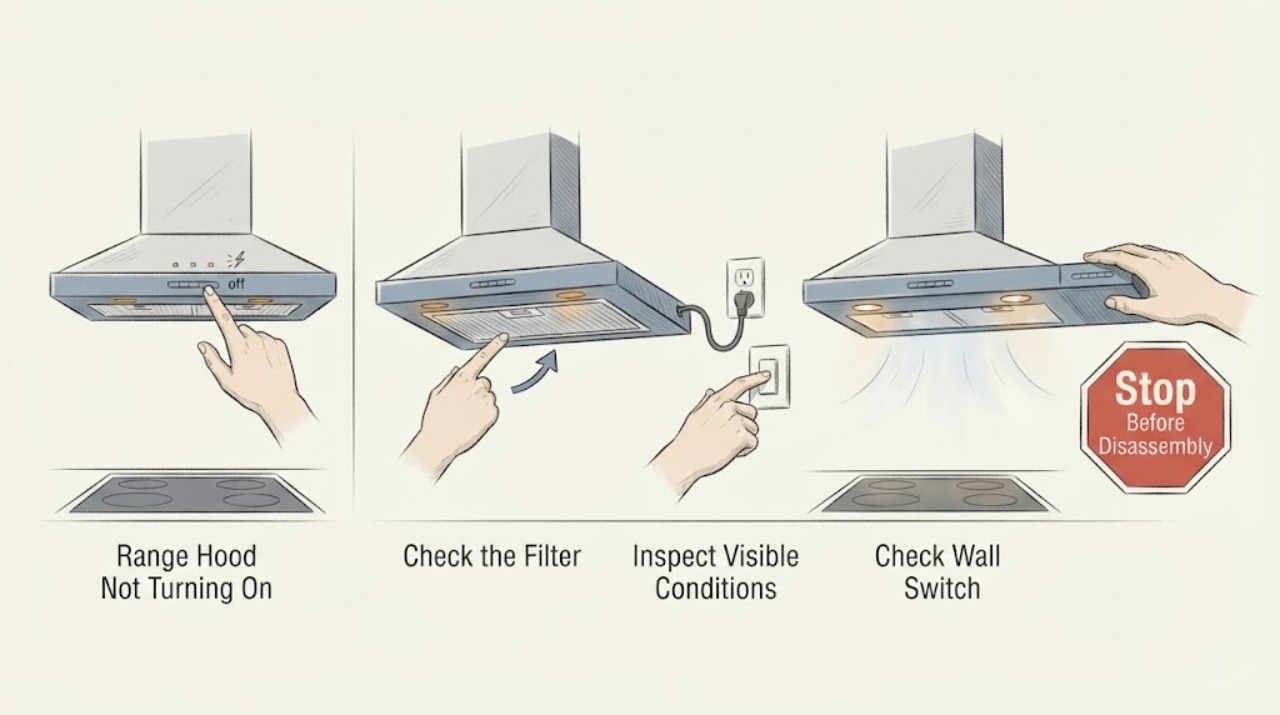
From outside the hood, press the normal light and blower controls once and note whether the lights, blower, indicators, or none of them respond. Do not put hands near a moving blower or reach through the filter opening.
Expected result: Lights work but the blower does not, the blower works but lights do not, or neither function responds.
Next step: Continue with the supply check for total non-operation; for an isolated light issue, use the exact hood manual and service path.
Why this matters
Why: A light-only failure is different from total hood non-operation; neither pattern alone proves a motor, switch, or control-board fault.
-
Check 2
Look at the household electrical panel for the hood circuit and note whether a breaker is visibly tripped or a fuse indication is present. Do not repeatedly reset protection; if it trips again, leave the hood off and use qualified electrical service.
Expected result: The circuit protection is tripped, remains on, or the hood circuit cannot be identified.
Next step: Arrange an electrician to verify the proper circuit when the supply is uncertain or protection will not hold.
Why this matters
Why: A tripped device or absent supply can explain a dead hood; a normal-looking panel does not prove power is present at the hood.
-
Check 3
With the hood cool and idle, inspect only accessible cord, plug, wall switch, and visible connection surfaces for scorching, melting, looseness, or heat. Do not remove the blower housing or hood covers.
Expected result: A connection is hot or damaged, a wall switch is off, or accessible connections look normal.
Next step: Disconnect power only if safe to do so and arrange qualified appliance or electrical service for damage or persistent non-operation.
Why this matters
Why: Heat or damage is an electrical stop condition; a switch or connection state can explain no response, while a normal exterior leaves internal diagnosis unresolved.
-
Check 4
If the hood remains inactive, record the model and serial numbers from the rating plate on the underside above the grease filter, along with which functions failed and the breaker observation.
Expected result: The model and serial information is available, or the plate cannot be reached without dismantling the hood.
Next step: Give the recorded information to Wolf-qualified service and keep the hood isolated until the cause is identified.
Why this matters
Why: Wolf uses model and serial information to route literature, parts, and service; inability to access it safely is not a reason to open the housing.
Use your observations
Decision map
Find the observation that best matches what you see, then follow the next safe action.
-
PATH 01Next step
What you see
The lights work but the blower does not and the hood circuit remains powered.
Do this next
Stop at external checks and arrange model-specific service rather than opening the blower housing.
Why this path and its safety boundary
Why it matters: The supply is less likely to be the sole cause; the blower control, motor, or an internal connection remains possible but is not identified.
-
PATH 02Next step
What you see
Neither lights nor blower responds and the breaker is tripped or will not stay on.
Do this next
Leave the hood off and have a qualified electrician assess the circuit; do not recreate the trip.
Why this path and its safety boundary
Why it matters: A supply fault or overload is more likely than a confirmed hood component fault.
-
PATH 03Next step
What you see
The panel appears normal but the hood still has no response and accessible connections are undamaged.
Do this next
Use the model and serial information to arrange qualified Wolf appliance or electrical service.
Why this path and its safety boundary
Why it matters: Power may be absent at the hood or an internal control fault may exist; the guide does not distinguish them without service checks.
-
PATH 04Next step
What you see
Any cord, plug, switch, or housing is hot, scorched, melted, sparking, or associated with smoke.
Do this next
Stop use, isolate power only when safe, keep clear of smoke, and obtain qualified electrical or appliance help.
Why this path and its safety boundary
Why it matters: This is an electrical safety boundary.
Helpful context
Understand the symptom
“Not turning on” can mean the hood lights work but the blower does not, or that neither lights nor blower responds. Record which function fails before treating the symptom as a total power loss. Wolf’s guide does not identify a specific failed internal part from no operation alone.
When checks do not resolve it
Need a professional?
Call qualified Wolf appliance service or an electrician for persistent non-operation, a breaker that trips again, uncertain circuit supply, or any damaged or hot connection. Do not remove the blower housing or service the internal disconnect switch as an ordinary user check.
Common questions
FAQ
Why do Wolf hood lights work while the blower does not?
That pattern separates the light circuit from the blower function but does not identify a motor, control, or wiring failure. Record the model and serial information and arrange model-specific service.
Where is the Wolf hood disconnect switch?
Wolf’s guide places the integral disconnect switch inside the blower housing and says to disconnect power before servicing. Treat it as a service boundary rather than an access check.
What should I record before calling about a Wolf hood?
Record whether lights and blower respond, the breaker observation, any visible heat or damage, and the model and serial numbers from the rating plate under the hood above the grease filter.
Read the exact guide
Official sources
- Wolf Cooktop Low-Profile Hoods Use and CareWolf / Sub-Zero · Wolf ventilation hood controls, no-operation troubleshooting, disconnect switch, and model/serial identification
Community feedback
Share a repair observation
Share a plain-text repair observation. Accepted observations are published automatically; this page may take a moment to update.