
On this page
Start here
Quick answer
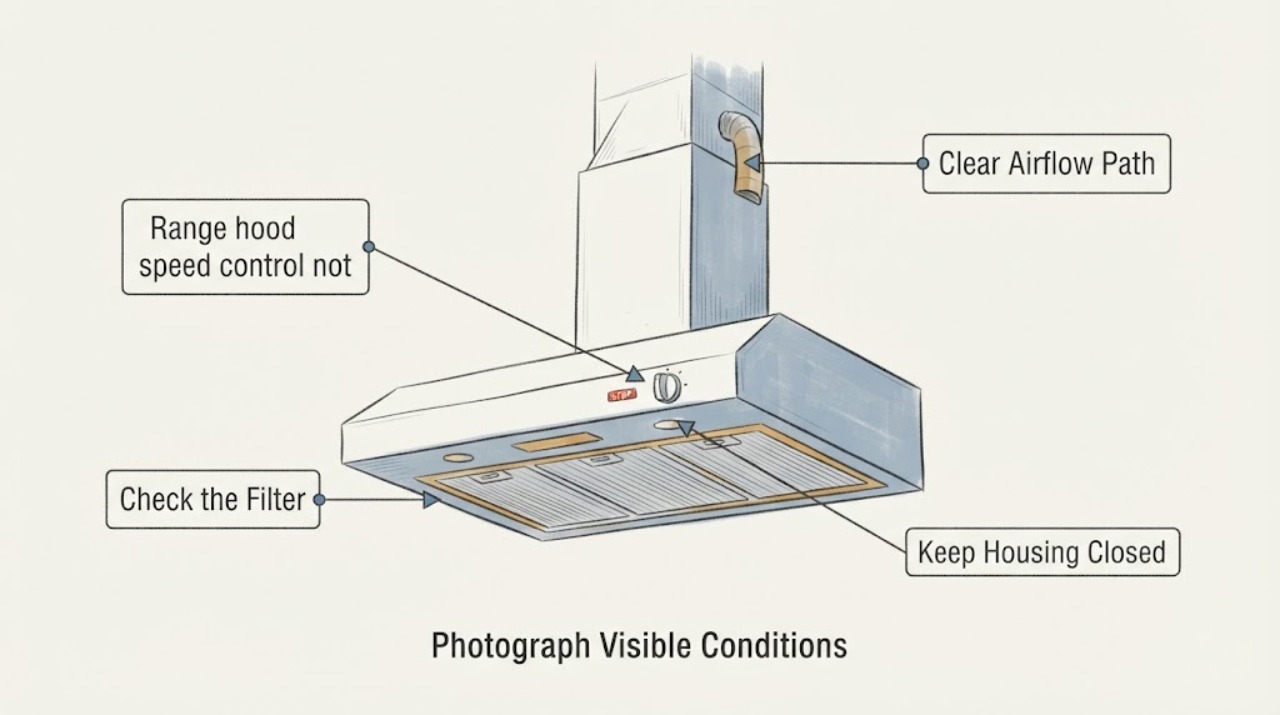
If a Wolf range hood blower runs but the speed does not change, first identify the hood type and its intended control: Wolf says current Pro Series hoods use a variable-speed control that starts at high and moves toward low, while downdraft and cooktop ventilation use separate low, medium, and high selections. Test each control once and note whether the motor, sound, or airflow changes. If the panel changes but the blower does not, or the knob spins freely, the symptom is more consistent with a control, wiring, blower, or installation problem than with a totally dead hood; Wolf's service guidance does not support choosing a part from the symptom alone. Check only accessible filters, the visible damper/duct path, and the household supply from a safe position. Do not open the hood, back-probe wiring, measure live voltage, bypass the heat sensor, or reach near the blower. Persistent loss of speed control needs Wolf Factory Certified Service, with an electrician involved when supply or installation is uncertain.
Work through in order
Diagnostic checks
Use only checks that match the exact appliance or system and its official guide.
-
Check 1
From the front of the cool, idle hood, identify whether it has a Pro Series variable-speed dial or low/medium/high controls. Photograph the control panel and rating plate if they are accessible without removing a cover, then use the exact model guide to confirm the intended direction or button sequence.
Expected result: The hood has a variable dial, discrete low/medium/high selections, a remote-control interface, or the model/control type cannot be identified.
Next step: Use the matching control sequence once. If the model cannot be identified or the control is physically broken, stop at identification and arrange model-specific service.
Stop if: Do not remove the control panel, hood shell, or blower cover to identify the control.
Why this matters
Why: A control that feels different from the user's expectation is not automatically defective. Wolf documents different speed interfaces for Pro Series versus downdraft and cooktop ventilation products.
-
Check 2
With no hands near the intake, start the blower and select every documented speed once. Compare the motor sound, visible damper movement if it can be seen without dismantling anything, and a light tissue held near the outside intake; do not insert the tissue or a hand through a filter opening.
Expected result: The sound changes with the setting, sound stays at one speed, the blower runs only at high or only at low, the blower does not run, or the control changes but airflow remains weak.
Next step: For unchanged speed, continue only with the external duct/filter and supply observations below, then arrange qualified service. For no blower operation, use the Wolf no-operation path and do not treat it as a speed-control-only fault.
Stop if: Stop immediately for scraping, burning odor, smoke, sparks, a hot housing, or an unstable blower; isolate power only from a safe location and obtain qualified help.
Why this matters
Why: A sound or airflow change means the command is producing at least some response. A blower that runs but stays at one speed points toward a speed-control, wiring, blower, or installation diagnosis; weak capture with changing sound can instead involve the ventilation path.
-
Check 3
If the motor sound changes but airflow does not, with the hood off and cool inspect only the accessible grease filters, visible damper area, and the room-side end of the duct or cap for obvious blockage. Clean and reinstall filters only according to the exact Wolf guide; do not run the hood without required grease filters.
Expected result: Filters are heavily soiled or incorrectly seated, the visible damper cannot open, the end cap or duct opening is blocked, or these accessible areas look normal.
Next step: Correct only an obvious filter seating or external obstruction, then retest once. If the restriction is in the ductwork or the speed remains unchanged, use qualified appliance or HVAC service for model-specific diagnosis.
Stop if: Do not dismantle ductwork, reach into the blower, remove the internal damper, or operate the hood with filters omitted.
Why this matters
Why: A restricted path can make a speed change hard to feel even when the blower changes speed. Wolf also identifies duct-run length and elbow placement as checks for a blower that does not appear to change speeds. A normal accessible path does not prove that the internal control or blower is healthy.
-
Check 4
If the hood has a separate remote or wall control, compare one command from the hood's own control with one command from the remote. Check only the remote's accessible battery condition and whether the hood's indicator or blower responds; also look at the household breaker without repeatedly resetting it.
Expected result: The hood control changes speed but the remote does not, both controls fail to change speed, the blower is dead and the breaker is tripped, or the breaker remains on.
Next step: For a remote-only symptom, use the exact model's remote instructions or service path. For both controls, one speed, or a recurring trip, leave the hood off and provide the model/serial information to Wolf-qualified service; involve an electrician for a supply or installation concern.
Stop if: Do not open the remote, hood wiring box, or control housing, and do not test live voltage or bypass protection.
Why this matters
Why: A single failed input can be separated from a blower or supply symptom. A normal-looking breaker does not prove power or internal control health, and repeated trips are an electrical stop condition.
Use your observations
Decision map
Find the observation that best matches what you see, then follow the next safe action.
-
PATH 01Next step
What you see
The hood type is identified, the control sequence matches its Wolf guide, and the blower sound or airflow changes across settings.
Do this next
Clean and seat the filters and check only the accessible ventilation path. If the duct run, elbows, damper, or end cap remain suspect, arrange qualified HVAC or Wolf service.
Why this path and its safety boundary
Why it matters: The speed command is producing a response; a perceived performance problem is more likely to be airflow capture, filters, duct geometry, damper, or end-cap restriction than a completely failed speed control.
-
PATH 02Next step
What you see
The blower runs, but its sound stays at one speed or the control input changes without any motor response, while the filters and accessible path are clear.
Do this next
Stop user testing and arrange Wolf Factory Certified Service with the model, serial number, control type, settings tried, and whether the lights or remote work. Do not open the hood for voltage or resistance tests.
Why this path and its safety boundary
Why it matters: Wolf's service guidance treats this as a diagnostic symptom that can involve the blower speed control, wiring, blower, or supply; the result does not identify a particular replaceable part.
-
PATH 03Next step
What you see
The hood's own control works but a separate remote does not, or the remote changes the indicator but not the blower while the panel works.
Do this next
Use the exact model's remote instructions and replace only accessible batteries if the guide calls for them. If the remote remains ineffective, use qualified model-specific service and do not substitute a control board or receiver.
Why this path and its safety boundary
Why it matters: The symptom is localized to an input or communication path more than to a totally dead hood, but the opened sources do not establish a universal remote part or pairing procedure across Wolf models.
-
PATH 04Next step
What you see
The blower is dead, the lights and blower are both unresponsive, the breaker trips again, or there is heat, smoke, sparking, scorching, or a damaged cord or housing.
Do this next
Leave the hood off, keep clear of smoke or heat, isolate power only if it can be done safely, and contact qualified Wolf appliance service or an electrician. Do not recreate a trip or continue testing.
Why this path and its safety boundary
Why it matters: This is no longer a simple speed-control symptom. A supply, wiring, installation, blower, or immediate electrical hazard must be separated by qualified service.
Helpful context
Understand the symptom
First identify what kind of speed control your Wolf hood has
The expected control depends on the ventilation family. Wolf says current Pro Series hoods use a variable-speed control, generally a dial that starts at high and moves toward low. Downdraft and cooktop ventilation hoods instead use low, medium, and high fan selections. A control can appear ineffective when the user is expecting button-like steps from a variable dial, or expecting a continuously changing speed from a three-level control. Use the exact model's Use and Care Guide to confirm the interface before diagnosing a failed component.
Separate a control symptom from an airflow symptom
Run the blower at each available setting only long enough to compare its sound and airflow. If the motor sound changes but capture remains weak, duct length, closely spaced elbows, a damper, end cap, or filter condition can affect the result. Wolf's public speed-change guidance specifically calls for checking duct-run length and elbow placement. If the control indication changes but the motor sound never changes, that is a different service symptom from a hood that has no power at all.
Do not turn a speed-control complaint into a live electrical test
Wolf's service documentation describes voltage and resistance checks for trained service diagnosis, but those checks require access to internal wiring. They are not ordinary user checks. Stop at the external observations in this guide. If a knob is broken, spins freely, will not turn, or the blower remains at one speed after the safe checks, record the model and serial information and arrange qualified service rather than ordering a switch, potentiometer, motor, or board from the symptom alone.
When checks do not resolve it
Need a professional?
Have this ready
- Exact Wolf model and serial information, hood family/control type, whether the blower runs and at which apparent speed, which panel or remote settings were tested, whether lights work, filter and accessible duct/damper observations, breaker history, and any heat, smoke, odor, sparking, or installation change.
Common questions
FAQ
Why does my Wolf range hood stay at one fan speed?
First confirm whether the hood uses a Pro Series variable-speed dial or low/medium/high selections. If the blower runs but its sound stays at one speed after the correct control sequence, Wolf lists speed control, wiring, blower, and installation-related causes; the symptom does not identify one part. Check only accessible filters and the ventilation path, then arrange qualified service if the behavior remains.
Does weak airflow prove the Wolf speed control is bad?
No. If motor sound changes but capture remains weak, duct-run length, closely spaced elbows, filters, a damper, or an end cap can affect airflow. Wolf specifically directs owners to verify duct-run conditions for a blower that does not appear to change speeds. A clear accessible path still does not justify internal electrical testing.
Can I test the Wolf speed-control voltage or resistance myself?
No. Wolf's service material describes internal voltage and resistance diagnostics for service work, but those checks require access to wiring and are not ordinary user checks. Do not open the hood, test live circuits, bypass protection, or order a control part from the symptom. Give the model, serial information, and observed speed pattern to qualified service.
When should I stop using the Wolf hood?
Stop for smoke, burning odor, sparks, scorching, a hot cord or housing, a damaged control, an unstable blower, or a breaker that trips again. Leave the hood off, isolate power only from a safe location, and obtain qualified appliance or electrical help.
Read the exact guide
Official sources
- WOLF — Pro Ventilation EnhancementsWolf Appliance, Inc. · Official Wolf service manual used only to scope professional diagnosis: it identifies speed-control and supply possibilities and describes internal voltage/resistance tests. It is not a homeowner repair procedure or universal model-specific part guide.
- Ventilation Blower Does Not Change Speeds | FAQ | Sub-Zero, Wolf, and CoveSub-Zero, Wolf, and Cove · Official Wolf FAQ supporting external duct-run and elbow checks for a blower that does not appear to change speeds; it does not authorize internal electrical testing by an owner.
- Blower Motor Speed Control | FAQ | Sub-Zero, Wolf, and CoveSub-Zero, Wolf, and Cove · Official Wolf FAQ supporting the distinction between Pro Series variable-speed controls and downdraft/cooktop low-medium-high controls; it does not diagnose a particular model's failed component.
- Ventilation Hood Blower Does Not Operate | FAQ | Sub-Zero, Wolf, and CoveSub-Zero, Wolf, and Cove · Official Wolf troubleshooting page whose listed topics include a fan not working on all speed or power settings and a variable control operating only as on/off; its cause list supports service-level differential diagnosis, not a user part selection.
- HOOD OPERATIONWolf Appliance · Official Wolf CV hood Use and Care guide supporting control/remote operation, accessible filter care, and the instruction not to operate without grease filters; exact control layout varies by model.
- Ventilation Hood Control Stem Broken or Knob Will Not Turn | FAQ | Sub-Zero, Wolf, and CoveSub-Zero, Wolf, and Cove · Official Wolf FAQ supporting the distinction between a physically broken, stuck, or freely spinning control and other speed symptoms; unresolved control-stem faults require service.
Community feedback
Share a repair observation
Share a plain-text repair observation. Accepted observations are published automatically; this page may take a moment to update.