
On this page
Start here
Quick answer
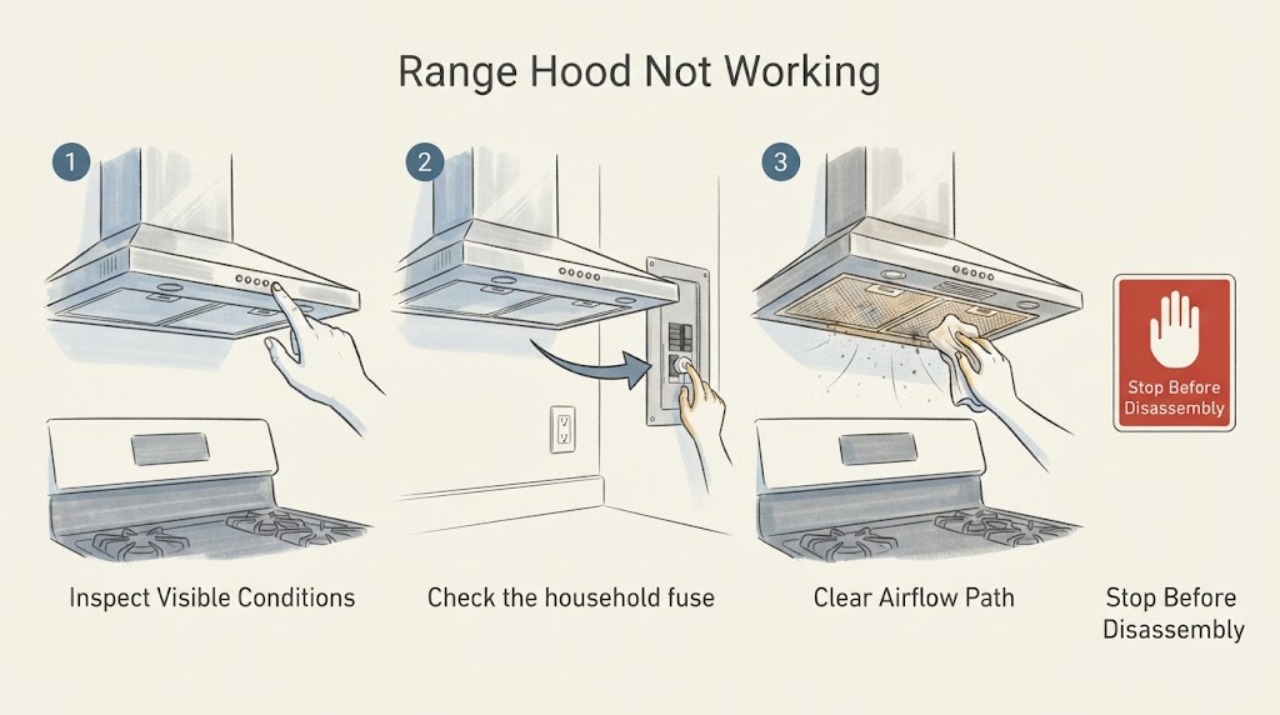
If a Wolf range hood is not working, check whether the hood lights and blower are both dead, confirm the household breaker or fuse and proper circuit, then test the controls once. A hood with power but no blower needs model-specific service; do not open the hood while connected to power.
Work through in order
Diagnostic checks
Use only checks that match the exact appliance or system and its official guide.
-
Check 1
Turn the hood controls on and observe the lights and blower separately; record whether either responds.
Expected result: Both are dead, lights work but the blower is dead, or the blower runs.
Next step: Continue with the matching external check and do not remove the hood cover.
Why this matters
Why: Both functions being dead points to supply or control power; lights with no blower narrows the issue toward blower control or motor; a running blower changes the problem to airflow.
-
Check 2
Check the household fuse or breaker and verify the hood is connected to the circuit specified by its model guide.
Expected result: The breaker or fuse is open, the circuit is wrong, or the supply appears correct.
Next step: Restore a tripped breaker once only if safe; stop repeated trips and arrange service.
Why this matters
Why: An open or incorrect supply can explain a dead hood; a breaker that opens again indicates a fault.
-
Check 3
With power isolated, inspect only accessible grease filters and the visible intake for heavy blockage; clean or reseat filters according to the manual.
Expected result: A filter or intake is heavily blocked, or the accessible airflow path is clear.
Next step: Reinstall filters and make one supervised test; do not reach into the blower.
Why this matters
Why: A blockage can reduce capture and noise performance; a clear path with a dead blower keeps the electrical or motor fault more likely.
-
Check 4
Record model, control response, breaker result, filter condition, and any noise before requesting Wolf service.
Expected result: The hood recovers once, or the symptom repeats.
Next step: Arrange Wolf certified service for a persistent dead blower, control fault, or internal wiring concern.
Why this matters
Why: A one-time recovery supports a supply or seating issue; recurrence needs model-specific diagnosis.
Use your observations
Decision map
Find the observation that best matches what you see, then follow the next safe action.
-
PATH 01Next step
What you see
Lights and blower are both dead and the breaker or fuse will not stay restored.
Do this next
Leave the hood off and obtain qualified service.
Why this path and its safety boundary
Why it matters: A supply or internal short is more likely than a filter issue.
-
PATH 02Next step
What you see
Lights work, the breaker is stable, and the blower remains silent after controls and filters are checked.
Do this next
Arrange Wolf service with the model and control observations.
Why this path and its safety boundary
Why it matters: Blower control, motor, or wiring is more likely.
-
PATH 03Next step
What you see
The blower runs but capture is weak or noisy and the filter or intake is blocked.
Do this next
Clean or reseat the filter as directed and monitor; service persistent noise or poor airflow.
Why this path and its safety boundary
Why it matters: An accessible airflow restriction is more likely.
Helpful context
Understand the symptom
Wolf’s hood guidance separates a complete no-power symptom from a blower or control symptom. Record whether lights, controls, and blower respond before resetting anything.
Grease filters and duct restrictions can reduce ventilation, but they do not prove an electrical failure. Internal wiring, switches, and blower work require the model manual and qualified service.
Only after diagnosis
Potential parts
- model-specific blower, switch, or filter component
Consider a part only after the control, power, and airflow observations identify the failed component.
Wolf hood families and blower configurations vary by model.
When checks do not resolve it
Need a professional?
Contact Wolf certified service when the breaker is stable but the hood remains dead, the blower does not run with working lights, or internal wiring or motor diagnosis is needed.
Common questions
FAQ
What should I record before calling about a Wolf hood?
Record the model, whether lights work, whether the blower starts at any speed, the breaker result, and the filter condition.
Can I open a Wolf hood to test wiring?
No. Wolf’s manual requires disconnecting power before service, and internal electrical or blower work belongs to qualified service.
Read the exact guide
Official sources
- Cooktop Low-Profile Hoods Use and CareWolf · Opened official Wolf use and care manual; model variants and wiring differ.
- Ventilation Hood Will Not Turn On or OffSub-Zero, Inc. · Opened official Wolf assistance page for a hood that will not turn on or off.
Community feedback
Share a repair observation
Share a plain-text repair observation. Accepted observations are published automatically; this page may take a moment to update.