
On this page
Start here
Quick answer
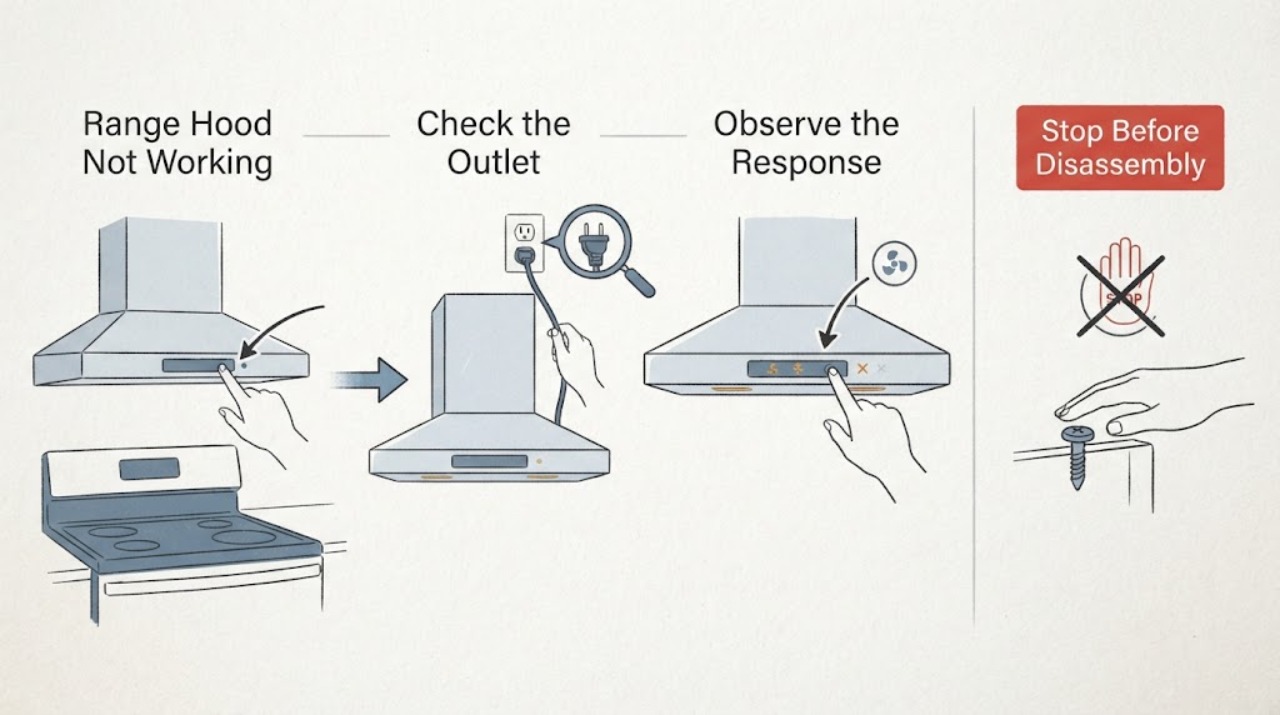
A range hood that is not working should be split into power, controls, blower, and light symptoms. Check the household supply and the hood’s visible switch or control state, then inspect only accessible filters and the exterior vent for blockage. Heat-sentry behavior and model-specific controls vary. If the hood is dead with power present, smells hot, sparks, or has damaged wiring, stop and use qualified service.
Work through in order
Diagnostic checks
Use only checks that match the exact appliance or system and its official guide.
-
Check 1
Check the hood’s household supply, wall switch, plug if fitted, and visible control lock or timer state. Note whether the light, display, or blower responds independently.
Expected result: Nothing responds, only the light responds, only the blower responds, or the controls respond normally but airflow is weak.
Next step: Restore only a tripped supply or visible control setting; leave electrical diagnosis to a qualified technician.
Why this matters
Why: No response points to supply or controls; one function working narrows the fault to that circuit; weak airflow with a running blower points to filters, ducting, or an exterior obstruction.
-
Check 2
Turn the hood off and let it cool. Remove only the accessible grease filter as the manual allows and check for heavy grease buildup; look at the visible exterior vent cap for an obstruction without climbing or dismantling ductwork.
Expected result: The filter is heavily loaded, the exterior cap is blocked, or both are clear.
Next step: Clean or replace the filter using the manual and keep the exterior opening clear; arrange service if airflow remains poor.
Why this matters
Why: A loaded filter or blocked cap can restrict airflow and make a working blower seem ineffective. Clear accessible maintenance items only; a clear path shifts attention to the blower or duct.
-
Check 3
Observe whether the blower starts or stops when the cooktop is hot, and check the owner manual for a Heat Sentry feature. Do not treat an automatic fan as a failed switch unless the model supports that interpretation.
Expected result: The blower runs during high heat and stops after cooling, or it runs/stops at unrelated times.
Next step: Follow the model manual; request service for abnormal cycling or a motor that will not run.
Why this matters
Why: Heat Sentry can intentionally start a blower during high heat. Unrelated cycling, a fan that never stops, or no response with power present suggests a control or motor issue.
Use your observations
Decision map
Find the observation that best matches what you see, then follow the next safe action.
-
PATH 01Next step
What you see
Only airflow is weak while the blower audibly runs and the filter or exterior cap is blocked
Do this next
Clean accessible filters and restore the exterior vent path.
Why this path and its safety boundary
Why it matters: Air resistance is the leading explanation.
-
PATH 02Next step
What you see
The blower runs during high cooktop heat and stops as the hood cools
Do this next
Confirm the feature in the owner manual and keep the hood’s vents clear.
Why this path and its safety boundary
Why it matters: The model may be using Heat Sentry automatic protection.
-
PATH 03Next step
What you see
No function responds with power present, or the blower sparks, smells hot, or cycles abnormally
Do this next
Isolate the hood and arrange qualified service.
Why this path and its safety boundary
Why it matters: An electrical control or motor fault is more likely.
Helpful context
Understand the symptom
A hood can appear not to work when only the light, blower, or automatic heat-sentry function is affected. A dead display and a blower with no airflow are different problems and need different checks.
Grease filters and duct openings affect airflow but cannot explain every electrical symptom. Do not remove the hood’s electrical housing or work on house wiring.
When checks do not resolve it
Need a professional?
If the safe external checks do not restore normal operation, arrange qualified appliance service using the complete model information.
Common questions
FAQ
Can I remove the hood’s wiring cover to test the motor?
No. Keep the troubleshooting at the supply, controls, filter, and visible vent. Electrical and motor testing belongs to a qualified technician.
Why did the hood turn on by itself?
Some models use Heat Sentry to start the blower when the cooking area is very hot. Check the exact model manual; unrelated cycling still needs service.
Read the exact guide
Official sources
- Motor will not shut off or turns on by itself | Range Hoods | SupportBroan-NuTone · range hood control and motor troubleshooting
Community feedback
Share a repair observation
Share a plain-text repair observation. Accepted observations are published automatically; this page may take a moment to update.