
On this page
Start here
Quick answer
First separate a safety problem from a capture problem. Stop cooking and leave the area if there is a gas smell, smoke that is becoming dense, a yellow or unstable burner flame, a carbon-monoxide alarm, or symptoms such as headache or dizziness. When the appliance is safe, identify whether the hood vents outdoors or recirculates, run it before cooking and for 10–20 minutes afterward, use the back burners, and clean the grease filter or replace a charcoal filter as applicable. A tissue that will not stay against the hood at high speed, a blocked damper or duct, or smoke that persists with a high-BTU gas range calls for qualified ventilation or gas service; do not alter the burner or open the hood housing.
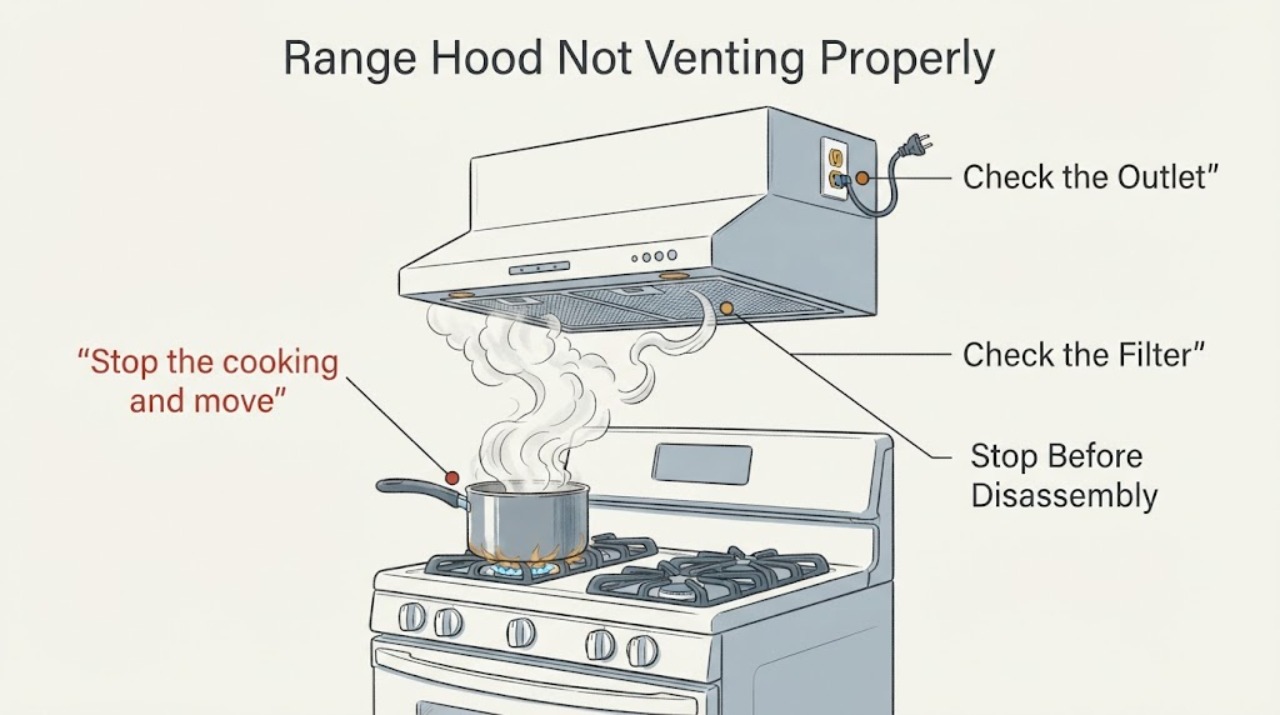
Work through in order
Diagnostic checks
Use only checks that match the exact appliance or system and its official guide.
-
Check 1
Stop the cooking and move away from the range if there is a gas smell, dense or worsening smoke, a carbon-monoxide alarm, a yellow or unstable flame, or headache, dizziness, or nausea.
Expected result: The warning sign clears after the burners are turned off and the area is ventilated, or it continues or the alarm remains active.
Next step: Leave the area and contact emergency services or the gas utility when appropriate; after the immediate danger, use qualified gas service. Do not keep testing the hood or relight burners to reproduce the symptom.
Why this matters
Why: These signs can involve combustion or fire safety and are not a range-hood airflow diagnosis.
-
Check 2
With the range off and the hood accessible, determine whether the hood has a duct that exits outdoors or a recirculating outlet that returns air to the room.
Expected result: Air exits outdoors through a duct, or the hood returns air through a grille and uses a charcoal filter.
Next step: For a recirculating hood, verify the model's charcoal-filter requirement and replacement interval; if gas cooking smoke remains a recurring problem, ask a qualified installer about an approved outdoor-vented solution rather than improvising a duct.
Why this matters
Why: Recirculation can reduce some grease and odor but does not remove room air outdoors or provide the same combustion-product removal as a ducted hood.
-
Check 3
Turn the hood off, then clean the accessible grease filter and hood surfaces according to the hood manual; if the hood recirculates, replace its charcoal filter only with the model-approved filter.
Expected result: The grease filter is coated, the charcoal filter is overdue or saturated, or both filters are clean and correctly installed.
Next step: Run the hood during the next safe cooking test only after the filter is secure. Do not immerse a charcoal filter or substitute an unapproved filter; arrange service if the symptom remains.
Why this matters
Why: Grease loading or an exhausted charcoal filter can reduce capture or odor control, while clean filters move the investigation toward the duct, damper, fan, or installation.
-
Check 4
At the highest fan setting, hold a small tissue under the hood's intake without touching moving parts and observe whether the draw is reasonably even across the intake.
Expected result: The tissue is held across the intake, or it falls away or is pulled strongly only in one small area.
Next step: If the draw is weak, check only for an accessible damper cover that cannot swing freely, packing, a visible nest, or another obvious external obstruction. Do not open walls or the hood housing; have a qualified technician inspect the duct and fan.
Why this matters
Why: A weak or uneven draw is consistent with an airflow restriction, damper or duct issue, installation problem, or fan fault; the tissue check does not measure airflow or prove a specific failed part.
-
Check 5
For safe cooking, start the hood before the burner, prefer the back burners when practical, and leave it running for 10–20 minutes after cooking; observe whether smoke still escapes the capture area.
Expected result: Smoke is captured with the back burner and normal pan load, or smoke still escapes during high-heat, front-burner, or high-BTU cooking.
Next step: Keep the hood and cookware positioned as the manual describes. If smoke persists, ask a qualified ventilation professional to assess hood sizing, duct routing, and makeup air; do not add an improvised fan or change the gas burner adjustment.
Why this matters
Why: The latter can indicate that the hood's capture area or airflow is inadequate for the cooking plume even when the fan operates.
-
Check 6
Record the hood model, vent mode, filter type, fan setting, burner used, and whether smoke is present only with a pan or also with an empty burner before requesting service.
Expected result: The symptom is repeatable under the same safe conditions, or it occurs intermittently and cannot be reproduced.
Next step: Give the technician the model and these observations. Stop using the range hood or gas appliance if smoke, heat, gas odor, or an alarm returns.
Why this matters
Why: Timing and vent configuration help service distinguish capture, duct, and control symptoms without guessing at a replacement part.
Use your observations
Decision map
Find the observation that best matches what you see, then follow the next safe action.
-
PATH 01Next step
What you see
There is a gas smell, a yellow or unstable burner flame, dense smoke, a carbon-monoxide alarm, or illness symptoms.
Do this next
Turn off the appliance only if it is safe, leave the area, and use emergency or qualified gas assistance. Do not continue hood tests or burner adjustments.
Why this path and its safety boundary
Why it matters: The immediate issue may be unsafe combustion or fire conditions rather than a routine ventilation complaint.
-
PATH 02Next step
What you see
The hood is recirculating and smoke or combustion odor returns to the room even with a clean, correctly installed filter.
Do this next
Use temporary dilution only when outdoor air conditions make it safe, then have a qualified installer assess an approved outdoor-vented configuration for the gas range.
Why this path and its safety boundary
Why it matters: The hood's design returns filtered air and cannot perform the same outdoor removal as a ducted system.
-
PATH 03Next step
What you see
The tissue draw is weak or uneven, or the accessible damper cannot open freely after filter maintenance.
Do this next
Stop at external checks and arrange qualified ventilation service to inspect the duct, damper, and fan.
Why this path and its safety boundary
Why it matters: The remaining possibilities include a restriction, duct or installation defect, or a fan problem; the observation does not identify which internal part failed.
-
PATH 04Next step
What you see
The hood draws evenly, but smoke escapes during front-burner, high-heat, or high-BTU gas cooking.
Do this next
Use the back burners and the documented fan setting while arranging a professional assessment of hood sizing, ducting, and makeup air; persistent smoke is not a reason to alter the gas burner.
Why this path and its safety boundary
Why it matters: The capture pattern or hood capacity may not match the cooking plume even though the fan runs.
Helpful context
Understand the symptom
What the hood can and cannot do
A ducted hood carries cooking contaminants outdoors. A recirculating hood filters some grease and odor, then returns air to the room, so it cannot provide the same removal of combustion products as an outdoor vent. Smoke can also escape capture when a front burner or high-output gas cooking produces more plume than the hood can collect. The exact hood, duct, installation, and local code determine the safe remedy.
Keep the diagnosis external
Filter condition, the vent mode, an accessible damper, visible blockage, and the hood's external draw can be checked without dismantling the hood or modifying a gas appliance. A clear filter does not prove that the duct is correctly sized or that the fan is healthy, and an airflow problem should not be solved by guessing at a motor, control board, or gas adjustment.
When checks do not resolve it
Need a professional?
Stop immediately for gas odor, fire, dense or worsening smoke, a carbon-monoxide alarm, a yellow or unstable burner flame, abnormal heat, or illness symptoms. Leave the area and use emergency or qualified gas assistance as appropriate. Arrange qualified ventilation service for duct, damper, fan, hood-sizing, makeup-air, or gas-appliance work; do not open the hood housing, alter burner settings, or bypass safety devices.
Common questions
FAQ
Does a recirculating hood remove gas-cooking combustion products?
It returns filtered air to the room, so it does not provide the same outdoor removal as a ducted hood. Charcoal filtration may help with some odor, but recurring gas-cooking smoke should be discussed with a qualified installer.
What does a tissue test under the hood prove?
It is a simple external indication of whether the intake has draw at the selected speed. A weak or uneven result supports service investigation, but it does not measure airflow or identify a failed motor, control, or duct part.
Why can a hood work but still let smoke escape?
Front burners, high heat, and high-output gas cooking can produce a plume outside the hood's capture area or exceed its airflow. Back burners and the model's documented operating procedure may help, but persistent smoke needs a professional assessment of hood sizing and ducting.
Read the exact guide
Official sources
- Addressing Indoor Environmental Concerns During RemodelingU.S. Environmental Protection Agency · Opened EPA remodeling guidance for properly sized gas-range hoods, outdoor capture, ducting, and makeup-air/service boundaries.
- Sources of Indoor Particulate Matter (PM)U.S. Environmental Protection Agency · Opened EPA source guidance for cooking PM, outdoor venting, hood use, backdrafting risk, and combustion-appliance ventilation.
- The Inside Story: A Guide to Indoor Air QualityU.S. Environmental Protection Agency · Opened EPA guidance for gas-range combustion and indoor-air safety; applies to the safety boundary, not to a particular hood model.
- What Is a Range Hood & Do I Need Range Hood Venting?Whirlpool · Opened Whirlpool educational guidance for ducted versus recirculating hood behavior and operating/filter practices; not a model-specific installation manual.
- Vent Hood System - Air DrawGE Appliances · Opened GE support guidance for a tissue draw check, front/back burner capture behavior, and service escalation when draw remains poor.
- Hood Does Not Remove Smoke or OdorGE Appliances · Opened GE support guidance for external filter, surface, duct obstruction, damper, and hood-capacity checks; not a claim about an unbranded hood's exact parts.
- Strategies for Improving Indoor Air Quality While CookingU.S. Environmental Protection Agency · Opened EPA cooking guidance for hood timing, back-burner use, filter cleaning, and safe supplemental ventilation.
- Which is better, ducted or non-ducted?Broan-NuTone · Opened manufacturer support guidance for outdoor ducting, recirculation limits, and high-BTU gas cooking; not a universal code or model-fit claim.
Community feedback
Share a repair observation
Share a plain-text repair observation. Accepted observations are published automatically; this page may take a moment to update.