
On this page
Start here
Quick answer
“Slow motion” needs translation before troubleshooting: it may mean the hood will not start on LOW, the fan runs slowly, or the hood has weak airflow. Range-hood controls differ by model. Start with the exact manual, then turn the hood off and cool it before checking the filter, any recirculating charcoal filter, the visible duct route and whether the room has enough replacement air. Some hoods deliberately change speed for heat protection, and some older slide-out or downdraft models need to be opened or raised before the speed control works. If the blower is completely dead, the breaker trips, wiring is suspected or airflow stays poor after these external checks, stop and use qualified service.
Before you begin
Safety first
- Turn controls off and let the hood cool before cleaning. Disconnect power before any model-authorized connector check. Do not bypass a filter interlock or Heat Sentry, open the control box, change wiring, use plastic/dryer duct or add an external booster fan.
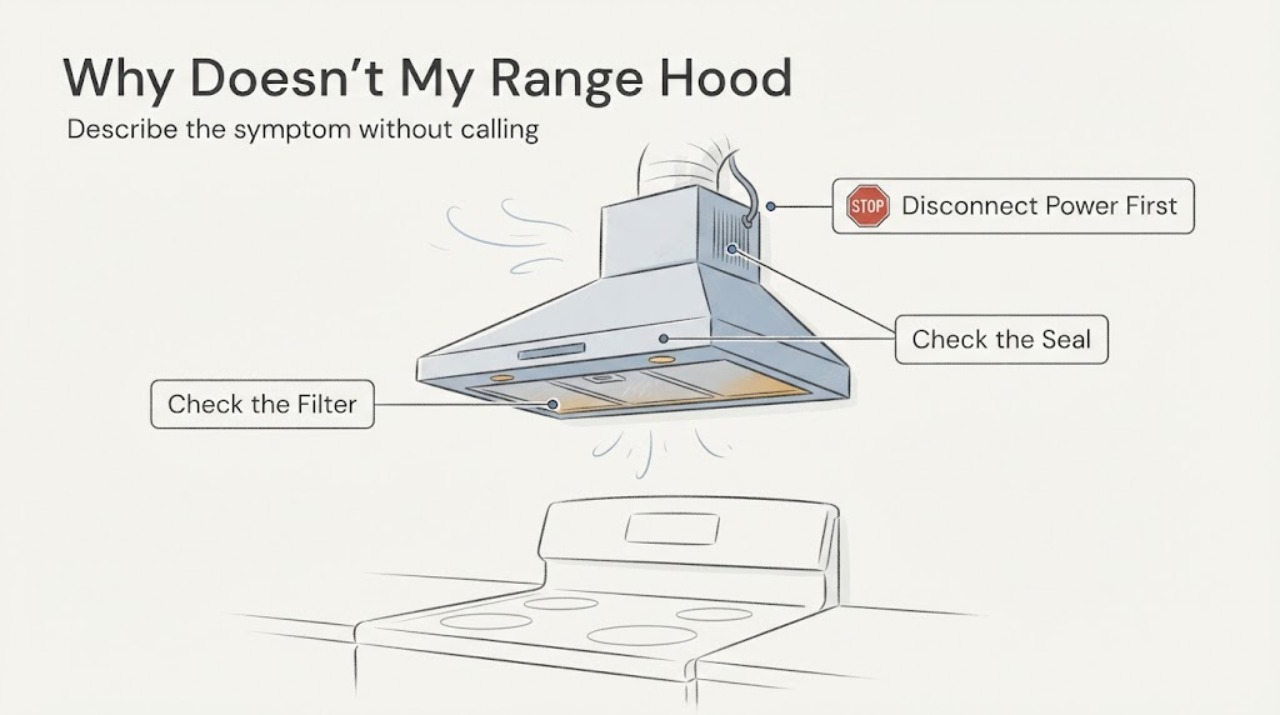
Work through in order
Diagnostic checks
Use only checks that match the exact appliance or system and its official guide.
-
Check 1
Describe the symptom without calling it a part failure: select the model's LOW setting from the exact manual and note whether the fan is silent, starts at a different speed, runs audibly but has weak capture, or changes speed while cooking.
Expected result: The hood is not in its operating position, the fan runs at a different speed, the blower is completely silent, or it runs but capture is weak.
Next step: Follow only the exact model's normal control sequence. If the blower is silent, check power externally; if it runs, continue with filter and airflow checks rather than assuming a motor fault.
Why this matters
Why: Some models require a slide-out/downdraft operating step and some use heat protection to change speed; a silent blower and weak airflow are different branches.
-
Check 2
Turn the controls off and wait until the hood and cooktop are cool. Remove only the user-accessible grease filter according to the manual and inspect it for heavy grease; if the hood recirculates, identify whether the charcoal filter is present and due for replacement.
Expected result: The grease filter is loaded or missing, the charcoal filter is restrictive/overdue, or the filters are clean and correctly installed.
Next step: Clean a washable filter with warm water and detergent or replace the specified charcoal filter. Reinstall all filters before operating; if airflow remains weak, inspect the duct/room branch or arrange service.
Why this matters
Why: Whirlpool says filters must be clean and correctly installed for performance; a recirculating charcoal filter is not washable and can restrict airflow when it needs replacement.
-
Check 3
With power off, inspect only the visible vent route and room conditions: note whether the hood is ducted outside or recirculating, whether the duct outlet is visibly blocked, whether nearby cabinets crowd the required clearance, and whether the room is unusually sealed while the hood runs.
Expected result: The duct mode or installation differs from the manual, filters/duct are restricted, clearances are tight, or airflow improves when a safe room opening provides replacement air.
Next step: Use the exact installation instructions and a qualified ventilation installer for duct, clearance or make-up-air changes. Do not cut cabinets, install plastic/dryer duct or add an external booster fan as a DIY fix.
Why this matters
Why: Whirlpool identifies incorrect installation, dead-air pockets, room air currents and insufficient make-up air as causes of poor capture; the fan itself is not proven defective by weak capture alone.
-
Check 4
Check the electrical symptom from outside the hood: determine whether the house breaker is tripped, whether the lights still operate, and whether the blower connector is explicitly user-accessible in the model installation instructions. Keep power disconnected before any connector inspection.
Expected result: The breaker is tripped, lights and blower are both dead, lights work but the blower is dead, or power is present and the connector/installation is not a user check.
Next step: Reset a tripped breaker only once if there is no sign of damage; stop if it trips again. Use an installer/electrician for suspected miswiring and appliance service for a dead blower or inaccessible connector.
Why this matters
Why: GE associates both-dead symptoms with power/connection or wiring and a light-on/blower-off symptom with a possible blower connection issue, but does not authorize live wiring work.
Use your observations
Decision map
Find the observation that best matches what you see, then follow the next safe action.
-
PATH 01Next step
What you see
The hood is a slide-out or downdraft style and the blower works only after the visor or downdraft is placed in its operating position, or the fan changes speed while cooking.
Do this next
Use the exact model manual for the operating and speed sequence. Do not bypass a microswitch or defeat a heat-protection feature.
Why this path and its safety boundary
Why it matters: Some official manufacturer guidance describes an operating-position requirement and heat-sensing speed override; this can be normal model behavior rather than a failure.
-
PATH 02Next step
What you see
The blower runs, but capture is weak and the grease or charcoal filter is dirty, missing, incorrectly installed or overdue.
Do this next
Clean the washable filter or replace the model-specified charcoal filter, reinstall it and reassess. Use service if weak airflow continues.
Why this path and its safety boundary
Why it matters: A filter restriction can reduce ventilation effectiveness without proving a failed motor or control.
-
PATH 03Next step
What you see
Filters are clean, the blower runs, but smoke/steam remains because ducting, room air replacement, cabinet clearance or recirculation mode is unsuitable.
Do this next
Have the exact installation checked against the model requirements by a qualified installer or ventilation technician. Do not improvise duct sizes, exhaust into an attic or add an unapproved external fan.
Why this path and its safety boundary
Why it matters: Whirlpool identifies installation and room-air restrictions as possible capture problems; an airflow symptom alone does not identify an internal part.
-
PATH 04Next step
What you see
The blower is silent, the breaker trips again, the lights work but the blower remains off, or wiring/connector access is unclear.
Do this next
Leave the hood off, use an electrician for breaker/miswiring concerns and appliance service for a dead blower. Do not remove the control box or perform live measurements.
Why this path and its safety boundary
Why it matters: This is an electrical or appliance-service branch rather than a safe low-speed adjustment; the no-brand/no-model identity prevents a precise connector or part instruction.
Helpful context
Understand the symptom
Clarify what “slow motion” means
There is no universal range-hood control called slow motion. Write down whether the blower does not start on LOW, starts but sounds weak, moves little air, or changes speed by itself. GE notes that some older slide-out and downdraft hoods need a separate operating-position step before the speed control works, while Broan notes that Heat Sentry can raise a hood to a higher speed when excessive heat is detected. These are model features, not a universal fault diagnosis.
Check airflow restrictions before the motor
Whirlpool's vent-hood guidance starts with the controls, grease filter and non-ducted charcoal filter, then considers room air movement, make-up air, nearby cabinet clearances and the exhaust installation. A hood can sound as if it is moving slowly when the filter is loaded or the duct system is restricted. Use the model manual for the correct filter type and duct arrangement; do not add a booster fan or improvise ductwork.
Clean only the user-accessible parts
With controls off and the hood cool, Whirlpool says to remove and clean a washable grease filter with warm water and detergent, then replace it. A non-vented charcoal filter is not washable and must be replaced as specified by the owner's manual. Do not reach into a moving blower, remove a control panel or work on wiring while the hood is energized.
Separate a no-power fault from weak capture
If the lights and blower are both dead, GE points first to the breaker or connection. If the lights work but the blower does not, GE supports a power-off connector check only when the model's installation instructions show that user-accessible connection; otherwise service is the safe route. If the blower runs but does not draw, use the model installation instructions and service rather than guessing a motor, capacitor or speed-control part.
When checks do not resolve it
Need a professional?
Call qualified service when the blower is silent with power present, the breaker trips again, wiring is suspected, airflow remains poor after correct filters and visible installation checks, or the hood's model-specific connector/control procedure is unclear.
Safety scope: Turn controls off and let the hood cool before cleaning. Disconnect power before any model-authorized connector check. Do not bypass a filter interlock or Heat Sentry, open the control box, change wiring, use plastic/dryer duct or add an external booster fan.
Have this ready
- Provide the hood brand/model, whether it is ducted or recirculating, what slow motion means in practice, whether lights work, filter condition, breaker behavior and any change when the hood is in its operating position.
Common questions
FAQ
What does slow motion mean on a range hood?
It is not a standard fault term. It may mean the low speed is not starting, the fan is running slowly, or airflow is weak. Record which condition occurs and use the exact model manual before diagnosing a control or motor.
Why does my hood jump to a higher speed while cooking?
Some hoods have heat protection that automatically raises the blower speed when excessive heat is detected. Broan says the fan returns to its prior setting or turns off after the temperature falls; do not bypass that feature.
Could a dirty filter make low speed seem not to work?
Yes. Whirlpool says a dirty or incorrectly installed grease filter and a restrictive recirculating charcoal filter can reduce ventilation performance. Clean or replace only the filter type specified by the owner's manual.
Can I add another fan to make the hood work better?
No. Broan warns against adding an external or in-line fan to a hood with its own power unit because the switch and motor ratings may not support the added load. Have the ducting and hood model assessed instead.
Read the exact guide
Official sources
- Vent Hood not Removing Smoke or OdorWhirlpool Product Help · Opened official Whirlpool guidance tagged for multiple brands. It supports general external ventilation checks for a no-brand range-hood topic while directing the user to the exact model manual for controls and installation.
- Venting Systems Infinite Fan Speed ControlGE Appliances · Opened official GE guidance that explicitly says the described infinite controls are not on current models. It is used only to show why a model-specific operating-position check is necessary, not to transfer a GE procedure to an unknown hood.
- Range Hood FAQsBroan-NuTone · Opened official Broan-NuTone FAQ. It is used for manufacturer-specific examples: Heat Sentry can change speed, filter/duct restrictions affect performance and adding an external fan is not an approved universal boost. Exact hood model instructions govern.
- Vent Hood System - Air DrawGE Appliances · Opened official GE guidance. It supports a high-speed tissue observation and directs duct-installation review/service when there is no draw; it is not used to set a universal low-speed performance threshold.
- Vent Hood - Does Not WorkGE Appliances · Opened official GE support guidance. It is used as a manufacturer-specific example of how to separate breaker/miswiring, lights-on/blower-off and service branches; it is not presented as a universal connector layout for an unknown hood.
- Clean or Replace Filters - Vent HoodWhirlpool Product Help · Opened official Whirlpool filter guide. It supports the user-safe external filter branch and explicitly says controls should be off and the hood cool; exact filter type and removal remain model-specific.
Community feedback
Share a repair observation
Share a plain-text repair observation. Accepted observations are published automatically; this page may take a moment to update.