
On this page
Start here
Quick answer
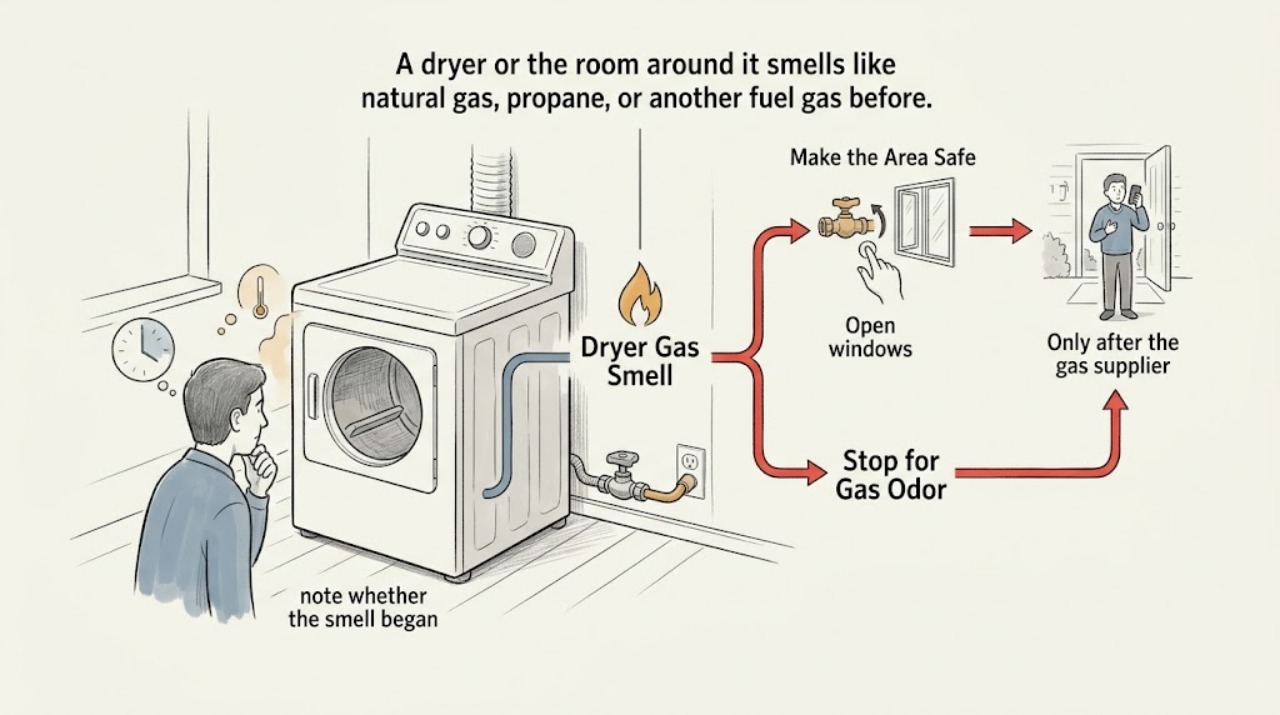
Treat a gas smell around a Roper dryer as a possible gas leak, not as an ordinary dryer odor. Do not start the dryer, relight anything, touch light switches or other electrical controls, use a phone in the building, or move the appliance. Clear people and pets from the room or building immediately. From a safe location outside or at a neighbor's home, contact the gas supplier, fire department, or emergency service and follow their instructions. Do not re-enter, shut a valve, disconnect the connector, inspect the burner, or test the dryer until the gas authority or a qualified professional has declared the area and appliance safe. Only after that clearance should you record the model and make limited external observations. A new dryer can have a temporary oily or semi-burning odor, but that explanation is not safe to use while a gas-like smell has not been ruled out.
Work through in order
Diagnostic checks
Use only checks that match the exact appliance or system and its official guide.
-
Check 1
If the odor may be fuel gas, stop the dryer if it is safe to do so without touching an electrical switch or approaching a suspected leak; otherwise leave immediately. Do not light a match, smoke, use a phone in the building, operate lights or other electrical equipment, or start the dryer.
Expected result: A continuing gas-like odor, hissing, a detector alarm, symptoms such as dizziness or nausea, or an odor that is strongest near the dryer confirms an emergency response is needed. The absence of a visible leak does not make re-entry safe.
Next step: Clear everyone and pets from the building or area. From outside or another safe location, contact the gas supplier, fire department, or emergency service and follow its instructions; do not return to test the dryer.
Why this matters
Why: Gas can ignite from an electrical switch or flame, and a connector or internal leak may not be visible. Roper and CPSC guidance put evacuation and professional assessment ahead of any appliance diagnosis.
-
Check 2
From a safe location, note whether the smell began before the cycle, during burner operation, after the dryer stopped, or after the appliance was installed or moved. Do not go back inside merely to locate the strongest point, and do not move the dryer to view the gas connector.
Expected result: The timing and whether the odor is inside the room, near the exhaust, or reported by a detector can help the gas authority or technician triage the response. It cannot distinguish a safe odor from a leak by itself.
Next step: Give the timing, model if already known, fuel type if known, and any symptoms to the responding professional. Remain out until they authorize re-entry.
Why this matters
Why: The observation is for the professional's incident record only. CPSC warns that even slight appliance movement can cause an older weakened connector to fail, so location checks are not a homeowner repair step.
-
Check 3
Only after the gas supplier, fire department, or qualified technician has declared the area safe, verify the model and whether the Roper dryer is gas-fired or electric from its rating label or existing paperwork. Do not remove panels, disconnect the line, adjust a regulator, convert fuel type, or inspect the burner yourself.
Expected result: A gas model has a fuel-supply and burner path that requires professional confirmation; an electric model with a claimed gas smell may be receiving odor from the room, another appliance, or a non-gas source. A mismatched fuel type or uncertain installation is a professional stop.
Next step: Record the model and installation history for service. If the model is gas-fired or the source remains uncertain, keep it out of use until the qualified professional completes the inspection.
Why this matters
Why: The label helps prevent applying gas-dryer instructions to an electric model, but it does not prove that the installation is safe. Roper's instructions reserve gas installation, conversion, and service for qualified personnel.
-
Check 4
After professional clearance, make only external, non-invasive observations: look for visible lint around the lint-screen and exhaust opening, a crushed or disconnected vent, a damaged cord, water, or fresh staining around accessible connections. Do not pull the dryer out, open covers, or run a cycle to reproduce an odor.
Expected result: Lint accumulation, a restricted vent, water, a damaged cord, or an installation defect gives the technician useful context but does not identify the gas leak. Any new odor, hissing, scorch mark, smoke, or heat during the observation is a reason to stop and leave again.
Next step: Photograph or describe the safe external condition without touching it, then provide those observations to the technician. Keep the dryer unused if any abnormal sign returns.
Why this matters
Why: External airflow and electrical observations can identify separate fire or installation risks, while gas-path diagnosis remains professional work. Roper requires periodic internal and exhaust cleaning by qualified personnel and warns against unapproved servicing.
-
Check 5
If the professional confirms there was no fuel-gas hazard and the odor was clearly a first-use oily or semi-burning smell, follow the exact model guide for commissioning and ventilation; do not substitute a test run for a safety inspection. If the smell is from paint, stain, varnish, mildew, lint, or an electrical source, keep the dryer off until the source is removed or repaired.
Expected result: Whirlpool notes that a new gas or electric dryer can emit a temporary oily or semi-burning odor, while room fumes can be drawn into a dryer. A fuel-gas smell, burning electrical smell, smoke, or an odor that persists after safe commissioning is not a normal first-use conclusion.
Next step: Stop and request qualified service if the odor returns, changes character, appears during burner operation, or is accompanied by heat, smoke, sparks, or a breaker trip.
Why this matters
Why: Odor character and first-use timing can explain some benign cases only after gas safety has been established. They must not be used to dismiss an unexplained gas-like smell.
-
Check 6
Before any future use, confirm that the responding professional has cleared the gas supply, connector, dryer, exhaust, and surrounding installation. Keep the model number, fuel type, installation date or move history, odor timing, detector response, and emergency visit notes for the service record.
Expected result: A written or clearly communicated professional clearance with no recurring odor supports a cautious return to normal use. Any recurring gas smell, unexplained detector alarm, unstable flame, smoke, or abnormal heat means the clearance is no longer sufficient.
Next step: Do not use the dryer until the source is re-evaluated if any warning returns. Use emergency help for smoke, fire, suspected active gas leak, or symptoms of gas or carbon-monoxide exposure.
Why this matters
Why: A gas-smell incident can involve the appliance, connector, household gas piping, or another nearby source. A single restart cannot establish which one is safe.
Use your observations
Decision map
Find the observation that best matches what you see, then follow the next safe action.
-
PATH 01Next step
What you see
The smell is currently gas-like, unexplained, or accompanied by hissing, an alarm, smoke, or symptoms.
Do this next
Leave immediately, avoid flames and electrical controls, do not move the dryer, and contact the gas supplier, fire department, or emergency service from a safe location.
-
PATH 02Next step
What you see
The odor appeared after the dryer was moved, installed, or connected, and gas safety has not been professionally confirmed.
Do this next
Do not inspect or tighten the connector. Keep the appliance out of use and have a qualified gas professional inspect the installation without homeowner movement of the dryer.
-
PATH 03Next step
What you see
A professional has cleared the area and identifies the appliance as electric rather than gas-fired.
Do this next
Do not assume the odor is harmless. Keep it off for smoke, burning electrical odor, heat, sparks, damaged cord, or a breaker trip, and arrange appliance or electrical service.
-
PATH 04Next step
What you see
A professional has ruled out fuel gas and confirms a first-use oily or semi-burning odor with no smoke or electrical warning.
Do this next
Follow the exact model guide for safe commissioning and ventilation. Stop if the odor persists, returns after commissioning, or changes to a gas-like or electrical smell.
-
PATH 05Next step
What you see
There is lint, a restricted or damaged exhaust, water, scorching, or another installation defect after clearance.
Do this next
Keep the dryer out of use until the defect is corrected by the appropriate qualified professional; do not open the cabinet or run a reproducing test.
-
PATH 06Next step
What you see
The gas smell returns or any odor is accompanied by smoke, fire, sparks, abnormal heat, or a repeated breaker trip.
Do this next
Stop immediately and leave. From a safe location request emergency or qualified assistance and do not re-enter or restart the dryer until cleared again.
Helpful context
Understand the symptom
A gas smell changes the normal troubleshooting order
The first decision is whether the odor could be fuel gas. If it could, the correct action is evacuation and professional gas-safety response, not a dryer test. Roper's installation instructions identify the gas-smell response and require installation and service by qualified personnel. The exact Roper model matters later because some dryers are gas-fired and others are electric.
Do not move the dryer or investigate the connector yourself
A gas connector can be damaged by movement, bending, corrosion, or an incorrect installation. The CPSC warns that moving an appliance to inspect an older connector can cause it to fail. Keep the dryer where it is and let the gas supplier or a qualified technician inspect the supply, connector, burner, and venting.
When checks do not resolve it
Need a professional?
For a current or unexplained gas-like smell, leave immediately and contact the gas supplier, fire department, or emergency service from a safe location. Do not use a phone or operate electrical controls inside the building., Do not move the dryer, inspect or tighten the gas connector, adjust gas pressure, convert fuel type, relight a burner, or remove panels yourself., Keep the dryer out of use until a qualified professional clears the gas supply, connector, burner, and installation. A first-use oily odor is not an explanation until fuel gas has been ruled out., Stop again for smoke, fire, sparks, burning electrical odor, abnormal heat, water near electrical parts, a damaged cord, detector alarm, or a repeated breaker trip.
Common questions
FAQ
What should I do first if my Roper dryer smells like gas?
Leave immediately. Do not start the dryer, touch switches, use a phone inside, light a flame, or move the appliance. From a safe location contact the gas supplier, fire department, or emergency service and follow its instructions.
Can I turn off the gas valve on a Roper dryer myself?
Only follow a gas professional's instructions, and only if the valve is safely reachable without entering or crossing the odor area. Do not search for a valve, move the dryer, or approach a suspected leak.
Could a new Roper dryer have an odor without a gas leak?
Whirlpool notes that a new gas or electric dryer can have a temporary oily or semi-burning odor. That possibility must not be used to dismiss a gas-like smell; have fuel gas ruled out professionally before any test run.
Should I move my Roper dryer to inspect the gas connector?
No. Roper and the CPSC warn that moving an appliance can damage or cause failure of an older weakened connector. Leave it in place and have a qualified professional inspect it.
What if my Roper dryer is electric but I smell gas?
Treat an unexplained gas-like smell as a building safety issue even if the dryer is electric. Leave, avoid electrical controls and flames, and have the gas source identified before considering dryer troubleshooting.
When can I use the dryer again after a gas smell?
Only after the gas supplier, fire department, or qualified technician has identified or ruled out the source and cleared the area and appliance. Do not restart it to see whether the smell returns.
Read the exact guide
Official sources
- Installation Instructions – RGD4516FWRoper Appliances · Roper gas dryer installation, gas-smell emergency response, connector, qualified service, fuel type, and safety instructions
- Certain Older Gas Connectors May Be DangerousU.S. Consumer Product Safety Commission · Government gas-leak evacuation, electrical-switch avoidance, and appliance connector safety
- Removing Odors or Smells - DryerWhirlpool · Whirlpool-family dryer odor distinctions, first-use oily or semi-burning odor, and surrounding-room fumes
Community feedback
Share a repair observation
Share a plain-text repair observation. Accepted observations are published automatically; this page may take a moment to update.