
On this page
Start here
Quick answer
‘Samsung ice maker not working’ can describe no ice, slow production, a stuck bucket, poor ice quality, or a dispenser that will not move cubes. Start by classifying the symptom, then check freezer temperature, Ice Off status, the bucket, water delivery, and the Test result. The branch determines whether to wait, correct a restriction, troubleshoot dispensing, or request service.
Work through in order
Diagnostic checks
Use only checks that match the exact appliance or system and its official guide.
-
Check 1
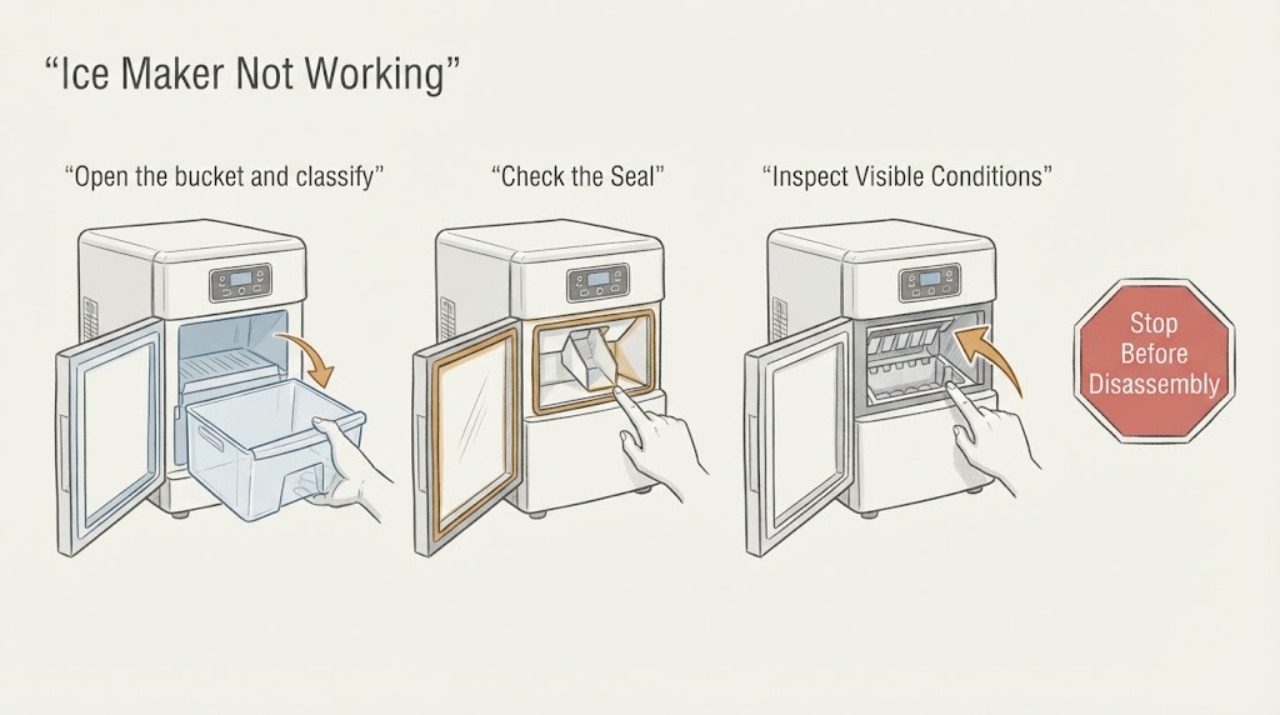
Open the bucket and classify the result as empty, partly filled, small/cloudy/clumped, frozen into a block, or containing loose ice that will not dispense.
Expected result: The bucket is empty or slow to fill, the cubes are poor quality or fused, or loose ice is present but will not exit.
Next step: Follow only the matching path below rather than replacing a common part for every symptom.
Why this matters
Why: Empty/slow points to production or water; poor/fused ice points to water quality, filter, or frost; loose ice with no exit points to dispensing.
-
Check 2
For an empty or slow bucket, read the freezer temperature, check that the freezer or ice compartment seals, and verify the maker is enabled rather than Ice Off.
Expected result: The freezer is warm, the seal or bucket is not seated, Ice Off is active, or all three conditions are correct.
Next step: Correct an obvious setting or seating issue, address cooling first when warm, and continue only after the condition is stable.
Why this matters
Why: Warmth, air leakage, a mis-seated bucket, or a disabled maker can each stop production; correct conditions move the diagnosis to water or the maker test.
-
Check 3
Run one model-specific Test cycle and observe whether the maker moves and whether water reaches the tray at the end.
Expected result: The maker moves and fills, moves but stays dry, or gives no chime and no movement.
Next step: Allow normal production for a successful test, use water-pressure/filter checks for a dry tray, and request service for a silent test after the safe reset limit.
Why this matters
Why: Movement plus fill suggests a production wait; movement without fill points to water delivery; no response points to control or maker service.
-
Check 4
For poor-quality or fused ice, inspect visible frost and the filter/supply history; for loose ice that will not exit, check the dispenser lock, chute, bucket seating, and auger sound.
Expected result: Frost or an overdue filter is present, or loose cubes remain blocked while the dispenser is locked, unseated, or silent.
Next step: Replace only an overdue filter with model-approved guidance, clear and dry accessible dispenser ice, and arrange service for persistent frost or a silent drive.
Why this matters
Why: Frost/filter conditions affect cube quality and flow; a dispenser lock, physical blockage, unseated bucket, or silent auger is a separate exit-path fault.
Use your observations
Decision map
Find the observation that best matches what you see, then follow the next safe action.
-
PATH 01Next step
What you see
The bucket is empty, the freezer is warm or not sealed, or Ice Off is active.
Do this next
Correct the temperature, seal, bucket seating, or setting and allow the freezer to recover before testing production.
Why this path and its safety boundary
Why it matters: A production prerequisite is missing; the ice-maker assembly is not yet the leading diagnosis.
-
PATH 02Next step
What you see
The maker moves and fills during its test, but the bucket remains empty immediately afterward.
Do this next
Keep the bucket seated, avoid repeated Test commands, and allow the model's normal production interval.
Why this path and its safety boundary
Why it matters: The maker has demonstrated basic operation, so normal freezing time, bucket position, or production conditions are more likely.
-
PATH 03Next step
What you see
Loose ice is present, but the lock is off, the bucket is seated, and the auger remains silent or cannot move cubes.
Do this next
Stop using the dispenser and arrange qualified service; do not disassemble the door or drive mechanism.
Why this path and its safety boundary
Why it matters: A dispenser drive, control, or wiring problem is more likely than an ice-production problem.
-
PATH 04Next step
What you see
The maker remains dry in its test despite adequate water flow, or it remains silent and motionless after one safe reset.
Do this next
Stop repeated testing and request service.
Why this path and its safety boundary
Why it matters: A refrigerator-side fill fault or ice-maker control/assembly fault needs professional diagnosis.
Helpful context
Understand the symptom
Classify the symptom before choosing a part
The broad ‘not working’ label is not one failure mode. A Samsung maker that makes small clumped cubes has a different next check from one that never moves, while ice that exists but will not exit belongs to the dispenser path.
When checks do not resolve it
Need a professional?
Request service for persistent frost, a maker that stays silent and motionless after the setting and one safe reset checks, a dry test tray after adequate water flow, damaged wiring, a bucket that will not seat, or an internal leak. Do not manually defrost or open powered appliance panels.
Common questions
FAQ
What is the first thing to check when a Samsung ice maker is not working?
Look in the bucket and classify the symptom. Then check the freezer condition, Ice Off status, bucket seating, and the Test result. ‘Not working’ can mean production, water, quality, or dispensing, and those paths are not interchangeable.
Should I manually defrost a Samsung ice maker that is frozen?
No. Samsung's guidance says not to defrost the ice maker manually because it has an automatic defrost function; persistent frost or a frozen assembly needs service-oriented troubleshooting.
Read the exact guide
Official sources
- Reset the ice maker in the back of freezer doorSamsung · Samsung ice-maker Test button procedure and reset limits
- Samsung ice maker is not workingSamsung · Samsung refrigerator ice-maker symptom classification, production, water, temperature, and service guidance
- Issues with Samsung refrigerator ice dispensersSamsung · Samsung refrigerator dispenser-specific lock, chute, bucket, auger, and harness checks
Community feedback
Share a repair observation
Share a plain-text repair observation. Accepted observations are published automatically; this page may take a moment to update.