
On this page
Start here
Quick answer
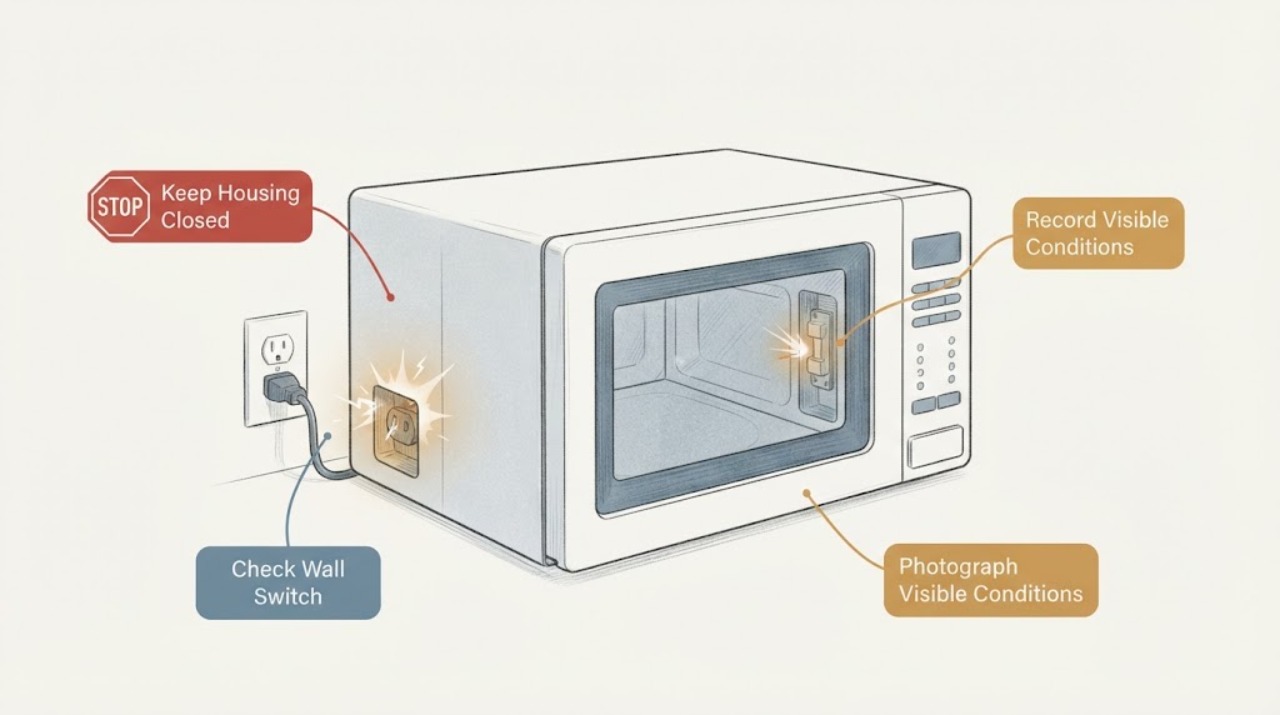
Stop using the Sharp Insight Pro drawer microwave when its fuse blows during a cooking attempt. Do not open the cabinet, discharge or test the high-voltage capacitor, disconnect the transformer or magnetron, bypass drawer interlocks, fit a larger fuse, or reconnect power to see whether it fails again. From a safe external position, record whether the fuse trips when the drawer is opened or closed or only after Start, photograph the rating/model label and any visible scorch, arcing, damaged seal or cord, and arrange Sharp-authorized or other qualified microwave service. Sharp's Insight Pro operation manual says the drawer should not be adjusted or repaired except by properly qualified personnel, and the matching community post ended with a service-reported door-switch repair; that outcome does not diagnose every Insight Pro unit.
Before you begin
Safety first
- Do not open the microwave, discharge the high-voltage capacitor, remove or disconnect the transformer/magnetron, bypass drawer interlocks, measure live voltage, replace a fuse by guesswork, fit a larger fuse, or reconnect power to reproduce the failure.
Work through in order
Diagnostic checks
Use only checks that match the exact appliance or system and its official guide.
-
Check 1
Stop the cooking attempt and isolate the microwave from a dry, safe position. If there is smoke, sparking, a hot or scorched plug/receptacle, burning odor or visible fire, leave it alone, move away and use local emergency procedures; otherwise switch off the circuit or unplug only if the connection is safe to reach.
Expected result: The fuse trips again, the appliance or outlet is hot or damaged, or there is smoke, arcing or a burning odor.
Next step: Keep the microwave disconnected and arrange qualified appliance service; have a qualified electrician assess any damaged receptacle or circuit. Do not reset repeatedly or reconnect the drawer.
Why this matters
Why: This is an electrical/fire safety condition, not a prompt to install another fuse or retry the cook cycle. A quiet appliance after power isolation does not clear the internal fault.
-
Check 2
From outside the isolated appliance, record when the fuse opens: while the drawer is opened or closed, immediately after Start, after a delay, or at an unknown point. Also note whether the display, light and automatic drawer still worked before isolation.
Expected result: The fuse opens at a repeatable point, or the timing is unknown because the event was not observed.
Next step: Give the timeline to the technician and do not recreate it. Do not disconnect a transformer or magnetron lead, bypass an interlock or take an energized reading.
Why this matters
Why: Timing and the state of the low-voltage controls are useful service history, but neither pattern identifies a failed component or makes high-voltage testing safe for a homeowner.
-
Check 3
Photograph or transcribe the nameplate with the drawer fully open only if it is safely visible, and record the model, serial and any rating information. Compare the identity with the Sharp manual or support route rather than selecting a fuse from a similar drawer model.
Expected result: The label identifies an Insight Pro family model, is unreadable, or the label cannot be reached without removing a cover or trim.
Next step: Provide the visible identity and photos to Sharp or a qualified servicer. Leave model-specific parts and repair decisions to that service path.
Why this matters
Why: Sharp publishes separate Insight Pro drawer model families; an unreadable or inaccessible label prevents model-specific fuse, interlock and service-document matching.
-
Check 4
Inspect only visible surfaces after power is isolated: the drawer front and seals, latch area, cord, plug, receptacle and nearby cabinetry. Look for cracks, bent or loose drawer alignment, scorch marks, melted plastic, residue or evidence of arcing; do not remove the outer cover or waveguide cover.
Expected result: Any visible damage or contamination is present, or the exterior looks normal despite repeated fuse failures.
Next step: Keep the unit out of service and send the observations to Sharp-authorized or qualified microwave service. Do not clean around a damaged seal by forcing the drawer or attempt a cover-off inspection.
Why this matters
Why: Visible damage supports immediate service and may affect the microwave safety enclosure. A normal exterior does not rule out an internal fault, because the Sharp manual reserves adjustment and repair for qualified personnel.
-
Check 5
Prepare a service handoff with the exact model and serial, fuse rating as printed on the unit or manual, trip timing, prior work on the capacitor or diode if any, and external photographs. State that the drawer, controls or light may still function if that was observed.
Expected result: The service record contains an exact identity and symptom timeline, or the identity and history are incomplete.
Next step: Use Sharp's authorized service route or a qualified microwave technician. Do not order a replacement fuse, switch, relay or high-voltage component based only on this symptom.
Why this matters
Why: Complete external history helps service choose the correct documentation; incomplete identity prevents a safe model-specific parts or repair claim.
Use your observations
Decision map
Find the observation that best matches what you see, then follow the next safe action.
-
PATH 01Next step
What you see
The fuse opens only when a cooking cycle is started while the display and drawer controls were otherwise working.
Do this next
Keep the unit isolated and give the exact timing and model evidence to qualified service; do not reproduce the event or open the cabinet.
Why this path and its safety boundary
Why it matters: The symptom is consistent with a fault that is reached when cooking power is commanded, but it does not distinguish the interlock, relay, high-voltage, wiring or another internal circuit.
-
PATH 02Next step
What you see
The fuse opens as the drawer is opened or closed, or the drawer/latch is visibly misaligned or damaged.
Do this next
Do not operate the microwave; arrange qualified service and include the alignment or damage observations.
Why this path and its safety boundary
Why it matters: The drawer safety and interlock area needs professional assessment. Normal drawer movement or a continuity result from an unqualified test would not establish safe operation.
-
PATH 03Next step
What you see
The plug, receptacle, cord, drawer seal or cavity area shows heat, scorch marks, arcing, smoke residue or other damage.
Do this next
Leave power isolated and use qualified appliance service, with a qualified electrician for supply damage. Do not reset or reconnect the appliance.
Why this path and its safety boundary
Why it matters: The appliance or supply may present an electrical, fire or microwave-safety hazard; the absence of a currently blown fuse does not make it safe to test.
-
PATH 04Next step
What you see
The exterior looks normal and the exact model cannot be confirmed, or the fuse has not yet been observed to fail again.
Do this next
Keep the microwave out of service until the identity and failure history are reviewed by qualified service; do not use a similar model's fuse or workshop procedure.
Why this path and its safety boundary
Why it matters: No visible evidence and an uncertain model are not proof that the capacitor, magnetron, transformer, switch or board is good or bad.
Helpful context
Understand the symptom
Treat a repeated fuse failure as a stop-use event
A fuse that opens during a cooking attempt means the microwave should remain out of service until the fault is assessed. A working display, light or drawer does not prove that the power or safety circuit is safe. The Sharp manual warns against operating a damaged drawer, defeating its safety interlocks, or having anyone other than qualified personnel adjust or repair it.
Separate the symptom timing from an internal diagnosis
Record whether the fuse trips while the drawer is being opened or closed, immediately after Start, or only after the unit has run for a while. This timing gives a qualified technician useful history, but it cannot identify a door switch, relay, transformer, magnetron, diode, capacitor or wiring fault from outside the appliance. The exact Reddit case supplied with this topic had the same Insight Pro identity and a fuse that blew when cooking was started, then reported door switches as the service resolution; it remains one case rather than a universal repair rule.
Confirm the drawer family and preserve external evidence
With power isolated and the appliance cool, photograph the nameplate and the outside of the drawer, latch area, cord and receptacle without removing panels. Sharp's design guide identifies several Insight Pro drawer model families and directs owners to the installation instructions for the specific model. Do not use a similar-looking Sharp drawer manual to choose a fuse or internal part when the nameplate is missing or unreadable.
Keep high-voltage and interlock work with qualified service
The high-voltage section and drawer interlock system are internal safety-critical areas. No public user procedure in the opened Sharp operation manual supports opening this drawer to test or replace those components. A technician needs the exact model, fuse timing, prior parts work and any external evidence to select the correct service documentation and determine whether repair is appropriate.
When checks do not resolve it
Need a professional?
Arrange Sharp-authorized or qualified microwave service for any repeated fuse failure, a fuse that opens during cooking, a drawer/latch or seal concern, visible arcing or heat damage, or any inspection that would require opening the cabinet. Use a qualified electrician for a damaged receptacle or circuit.
Safety scope: Do not open the microwave, discharge the high-voltage capacitor, remove or disconnect the transformer/magnetron, bypass drawer interlocks, measure live voltage, replace a fuse by guesswork, fit a larger fuse, or reconnect power to reproduce the failure.
Have this ready
- Provide the exact nameplate model and serial, fuse timing, whether the display/light/drawer worked, any prior external or authorized service, the printed fuse information, and photos of the plug, receptacle, drawer front, latch area and visible damage.
Common questions
FAQ
Can I replace the blown fuse and try the Sharp Insight Pro again?
No. A replacement fuse can fail again and does not identify or remove the underlying fault. Keep the drawer disconnected and have the exact model and failure timing assessed by qualified microwave service.
Does a fuse that blows when cooking starts prove the high-voltage capacitor failed?
No. The symptom alone cannot distinguish the capacitor from the interlock, relay, transformer, magnetron, wiring or another internal circuit. Do not open the microwave or perform high-voltage tests to decide among them.
Why does the drawer or display still work if the fuse blows?
A working display, light or drawer only records what was still functioning before the fuse opened; it does not prove that the cooking-power or safety circuit is healthy. Record that observation for service and leave the appliance disconnected.
Read the exact guide
Official sources
- Microwave diagnosis help, it’s not the HV cap…Reddit r/appliancerepair · Exact Reddit post supplied as the research lead; supports only the reported Sharp Insight Pro symptom pattern and the author's later service outcome, not a general diagnosis or safe repair method.
- DESIGN GUIDE for Built-in AppliancesSharp Electronics Corporation · Official Sharp design guide used only to identify the multiple Insight Pro drawer model families and reinforce model-specific installation documentation; it is not a repair manual.
- OPERATION MANUALSharp Electronics Corporation · Official operation manual for the matching Insight Pro drawer family; use the nameplate to confirm the exact model before applying any model-specific instruction.
Community feedback
Share a repair observation
Share a plain-text repair observation. Accepted observations are published automatically; this page may take a moment to update.