
On this page
Start here
Quick answer
Stop using a Panasonic microwave that repeatedly blows a fuse or trips its circuit. Unplug it only if the plug and outlet are dry, cool, and safe to touch; do not keep replacing a fuse, install a higher-rated fuse, use an adapter or extension cord, bypass the ground, open the cabinet, or test the high-voltage circuit. Panasonic's support guidance says the microwave should use a grounded, dedicated receptacle with model-specific power requirements and that persistent power failure requires service. With power isolated, record the model, whether the household breaker or an internal fuse opened, when the failure occurs, the outlet/cord condition, and whether the door closes squarely. If there is smoke, arcing, a burning smell, a hot or damaged cord, a damaged door/seal, or water near the appliance, keep it out of service and arrange qualified Panasonic microwave service or electrical help.
Before you begin
Safety first
- Do not open the cabinet, replace an internal fuse, fit a higher fuse, discharge a capacitor, test high-voltage parts, bypass a door interlock, or operate with damaged door/seals. Keep the unit unplugged and use qualified service.
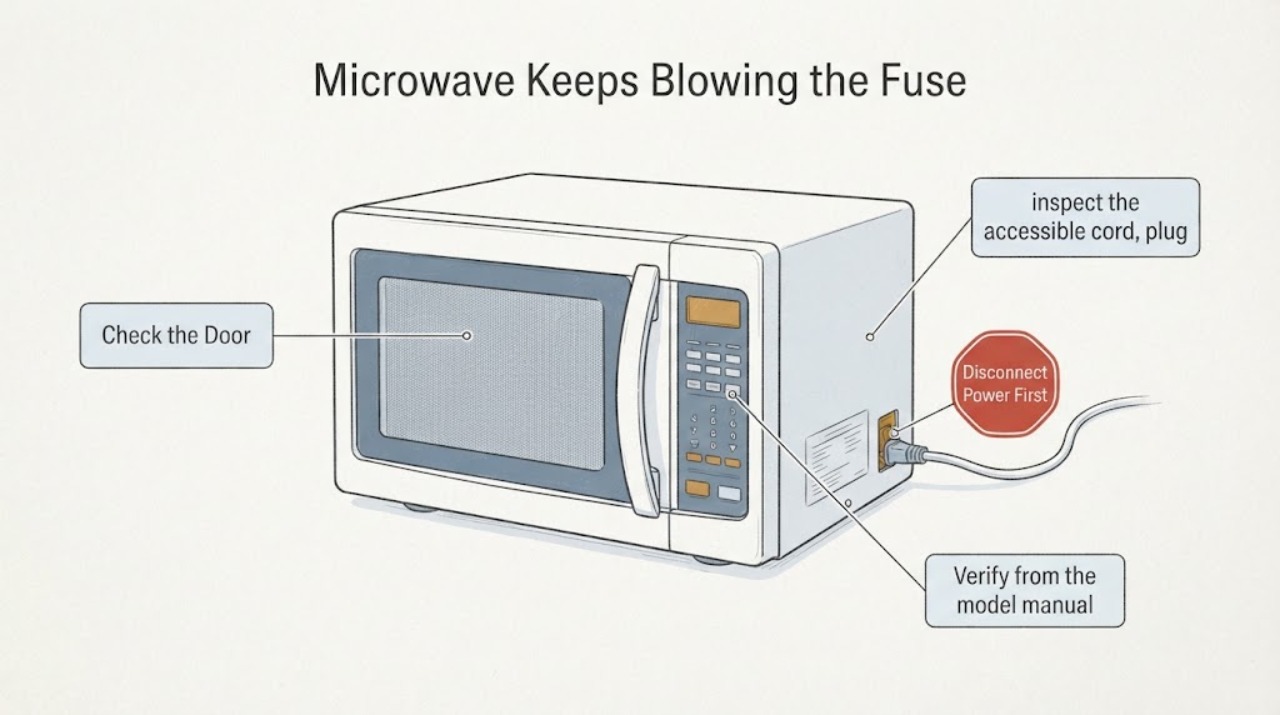
Work through in order
Diagnostic checks
Use only checks that match the exact appliance or system and its official guide.
-
Check 1
Stop using the microwave after a repeat fuse or breaker event and do not restore power if there is smoke, arcing, a burning smell, a hot/damaged cord or plug, water, or cabinet/door damage.
Expected result: A fire/electrical warning or physical damage is present, or the only symptom is a fuse/breaker opening without visible damage.
Next step: Keep the oven out of service. Isolate the circuit only from a safe dry location and arrange qualified electrical or Panasonic microwave service; do not perform another powered test.
Why this matters
Why: A fuse or breaker is interrupting a potentially unsafe condition; visible damage raises the urgency, while no visible damage does not clear the microwave.
-
Check 2
With the microwave unplugged and cool, inspect the accessible cord, plug, receptacle face, and surrounding area for looseness, heat marks, cracks, moisture, exposed conductor, or an altered/missing ground pin.
Expected result: The cord or outlet is damaged/loose/wet, the ground is altered, or the visible connection looks intact.
Next step: Do not tape, splice, adapt, or reuse a damaged connection. Have the outlet/circuit assessed; keep the microwave disconnected until cleared.
Why this matters
Why: A damaged or improper connection can create shock/fire risk and can explain a power interruption, but an intact exterior does not rule out an internal fault.
-
Check 3
Verify from the model manual or nameplate that the microwave is on the required grounded dedicated circuit and is not sharing the circuit with other appliances or an extension cord.
Expected result: The circuit is shared, an extension/adapter is present, the grounding arrangement is unknown, or the dedicated direct connection is documented.
Next step: Remove the extension/adapter from the plan and have a qualified electrician correct the circuit or receptacle. Do not infer that a different fuse rating is safe.
Why this matters
Why: Panasonic says shared circuits can blow a branch fuse or trip a breaker and instructs users to use a dedicated grounded receptacle; model power requirements vary.
-
Check 4
Record when the fuse or breaker opens: immediately at plug-in, when Start is pressed, when the door closes, or only after heating begins; also note whether the display, light, fan, or turntable changed first.
Expected result: The event is tied to power-up, Start/door operation, heating, or no repeatable timing is available.
Next step: Do not repeat the event to obtain better timing. Give the one observed sequence and exact model to service.
Why this matters
Why: Timing helps service separate supply/connection symptoms from door/safety or internal operating faults, but it cannot identify a high-voltage part for the user.
-
Check 5
Prepare the model/serial, outlet and circuit details, fuse versus breaker behavior, failure timing, prior repairs, and photographs of visible cord, plug, receptacle, door, seal, or cabinet damage for qualified service.
Expected result: The microwave continues to blow protection after the external arrangement is corrected, or the internal cause remains unknown.
Next step: Use Panasonic-authorized or qualified microwave service. Do not open the cabinet, replace an internal fuse, discharge a capacitor, test a magnetron, or bypass a door interlock.
Why this matters
Why: Panasonic directs persistent power failure and a microwave that stops after external checks to service; the internal cause may involve protected microwave-energy or high-voltage parts.
Use your observations
Decision map
Find the observation that best matches what you see, then follow the next safe action.
-
PATH 01Next step
What you see
The cord, plug, receptacle, or cabinet is hot, wet, burned, sparking, or visibly damaged.
Do this next
Do not touch or reuse it. Isolate power only if safe from a dry location and obtain qualified electrical or microwave service.
Why this path and its safety boundary
Why it matters: The setup presents an immediate electrical or fire hazard, independent of the internal microwave diagnosis.
-
PATH 02Next step
What you see
The microwave shares a circuit, uses an extension cord/adapter, or its grounded dedicated circuit is unknown.
Do this next
Keep it off and have the outlet/circuit brought into compliance by a qualified electrician; do not substitute a larger fuse or breaker.
Why this path and its safety boundary
Why it matters: Panasonic identifies shared circuits and improper connection as possible causes of a blown branch fuse or tripped breaker, while the exact model requirements remain unresolved.
-
PATH 03Next step
What you see
The direct grounded dedicated connection is correct, but the fuse/breaker opens again at Start or during heating.
Do this next
Stop use and arrange Panasonic-authorized or qualified microwave service. Do not open the cabinet or replace internal components.
Why this path and its safety boundary
Why it matters: An internal operating or safety fault remains possible, and the external checks have not made a user repair safe.
-
PATH 04Next step
What you see
The fuse or breaker has not opened again, but the door/seal is damaged, the oven arcs, or a burning smell remains.
Do this next
Keep the microwave out of service and obtain inspection; do not test it with food or an empty cavity.
Why this path and its safety boundary
Why it matters: A temporary return of power does not clear a safety or microwave-energy containment concern.
Helpful context
Understand the symptom
A fuse opening is a protection event, not a diagnosis of a magnetron, capacitor, diode, door switch, or control board. The user-visible symptom can come from the supply circuit, connection, door/safety interlock, or an internal microwave fault. Treat repeated blowing as a stop-use condition while preserving the exact model and event details.
Stop before the next fuse or breaker test
Do not keep powering the microwave to see whether the next fuse holds. Do not fit a larger fuse, bridge a fuse, defeat a door switch, or open the outer cover. If the plug, cord, or receptacle is hot, wet, sparking, or burned, do not handle it; isolate the circuit only from a safe dry position and obtain electrical help.
Check only the external power arrangement
With the appliance unplugged and cool, identify whether the household breaker/fuse opened or the microwave reports no power. Confirm the cord is fully inserted into a properly grounded three-prong receptacle and that the circuit is dedicated to the microwave. Panasonic says not to use an extension cord and notes that power requirements vary by model, so do not select a cord, outlet rating, adapter, or circuit size from the brand name alone.
Inspect the door and visible condition without opening the case
Record whether the door closes squarely and latches without force, and look only for visible damage to the door, seal area, cord, plug, or cabinet. Do not remove panels, probe the interlock, or lubricate an unknown mechanism as a substitute for the model's manual. A damaged door or seal, arcing, scorch mark, or repeated failure keeps the oven out of service.
Give service the exact event history
Provide the exact model and serial, whether the failure occurs at plug-in, Start, door closure, or after heating begins, whether the circuit is shared, whether a fuse or breaker opened, and any odor, spark, smoke, heat, or visible damage. Panasonic's generic support page cannot identify the internal failed part for an unspecified model; an authorized technician must handle any repair that exposes microwave-energy shielding or high-voltage components.
When checks do not resolve it
Need a professional?
Arrange service after any repeated fuse/breaker event, and immediately for smoke, arcing, burning odor, hot/damaged cord or outlet, water, damaged door/seals, or a cabinet fault. Use an electrician for the household circuit and qualified Panasonic microwave service for the appliance.
Safety scope: Do not open the cabinet, replace an internal fuse, fit a higher fuse, discharge a capacitor, test high-voltage parts, bypass a door interlock, or operate with damaged door/seals. Keep the unit unplugged and use qualified service.
Have this ready
- Exact model and serial, fuse versus breaker behavior, timing of failure, dedicated-circuit status, extension/adapter history, outlet/cord condition, door/seal condition, prior repairs, and any smoke, spark, odor, or heat.
Common questions
FAQ
Can I replace the microwave fuse myself?
Do not open the cabinet or replace an internal fuse yourself. Panasonic warns against disassembly or repair because of electric shock, ignition, and abnormal-operation risks; use qualified service.
Can I install a larger fuse so the microwave keeps running?
No. Do not fit a higher-rated fuse or bypass the protection. The repeated opening is a reason to stop and have the circuit and microwave assessed.
Could a shared outlet cause the fuse to blow?
Yes, Panasonic says a shared circuit can blow a branch fuse or trip a breaker. Verify the model's required grounded dedicated circuit through its manual or have an electrician assess it, without repeating the failure.
What information should service receive?
Give the exact model and serial, whether a fuse or breaker opened, when it happened, the circuit/outlet arrangement, door and cord condition, prior work, and any smoke, spark, odor, or heat. Do not continue testing to create a longer history.
Read the exact guide
Official sources
- Troubleshooting - Microwave power, fan or motor problemsPanasonic · Official Panasonic support page applies to Panasonic microwave power symptoms; model power requirements vary, so it supports dedicated-grounded-circuit and service boundaries rather than an internal component diagnosis.
- Service - Where can I find instructions to repair my microwave myself?Panasonic · Official Panasonic service page applies to Panasonic microwaves and explicitly blocks user disassembly, repair, and remodeling because of electric-shock, ignition, and abnormal-operation risks.
Community feedback
Share a repair observation
Share a plain-text repair observation. Accepted observations are published automatically; this page may take a moment to update.