
On this page
Start here
Quick answer
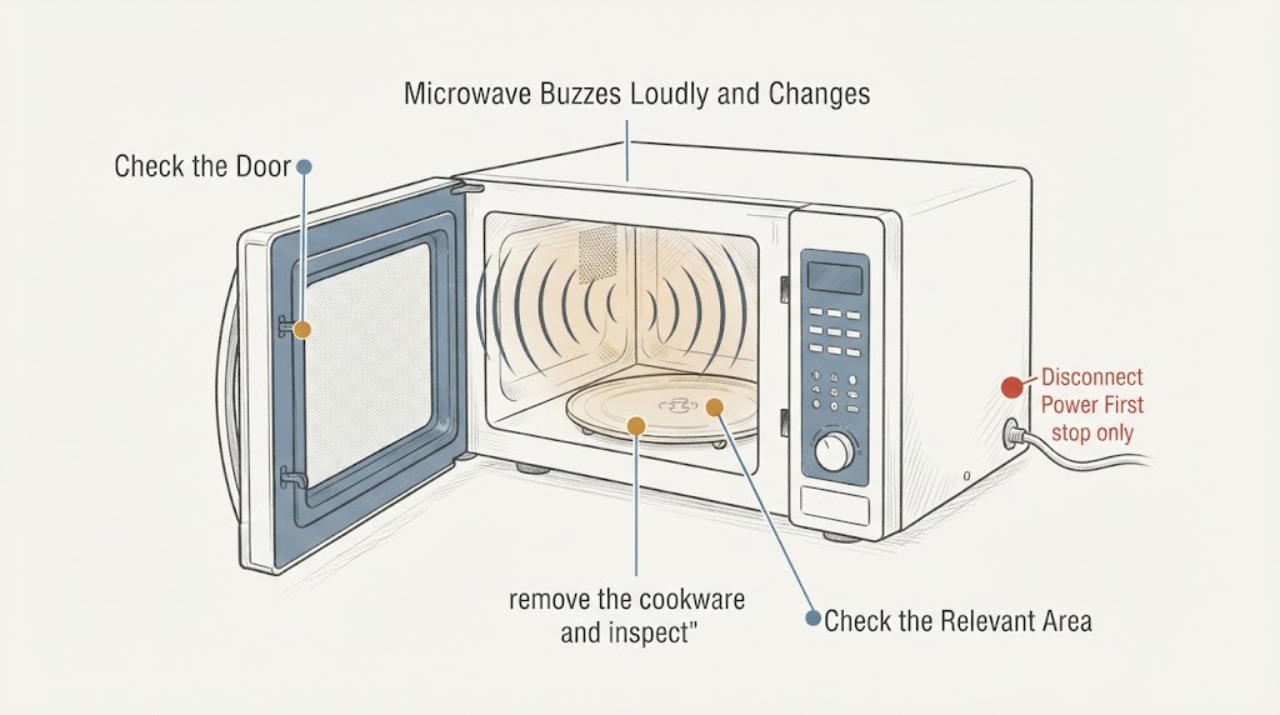
Do not press, hold, or push the microwave door while it is running to make the buzzing stop. Sharp notes that a steady cooking hum can be normal and that a rattling sound can come from a turntable or roller support that is not seated correctly, but a loud buzz that changes when the door is pushed is an abnormal door-dependent symptom. Stop use, disconnect power safely, and inspect only the cooled, unpowered exterior door, hinges, latches, seals, and turntable area. Sharp manuals say not to operate a damaged or malfunctioning oven or attempt internal repair; arrange authorized service if the sound returns, the door is loose or damaged, or there is burning smell, smoke, arcing, or heat.
Work through in order
Diagnostic checks
Use only checks that match the exact appliance or system and its official guide.
-
Check 1
Stop the microwave and do not press, pull, or hold the door while it is energized to reproduce the noise. Disconnect the plug or the accessible supply only from a dry, safe position; if there is smoke, burning smell, heat, arcing, water, a damaged cord or a tripped breaker, keep away and leave it out of service.
Expected result: The buzz is accompanied by smoke, burning odor, heat, visible arcing, a damaged cord/plug, wetness or a protective-device trip, or none of those signs are present.
Next step: For any odor, smoke, heat, arcing, water or electrical damage, keep power off and arrange qualified appliance/electrical service. Otherwise continue only with the unpowered visual checks below; do not restore power just to test door pressure.
Why this matters
Why: Sharp’s safety guidance treats strange noise, burning smell and smoke as reasons to unplug and contact service. A door-dependent buzz cannot be cleared by a live door test, even when no smoke is visible.
-
Check 2
With the microwave disconnected and cool, look at the closed door, frame, hinges, latch area and seals without removing screws or panels. Check for a door that sits out of line, a loose or broken latch/hinge, torn or displaced sealing material, an obstruction, or residue on the mating surfaces.
Expected result: The door is visibly misaligned or loose, a hinge/latch/seal is damaged, the frame is bent, or the exterior appears intact.
Next step: If any damage, looseness or frame distortion is present, keep the microwave unplugged and book authorized service. Do not adjust the latch, wedge the door, tape it shut, or bypass an interlock.
Why this matters
Why: Sharp’s operation manual says a bent or misaligned door, damaged seals, broken hinges or loose latches require the oven not to be operated and service to be contacted. An intact exterior does not prove that the internal interlock is safe or that any particular switch is faulty.
-
Check 3
After power is disconnected, remove the cookware and inspect the turntable, center post and roller support. Clean only accessible food splashes or grease with the manual’s permitted method, then reseat the roller support and turntable so they are centered and stable; do not remove a waveguide cover or any cabinet part.
Expected result: The roller support is dirty, displaced, cracked or dragging; the turntable is off-center or wobbles; or the assembly is clean, centered and intact.
Next step: Correct only a plainly visible, user-accessible seating or residue issue while power is disconnected. If the door-dependent buzz was the reported symptom, keep the unit out of service and seek model-specific inspection even if the turntable is correctly seated.
Why this matters
Why: Sharp’s noise guide identifies turntable/roller alignment as a possible source of rattling, and its manual warns that food or grease buildup around the support can overheat, arc, smoke or cause fire. This check can explain a mechanical rattle, but it does not explain away a buzz that changes with door pressure.
-
Check 4
Record the model and serial label, microwave type (countertop or over-the-range), when the sound begins, whether it is a steady hum or a buzz/rattle, and whether the door was merely closed or was being pushed. Take photographs only with power off and without touching damaged areas.
Expected result: The model label is available and the sound can be described without another powered run, or the label is missing and the symptom cannot be safely reproduced.
Next step: Give the exact model, symptom timing, door condition, any odor/smoke/arcing, and the power-disconnect status to an authorized Sharp servicer. Do not open the chassis or perform a live voltage test.
Why this matters
Why: Sharp family manuals and service paths differ, and the absence of a model prevents assigning an exact door, interlock, fan or high-voltage diagnosis. A safe symptom record is more useful than another live test.
Use your observations
Decision map
Find the observation that best matches what you see, then follow the next safe action.
-
PATH 01Next step
What you see
Smoke, burning smell, visible arcing, heat, water, damaged power parts or a breaker trip occurred with the buzz.
Do this next
Keep the appliance disconnected, do not reset the breaker or repeat a door test, and arrange qualified appliance/electrical service. If there is an active fire, keep the door closed and follow local emergency guidance.
Why this path and its safety boundary
Why it matters: This is an electrical or fire-risk stop condition; the noise is not a normal-hum decision.
-
PATH 02Next step
What you see
The door is loose, skewed or visibly damaged, or a hinge, latch, seal or frame has a defect.
Do this next
Leave it unplugged and have the exact model inspected by authorized service; do not press the door during operation, force alignment, or bypass the latch.
Why this path and its safety boundary
Why it matters: Sharp’s manual says a damaged door or related sealing/latching part requires the oven not to be operated. The visible defect does not prove which internal interlock part failed.
-
PATH 03Next step
What you see
The door and frame look intact, but the loud buzz returns or changes when the closed door is pressed or moved.
Do this next
Stop using the microwave and arrange model-specific service. Do not perform another energized test or remove the cabinet, waveguide cover or door-switch assembly.
Why this path and its safety boundary
Why it matters: A door-dependent sound is outside the steady-hum case described by Sharp’s noise guide. A clean exterior cannot clear an internal interlock or high-voltage concern.
-
PATH 04Next step
What you see
The sound is a steady hum that never changes with door movement, there is no damage or odor, and the unpowered turntable/roller assembly is correctly seated.
Do this next
Use the exact model manual for any continued operation decision. If the sound becomes loud, rattling or door-dependent again, stop and use the service branch rather than pressing the door.
Why this path and its safety boundary
Why it matters: Sharp describes a normal cooking hum as possible, so this pattern is more consistent with ordinary operation than with the reported door-dependent symptom; the initial report still matters if the sound is unusually loud or new.
Helpful context
Understand the symptom
A buzz that changes with door pressure needs a safety-first decision
A normal microwave hum should be steady and unrelated to pushing the door. The assigned topic describes a loud buzz that stops when the door is pressed, so do not use the door as a test switch and do not reproduce the symptom. This does not identify a failed door switch, latch, magnetron, fan or other component; it identifies a condition where further powered testing is not appropriate without the exact model and qualified service.
The owner checks end at the unpowered exterior
With power disconnected and the oven cool, a user can look for a visibly skewed door, loose hinge, damaged latch or seal, residue on the sealing surfaces, or a turntable and roller support that is not seated. Sharp’s manuals describe door/latch/seal damage as a reason not to operate, and the turntable guidance warns that food or grease buildup around the rollers can cause abnormal operation. No cover, waveguide panel, door-switch assembly or chassis should be removed.
Exact model details matter for service
No Sharp model number was supplied. Sharp has multiple countertop and over-the-range families, so the article stays at the common external safety boundary rather than assigning a code or component. Photograph the model label and describe whether the buzz is a steady hum, a rattle, a scrape, or a sound that changes with door movement; that information helps an authorized servicer choose the correct manual and inspection path.
Common questions
FAQ
Can I press the Sharp microwave door while it is running to stop the buzzing?
No. Do not use door pressure as a live test or bypass the interlock. Stop the oven, disconnect power safely, inspect only the unpowered exterior and arrange service if the sound returns or the door is not sound.
Is a microwave hum always a fault?
Sharp says a cooking hum can be normal, while a louder rattling sound can come from a turntable or roller support that is not aligned. A buzz that changes when the door is pressed is a different, door-dependent symptom and should not be dismissed as normal hum.
What can I check without opening the microwave?
With power disconnected and the unit cool, check the visible door alignment, hinges, latch area, seals and frame, and clean/reseat an accessible turntable and roller support. Do not remove the waveguide cover or cabinet and do not inspect the door switch live.
When should I call for service?
Keep the microwave out of service and contact authorized service for a buzz that returns or changes with door movement, any loose or damaged door/hinge/latch/seal, or smoke, burning smell, arcing, heat or breaker trips. Give the exact model rather than selecting a replacement switch or other component from the sound alone.
Read the exact guide
Official sources
- SHARP SMO1652DS Operation ManualSharp Electronics · Official Sharp manual for SMO1652DS, not the unspecified task model; used only for general Sharp microwave electrical and service boundaries, not to assign an exact part or procedure.
- How to Fix a Buzzing or Rattling Noise in Your Countertop Microwave | Easy DIY GuideSharp Simply Better Living · Official Sharp consumer guidance for countertop microwave noise; it supports the distinction between steady hum and possible turntable/roller rattling and the unpowered seating check, but it is not an exact-model diagnosis and does not authorize a live door-pressure test.
- R-930AK/R-930AW/R-930CS Operation ManualSharp Electronics · Official Sharp manual for the listed R-930 family, not the unspecified task model; used for general external door/latch, safety-latch, turntable-cleaning and no-DIY-service boundaries only.
Community feedback
Share a repair observation
Share a plain-text repair observation. Accepted observations are published automatically; this page may take a moment to update.