
On this page
Start here
Quick answer
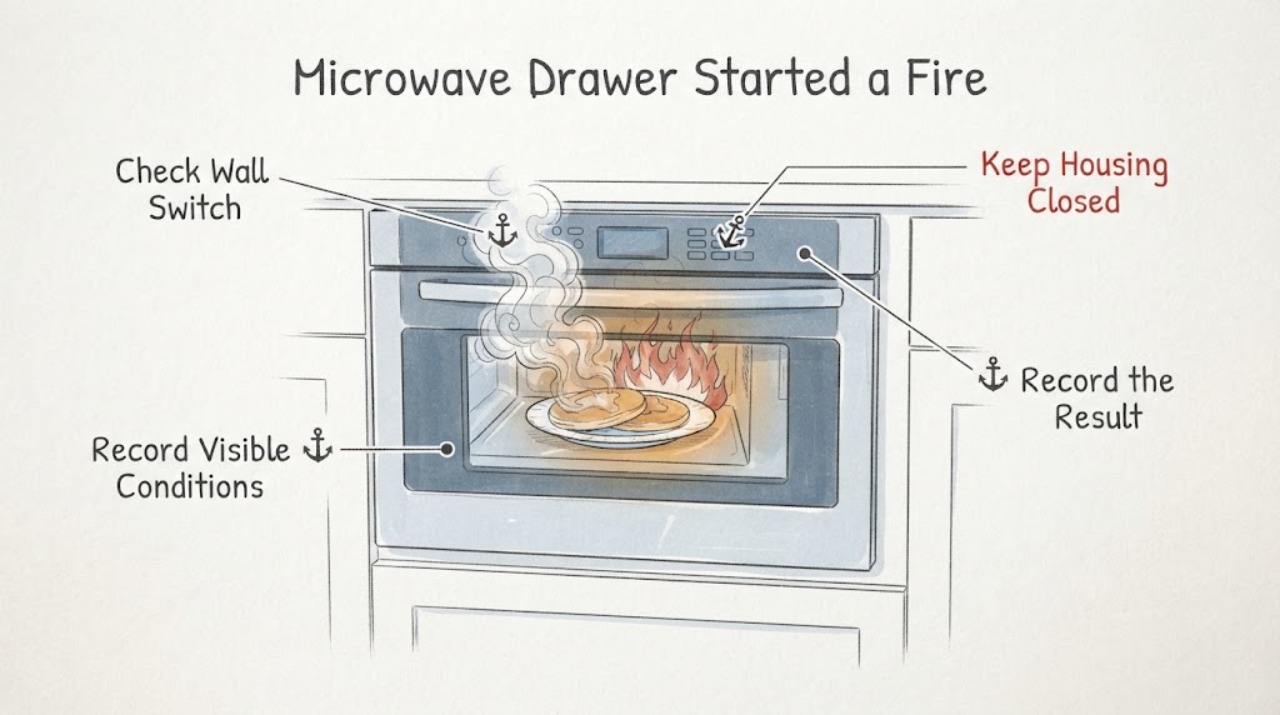
If a Sharp Microwave Drawer ignited a paper plate and the cavity bottom is cracked, stop using it. During an active fire, keep the drawer closed, turn the microwave off and shut off power at the fuse or circuit-breaker panel if that can be done without approaching the hazard. After the appliance is completely cool and de-energized, do not scrape, seal, repaint or test the cracked surface; Sharp's drawer manuals say not to operate a damaged drawer and to contact a Sharp Authorized Servicer.
Before you begin
Safety first
- Do not reopen an active fire, run another cycle, patch the cavity, remove the waveguide cover, open the chassis, move the built-in drawer, alter grounding or use an extension cord.
Work through in order
Diagnostic checks
Use only checks that match the exact appliance or system and its official guide.
-
Check 1
If the paper or food is still burning, do not open the drawer. Keep it closed, turn the microwave off and, only if the panel can be reached without approaching smoke, flame or hot surfaces, switch off the circuit at the fuse or breaker panel. Leave the area and call emergency services if the fire or smoke does not stop.
Expected result: The fire stops inside the closed drawer, or smoke/flame continues or spreads outside the appliance.
Next step: For continuing smoke or flame, evacuate and use local emergency help. If the event stops, keep the drawer closed and power isolated until it is cool and inspected; do not restart it.
Why this matters
Why: A contained microwave fire can be deprived of air, while continuing smoke/flame is an active fire emergency rather than a troubleshooting state.
-
Check 2
After the drawer and contents are completely cool and the power is isolated, record the visible damage without touching the cavity surface: note the crack location, burn or discoloration, damaged seal, bent drawer, loose guide, odor or residue. Do not remove the waveguide cover or reach into a sharp or heat-damaged area.
Expected result: The cavity bottom is cracked, the seal or drawer is damaged, there is a loose guide, or only removable residue is visible with no damage.
Next step: For any crack, burn-through, seal or structural damage, keep the appliance out of service. If only residue is visible, do not assume the fire event is resolved; report the event and have the appliance assessed before use.
Why this matters
Why: Sharp treats damage to the cavity, seals, drawer or guides as a reason not to operate and to contact an authorized servicer. Residue alone does not clear a reported crack or fire event.
-
Check 3
Write down what was in the drawer, the paper plate type, whether any foil, twist-tie, metal trim or other packaging was present, the food quantity, the selected time/power, when smoke appeared and whether the drawer was attended. Do not repeat the recipe or use a different container to compare results.
Expected result: The record shows a combustible paper/plastic item, packaging metal, severe overcooking, unknown settings or an unexplained ignition.
Next step: Give the record and photographs, taken only when safe, to Sharp service. Keep the drawer disconnected and do not perform a second heating test.
Why this matters
Why: Sharp warns that paper/plastic must be attended and that severely overcooked food can smoke or ignite, but the event record cannot establish the cause of a cracked cavity.
-
Check 4
Locate the model and serial label only when doing so does not require moving the built-in drawer or touching damaged surfaces. Sharp manuals place the name plate inside or behind the drawer depending on model; if accessing it is unsafe, let the servicer identify it.
Expected result: The model/serial is readable, or the label cannot be reached without moving the unit or touching damage.
Next step: Provide the readable identity to Sharp service. If it cannot be reached safely, leave the drawer in place and tell the servicer that the model label was inaccessible.
Why this matters
Why: Sharp Microwave Drawer families differ, so the model is needed for the correct manual and service record. A label-access task must not become an installation or cabinet-removal task.
-
Check 5
Request a Sharp Authorized Servicer or qualified microwave technician to inspect the damaged drawer, cavity, seals, waveguide area, grounding and installation before any future use. Keep the appliance disconnected and do not open the cabinet or microwave chassis.
Expected result: The cavity bottom is cracked or burned, the drawer/seal is damaged, the cause is uncertain, or the appliance has smoke/odor/electrical damage after the fire.
Next step: Do not operate the drawer until the servicer explicitly clears it or replaces it according to the exact model documentation. Do not patch the cavity or remove internal covers.
Why this matters
Why: The reported fire plus structural damage is beyond a safe user adjustment. Sharp's installation and operation manuals reserve damaged-unit evaluation and installation/service work for qualified personnel.
Use your observations
Decision map
Find the observation that best matches what you see, then follow the next safe action.
-
PATH 01Next step
What you see
Smoke or flame continues after the microwave is turned off, escapes the drawer, or reaches surrounding cabinetry.
Do this next
Leave the area, close doors behind you if safe, call local emergency services and do not reopen or approach the appliance.
Why this path and its safety boundary
Why it matters: This is an active fire emergency, not an appliance-cleaning or repair decision.
-
PATH 02Next step
What you see
The fire stopped, but the drawer cavity bottom is cracked, burned through, or the seal/drawer/guide is damaged.
Do this next
Keep power isolated and arrange authorized service. Do not clean over, seal, coat or test the damaged area.
Why this path and its safety boundary
Why it matters: Sharp's damage inspection rule says not to operate a damaged Microwave Drawer and to contact a Sharp Authorized Servicer.
-
PATH 03Next step
What you see
Only removable residue is visible after cooling and no crack, burn-through, seal damage or structural damage can be confirmed.
Do this next
Do not run another cycle to check it. Give Sharp service the event history and have the drawer assessed before use.
Why this path and its safety boundary
Why it matters: Cleaning may remove residue, but the reported ignition still has no verified cause and the visual check does not certify microwave safety.
-
PATH 04Next step
What you see
The model label cannot be reached without moving the built-in drawer or touching the damaged cavity.
Do this next
Leave the unit in place and provide photos and the best available identity to an authorized servicer; do not remove the drawer or cabinet panels.
Why this path and its safety boundary
Why it matters: The model-specific service path is unresolved, and accessing the label is not worth creating a new handling or electrical risk.
Helpful context
Understand the symptom
Treat the fire and crack as a stop condition
Sharp's Microwave Drawer operation manual says that if material inside ignites, the drawer should remain closed, the microwave should be turned off and power should be shut off at the fuse or circuit-breaker panel. The same manual says not to operate a drawer with damage to the drawer, seals, sealing surfaces, guides or cavity/front surfaces. A cracked bottom therefore needs service evaluation, not a cooking test.
The paper plate explains the fire context, not the repair
Sharp warns users to attend the appliance when paper, plastic or other combustible materials are inside and not to overcook food. Frozen pancakes on a paper plate can leave a combustible-material event, but the reported crack means the condition of the drawer must be assessed separately. The event does not establish whether the paper, food, surface damage or another internal issue caused the heat concentration.
Do not mistake cleaning for repair
Once the appliance is cold and power is isolated, a user may document what is visible without scraping, sanding or coating the cavity. Sharp's manual says to use only mild soap and a soft damp cloth for ordinary interior cleaning and says not to remove the waveguide cover. A crack, burn-through, loose surface or damaged seal remains a service issue even if residue can be wiped away.
When checks do not resolve it
Need a professional?
Call emergency services for continuing fire or smoke. Once safe, contact a Sharp Authorized Servicer or qualified microwave technician for any crack, burn-through, damaged seal/guide, persistent odor, smoke or uncertain cause.
Safety scope: Do not reopen an active fire, run another cycle, patch the cavity, remove the waveguide cover, open the chassis, move the built-in drawer, alter grounding or use an extension cord.
Have this ready
- Provide the model and serial if safely visible, drawer type, food and paper-plate details, time/power setting, fire and smoke behavior, crack location, photos taken after cooling, and whether the breaker was shut off.
Common questions
FAQ
Can I seal or cover the crack and try the microwave again?
No. A cavity crack after a fire is damage, not a cosmetic cleaning issue. Sharp's manuals say not to operate a damaged Microwave Drawer and to contact an authorized servicer.
What should I do if paper or food catches fire inside the drawer?
Keep the drawer closed, turn the microwave off and shut off power at the fuse or circuit-breaker panel if that can be done without approaching the hazard. If smoke or fire continues, leave and call emergency services.
Can I remove the waveguide cover to inspect the burn?
No. Sharp identifies the waveguide cover as a part that must not be removed. Leave internal inspection to an authorized servicer.
Read the exact guide
Official sources
- Sharp SMD2489ES Microwave Drawer Operation ManualSharp USA · Opened the official Sharp SMD2489ES operation manual. It confirms the same family-level rule that drawer, seal, guide, cavity or front damage means do not operate and contact a Sharp Authorized Servicer.
- Sharp Microwave Drawer Operation ManualSharp USA · Opened the official Sharp operation manual for SMD2470AS/SMD3070AS Microwave Drawer family. It is used for family-level safety rules because the task supplies no model number.
- Microwave Drawer Installation Instructions for 24 in. and 30 in. ModelsSharp USA · Opened the official Sharp installation manual. It requires qualified installation/service and says a drawer with cavity, seal, guide or structural damage must not be operated.
Community feedback
Share a repair observation
Share a plain-text repair observation. Accepted observations are published automatically; this page may take a moment to update.