
On this page
Start here
Quick answer
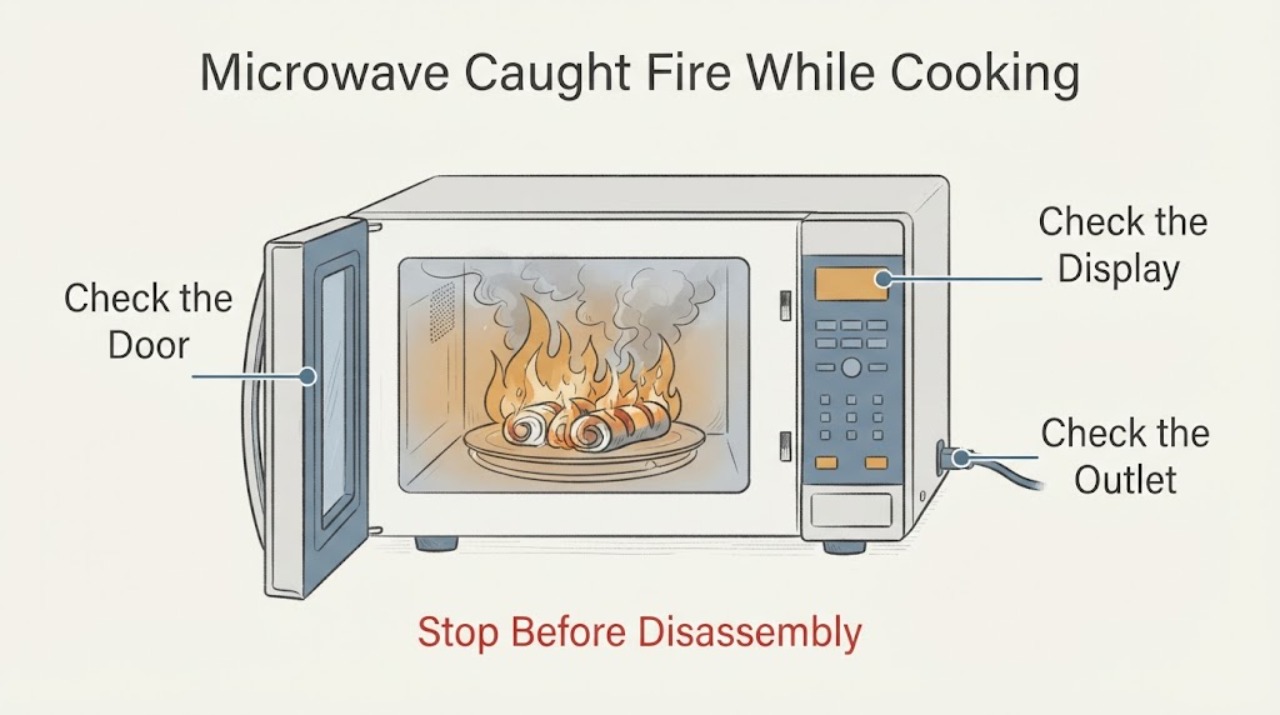
Treat a GE microwave fire during cooking as a stop-use safety event. Keep the door closed, turn the microwave off, and unplug it from the wall only if you can do so without approaching flames, heat, smoke, or a damaged connection. If the fire does not go out, leave the area and call the fire department. Do not open the door while the fire is active, restart the microwave to see whether it still works, run a cup of water as a test, or remove the cabinet and high-voltage cover. After the appliance is fully cool and disconnected, record the exact model and serial number and make only a visual check for a hole, active peeling, chipping, scorching, melted parts, door damage, or smoke damage. GE says a cavity hole or actively peeling interior coating requires discontinuing use and replacement; any unresolved fire or electrical damage needs GE or qualified appliance service.
Work through in order
Diagnostic checks
Use only checks that match the exact appliance or system and its official guide.
-
Check 1
If the microwave is still burning, stop the cooking cycle and keep the door closed. Turn the oven off and unplug it from the wall only if the plug and route are cool, dry, and safe to reach; do not open the door to inspect or add air. If the fire does not go out, leave the building and call the fire department.
Expected result: The fire goes out with the door closed, or flames/smoke continue or the power connection is unsafe to approach.
Next step: For continuing fire, heavy smoke, injury, or unsafe access, evacuate and obtain emergency help. Do not return to open or move the microwave until responders say it is safe.
Why this matters
Why: USFA and NFPA both direct the reader to keep a microwave fire contained with the door closed, turn it off, and disconnect power only when safe; an uncontrolled fire is an emergency.
-
Check 2
After the fire is out, leave the microwave disconnected and untouched until it is fully cool and the room is clear of smoke. Do not run another roll, a cup of water, or an empty-cycle test, and do not use the appliance because the display or light still works.
Expected result: The microwave is cool and disconnected, or there is lingering smoke, odor, heat, melted material, or a damaged plug, cord, door, or outlet.
Next step: Keep the appliance out of service. If heat, smoke, odor, or electrical damage remains, do not approach the connection and arrange fire or qualified appliance service.
Why this matters
Why: A fire can leave electrical, cavity, door, or control damage that is not cleared by a successful display or motor test. NFPA says to unplug after a microwave fire, and GE directs unusual electrical or mechanical sounds to service.
-
Check 3
Only when the unit is cool and disconnected, look through the door and at the visible exterior without removing panels. Check for a hole in the cavity wall, active peeling or flaking coating, deep scorch marks, melted plastic, a warped or damaged door, a damaged plug or cord, or burn marks around the outlet. Do not touch soot-covered electrical parts or open the cabinet.
Expected result: A cavity hole, active peeling, deep scorching, melted material, door or cord damage, or no obvious visible damage is found.
Next step: For any cavity or exterior damage, keep the microwave out of service and contact GE or qualified service. If nothing is visible, still do not restart after a fire until the exact model instructions or a service provider has assessed it.
Why this matters
Why: GE says a cavity hole is non-repairable and that active peeling or flaking requires discontinuing use and replacement. Visible damage after a fire is not a user-repair diagnosis; no visible damage does not prove the microwave is safe.
-
Check 4
Photograph the model and serial label without opening the cabinet. Use GE's model-specific Owner Support path and compare the exact model and serial range with official recall information; do not infer recall coverage from the GE brand, the appliance age, or a similar-looking microwave.
Expected result: The model and serial number are readable and match a GE support page or recall entry, or the identity is missing or does not match.
Next step: If the identity matches a recall, follow the recall remedy and keep the microwave unused. If it does not match or cannot be read, give the photos and fire details to GE or a qualified technician; do not apply a similar model's repair procedure.
Why this matters
Why: GE routes manuals and service by appliance model. The opened CPSC recall is limited to specified built-in combination wall-oven/microwave models and serial ranges, so a brand-only match is insufficient.
-
Check 5
Arrange GE or qualified microwave service for any fire, cavity damage, electrical or mechanical popping, smoke damage, or unresolved uncertainty. Do not remove the outer cabinet, access the magnetron, transformer, capacitor, door switches, or other high-voltage parts, and do not replace an internal part from a symptom or photo alone.
Expected result: The microwave has had a fire or post-fire damage, even if it appears to heat normally after cooling.
Next step: Keep the microwave disconnected and provide the exact model, serial, cooking item, duration, fire location, and photographs to GE or a qualified service provider.
Why this matters
Why: GE's support directs electrical or mechanical arcing concerns to service and identifies specific cavity damage as non-owner-repairable. Microwave high-voltage access is outside this article's safe external checks.
Use your observations
Decision map
Find the observation that best matches what you see, then follow the next safe action.
-
PATH 01Next step
What you see
Flames or heavy smoke continue after the microwave is turned off, or the plug and outlet cannot be safely reached.
Do this next
Keep the door closed if it is safe to remain nearby, leave the building, and call the fire department. Do not attempt to move the microwave or extinguish it by opening the door.
Why this path and its safety boundary
Why it matters: This remains an active fire emergency; opening the door or approaching a damaged connection can make the situation worse.
-
PATH 02Next step
What you see
After cooling, the cavity has a hole, active peeling or flaking, deep scorching, melted material, or the door no longer closes normally.
Do this next
Keep the microwave disconnected and arrange GE service or replacement according to the model-specific support path. Do not attempt a coating, waveguide, door-switch, or high-voltage repair yourself.
Why this path and its safety boundary
Why it matters: GE identifies a cavity hole and active peeling as discontinuation and replacement conditions; a damaged door or severe scorch after a fire is not cleared by cleaning.
-
PATH 03Next step
What you see
The fire is out and no cavity or exterior damage is obvious, but the microwave has not been assessed by model-matched service.
Do this next
Do not perform a test heating cycle. Keep the unit disconnected, document the model and incident, and obtain GE or qualified microwave service before use.
Why this path and its safety boundary
Why it matters: A clean-looking cavity does not establish that the fire source or electrical components are safe.
-
PATH 04Next step
What you see
The model or serial number is missing, or it does not exactly match the historical CPSC GE combination-oven recall list.
Do this next
Keep the microwave out of service and give the model, serial, purchase details, and photographs to GE support or a qualified technician. Do not assume a recall or non-recall status from the brand alone.
Why this path and its safety boundary
Why it matters: The available recall evidence cannot establish coverage for this microwave; the fire remains an incident requiring a model-specific safety decision.
Helpful context
Understand the symptom
The fact that the microwave was cooking rolls does not establish whether the ignition began in the food, from arcing, or from an appliance fault. The safe decision is the same until the cavity and model are assessed: contain the fire without opening the door, disconnect power only when safe, and keep the microwave out of service.
GE's public support distinguishes normal food-related popping from electrical or mechanical sounds that need service and says cavity holes or actively peeling interior coating are not owner-repair conditions. No exact model was supplied, so no GE recall, cavity design, part, or internal cause is assigned to this incident.
When checks do not resolve it
Need a professional?
Immediately if the fire does not go out with the door closed and the oven off, or if smoke, flames, or unsafe electrical access remain., Before opening the cabinet, accessing high-voltage parts, testing the microwave, or replacing a door, waveguide, switch, magnetron, or control component., After any microwave fire, cavity hole, active peeling, severe scorch, door damage, or uncertain model/recall status.
Common questions
FAQ
Should I open the GE microwave door when the rolls catch fire?
No. Keep the door closed while the fire is active, turn the microwave off, and unplug it only if the connection is safe to reach. If the fire does not go out, leave and call the fire department.
Can I run a cup of water to see whether the microwave still works?
No. A successful heating cycle would not clear damage caused by the fire. Keep the unit disconnected and arrange model-specific GE or qualified service first.
Does a GE microwave fire mean my model is recalled?
Not automatically. The opened CPSC recall covers listed GE/GE Profile built-in combination wall-oven/microwave models and serial ranges. Check the exact model and serial number through official GE and CPSC information.
What cavity damage means the microwave should not be used?
GE says a hole in the cavity wall is non-repairable and requires discontinuing use and replacement. GE also says active flaking or peeling of the interior coating requires discontinuing use and replacement.
Read the exact guide
Official sources
- Microwave Oven SafetyNational Fire Protection Association · Opened official NFPA safety sheet. Used for keeping the door closed, turning the oven off, unplugging it, and calling the fire department if the fire does not go out; it is not a GE model manual.
- Fire Safety for College StudentsU.S. Fire Administration · Opened official U.S. Fire Administration guidance. Used only for immediate fire containment and evacuation boundaries, not for GE model diagnosis or repair.
- GE Appliances Service and Support by Product LineGE Appliances · Opened GE official owner-support page. Used only to direct model/serial identification and the microwave support/service path; it does not support a fire cause or internal repair.
- General Electric Recalls Microwave Combo Wall Ovens Due to Fire HazardU.S. Consumer Product Safety Commission · Opened CPSC recall page. Used only as a conditional model-and-serial lookup example; it is not evidence that the unidentified GE microwave in this task is recalled.
- Pictograph: Microwave Oven SafetyU.S. Fire Administration · Opened official U.S. Fire Administration pictograph. Used to support turning the oven off and keeping the door closed until the fire is out; it does not establish GE-specific service or repair steps.
- Microwave - Cavity Repair Needed Due to Arcing, Chipping, Peeling or ScorchingGE Appliances · Opened GE official support article. Used for the cavity-hole and active-peeling boundaries only; no interior repair, waveguide, or high-voltage procedure is inferred.
- Microwave - Arcing or Making SoundsGE Appliances · Opened GE official support article. Used for distinguishing food-related popping from electrical or mechanical sounds that need service, and for the visible cavity-hole boundary. It is not used to infer the cause of this incident without an exact model.
Community feedback
Share a repair observation
Share a plain-text repair observation. Accepted observations are published automatically; this page may take a moment to update.