
On this page
Start here
Quick answer
A brief click can occur when a microwave switches functions, but the opened Sharp material does not establish that a loud, model-unknown clack is a harmless relay or door-latch sound. Treat a sharp bang, repeated cracking, sparks, smoke, burning odor, melted or scorched cavity material, damaged door, or an abnormal sound that is getting worse as a stop-use condition: press Stop/Clear if it is safe, keep the door closed, disconnect power when safely accessible, and arrange qualified Sharp or microwave service. If there are no hazard signs and the sound was only a turntable rattle, inspect the glass tray and roller guide with the oven unplugged and the cavity cool. Do not open the case, defeat door interlocks, or run another risky test to identify an internal part.
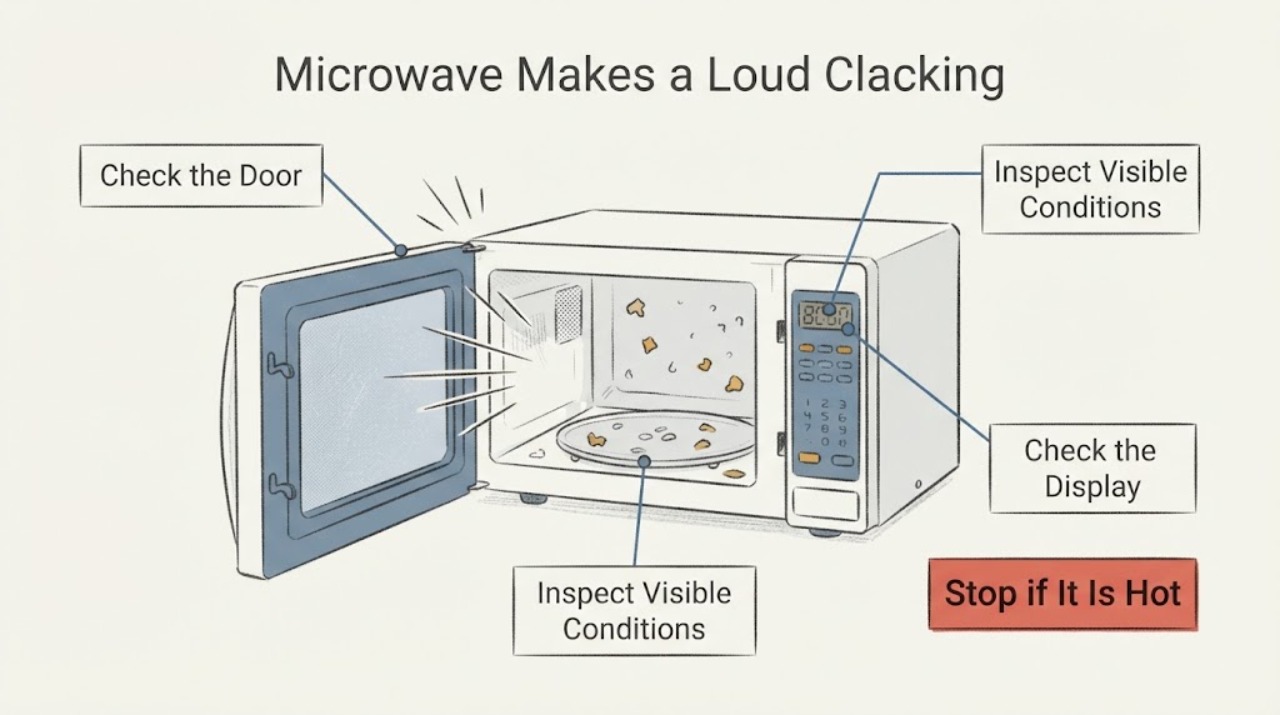
Work through in order
Diagnostic checks
Use only checks that match the exact appliance or system and its official guide.
-
Check 1
If the clack is accompanied by a bang, flash, sparks, smoke, burning or electrical odor, scorch mark, melted material, a hot plug, or a damaged door, press Stop/Clear if it can be done without reaching toward a hazard, keep the door closed, and disconnect power only from a safe accessible point.
Expected result: There is a visible spark or damage/odor, or the sound occurred without any visible hazard sign.
Next step: Leave the oven out of service and contact qualified Sharp/microwave service. Do not reopen the case or energize it to reproduce the sound.
Stop if: Stop immediately for sparks, smoke, burning smell, repeated popping/banging, damaged cavity or waveguide cover, exposed wiring, or door/seal/hinge damage.
Why this matters
Why: Sparks, fire signs, or damaged door/sealing parts can involve arcing, fire, shock, or microwave-safety risk; absence of a visible spark does not prove that an unknown loud clack is safe.
-
Check 2
Use only the sound already observed to describe its timing: one click at a switch point, a repeating rattle during turntable movement, or a crack/pop that coincides with heating. Do not start another cycle, run the oven empty, or place hands near moving or energized parts just to classify it.
Expected result: The sound was a low-level rattle linked to the removable turntable, or it was a loud/irregular clack whose source and timing are uncertain.
Next step: For an uncertain or loud clack, keep the microwave unplugged and give the technician the model label and any recording that already exists. Do not rely on a guessed internal component.
Why this matters
Why: Sharp's official countertop guidance links rattling to turntable/roller-stay seating, but no opened Sharp source proves that an unknown clack is a normal relay or door-latch sound.
-
Check 3
After unplugging the countertop unit and allowing it to cool, inspect only the removable glass tray, roller guide/stay, and oven floor for a loose fit, trapped food, cracked glass, or an object touching the cavity. Do not remove a cover, touch wiring, or inspect behind the control panel; for a drawer or built-in model, do not pull it from the cabinet.
Expected result: The tray/roller guide is visibly mis-seated or contaminated, or the removable parts look correctly seated and the clack remains unexplained.
Next step: Remove only loose food residue or reseat a removable tray/roller guide exactly as the model manual shows. If the sound was loud, persists, or the model is not known, stop and arrange service instead of testing it under power.
Why this matters
Why: The official Sharp noise guidance identifies turntable and roller-stay alignment as a possible external rattle source. A correctly seated tray does not clear the door, fan, relay, high-voltage, or other internal assemblies.
-
Check 4
With power disconnected, look from the outside for a door that closes squarely, a seal that is not torn or displaced, loose/broken hinges or hooks, and residue or an object at the sealing surfaces. Do not press, bend, shim, or adjust the latch/interlock assembly.
Expected result: The door, hinges, hooks, seals, and front frame appear intact, or any part is bent, loose, broken, or unable to close normally.
Next step: Keep the microwave out of service and request qualified repair for any damage, misalignment, or unexplained clack. Do not bypass or modify the door safety interlocks.
Why this matters
Why: Sharp warns against operation with damaged doors, hinges, hooks, seals or sealing surfaces, and says not to tamper with safety interlocks. An intact-looking door does not prove that the internal switch assembly is safe.
-
Check 5
Read the complete Sharp model and serial label without moving a built-in/drawer unit. Record whether it is countertop, over-the-range, or drawer/built-in, when the sound happens, whether heating still occurs, and whether the unit is under warranty.
Expected result: The complete identity and configuration are available, or the label/configuration remains unknown.
Next step: Give the model, configuration, timing description, visible safety symptoms, and any already-captured recording to Sharp warranty/service or a qualified microwave technician. Do not order an internal part from a sound description alone.
Why this matters
Why: Sharp publishes different procedures for countertop and drawer products, and a model-specific manual is needed before any sound or removable-part procedure is transferred.
Use your observations
Decision map
Find the observation that best matches what you see, then follow the next safe action.
-
PATH 01Next step
What you see
The clack includes sparks, smoke, a burning smell, repeated explosive pops, scorch/melt marks, or any damaged door, seal, hinge, cavity or waveguide cover.
Do this next
Stop the oven, keep the door closed, disconnect power only when safely accessible, and arrange qualified microwave service. Do not run another cycle or open the cabinet.
Why this path and its safety boundary
Why it matters: This is a possible arcing, fire, electrical, or microwave-sealing hazard rather than a normal sound question.
-
PATH 02Next step
What you see
The only evidence is a low-level rattle already associated with the removable glass tray or roller guide, and there are no sparks, odors, scorch marks, or door damage.
Do this next
Unplug the oven, clean or reseat only the removable tray/roller guide using the exact model guide, and use warranty or service if the loud sound remains. Do not perform a powered test solely to confirm a guess.
Why this path and its safety boundary
Why it matters: Sharp identifies turntable/roller-stay seating as one possible external source of rattling, but this does not prove that every clack is harmless.
-
PATH 03Next step
What you see
The sound is a loud or irregular clack, its source is uncertain, or the model is a drawer/built-in/unknown configuration.
Do this next
Leave the microwave unplugged and request model-specific Sharp or qualified microwave service. Do not pull out a built-in unit, remove the case, or buy a component from the sound alone.
Why this path and its safety boundary
Why it matters: The official countertop rattle guidance cannot establish a safe cause for another configuration, and the clack could involve an internal or door-safety assembly.
-
PATH 04Next step
What you see
The door does not close squarely, the seal or hinge is damaged, or an interlock appears loose or altered.
Do this next
Keep the unit out of service and arrange competent service; do not shim, tape, bypass, or adjust the latch/interlock.
Why this path and its safety boundary
Why it matters: Sharp says not to operate a microwave with damaged door/sealing parts and not to tamper with safety interlocks.
Helpful context
Understand the symptom
A clack is not a diagnosis
The exact Sharp model is not supplied, and the accessible official material does not publish a cross-model table saying that a loud clack is a normal relay, latch, magnetron, or fan sound. Sharp's countertop guidance does say that cooking hum is normal and that a rattling noise can come from a turntable or roller stay that is not seated. That supports a limited, power-off inspection of the removable turntable parts, not an internal diagnosis or permission to continue cooking until the sound is reproduced.
Sparks and damage change the decision
A bang or clack accompanied by a flash, smoke, burning smell, scorch mark, damaged waveguide cover or cavity, or a door/seal problem has a different safety boundary from a clean mechanical rattle. Sharp's manuals describe arcing as sparks, tell the user to correct the problem and avoid unsafe metal or food residue, and say not to operate a damaged oven or tamper with safety interlocks. When the model and sound source are unknown, stop use and use qualified microwave service rather than opening the case.
When checks do not resolve it
Need a professional?
Provide the complete model/serial label, configuration, purchase/warranty status, when the clack occurs, whether heating and turntable movement were normal before the sound, any safe recording already captured, and any sparks, odor, smoke, scorch or door symptoms.
Common questions
FAQ
Is a loud clack automatically a bad magnetron or relay?
No. The opened Sharp sources do not provide a universal clack-to-part diagnosis. A rattle can come from removable turntable parts, while an irregular clack with sparks, odor, smoke or door damage requires the oven to stay out of service and be inspected by qualified service.
Can I run it once more with a cup of water to see whether the sound is safe?
Do not repeat a test when the sound is loud, unexplained, or accompanied by any spark, odor, smoke, popping or door damage. Keep the appliance unplugged and use the exact model's warranty/service route.
What can I check without opening the microwave?
After unplugging and cooling, inspect only the removable glass tray, roller guide/stay and cavity floor for a loose fit or residue, and inspect the closed door, seal and hinges from outside. Do not pull a built-in unit out or touch the interlock/cabinet.
What if the clack happens with sparks?
Stop the oven, keep the door closed, press Stop/Clear only if safe, disconnect power from a safe accessible point, and arrange qualified service. Do not continue cooking or open the case to look for the source.
Read the exact guide
Official sources
- Sharp Microwave Oven Operation Manual — SMC1655BSSharp · Opened official Sharp manual for a different model because the task supplies no model. Used only for general microwave safety principles that are explicitly stated in the manual; no SMC1655BS-specific control or part is applied to the task.
- How to Fix a Buzzing or Rattling Noise in Your Countertop MicrowaveSharp · Opened official Sharp guidance for countertop microwave rattling. The task has no model, so it is used only for the limited removable-turntable branch and not transferred to drawer/built-in or internal components.
- Safety Tips and Instructions for Convection Microwave Drawer SMD2499FSSharp · Opened official Sharp drawer-microwave safety article for high-risk spark handling and service boundary. It is not used to infer that the unknown task unit is an SMD2499FS or that its internal parts match.
Community feedback
Share a repair observation
Share a plain-text repair observation. Accepted observations are published automatically; this page may take a moment to update.