
On this page
Start here
Quick answer
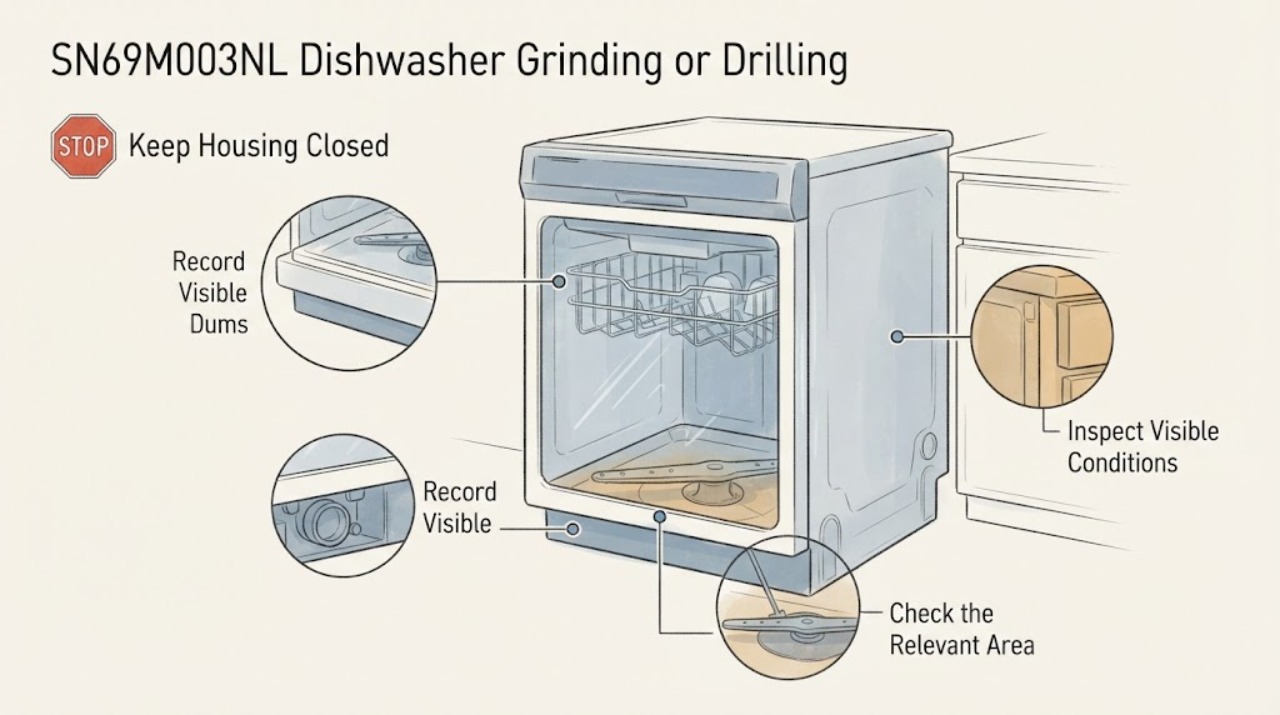
A Siemens dishwasher can make a brief grinding or buzzing sound while forcing water into the drain, but a suddenly loud or persistent grinding sound needs a more specific check. The exact Siemens service page identifies SN69M003NL/97 as a fully integrated iQ500 dishwasher; verify the complete E-Nr suffix and market before applying a manual. Then record whether the noise occurs at initial drain, during washing, at the end of a programme, or at regular intervals. A drain-timed sound points toward the drain-water or pump path; a rhythmic knock during washing can be a spray arm contacting a utensil; a sound that changes with the door or adjacent cabinet may be installation contact. Do not pull out the built-in appliance, reach into the pump, or run a live electrical test. If the noise is very loud, persists after safe loading and filter/spray-arm checks, is accompanied by a leak or standing water, or the appliance smells hot or burnt, stop using it and arrange qualified Siemens service.
Before you begin
Safety first
- Owner checks are limited to reading the complete E-Nr, listening from outside, inspecting visible loading and spray-arm clearance, and checking the filter assembly only when the appliance is cool, stopped, and safely isolated. Do not reach into the pump, remove a pump cover, pull out the integrated dishwasher, loosen mounting hardware, disturb wiring, or perform a live electrical test.
Work through in order
Diagnostic checks
Use only checks that match the exact appliance or system and its official guide.
-
Check 1
From the front of the appliance, read the rating label or service information and record the complete E-Nr, including the suffix after SN69M003NL, the market, the selected programme, and whether the unit is fully integrated. Do not pull the dishwasher forward or remove a panel to find the label.
Expected result: The E-Nr confirms SN69M003NL/97 or another suffix, only the base model is known, or the label cannot be reached without moving the built-in dishwasher.
Next step: Use the exact Siemens service page and matching manual for the recorded suffix. If the suffix cannot be recovered without disturbing the installation, give the visible base model and photos to Siemens service instead of applying a different model's procedure.
Stop if: Do not pull the appliance out, loosen mounting hardware, open the door hinge area, or disturb wiring to find an E-Nr.
Why this matters
Why: Siemens publishes separate service pages and documents by E-Nr suffix. The opened page confirms SN69M003NL/97 as a fully integrated iQ500 dishwasher, but it does not establish that another suffix has identical pump, programme, installation, or noise behavior.
-
Check 2
Listen from a dry position and note the exact phase: immediately after Start, while the tub is filling, during the main wash, at repeated roughly timed intervals, during a drain near the end, or after the programme appears finished. Record whether water remains, the sound is a low buzz versus hard grinding, and whether the programme completes.
Expected result: The sound is brief and limited to draining, repeats during washing, occurs as a rhythmic knock, or is very loud and persistent across phases.
Next step: Use the phase record to choose the filter/drain, loading/spray-arm, or service branch below. Do not keep rerunning programmes solely to reproduce the noise.
Stop if: Stop if the noise is accompanied by a leak, standing water near electrical parts, smoke, burning smell, a hot control area, or a repeated electrical trip.
Why this matters
Why: Siemens says grinding or buzzing can be normal when the dishwasher forces water down the drain; a very loud version warrants pump-impeller attention. A repeated knock during washing is more consistent with spray-arm or loading contact than with a drain-timed sound, while a persistent cross-phase noise is not identified by the public guide as normal.
-
Check 3
With the programme stopped, the interior cool, and the appliance not running, look at the racks, tall pans, cutlery, and lower spray arm. Make sure no item can strike the arm and that the arm can turn freely by hand without forcing it; check only the visible nozzles for a loose food fragment. Do not reach into the pump opening.
Expected result: A utensil or tall item is in the spray-arm path, the arm is loose or obstructed, visible nozzles are blocked, or the arm and loading are clear but the sound occurs during washing.
Next step: Reposition only the visible load obstruction and secure the rack or spray arm as the exact manual permits, then run one short supervised programme. If the noise remains, stop and arrange service rather than touching the pump or circulation assembly.
Stop if: Do not use tools on the spray arm, reach beneath the filter, remove a pump cover, or operate the dishwasher with a loose part that could break glass or damage the tub.
Why this matters
Why: Siemens specifically attributes knocking or rattling to spray-arm contact with incorrectly loaded utensils and notes that large items can obstruct spray arms and water flow. A clear arm and load make this explanation less likely but do not diagnose the circulation pump or motor.
-
Check 4
If the noise is tied to draining and there is no leak or electrical hazard, switch the dishwasher off and isolate power only at an accessible user control or isolator. Inspect and reseat the accessible filter assembly according to the exact manual; look only at the filter and visible sump surface for obvious food fragments or glass, using gloves for broken glass. Do not enter the pump or pull out the integrated appliance.
Expected result: The filter is dirty or not seated, a visible foreign object is present at the filter surface, the filter and visible area are clear, or water remains and the noise is very loud.
Next step: Correct only a visible filter-seating or surface-debris issue, reinstall the filter exactly, and perform one model-approved drain check. If the sound persists, water remains, or access would require the pump cover or appliance removal, leave it off and arrange Siemens service.
Stop if: Do not reach into the pump, remove a cover, use a tool to fish for debris, or reconnect power while water is near electrical parts.
Why this matters
Why: Siemens says the filter system protects the pump from impurities and that a grinding or buzzing noise can occur during drain; very loud noise can warrant pump-impeller attention. A clean, correctly seated filter does not prove the pump is healthy, and a foreign object beyond the visible filter boundary requires service under this safety boundary.
-
Check 5
Because the dishwasher was encountered in a new place, observe from outside whether the sound changes when the door is opened or closed, when the adjacent cabinet door moves, or when a visible front panel touches a neighboring surface. Do not push on the integrated unit, remove the furniture panel, loosen screws, or pull the dishwasher out.
Expected result: The noise follows door or cabinet contact, is accompanied by visible rubbing or vibration at the front, or remains identical with no visible contact and only during a water phase.
Next step: Photograph the contact point and ask the installer or Siemens service to check alignment and clearances without removing the appliance until the exact installation procedure is known. For operation-timed noise with no contact, use the appropriate drain or wash-phase service branch.
Stop if: Stop if the cabinet or door is binding, the unit rocks, a panel is loose, water leaks, or the noise is accompanied by electrical or burning symptoms.
Why this matters
Why: A sound that follows a visible contact point makes an installation or panel-contact issue plausible; a sound that follows drain or wash operation points more toward the appliance's water or circulation path. Neither pattern identifies a replacement part.
Use your observations
Decision map
Find the observation that best matches what you see, then follow the next safe action.
-
PATH 01Next step
What you see
The grinding or buzzing is brief and occurs only when water is being forced toward the drain, with no leak, standing water, programme failure, or unusual heat.
Do this next
Monitor one normal programme after confirming the accessible filter is seated. If it becomes very loud, persists outside draining, or the dishwasher stops draining, leave it off and arrange service.
Why this path and its safety boundary
Why it matters: This pattern is consistent with Siemens' description of a drain-related sound that is often not concerning, although a sudden increase in volume still needs attention.
-
PATH 02Next step
What you see
The noise is a rhythmic knock or rattle during washing and a utensil, pan, or rack is visibly in the lower spray-arm path.
Do this next
Rearrange the visible load so the spray arm can turn freely and run one supervised check. If the arm is clear or the noise continues, request service without opening the circulation system.
Why this path and its safety boundary
Why it matters: Spray-arm contact is more likely than a drain-pump sound when the noise tracks wash circulation and changes with loading.
-
PATH 03Next step
What you see
The sound is very loud during draining, water remains in the tub, or the visible filter is clear but the noise continues.
Do this next
Keep the dishwasher off, do not reach into the pump or pull out the integrated unit, and arrange Siemens or qualified appliance service with the E-Nr, programme, water level, and filter observation.
Why this path and its safety boundary
Why it matters: A drain restriction, foreign object beyond the filter boundary, or pump-side fault is possible. Siemens' public guidance does not justify identifying the impeller or ordering a pump from sound alone.
-
PATH 04Next step
What you see
The sound changes with door or cabinet movement, a visible front panel rubs, or the integrated dishwasher vibrates against adjacent furniture in the new installation.
Do this next
Leave the appliance off if the door binds or the unit rocks, photograph the contact, and ask the installer or Siemens service to assess alignment and clearances in place.
Why this path and its safety boundary
Why it matters: Installation or panel contact is more plausible than a purely phase-timed pump sound, but the built-in unit must not be moved as an owner test.
-
PATH 05Next step
What you see
There is a leak, standing water near electrical parts, smoke, burning odor, a hot or damaged cord, repeated electrical trips, or a damaged door or cabinet mounting.
Do this next
Stop the dishwasher, close the water tap and isolate power only if safe to do so, keep clear of wet electrical equipment, and obtain qualified Siemens, electrical, or emergency help as appropriate.
Why this path and its safety boundary
Why it matters: This is a water, fire, electrical, or installation safety stop rather than a routine noise check.
Helpful context
Understand the symptom
The word 'drilling' describes a sound, not a failed component. Start with when it happens and what the dishwasher is doing at that moment. Siemens separates drain-related grinding or buzzing from wash-phase knocking or rattling, and recommends professional help when the accessible guidance does not resolve the problem. Because this is a built-in dishwasher in a new place, installation contact is also a useful observation, but it should be assessed without pulling the machine out.
Only the inner filter, spray arms, loading, and visible door or cabinet contact are within the safe owner boundary here. Siemens' pump-unblocking instructions require the appliance to be switched off and disconnected, and include warnings about glass in the pump; this article therefore stops at the filter and visible sump area and does not ask the reader to reach into the pump or remove the integrated unit.
When checks do not resolve it
Need a professional?
Contact Siemens service for persistent or very loud noise, drain-related grinding with standing water, noise that continues with a clear spray arm and filter, programme interruption, or any leak, electrical, heat, or installation hazard.
Safety scope: Owner checks are limited to reading the complete E-Nr, listening from outside, inspecting visible loading and spray-arm clearance, and checking the filter assembly only when the appliance is cool, stopped, and safely isolated. Do not reach into the pump, remove a pump cover, pull out the integrated dishwasher, loosen mounting hardware, disturb wiring, or perform a live electrical test.
Have this ready
- Provide the complete E-Nr and market, the programme and exact phase of the noise, a short audio/video recording made from a safe position, whether water remains, filter and spray-arm observations, visible cabinet or door contact, and any leak, code, odour, or electrical symptom.
Common questions
FAQ
Is grinding noise from a Siemens dishwasher always a failed pump?
No. Siemens says grinding or buzzing can occur while water is forced down the drain. A very loud sound warrants pump-impeller attention, but sound timing alone does not prove a pump failure or identify a compatible part. Check only the visible filter boundary and arrange service for persistent or loud noise.
What does a rhythmic knocking sound during the wash usually suggest?
Siemens links knocking or rattling to a spray arm hitting utensils when the dishwasher is loaded incorrectly. Look from the cool, stopped interior for a tall pan, utensil, or rack obstruction. If the spray arm is clear or the sound remains, stop trying to force a diagnosis and request service.
Can I pull out the built-in Siemens dishwasher to inspect the pump?
Not as an ordinary-user noise test here. The exact service page identifies this as a fully integrated dishwasher, and pump access can involve water, sharp debris, electrical isolation, and installation hardware. Keep the unit in place and ask Siemens or a qualified installer to inspect it when the filter and visible spray-arm checks do not resolve the sound.
Does the SD6P1S label identify the exact dishwasher manual?
Not by itself. The Siemens service page is keyed to the E-Nr SN69M003NL/97, so record the full E-Nr suffix and market before applying a manual or service procedure. Do not assume that another SN69M003NL suffix has identical documents or installation details.
Read the exact guide
Official sources
- Service Page - SN69M003NL/97Siemens Home Appliances · Opened the official Siemens Ireland service page for the same exact E-Nr suffix. It reinforces that manuals and safety documents are accessed through the precise product-service identity; it does not define the noise cause.
- Why is my dishwasher not cleaning properly?Siemens Home Appliances · Opened the official Siemens Germany care/troubleshooting page. It explains that blocked spray arms, clogged filter, and loading can obstruct water distribution, and gives visible care steps; it is not used to infer a pump part or transfer a model-specific programme.
- Why is my dishwasher making noises?Siemens Home Appliances · Opened the official Siemens dishwasher-noise troubleshooting page. It says drain-related grinding or buzzing can be normal, unusually loud noise warrants pump-impeller attention, and wash-phase knocking or rattling can result from spray-arm contact with utensils. Its pump steps are intentionally not reproduced as owner instructions here because the delegated safety boundary prohibits pump access.
- Service Page - fully-integrated dishwasher SN69M003NL/97Siemens Home Appliances · Opened the official Siemens Netherlands service page for the requested SD6P1S-type SN69M003NL appliance, specifically the SN69M003NL/97 suffix. It identifies the appliance as an iQ500 fully integrated dishwasher and provides model-specific manuals, parts, self-help, and service routing; it does not diagnose the grinding sound.
Community feedback
Share a repair observation
Share a plain-text repair observation. Accepted observations are published automatically; this page may take a moment to update.