
On this page
Start here
Quick answer
Stop the ASKO dishwasher if the grinding is harsh, continuous, accompanied by leaking, standing water, an error or poor washing, and do not assume the pump is defective from the sound alone. With power off, remove the dishes and inspect only the visible wash area for a utensil or broken glass contacting a spray arm, then clean and correctly reinstall the filters using ASKO's official cleaning guide. Note whether the sound occurs during filling, washing or draining. ASKO says to turn power and water off and contact service when the drain pump runs continuously; if the grinding remains after the visible load and filter checks, use the same service boundary rather than opening the pump or running repeated tests.
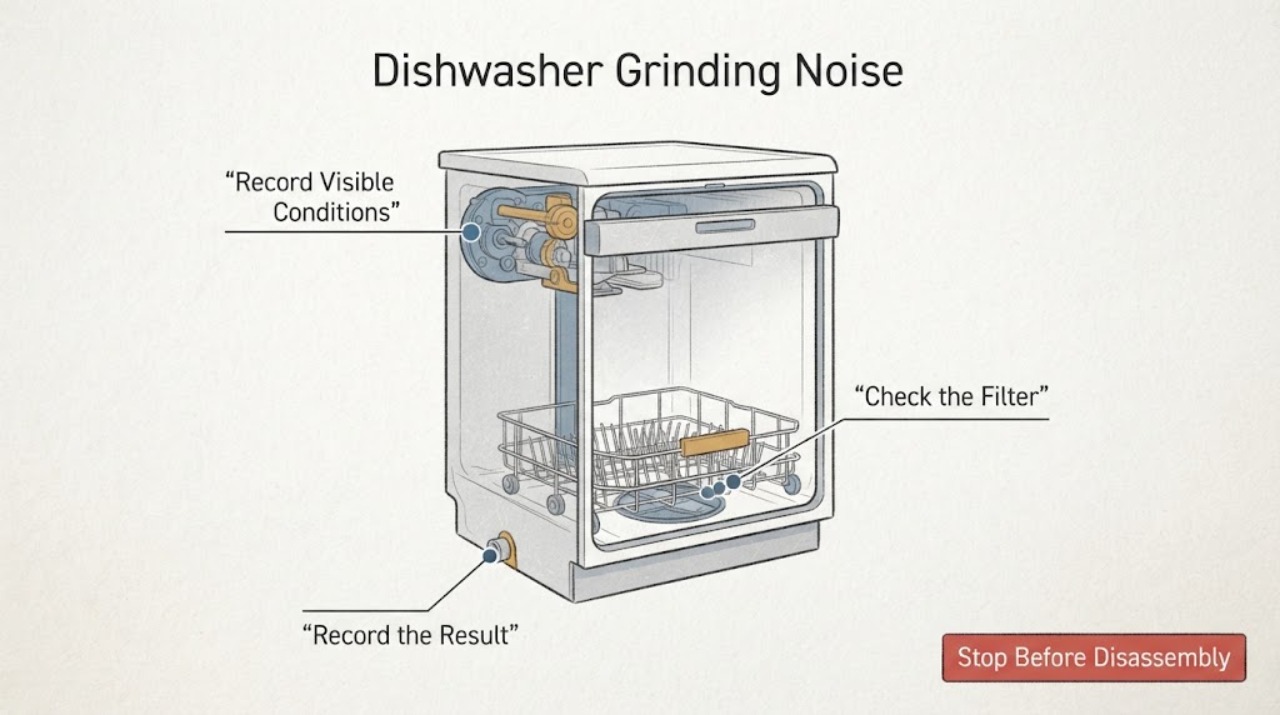
Work through in order
Diagnostic checks
Use only checks that match the exact appliance or system and its official guide.
-
Check 1
Cancel or stop the program and switch the dishwasher off before opening it. Record whether the grinding occurred during filling, washing/spray-arm movement or draining, and check from outside for a leak, standing water, an error display or a pump that keeps running.
Expected result: The sound is a brief phase-specific noise with no leak, the grinding is continuous, or it is accompanied by water, an error or poor cleaning/draining.
Next step: If the pump runs continuously, water leaks, the machine will not stop or the sound is severe, turn power and water off and contact qualified ASKO service. Otherwise continue with the unloaded visual check while power is off.
Why this matters
Why: Timing narrows the external check but does not identify a pump or motor. Continuous pump operation or a grinding sound with a leak, error or performance loss is a service condition rather than a reason for repeated cycles.
-
Check 2
Remove the racks and dishes and inspect the visible wash chamber, lower filter cover and spray-arm path for a loose utensil, broken glass, bone, label or other object that could contact a rotating arm. Do not reach into a pump opening or remove a fixed guard.
Expected result: A visible object is touching or obstructing the spray-arm path, the spray arms turn freely by hand with power off, or no external object is visible.
Next step: Remove only a loose, safely reachable object, reload so items cannot contact the arms, and do not run a test if glass, water or damage remains. If no object is visible, continue to the filter check and service branch.
Why this matters
Why: A visible load obstruction can explain a noise that occurs only with that load. A clear path does not prove the motor, pump or bearing is sound; it only removes one external possibility.
-
Check 3
With the dishwasher off and the lower rack removed, clean the filter assembly using ASKO's guide: rotate the filter basket handle counterclockwise, lift it from the fine filter, lift the surrounding filter cover, wash the components with soap and water, and reinstall each piece in its original position.
Expected result: Debris or broken material is present in the filters, the filter assembly is clean and correctly seated, or a filter/cover will not reinstall securely.
Next step: Remove only accessible debris and reinstall the filter as documented. If the filter or cover is damaged, loose or cannot seat, leave the dishwasher off and arrange model-specific service; do not run without the filters installed.
Why this matters
Why: Debris in the filter area is an external blockage clue, not proof of a damaged pump. A filter or cover that will not seat can allow debris or unsafe operation and should not be forced.
-
Check 4
After the visible load and filter checks, compare the exact model label and obtain the matching ASKO use-and-care guide before any model-specific repair. Do not remove the pump cover, dismantle the spray-arm assembly, or use a tool to probe the pump based only on the grinding sound.
Expected result: A matching manual is available, the exact model is still unknown, or the grinding remains after the external checks.
Next step: Use the exact manual only for its model-specific user checks. If the sound persists or the model cannot be confirmed, stop using the dishwasher and request qualified ASKO service with the phase, duration, error and filter observations.
Why this matters
Why: ASKO dishwasher layouts and service procedures vary by model and region. Persistent grinding after the visible checks is insufficient to distinguish a drain pump, circulation system, foreign object or another internal cause.
-
Check 5
If a qualified technician has cleared the appliance for a controlled observation, note whether the noise returns with an empty chamber and clean, correctly seated filters. Do not repeat energized cycles yourself when there is a leak, continuous pump operation, exposed glass or an electrical concern.
Expected result: The noise is absent after service/clearance, returns with the empty chamber, or is accompanied by leaking, pump continuously running or poor wash/drain performance.
Next step: Stop operation and use qualified service for persistent or hazardous symptoms. Do not order or replace a pump solely from the word grinding.
Why this matters
Why: A return with no dishes or visible filter debris indicates the cause is not simply load contact, but it still does not identify a specific internal part. The accompanying hazards take priority over sound diagnosis.
Use your observations
Decision map
Find the observation that best matches what you see, then follow the next safe action.
-
PATH 01Next step
What you see
The grinding occurs only with a particular load and a utensil or other object is visibly contacting the spray-arm path.
Do this next
Switch the dishwasher off, remove or reposition the object and confirm the spray-arm path is clear before normal use. Stop if glass, water or damage is present.
Why this path and its safety boundary
Why it matters: The pattern supports a loading obstruction as the first external explanation; it does not establish a dishwasher component failure.
-
PATH 02Next step
What you see
Debris is found in the filter assembly, but the filter and cover can be cleaned and securely reinstalled.
Do this next
Clean and reinstall the filters exactly as ASKO's guide describes, and use the exact model manual for any follow-up. Do not operate without the filters in place.
Why this path and its safety boundary
Why it matters: The filter area provides a plausible external source of obstruction, while the debris itself does not prove a damaged drain or wash pump.
-
PATH 03Next step
What you see
The filters are clean and seated, no visible load object is present, and grinding continues or occurs with poor washing/draining.
Do this next
Stop using the dishwasher and arrange qualified ASKO service. Provide the exact model, cycle phase, duration, error and observations; do not guess or replace a pump.
Why this path and its safety boundary
Why it matters: The remaining symptom is not safely distinguishable between internal causes from sound alone.
-
PATH 04Next step
What you see
The drain pump runs continuously, water leaks, the dishwasher will not stop, there is standing water with a severe noise, or an electrical/burning sign is present.
Do this next
Turn power and water off to the dishwasher when safe and contact qualified service. Do not open the pump, run repeated cycles or probe wiring.
Why this path and its safety boundary
Why it matters: The appliance has crossed the external user-check boundary and continued operation may worsen water or electrical risk.
Helpful context
Understand the symptom
Treat the sound as a symptom, not a pump diagnosis
The task has no ASKO model and the supplied Reddit lead could not be opened, so the page stays at the shared external-check level. ASKO product material identifies filters, spray arms and an anti-block drain pump as dishwasher components, while its cleaning guide gives a filter procedure and a service boundary for a drain pump that runs continuously. A grinding description alone does not establish which of those parts, if any, is involved.
First separate load contact from a machine noise
With the dishwasher switched off and safe to open, look for a utensil, shard or other visible object near the spray-arm path and remove only loose objects that can be reached without opening the pump or dismantling the wash system. A noise that disappears after correcting a visible loading obstruction is a different decision from a grinding sound that continues with the cabinet empty.
Keep filters correctly installed
ASKO's cleaning guide says to remove the lower rack, rotate the filter basket handle, separate it from the fine filter, lift the filter cover, clean the components with soap and water and reinstall them. Do not run the dishwasher with a missing or incorrectly seated filter, and do not use filter cleaning as proof that a wash or drain pump is healthy.
Common questions
FAQ
Does a grinding noise prove the ASKO dishwasher pump is bad?
No. A grinding description does not distinguish a visible load obstruction, filter debris, drain issue, spray-arm contact or an internal pump/motor problem. Check only the visible load and filter area, then use qualified service if the sound persists.
What should I check first when an ASKO dishwasher makes grinding noise?
Stop the program, switch power off, note the cycle phase and check for leaks or continuous pump operation. Then inspect the visible spray-arm path and clean/reinstall the filters using ASKO's guide. Do not dismantle the pump.
Can I keep running the dishwasher to see whether the noise goes away?
Do not repeat cycles when the noise is severe or continuous, the pump keeps running, water leaks, the unit will not stop, or performance is poor. ASKO directs power and water off and service for a drain pump that runs continuously.
Does ASKO's filter cleaning guide apply to every model?
The opened guide provides family-level cleaning steps, but no exact model was supplied for this topic. Confirm the model and use its matching manual for any model-specific removal or repair procedure.
Read the exact guide
Official sources
- ASKO Dishwasher CleaningASKO · Opened the official ASKO-hosted cleaning guide PDF. Its first two pages cover dishwasher cleaning/troubleshooting, including filter basket/fine-filter removal, soap-and-water cleaning, reinstallation, and turning power and water off/contacting service if the drain pump runs continuously. It is used for family-level external checks because no exact model was supplied.
- ASKO | Dishwashers - DW60ASKO · Opened an official ASKO product-family PDF. It identifies ASKO dishwasher spray arms, strainers/filters and loading features, supporting a visible load/spray-arm distinction. It does not define a grinding fault or prove a component failure for the unmodeled task.
Community feedback
Share a repair observation
Share a plain-text repair observation. Accepted observations are published automatically; this page may take a moment to update.