
On this page
Start here
Quick answer
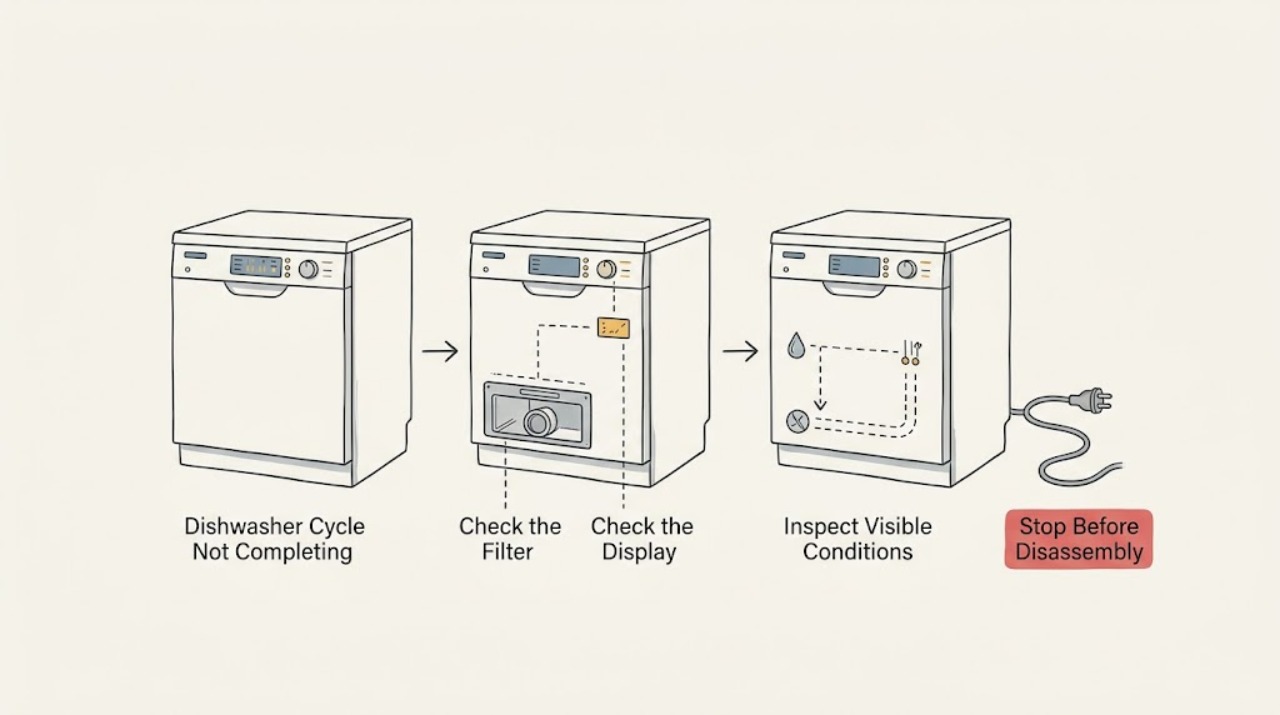
First confirm that the cycle is truly unfinished: on Asko models equipped with Turbo Dry, the fan may continue for two hours or more after washing is complete. If the dishwasher stops while washing, note whether the display still responds, whether water remains above the filters, and whether a drain pump runs continuously. Asko's dishwasher guide directs checks of the power connection, detergent amount, filters, and drain for a unit that stops during a cycle. With the appliance safe and idle, perform only those external checks and follow the model's use-and-care guide for cancel or drain controls. If an error returns, the pump runs continuously, water remains, or the problem needs electrical or internal access, leave the dishwasher off and arrange qualified service.
Work through in order
Diagnostic checks
Use only checks that match the exact appliance or system and its official guide.
-
Check 1
Leave the dishwasher closed for a moment and distinguish a completed wash with ongoing drying from a wash program that stopped. Note whether only a fan is audible, whether spray or drain activity is occurring, whether water remains above the filters, and what the display or status indicators show.
Expected result: Only the drying fan continues after washing; the unit is silent with water remaining; the program stopped with controls still lit; or the display is blank or shows an error.
Next step: If it is only the documented post-cycle fan, allow the drying phase to finish. For a true stop, keep the cycle notes and continue with the power, filter, and drain checks without repeatedly restarting it.
Why this matters
Why: On applicable Asko Turbo Dry models, a fan running for two hours or more can follow a completed wash. Water remaining or a program stopping before completion is a different condition, while a blank display or error points toward power or control follow-up rather than a normal drying period.
-
Check 2
For a true mid-cycle stop, inspect the plug and accessible power connection without touching wet electrical equipment. Check whether the dishwasher's display and controls respond normally; do not remove an electrical cover or bypass a breaker.
Expected result: The plug is loose, the display is blank, controls are unresponsive, or power and controls appear normal.
Next step: Restore only a visibly loose plug if it can be done dry and safely, then follow the model guide for normal restart. If the outlet, cord, breaker, or controls show damage or the stop recurs, leave the dishwasher off and arrange qualified service.
Why this matters
Why: Asko lists proper connection to the outlet as a check when the unit stops during a cycle. A blank display or unresponsive controls may reflect an interrupted supply or a control condition, but the observation alone does not identify an electrical part.
-
Check 3
With the dishwasher off and the interior safe to access, inspect and clean the user-removable filters exactly as the product use-and-care guide describes. Look for food or other debris around the filter area; do not remove a pump cover or reach beyond the documented filter access.
Expected result: Filters are clogged or coated with debris; water is sitting above the filters; or filters are clean and water is not trapped there.
Next step: Reinstall the filters correctly and run one supervised test only if there is no active leak or electrical concern. If water remains, the pump runs continuously, or the cycle stops again, cancel further testing and arrange service.
Why this matters
Why: Asko's guide links a mid-cycle stop and drainage complaints to clean filters and a drain free of debris, and its issue table calls for cleaning the interior and filters when water is above them. Clean filters make a drainage restriction less likely, not impossible.
-
Check 4
Inspect only the accessible drain-hose route and sink or disposal connection for an obvious kink, blockage, or disconnection. Do not pull out a built-in dishwasher, undo plumbing, or force a hose through the cabinet.
Expected result: The accessible drain route is kinked or visibly blocked; water remains after the cycle; the drain pump runs continuously; or the visible route is clear.
Next step: Correct only an obvious external routing issue allowed by the installation instructions. If water remains, the pump runs continuously, or the blockage is inside the appliance or plumbing, turn the appliance off and arrange qualified service.
Why this matters
Why: Asko directs owners to verify that the drain line is not clogged when the unit does not drain. A continuously running drain pump is treated separately in the guide as a reason to turn power and water off and contact service, so it is not a cue to keep probing the pump.
-
Check 5
Review the detergent amount and selected program against the model's use-and-care guide. Do not add more detergent to force the cycle to finish, mix cleaning chemicals, or change several program options at once.
Expected result: The load used more detergent than the guide allows, the correct amount was used, or the cycle stops despite a clean filter, clear accessible drain, and appropriate detergent.
Next step: Use the model-specified detergent amount on the next supervised cycle only if the appliance is dry and safe. If the program still fails to complete, record the cycle, display, water level, and prior checks for service rather than selecting a replacement part.
Why this matters
Why: Asko specifically lists using less detergent among checks for a unit that stops during a cycle. That guidance makes excess detergent a possible contributor, but it does not prove a detergent fault when the amount was correct or the symptom persists.
-
Check 6
If the display shows an error, record the exact code before using any reset or cancel control. Follow only the model-specific reset procedure in the use-and-care guide; if the code returns, do not keep clearing it to force another cycle.
Expected result: The code is absent, the same code returns after the documented reset, or the display cannot be read because the unit loses power.
Next step: Leave the dishwasher off and arrange qualified service for a recurring code, repeated incomplete cycle, or unstable display. Provide the exact code, model number, cycle, and the filter and drain observations.
Why this matters
Why: Asko's guide says to document an F4 code, reset it using the stated Start/Stop control, and contact service if it reappears. A code or recurring power loss is a service clue, not proof of a particular inlet, pump, heater, or control-board part.
Use your observations
Decision map
Find the observation that best matches what you see, then follow the next safe action.
-
PATH 01Next step
What you see
Only a drying fan remains after washing, there is no standing water, and the appliance otherwise indicates that the wash has ended.
Do this next
Allow the documented drying period and consult the model guide if the fan continues far beyond that behavior or the cycle never indicates completion.
Why this path and its safety boundary
Why it matters: A normal post-cycle drying phase is more likely than an incomplete wash; Asko notes that Turbo Dry fans may operate for two hours or more after completion on applicable models.
-
PATH 02Next step
What you see
The dishwasher stops mid-cycle, the display remains active, and filters or the accessible drain path contain debris or retain water.
Do this next
Clean and reinstall the documented user-removable filters and correct only an obvious external drain-route issue. If the cycle stops again or the pump runs continuously, turn power and water off and call service.
Why this path and its safety boundary
Why it matters: A drainage restriction is more plausible than a confirmed failed pump or control board.
-
PATH 03Next step
What you see
The cycle stops with a blank display, a loose or damaged power connection, or controls that remain unresponsive after a safe connection check.
Do this next
Do not bypass protection or open the electrical housing. Leave the appliance off and arrange qualified service if the connection, cord, outlet, breaker, or controls are abnormal or the stop recurs.
Why this path and its safety boundary
Why it matters: An interrupted supply or control fault is more likely, but the external observation cannot identify the failed electrical component.
-
PATH 04Next step
What you see
The same error returns, the dishwasher leaves water after the documented filter and drain checks, or the cycle still fails with normal power and detergent use.
Do this next
Stop repeated resets and arrange qualified service with the exact code, model, cycle stage, water level, and checks already completed.
Why this path and its safety boundary
Why it matters: A persistent water-system, sensor, heater, latch, or control problem is possible, but no part can be selected safely from this symptom alone.
-
PATH 05Next step
What you see
The drain pump runs continuously, water is near a plug or other electrical equipment, there is smoke or a burning odor, or the appliance trips protection.
Do this next
Stop using the dishwasher. If it can be done without touching wet electrical equipment, turn power and water off as the guide directs; otherwise keep clear and obtain qualified help. Do not restart it to reproduce the fault.
Why this path and its safety boundary
Why it matters: The symptom has crossed a safety boundary; continued cycling or panel access could worsen water or electrical damage.
Helpful context
Understand the symptom
Make sure the program is actually stuck
A fan that continues after washing is not the same observation as a wash program stopping mid-cycle. Asko's guide says models with Turbo Dry may run the fan for two hours or more after the wash cycle is complete. Record whether the dishwasher is spraying or draining, whether water remains, what the display shows, and whether only a drying fan can be heard before treating the behavior as a fault.
Use the symptom to choose the next external check
For a true mid-cycle stop, Asko's published checks are the plug connection, detergent quantity, filters, and a drain path clear of debris. These observations separate a power interruption or drainage condition from an unexplained control or component failure; they do not identify a particular pump, board, or replacement part.
Do not turn a stalled cycle into a panel-repair project
Use the model-specific use-and-care guide for any Start/Stop, cancel, manual-drain, child-lock, or error-reset control. Do not open the door panel, reach into wiring, force a latch, or run an energized test. A recurring error, continuous drain-pump operation, standing water, or a fault that remains after external checks belongs with qualified service.
When checks do not resolve it
Need a professional?
The same cycle stop or error returns after the model-specific reset or filter and drain checks., Water remains above the filters, the drain pump runs continuously, or the accessible drain route is clear but draining still fails., The display is blank or controls remain unresponsive after a safe power-connection check., Water is near electrical equipment, or there is smoke, burning odor, a trip, or another safety symptom.
Have this ready
- The complete Asko model number and the exact program selected.
- Whether the wash truly stopped or only a Turbo Dry fan continued after washing.
- The display or error code, cycle stage, water level, power observation, detergent amount, and filter and drain findings.
Common questions
FAQ
Is an Asko dishwasher fan running after the cycle a fault?
Not necessarily. Asko's guide says models with Turbo Dry may operate the fan for two hours or more after the wash cycle is complete. Check whether water remains and whether the display indicates a completed wash before treating fan-only operation as a stalled cycle.
What should I check when my Asko dishwasher stops mid-cycle?
Asko lists a proper plug connection, using less detergent, clean filters, and a drain free of debris. Check only those external or user-removable items as the model guide permits. If the cycle stops again, leave it off and arrange service rather than guessing at a pump or control part.
Why is there water above the filters after my Asko dishwasher stops?
Asko's issue table directs owners to clean the interior and filters when water is above the filters, while its troubleshooting guidance also says to verify that the drain is clear of debris. Clean only the documented filter access. If water remains or the pump runs continuously, turn power and water off and contact service.
What should I do if an F4 code returns on an Asko dishwasher?
Record the code and follow the exact reset procedure in the model's use-and-care guide. Asko's guide says to contact service if F4 reappears after the documented reset. Do not keep resetting the appliance or select an inlet or pump part from the code alone.
When should I stop troubleshooting an Asko dishwasher cycle?
Stop when the cycle repeatedly fails after safe power, detergent, filter, and drain checks; an error returns; water remains; or access would require opening the appliance. Stop immediately for a continuously running drain pump, water near electrical equipment, smoke, burning odor, or a protection trip.
Read the exact guide
Official sources
- Dishwasher Cleaning: TroubleshootingASKO · Official ASKO USA literature covering general dishwasher cleaning and troubleshooting; controls, error handling, and drying behavior vary by model and market.
Community feedback
Share a repair observation
Share a plain-text repair observation. Accepted observations are published automatically; this page may take a moment to update.