
On this page
Start here
Quick answer
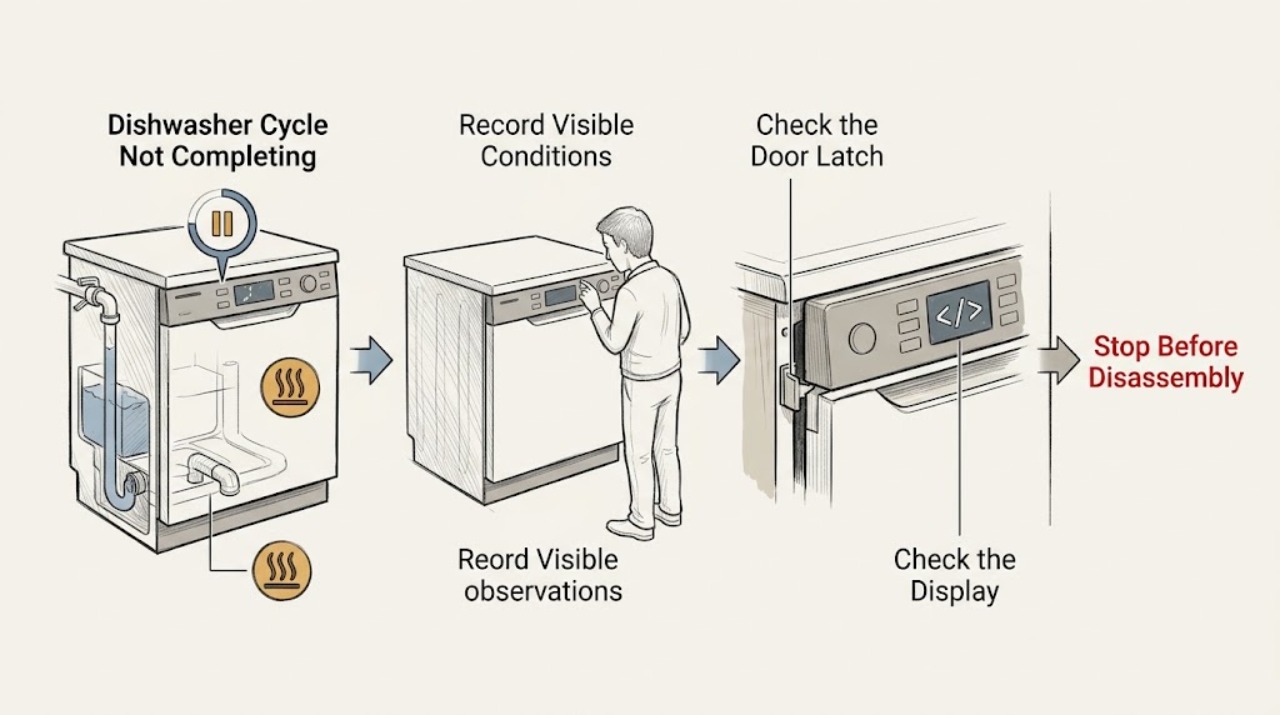
An Amana dishwasher that does not complete a cycle may be paused, taking a normal thermal hold, unable to fill or drain, or stopping on a control or door condition. First note whether the display or Start/Resume light is flashing, whether water remains in the tub, and which part of the programme was active; an efficient cycle can take longer and may pause while water heats. If the door was opened or power was interrupted, close the door firmly and use Start/Resume as the model requires. If it stops with water remaining, check only the removable filter, the accessible drain hose for a kink, and a connected disposer's clear inlet and removed knockout plug. Confirm the water valve is open, the door is latched, and Control Lock or Delay Wash is not holding the cycle. After recording any code, one documented Cancel/Drain and power reset may clear a temporary control state, but a returning stop, leak, repeated error, burning smell, or need to access wiring requires qualified service.
Work through in order
Diagnostic checks
Use only checks that match the exact appliance or system and its official guide.
-
Check 1
Record the selected cycle and options, elapsed time, display or indicator pattern, sound, and where the programme appears to stop. If the unit is quiet but the cycle is still displayed, wait through the period specified by the model manual before cancelling it.
Expected result: The cycle is longer than expected, pauses and later advances, the Start/Resume light flashes, a status light shows a paused state, or the same stage never advances.
Next step: If the programme is making progress and there is no leak or hazard, allow the documented cycle time. If it remains at one stage, note the stage and continue with the door, water, and drain checks rather than assuming the control or motor has failed.
Why this matters
Why: Amana says efficient cycles can run longer and can pause for thermal holds while water reaches the required temperature. A flashing resume indicator or a door/power interruption is a different condition from a normal heat hold.
-
Check 2
If the door was opened or the power went out, wait until spraying has stopped, close the door firmly until the latch engages, and press Start/Resume or Start only as the model's control panel requires. Do not force the latch or reach into a hot tub.
Expected result: The flashing indicator stops and the cycle resumes, the dishwasher remains paused, the door will not latch, or the cycle stops again at the same point.
Next step: If the cycle resumes, monitor it without opening the door again. If the latch will not engage or the dishwasher pauses again, stop the cycle and arrange service; do not bypass or dismantle the latch.
Why this matters
Why: Amana identifies an opened door, interrupted power, or an unlatched door as conditions that can pause or prevent a cycle from resuming. A latch that will not engage or a repeated stop is not corrected by repeatedly pressing Start.
-
Check 3
Check the controls without opening any panel: confirm Control Lock is not active, Delay Wash is not selected, the dishwasher is awake rather than in standby, and the intended cycle and Start command are selected. Use the model manual for the exact lock and delay controls.
Expected result: A lock icon or padlock light is on, a delay time is displayed, the controls respond only after the door or Start button is used, or the controls are normal but the cycle still stops.
Next step: Cancel the delay or unlock the controls only with the documented model procedure, then start a fresh cycle if the tub is safe and empty of standing water. If the controls remain unresponsive, continue to the one-time reset or service branch.
Why this matters
Why: Amana says Control Lock disables touch commands, Standby or Sleep Mode may require a door or Start action, and Delay Wash intentionally postpones operation. These states can look like a stalled or incomplete cycle without a component failure.
-
Check 4
If the cycle stopped with no or little water entering, check that the under-sink dishwasher water valve is open and that the door is latched. Look at the Start/Resume indicator for a flashing interruption state; do not disconnect the water hose or open the inlet assembly.
Expected result: The water valve is closed or restricted, the Start/Resume light flashes, the door is unlatched, or the valve and latch appear correct but the tub still does not fill.
Next step: Open only an accessible water valve fully and resume the cycle according to the manual. If there is a leak, no fill after the external check, or any need to remove the inlet or wiring, stop using the appliance and arrange service.
Why this matters
Why: Amana states that the water supply must be open for the dishwasher to fill, wash, and rinse, and that a door interruption can leave the resume indicator flashing. Correcting an external valve or closing the door can restore a paused cycle; a correct supply with no fill needs model-specific service diagnosis.
-
Check 5
If water remains when the cycle stops, cancel the cycle as the controls allow and wait for the pump to finish. With the appliance stopped, clean the removable filter under running water, inspect the accessible drain hose for a kink or pinch, and if it connects to a disposer, confirm the disposer inlet is clear and its new-installation knockout plug was removed.
Expected result: The filter is blocked, the drain hose is kinked or pinched, the disposer inlet is obstructed, the tub drains after Cancel/Drain, or water remains after these external checks.
Next step: Refit the filter correctly and run only a brief rinse or drain observation if there is no leak or hazard. If water remains, the pump makes an abnormal sound, or access would require moving a built-in unit or removing a panel, stop and request qualified service.
Why this matters
Why: Amana treats stopping mid-cycle with standing water as a possible drainage concern and lists the filter, drain hose, and disposer connection as external checks. Persistent standing water after those checks makes an internal drain or control fault more likely.
-
Check 6
After preserving the original display or indicator state, use the model-appropriate Cancel/Drain control if a cycle is active. If the controls still stall and the appliance is safe, perform one power reset: unplug an accessible plug for the documented period, or switch off the dedicated dishwasher breaker for that period if it is hard-wired; then restore power and close the door firmly.
Expected result: The control restarts and a new cycle completes, the same stop returns, a different error appears, or the dishwasher remains unresponsive.
Next step: Do not repeat the reset or keep restarting a cycle that stops at the same point. Record the code, programme stage, water condition, and result of the one reset, then arrange authorized or qualified appliance service.
Why this matters
Why: Amana describes cycle cancellation and a short power isolation as a way to clear a temporary control state, not as proof that a failed pump, latch, heater, sensor, or wiring fault is repaired.
Use your observations
Decision map
Find the observation that best matches what you see, then follow the next safe action.
-
PATH 01Next step
What you see
The cycle is progressing slowly or pauses during a heat hold, then advances without a leak, error, or standing water.
Do this next
Allow the model's documented cycle time and avoid interrupting it. Escalate if the same stage never advances or performance changes.
Why this path and its safety boundary
Why it matters: A longer efficient cycle or thermal hold is more likely than a stalled component.
-
PATH 02Next step
What you see
The Start/Resume indicator flashes after the door was opened or power was interrupted, and the cycle resumes after the door is latched and Start/Resume is used.
Do this next
Leave the door closed and monitor the rest of the cycle. A latch that will not engage or a repeated pause needs service.
Why this path and its safety boundary
Why it matters: An interruption or latch state likely paused the cycle.
-
PATH 03Next step
What you see
Water remains, the filter or accessible drain path is obstructed, and the dishwasher drains after the external obstruction is corrected.
Do this next
Refit the filter and observe one short cycle only if safe. Persistent standing water or abnormal pump behavior requires service.
Why this path and its safety boundary
Why it matters: A drainage restriction likely prevented the cycle from reaching its completion stage.
-
PATH 04Next step
What you see
The dishwasher does not fill, the water valve is closed or restricted, or the door is not latched, and the issue remains after the accessible correction.
Do this next
Stop testing if there is a leak or no fill after the external checks. Provide the model and indicator pattern to qualified service.
Why this path and its safety boundary
Why it matters: A water-supply, latch, inlet, or control condition remains possible; the user-level checks do not identify an internal part.
-
PATH 05Next step
What you see
The same stage, error, or unresponsive control returns after one documented Cancel/Drain and power reset, or there is smoke, a burning smell, a leak, a hot cord, or repeated breaker operation.
Do this next
Stop using the dishwasher and arrange authorized or qualified service. Do not bypass the latch, access wiring, or replace a part based only on the stopping point.
Why this path and its safety boundary
Why it matters: A persistent control, pump, latch, heating, sensor, wiring, or other internal condition is more likely, and the symptom has crossed the safe user-check boundary.
Helpful context
Understand the symptom
Cycle not completing is a symptom, not a single part diagnosis. A cycle can appear stopped during a heat hold, pause after the door is opened, stop because the dishwasher cannot fill or drain, or remain in a control state such as Delay Wash or Control Lock. The most useful first evidence is the programme stage, the display or indicator pattern, and whether water remains.
Keep the door closed during a hot portion unless the controls or manual require otherwise, and wait for spraying to stop before reaching inside. Do not remove the toe-kick, access wiring, bypass the door latch, or work on the water or electrical connections. Stop using the dishwasher for a leak, smoke, burning odor, a hot or damaged cord, repeated breaker trips, or any condition that makes the appliance unsafe.
When checks do not resolve it
Need a professional?
The same cycle stage, error, or unresponsive control returns after the door, water, drain, and one-time reset checks., Water remains, the dishwasher will not fill or latch, the drain pump behaves abnormally, or a leak is present., There is smoke, a burning smell, sparking, a hot or damaged cord, repeated breaker trips, or any need to remove panels or test internal parts.
Have this ready
- The complete Amana model number and whether the dishwasher is plugged in or hard-wired.
- The selected cycle and options, elapsed time, exact stopping stage, display or flashing-light pattern, and whether the door was opened or power was interrupted.
- Whether water remained, what was found at the removable filter, hose, or disposer connection, and the result of any documented Cancel/Drain or single power reset.
Common questions
FAQ
Is a long Amana dishwasher cycle always a fault?
No. Amana says efficient cycles can run longer and may pause for thermal holds while water reaches the required temperature. Compare the elapsed time with the selected cycle and options; a cycle that never advances, stops with an error, or leaves water is a different symptom.
What should I do when my Amana dishwasher stops after I open the door?
Wait for spraying to stop, close the door firmly until it latches, and press Start/Resume or Start as the model requires. A flashing resume indicator can show that the cycle is paused; if it will not resume or the latch will not engage, arrange service rather than bypassing the latch.
Why does an Amana dishwasher stop with water in the tub?
Amana treats standing water when a cycle stops as a possible drainage concern. With the dishwasher stopped, clean the removable filter, look for a kinked or pinched accessible drain hose, and check a connected disposer inlet and knockout plug on a new installation. Persistent water needs service.
Can Control Lock or Delay Wash make a cycle appear stuck?
Yes. Amana says Control Lock disables the controls, while Delay Wash intentionally postpones operation; Standby or Sleep Mode may also require opening or closing the door or pressing Start to wake the dishwasher. Use the model manual for the exact way to unlock or cancel a delay.
Should I reset an Amana dishwasher that stops mid-cycle?
After recording the display and checking for a leak or other hazard, use Cancel/Drain as the model permits and perform one documented power reset. Amana describes disconnecting power briefly as a possible control recovery step; a returning stop or error means the dishwasher needs diagnosis, not repeated resets.
Read the exact guide
Official sources
- Long Cycle Time - DishwasherAmana Product Help · Amana dishwasher cycle-time guidance; duration varies with cycle, options, incoming water temperature, and soil load
- Will Not Fill With Water - DishwasherAmana Product Help · Amana dishwasher no-fill and cycle-advancement guidance; installation instructions control hose routing for the exact model
- Not Starting or Operating - DishwasherAmana Product Help · Amana dishwasher operation support; the exact lock, delay, and start controls vary by model
- Resetting the Dishwasher's Controls (Cycle Power)Amana Product Help · Amana dishwasher reset guidance; use the Owner's Manual for the exact model and do not treat a reset as an internal repair
- Stops Mid Cycle - DishwasherAmana Product Help · Amana dishwasher support guidance for a cycle that stops before completion; model controls and installation details remain controlling
Community feedback
Share a repair observation
Share a plain-text repair observation. Accepted observations are published automatically; this page may take a moment to update.