
On this page
Start here
Quick answer
First determine whether the Beko dishwasher is still within the selected programme time, waiting on a delay setting, or genuinely stopping before the end. If water remains in the tub, clean the accessible drain filters and check the drain hose for a kink or blockage with the appliance switched off. If the display says the cycle is finished but the pump keeps running, a short drain-pump run can be normal; persistent running, an inability to drain, or a cycle that repeatedly stops needs authorised service.
Before you begin
Safety first
- Do not open sealed panels, work on live wiring, reach into a running dishwasher, or force an integrated appliance out of its cabinet. Disconnect power before cleaning an accessible filter or checking a visible hose, and stop if access is not safe.
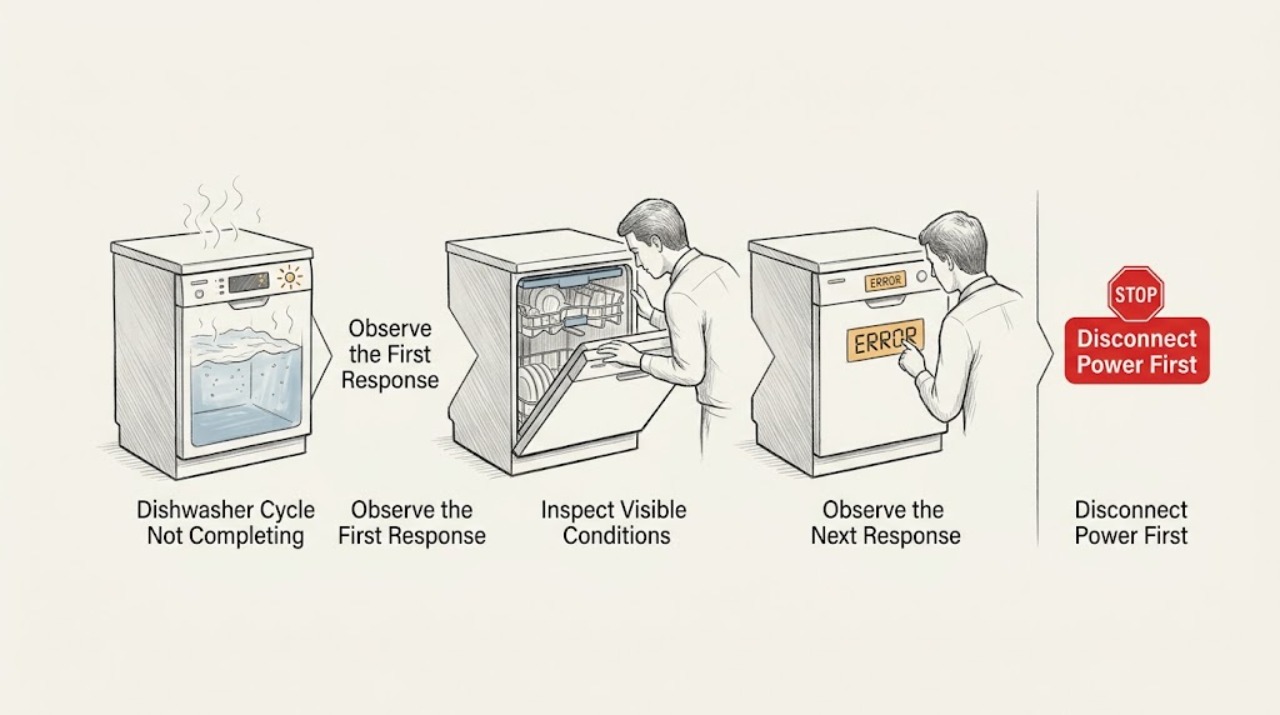
Work through in order
Diagnostic checks
Use only checks that match the exact appliance or system and its official guide.
-
Check 1
Note the selected programme, any Fast or time-saving function, the elapsed time, and the number or status shown on the display. Compare that information with the programme table in the manual for the exact Beko model.
Expected result: The programme is still within the model's expected range, or it has run substantially longer than expected and the display is no longer progressing.
Next step: If the time is expected, allow the programme to finish. If the display is stalled, continue with the delay and water-path checks rather than repeatedly restarting the appliance.
Why this matters
Why: Beko says cycle length varies with the selected programme, the model, and the appliance's age; a long programme is not automatically a failure. A display that stops progressing beyond the model's expected range is more consistent with a process that is waiting or failing.
-
Check 2
Check the display and control panel for a Time Delay, end-time, or similar delayed-start indication before starting another programme.
Expected result: A delay is active and the programme has not reached its start time, or no delay indication is present.
Next step: If a delay is active, cancel it using the controls described in the model manual; on supported Beko controls, the Programme Selection and Programme Cancel controls are held together for three seconds, then the appliance is allowed to drain. If no delay is shown, continue to the water-level check.
Why this matters
Why: Beko explains that a delayed programme starts automatically only after its delay period ends, and that the exact controls depend on the model. An active delay can look like a cycle that will not complete when the appliance has not actually begun the wash programme yet.
-
Check 3
After the dishwasher is switched off and unplugged, look at the bottom of the tub for standing water. Remove only the accessible drain filters beneath the lower basket, rinse food residue away under a tap, and refit the filters fully.
Expected result: Water is standing in the tub or drainage is slow, and the filter contains food residue or foreign material; alternatively, the filter is clear and the tub is dry.
Next step: If the filter was blocked, refit it and run a short programme only when the appliance is safe to use, then check whether water clears. If water remains or the filter was already clear, inspect the drain hose without opening sealed panels.
Why this matters
Why: Beko identifies a blocked filter as a possible reason for poor drainage and says abnormal gurgling, thumping, or shaking together with water remaining can indicate a blockage. A clear, dry filter makes that accessible blockage less likely but does not rule out a hose or internal fault.
-
Check 4
With power disconnected, check the visible drain hose behind or below the dishwasher for crushing, kinks, twists, an obvious blockage, or a connection that has slipped. Do not pull an integrated appliance out farther than can be done safely.
Expected result: The hose is kinked, crushed, or blocked, or it looks clear and correctly connected.
Next step: Correct only a plainly visible kink or crush that can be reached safely, then retest once. If the hose is clear, water still remains, or the appliance is integrated and access would require force, stop and arrange authorised service.
Why this matters
Why: A restricted drain hose can prevent the dishwasher from removing water and leave the programme unable to move on. If the hose is clear and correctly routed, the fault may be at an internal pump, valve, sensor, or control stage that is not safe to diagnose by opening the appliance.
-
Check 5
If the machine stops while trying to fill, confirm that the connected water tap is open and that the inlet hose is not kinked or squashed; record any water-supply warning shown by the appliance.
Expected result: The tap was closed or the inlet hose was restricted, or the supply looks normal but the programme still stops at filling.
Next step: Restore a normal tap and hose position and run the model's recommended reset or programme-start sequence. If it still will not fill or repeatedly stops, stop using it and contact an authorised service agent.
Why this matters
Why: Beko links a failure to fill with the water supply and recommends checking the tap and inlet hose. If those checks are normal, an internal inlet or control issue becomes more likely than a simple user-accessible restriction.
-
Check 6
If the display indicates that the programme has finished, listen briefly to determine whether the remaining sound is a drain-pump hum and check whether water is actually disappearing from the tub.
Expected result: The pump runs briefly while the final water is removed, or it continues for a significant time without clearing the water.
Next step: Allow a normal short drain to finish. If the pump continues, the tub remains wet, or the motor keeps running for a significant time, switch the appliance off and arrange service rather than repeatedly cycling the controls.
Why this matters
Why: Beko says the drain pump at the base can keep running after a cycle until all water has been removed. Continued running without drainage is not the same as a normal short finishing operation and points back to a blocked or failed drain path.
Use your observations
Decision map
Find the observation that best matches what you see, then follow the next safe action.
-
PATH 01Next step
What you see
The elapsed time matches the selected programme or a delay is visibly active, and there is no standing water or fault indication.
Do this next
Leave the dishwasher closed while it runs and use the model manual to confirm the programme's expected sequence. Do not cancel it solely because the run time is longer than a quick programme.
Why this path and its safety boundary
Why it matters: This pattern is more consistent with a long or intentionally delayed programme than with a cycle failure.
-
PATH 02Next step
What you see
The programme stops before the end and the tub contains water, especially with slow drainage or abnormal gurgling, thumping, or shaking.
Do this next
Retest only after a safe, visible restriction has been cleared. If water remains, the pump keeps running, or access would require opening panels, stop and contact authorised service.
Why this path and its safety boundary
Why it matters: A change after the filter or hose check makes an accessible drain blockage more likely. No change, persistent standing water, or a pump that runs without moving water makes an internal drain fault more concerning.
-
PATH 03Next step
What you see
The machine stalls during filling, repeatedly stops with a water-supply warning, or finishes the displayed cycle but the pump runs on for a significant time.
Do this next
Stop using the dishwasher and arrange an authorised service visit. Provide the model or service code, the point in the programme where it stops, any displayed warning, and whether water remains in the tub.
Why this path and its safety boundary
Why it matters: The remaining pattern is less likely to be a simple setting or visible hose issue and more likely to need diagnosis of an internal water-inlet, drain, pump, sensor, or control problem.
Helpful context
Understand the symptom
A dishwasher that appears not to finish can be in three different states: it may still be running a long programme, it may be waiting because a delay function is active, or it may have stopped at a water-handling step. Beko notes that the selected programme and the appliance model affect the run time, so compare the display with the programme information for this exact machine before treating a long cycle as a fault.
The most useful physical clue is what is left in the tub. Standing water or slow drainage points first to the filter and drain path. A machine that shows the cycle as finished but can still be heard running may be removing the last water with its drain pump. Do not open the door while a wash programme is running just to inspect it: Beko warns that hot water or steam may escape.
When checks do not resolve it
Need a professional?
Contact an authorised service agent when the cycle repeatedly stops after the filter and visible hose checks, water will not drain, the pump runs for a significant time after the displayed end, the machine will not fill despite a normal tap and inlet hose, or a leak, smoke, burning smell, or electrical fault is present.
Safety scope: Do not open sealed panels, work on live wiring, reach into a running dishwasher, or force an integrated appliance out of its cabinet. Disconnect power before cleaning an accessible filter or checking a visible hose, and stop if access is not safe.
Have this ready
- Give the full model or service code, selected programme, point where the cycle stops, display warning, whether the tub contains water, and the result of the filter, drain-hose, and water-supply checks.
Common questions
FAQ
How long should a Beko dishwasher cycle take?
There is no single time for every Beko model. Beko says the selected programme, model, and appliance age affect duration, and many programmes take around two hours. Check the manual for the exact programme before diagnosing a long run as a failure.
Why is my Beko dishwasher still running after the display says the cycle is finished?
The drain pump may continue briefly while it removes remaining water. If it continues for a significant time or the tub does not drain, switch the appliance off and arrange authorised service.
Can a blocked filter stop a Beko dishwasher from completing its cycle?
Yes. Beko says a blocked filter or drain hose can cause poor drainage, and standing water or abnormal gurgling, thumping, or shaking can indicate a blockage. Clean only the accessible filter with the appliance disconnected, then seek service if drainage remains poor.
What if a delayed programme makes it look as though the dishwasher is stuck?
Check the display for a delay or end-time setting. A delayed programme waits until its delay period ends; use the controls in the model manual to cancel it and allow the appliance to complete its drain sequence.
Read the exact guide
Official sources
- DishwasherBeko · Beko dishwasher delayed programmes and safe use while running
- How to clean a dishwasherBeko · Beko dishwasher drain-filter cleaning and maintenance
- My dishwasher cycle has finished but the motor is still running.Beko · Beko dishwasher drain-pump operation after a displayed cycle end
- What To Do When A Dishwasher Did Not DrainBeko · Beko dishwasher standing water, drain filters, and drain hoses
- Why is my Beko dishwasher not filling with water?Beko · Beko dishwasher water-inlet checks when a programme stalls during filling
- How Long Does A Dishwasher Take?Beko · Beko dishwasher programme duration and model variation
Community feedback
Share a repair observation
Share a plain-text repair observation. Accepted observations are published automatically; this page may take a moment to update.