
On this page
Start here
Quick answer
“Beko 300” is a family description, not enough to identify one dishwasher manual or one pump, spray-arm assembly, filter, or other part. Beko’s opened US dishwasher catalog lists many separate model codes, and Beko says dishwasher programs and features depend on the model. First photograph the full model label on the right side of the door frame. Then stop the cycle and check only accessible loading and spray-arm interference. If the sound continues on an empty, safe test cycle, is accompanied by a leak, burning smell, visible damage, or abnormal operation, stop using the dishwasher and contact an authorised Beko service agent; do not diagnose a grinding noise as a failed motor or pump from the family name alone.
Before you begin
Safety first
- Do not run the dishwasher with a leak, burning smell, exposed damage, repeated electrical trip or severe vibration. Do not open the cabinet, remove pump or motor wiring, force a spray arm, or order a component from a different Beko model.
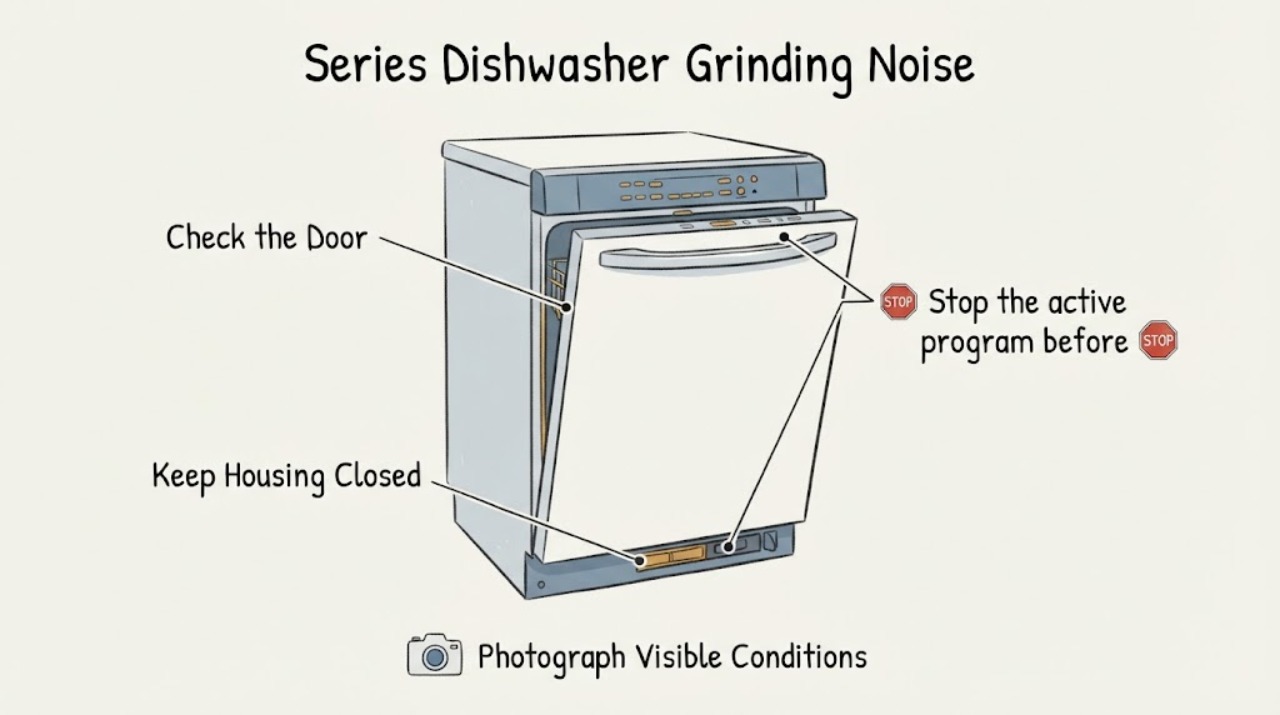
Work through in order
Diagnostic checks
Use only checks that match the exact appliance or system and its official guide.
-
Check 1
Open the door with the dishwasher stopped and photograph the complete model and serial label on the right-hand side of the door frame. Record every letter, digit and suffix instead of writing only “Beko 300.”
Expected result: The label gives one complete model code, or the sticker is unreadable or missing.
Next step: Use the complete code in Beko’s manual lookup. If the label cannot be read, contact Beko support or an authorised service provider with clear photos before attempting a component diagnosis.
Why this matters
Why: Beko directs owners to model-number manuals, and its catalog contains many distinct dishwasher model records. The 300-series wording cannot determine the exact manual, feature set or compatible part.
-
Check 2
Stop the active program before reaching into the tub. Remove or reposition any loose utensil, dish, rack item or visible object that could contact a spray arm, and check by hand only that the accessible spray arms can move freely without force.
Expected result: The noise is rhythmic and changes when the load is rearranged, or the spray arm remains obstructed or the noise is unchanged.
Next step: Run only the normal model-approved program after the obstruction is removed and the appliance is dry and intact. If the sound remains or the appliance behaves abnormally, stop using it and arrange authorised service.
Why this matters
Why: Beko identifies item contact and spray-arm interference as possible sources of cycle noise. A change with loading supports a load-related explanation; unchanged noise does not prove a particular internal component.
-
Check 3
If there is no leak, burning smell, visible damage, repeated electrical trip or other safety concern, compare the sound on a short empty cycle only as permitted by the exact manual. Stay outside the open door path and do not interrupt a running cycle to inspect inside.
Expected result: The sound disappears when empty, or it occurs empty and on every cycle; the dishwasher may also show abnormal operation.
Next step: Stop further testing if the sound persists empty, becomes louder, or is accompanied by a leak, smell, vibration or poor operation; contact an authorised Beko service agent.
Why this matters
Why: A sound that disappears empty is more consistent with loading or contact than a persistent machine sound. A sound that remains empty is unresolved and should not be assigned to a pump, motor or bearing without exact-model evidence.
-
Check 4
Prepare the exact model code, when in the cycle the grinding begins, whether the tub is loaded or empty, and any leak, vibration, odor or cleaning change for Beko or an authorised service provider.
Expected result: The complete model is available and the grinding persists, or the model and water/electrical behavior remain unclear.
Next step: Leave the dishwasher out of service if the noise is persistent or unsafe and request model-specific diagnosis. Do not open the pump housing, remove wiring, or order a component from another 300-series model.
Why this matters
Why: Beko’s public guidance routes persistent unusual noise or abnormal operation to authorised service. The family name alone is insufficient for an internal repair or part match.
Use your observations
Decision map
Find the observation that best matches what you see, then follow the next safe action.
-
PATH 01Next step
What you see
The grinding or rhythmic noise stops after the load is rearranged and the accessible spray arms can rotate freely.
Do this next
Use the correct loading pattern from the exact manual and monitor the next cycle. If the sound returns with a correctly loaded tub, stop and escalate to service.
Why this path and its safety boundary
Why it matters: The result is consistent with Beko’s documented load or spray-arm contact possibilities, but it does not establish the identity of any internal part.
-
PATH 02Next step
What you see
The noise remains during an appropriately safe empty comparison, occurs every cycle, or the dishwasher is not operating normally while making it.
Do this next
Stop further test runs and provide the full model label, cycle timing, load/empty result and any leak or vibration evidence to Beko or an authorised service provider.
Why this path and its safety boundary
Why it matters: Beko directs persistent or abnormal noise to an authorised service agent. The result does not distinguish pump, motor, bearing, impeller or another internal cause.
-
PATH 03Next step
What you see
Grinding is accompanied by a burning smell, water leak, exposed damage, repeated electrical tripping, severe vibration, or hot water/steam escaping unexpectedly.
Do this next
Stop the program, isolate power and water only from accessible controls or shutoffs when safe, keep clear of hot water or steam, and arrange qualified service. Do not open the cabinet or test a suspected component.
Why this path and its safety boundary
Why it matters: Continued operation could create an electrical, water or burn hazard, and the public family-level guidance cannot safely narrow the fault.
Helpful context
Understand the symptom
The 300-series label does not identify one machine
The task identifies a Beko 300-series dishwasher, but it does not provide a complete model code. Beko’s opened catalog lists many distinct dishwasher records, including separate DIT, DDT and DUT codes with different capacities and noise ratings. Beko’s own program guide also says that programs and features depend on the model. Treat “300” as a family clue until the full rating label is read; do not select a manual or replacement part from that family wording alone.
Start with the accessible causes Beko documents
Beko’s troubleshooting page says that a rhythmic sound can come from an item inside the tub, that continuous knocking can come from spray arms striking dishes, and that dishes or racks can move during a cycle. Stop the appliance before rearranging the load, and check only that no dish, utensil or accessible obstruction prevents the spray arms from rotating. This is a symptom check, not proof that the motor, pump or bearing is defective.
Use an empty comparison only within the model and safety boundary
Beko’s guidance says that if a noise occurs every cycle, an empty run can help distinguish a load-related sound from a persistent appliance sound, and that persistent noise should be referred to an authorised service agent. Do not run an empty cycle if there is a leak, burning smell, exposed damage, repeated tripping, or any sign that continued operation could be unsafe. Do not open the door while the dishwasher is running because Beko warns that hot water or steam can escape.
Get the exact manual before any repair decision
Beko’s official manual page places the dishwasher model and serial sticker on the right-hand side of the door frame and provides model-number lookup. Record the entire code, including letters, digits and suffixes, then use the matching manual or authorised service route. A grinding noise alone does not justify ordering a pump, motor, impeller or bearing, and a part listed for another Beko dishwasher is not evidence of compatibility.
When checks do not resolve it
Need a professional?
Contact Beko or an authorised service provider when the grinding persists after accessible loading and spray-arm checks, occurs on a safe empty comparison, or is accompanied by a leak, burning smell, severe vibration, electrical trip or abnormal cleaning operation. Give the complete model label rather than only “300 series.”
Safety scope: Do not run the dishwasher with a leak, burning smell, exposed damage, repeated electrical trip or severe vibration. Do not open the cabinet, remove pump or motor wiring, force a spray arm, or order a component from a different Beko model.
Have this ready
- Provide the complete model and serial label from the right-hand side of the door frame, region, cycle and time of noise, loaded-versus-empty result, and photos or notes about leaks, vibration, odor, visible damage and spray-arm clearance.
Common questions
FAQ
Does Beko 300 mean one dishwasher model?
No. Beko’s official catalog lists many dishwasher model codes, and the official programs guide says features depend on model. Read the complete sticker on the right-hand side of the door frame before choosing a manual or part.
Could a dish or spray arm cause the grinding noise?
Beko documents load items contacting moving parts and spray arms striking dishes as possible cycle-noise causes. Stop the machine before rearranging the load and check accessible spray-arm movement, but do not use that possibility to diagnose an internal motor or pump.
Should I keep running it to identify the part?
No. Only use an empty comparison when the machine is dry and intact, there is no leak, burning smell, severe vibration or electrical trip, and the exact manual permits it. Persistent or abnormal noise should go to an authorised service agent.
Read the exact guide
Official sources
- Dishwasher Help Center | BekoBeko · Opened Beko’s US dishwasher help center. It warns against opening the door during a running cycle because hot water or steam may escape, routes manual lookup by model number, and provides official support contact information.
- Dishwasher Troubleshooting Help Center | BekoBeko · Opened Beko’s official dishwasher troubleshooting help center. It discusses load or spray-arm contact, normal pump/control sounds, persistent cycle noise, and contacting an authorised service agent when the appliance is not operating normally. It does not map “grinding” to one specific internal part across the Beko range.
- How to install your Beko dishwasher | BekoBeko · Opened Beko’s official installation guide. It states that water and electrical supplies must be switched off before disconnecting, that the user manual is model-dependent, and that an empty test run should be checked for leaks, excessive vibration and odd sounds with authorised service recommended if issues appear. It is not a repair-manual source for internal components.
- Dishwashers | BEKOBeko · Opened the official Beko US dishwasher catalog. It lists 33 results with distinct model codes such as DIT39434C2, DDT39434XC2, DDT38532X and DUT36522X, with differing capacities and noise ratings. It supports the scope warning that “300 series” is not one exact model.
- Beko dishwasher programs explained | BekoBeko · Opened Beko’s official programs guide. It explicitly says programs and features depend on model and directs owners to check product specifications, supporting the restriction against treating a 300-series label as one exact design.
- User Manual | BekoBeko · Opened Beko’s official user-manual page. It provides model-number lookup and says the dishwasher factory sticker is on the right-hand side of the appliance door frame. It is used to obtain the exact model before relying on a manual or part route.
Community feedback
Share a repair observation
Share a plain-text repair observation. Accepted observations are published automatically; this page may take a moment to update.