
On this page
Start here
Quick answer
A bad smell from a Beko dishwasher most often starts with food residue trapped in the drain filter, but residue in spray-arm holes, dirty door seals, limescale, or moisture left after a cycle can also contribute. Start with the power off and the filter at the bottom of the tub, then inspect the spray arms, seals, and drainage symptoms. If the smell is chemical or electrical, there is a leak, or cleaning does not stop a recurring odor, stop using the dishwasher and arrange qualified service.
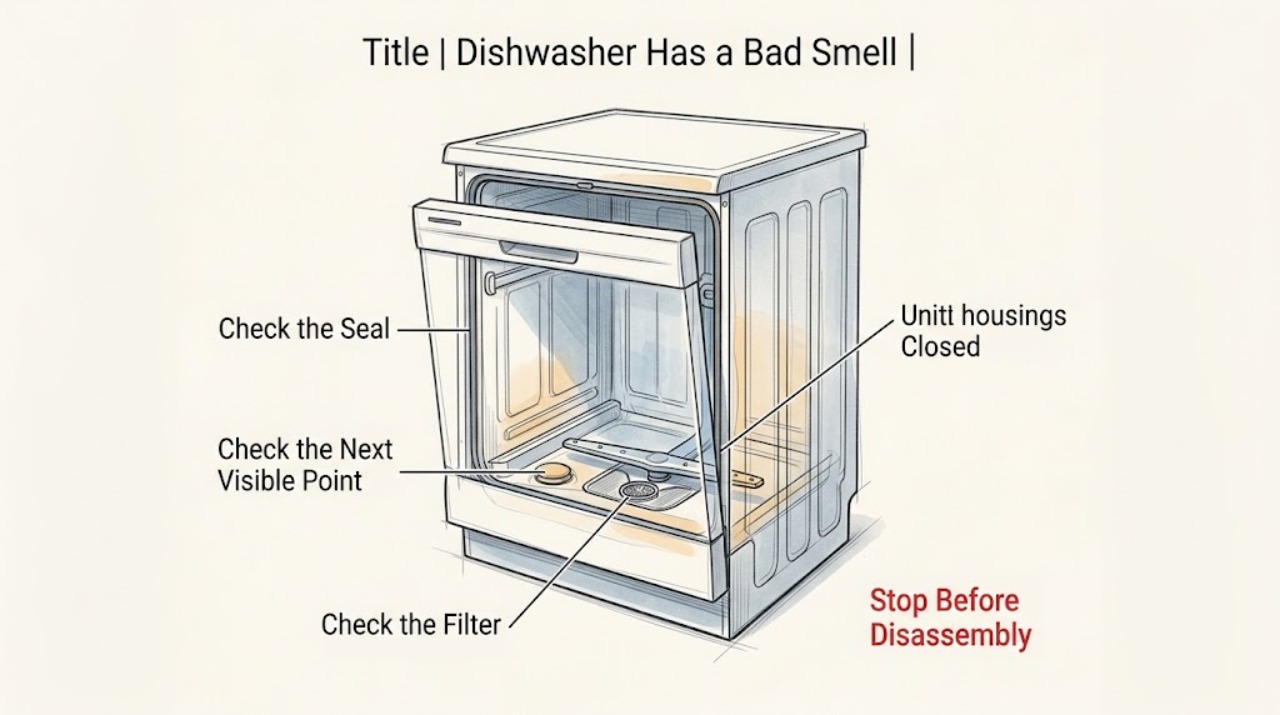
Work through in order
Diagnostic checks
Use only checks that match the exact appliance or system and its official guide.
-
Check 1
Switch the dishwasher off, remove the lower basket, and inspect the bottom of the tub and the accessible filter area for trapped food, grease, or standing dirty water.
Expected result: Food residue is packed into the filter, or dirty water remains around the filter after a completed cycle.
Next step: Clean the filter using the model manual and continue to the drainage check if water remains. Do not reach into a powered appliance or force a filter that does not release as described for the model.
Why this matters
Why: Residue in the filter is the leading odor explanation; standing water also makes a drainage restriction more likely than a simple exterior smell.
-
Check 2
Remove the accessible filter components according to the Beko manual, rinse food residue from inside and on the filters, and reinstall the pieces so the coarse filter is fully enclosed and locked.
Expected result: The filter is clear and correctly seated, and the smell is noticeably reduced after the next normal cycle; or the filter was already clean and the smell is unchanged.
Next step: Repeat filter cleaning at least as often as Beko recommends for the model or whenever it clogs, then inspect spray arms and seals instead of repeatedly cleaning an already-clear filter.
Why this matters
Why: Improvement confirms a filter-residue source. No change means the odor is likely coming from another dirty surface, spray path, retained water, or an appliance fault.
-
Check 3
Inspect the upper and lower spray arms and their holes for visible food debris, then wipe the door seals and surrounding accessible surfaces with a slightly damp cloth.
Expected result: A spray-arm hole is blocked, or dark/slimy residue is present around a door seal and the odor is strongest there.
Next step: Rinse the spray arms and clear only visible, accessible debris without a sharp object; wipe the seals without pulling them away from the metal. Retest with an appropriate programme and continue if the odor persists.
Why this matters
Why: A blocked spray path can leave food behind, while residue on the seal can create a localized odor that filter cleaning will not remove.
-
Check 4
Run an empty inner-cleaning or suitable intensive programme using a dishwasher cleaner or descaler that the model manual permits, after the filter and spray arms are clear.
Expected result: The odor disappears after the empty cleaning cycle, or it returns quickly despite a clear filter, clean spray arms, clean seals, and an appropriate empty cycle.
Next step: Keep a regular cleaning schedule suited to use and soiling. If the odor returns quickly or cleaning performance is also poor, stop escalating chemical cleaning and arrange qualified diagnosis.
Why this matters
Why: Improvement points to accumulated limescale, grease, bacteria, or odor residue. Rapid recurrence makes retained water, drainage, a seal problem, or an internal fault more likely.
Use your observations
Decision map
Find the observation that best matches what you see, then follow the next safe action.
-
PATH 01Next step
What you see
The smell is strongest at the filter and there is food residue or dirty water at the bottom of the tub.
Do this next
Clean and reseat the filter, then check whether water remains after a cycle. If standing water persists or the machine leaves food behind, stop repeated cycles and arrange service for the drainage fault.
Why this path and its safety boundary
Why it matters: The pattern makes trapped food and a drainage-related problem more likely than a need for a replacement part.
-
PATH 02Next step
What you see
The filter is clean, but spray-arm holes or the door seal carry visible residue and the smell improves after those surfaces are cleaned.
Do this next
Keep the spray arms, filter, and seals on a regular cleaning routine and use a programme appropriate for the load. Reassess if the odor returns after normal use.
Why this path and its safety boundary
Why it matters: The odor is more consistent with buildup outside the filter; the successful change also makes a control or electrical fault less likely.
-
PATH 03Next step
What you see
The smell returns quickly after the filter, spray arms, seals, and an empty cleaning cycle are clean, or the dishwasher also has poor drainage, a leak, or an unusual chemical or burning odor.
Do this next
Stop using the dishwasher if the odor is chemical or burning, or if water is near electrical components. Otherwise arrange a qualified appliance technician rather than dismantling fixed or powered components.
Why this path and its safety boundary
Why it matters: The pattern makes retained water, a sealing or drainage fault, or an internal electrical problem more likely than ordinary food residue.
Helpful context
Understand the symptom
Why a Beko dishwasher can smell bad
The filter is designed to catch food and foreign objects. When residue remains in or around it, the dishwasher can smell even if the dishes look clean. A restricted spray arm can leave food behind, while grime on the door seal and moisture or limescale buildup can make an odor return after each cycle. The most useful first distinction is whether you can find trapped residue or standing water, versus an unusual smell with no visible soil.
Keep the checks model-safe
Filter shapes and release methods vary. Use the Beko manual for the exact model if a filter does not lift or turn as expected. Work only on accessible, removable parts with the appliance switched off; do not pry fixed components, pour chemicals into the rinse-aid reservoir, or use a sharp tool to clear a spray-arm hole.
When cleaning is not the fix
A smell that is burning, strongly chemical, or accompanied by a leak is not a routine odor-cleaning problem. Stop the appliance and use qualified service. For a food or musty smell, judge the result after the filter, spray arms, seals, and an empty cleaning cycle have been addressed; a quick recurrence points to an unresolved drainage, sealing, or internal fault.
When checks do not resolve it
Need a professional?
Arrange qualified appliance service when odor returns quickly after the accessible cleaning checks, when standing water or poor drainage remains, or when a door seal cannot sit correctly. Stop using the dishwasher immediately for a burning or strongly chemical smell, a leak near electrical components, damaged wiring, or any situation that requires opening fixed or powered parts.
Common questions
FAQ
What is the most common reason a Beko dishwasher smells bad?
Beko says a clogged filter or food buildup in the filter is a common cause. Switch the appliance off, clean the filter as described for the model, and inspect the spray arms and seals if the odor remains.
How often should I clean a Beko dishwasher filter?
Beko UK recommends checking and cleaning the filters weekly or whenever they become clogged. The exact filter release method varies, so follow the manual for the complete model.
Can the spray arms or door seal cause a dishwasher odor?
Yes. Food or grease in spray-arm holes can reduce cleaning performance and leave residue behind, while grime around the door seal can hold odor. Rinse accessible spray arms and wipe the seals gently without pulling them away from the metal.
When should I stop cleaning and call a technician?
Call for qualified service if the odor quickly returns after the accessible cleaning routine, if water remains after a cycle, or if there is a leak or unusual chemical or burning smell. Do not dismantle powered or fixed components.
Read the exact guide
Official sources
- How to clean a dishwasherBeko UK · Beko dishwasher filter, spray-arm, seal, empty-cycle, descaling, and odor-prevention guidance
- How do I remove and clean the filters?Beko UK · Beko dishwasher filter cleaning frequency, residue removal, and model-manual guidance
- Why Does My Dishwasher Smell?Beko UK · Beko dishwasher odor causes, filter residue, seal cleaning, deep cleaning, and service support
Community feedback
Share a repair observation
Share a plain-text repair observation. Accepted observations are published automatically; this page may take a moment to update.