
On this page
Start here
Quick answer
A bad smell from a Bosch dishwasher most often starts with food particles or other debris in the filter, spray arms, or retained wastewater. Switch the dishwasher off and isolate it before handling the filter; wear protective gloves because sharp glass can be trapped there. Remove and clean the filter exactly as the owner manual shows, rinse accessible spray-arm openings, and check for standing water or a kinked visible drain route. If the filter and spray arms are clean, run a maintenance wash or a higher-temperature rinse only with a programme and cleaner permitted by the exact manual and product label. Do not mix cleaners, use an abrasive tool, reach into a moving pump, or dismantle the appliance. A smell that returns with standing water, a leak, a sewage-like drain problem, smoke, burning odor, damaged wiring, or a dishwasher that still smells after the accessible cleaning needs qualified service diagnosis.
Before you begin
Safety first
- This article covers external odor classification and accessible filter, spray-arm, drain-route, and manual-directed cleaning checks only. A qualified technician must handle pump covers, internal drains, heaters, electrical controls, leak protection, wiring, and any built-in dismantling.
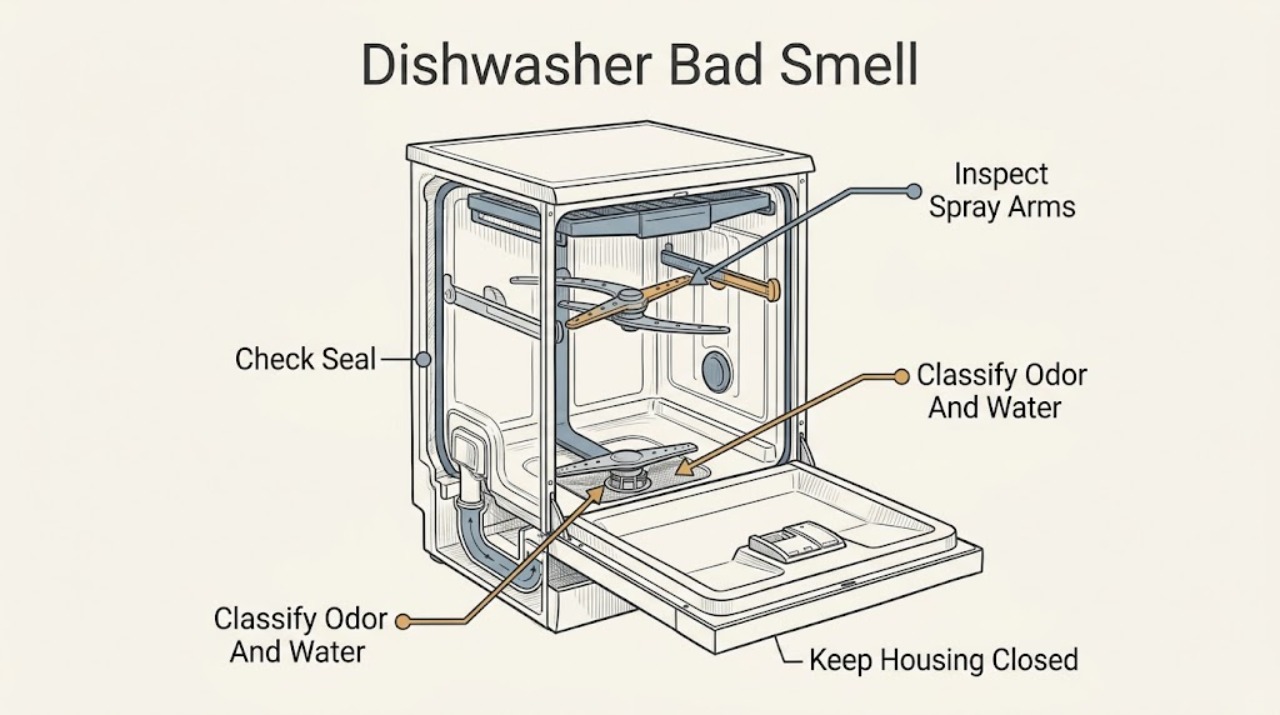
Work through in order
Diagnostic checks
Use only checks that match the exact appliance or system and its official guide.
-
Check 1
Note whether the odor is stale/food-like, sewage-like, chemical, burning, or electrical, and inspect the dishwasher floor for standing water, a leak, or a wet area outside the appliance without starting a cycle.
Expected result: The smell is food-like with no standing water, sewage-like with retained water, chemical or burning, or accompanied by a visible leak.
Next step: Use the filter and spray-arm checks only for a food-like odor with no safety hazard. For retained water or a leak, follow the drainage branch; for burning, chemical, or electrical odor, stop and arrange qualified service.
Stop if: Do not continue operating for smoke, burning odor, exposed wiring, water near electrical parts, or a leak that cannot be safely contained.
Why this matters
Why: Food-like odor makes residue in the filter, spray arms, or wash area more likely. Sewage-like odor with retained water makes drainage or a connected waste path more likely. Chemical, burning, or electrical odor is a safety issue rather than a cleaning task.
-
Check 2
With power isolated, remove the lower rack and unlock the filter unit as shown in the exact Bosch owner manual. Separate only the filter pieces the manual identifies, inspect for food or foreign material, and rinse them under running water with mild soap and a soft brush when permitted.
Expected result: The filter contains food, grease, or a sharp foreign object; the filter is clear; the filter is damaged; or it does not lock back into place.
Next step: Remove only loose residue, avoid abrasive tools, and reinstall the filter until the model's locking marks or arrows align. If it is damaged, cannot be secured, or the smell/standing water remains, stop and arrange service.
Stop if: Do not reach into a moving pump, probe hidden passages with a sharp object, run without a required filter, or handle glass fragments without gloves.
Why this matters
Why: A soiled filter can retain food and reduce effective wastewater pumping, making an odor more likely. A clear, damaged, or unsecured filter shifts suspicion toward spray arms, the sump/drain path, or an internal issue rather than proving a pump failure.
-
Check 3
With the dishwasher off, remove or release the spray arms only as the exact model manual shows and inspect the spray holes under running water. Loosen reachable debris gently with a soft method allowed by the manual, then ensure each arm is seated and can rotate freely.
Expected result: Several spray holes are blocked, an arm is fouled with food or scale, an arm cannot rotate, or the spray arms are clear and correctly seated.
Next step: Clear only accessible debris without enlarging holes, refit the arms, and make one normal test after the filter is secured. If an arm is cracked, cannot seat, or the odor returns, arrange model-specific service.
Stop if: Do not force clips, drill or enlarge spray holes, use abrasive tools, or run the machine with a loose arm.
Why this matters
Why: Debris in spray arms can leave residue throughout the tub and contribute to odor; a clear, freely rotating arm makes the filter, drain, door-seal, or internal wash-system path more likely.
-
Check 4
If water remains in the base or the smell is sewage-like, inspect the visible drain hose route and accessible air-gap or sink connection for a kink, sharp bend, or obvious blockage. Do not disconnect a hose or open a pump cover unless the exact manual explicitly makes that a safe user step.
Expected result: Standing water remains, the visible hose is kinked, the connected sink/air-gap is slow, the drain route is clear, or the dishwasher empties but the odor returns.
Next step: Correct only an obvious, safely accessible hose route issue and retest once with the filter secured. If water remains, the pump area is inaccessible, a leak appears, or the odor returns, isolate the appliance and arrange service.
Stop if: Do not loosen plumbing connections with water present, remove a pump cover without model instructions, reach into standing water near electrical parts, or force a built-in machine out.
Why this matters
Why: Bosch links standing water with failure to pump out and commonly with filter or pump debris; a kinked or blocked connected path can also leave wastewater and odor. A clear route with recurring retained water points beyond an accessible check.
-
Check 5
After the filter and spray arms are clean, and only when there is no standing water, leak, or electrical hazard, run the model's maintenance wash or higher-temperature rinse using a dishwasher cleaner and programme permitted by the exact Bosch manual and cleaner label.
Expected result: The odor clears after the maintenance cycle, improves but returns, or remains unchanged; foam, leakage, or an abnormal noise appears.
Next step: Use the maintenance cycle only as directed and allow the appliance to finish safely. If the odor returns or the cycle produces a leak or abnormal operation, stop adding cleaner and arrange qualified diagnosis.
Stop if: Do not mix cleaners, exceed the product label, open the door into escaping steam or chemicals, or continue through foam overflow, leaks, smoke, or burning odor.
Why this matters
Why: Improvement supports removable greasy or organic residue as a contributor, but it does not prove that all internal surfaces are clean. A returning odor suggests retained water, a drain/airflow issue, door-seal contamination, or an internal fault; foam or leakage is a stop signal.
-
Check 6
If the smell persists or returns after one accessible filter, spray-arm, drain-route, and manual-approved maintenance check, record the model number, odor type, standing-water result, cycle used, and any leak, noise, or error indication for service.
Expected result: The odor recurs with a clean filter, the dishwasher retains water, a leak or abnormal noise appears, a related error code is displayed, or internal access would be required.
Next step: Leave the dishwasher out of service when unsafe and arrange qualified Bosch or appliance service. Provide the exact model and the observed odor/drain pattern instead of ordering an unverified pump, seal, or control.
Stop if: Do not remove electrical covers, bypass leak protection, handle energized wiring, or continue using the appliance through smoke, burning odor, or water near electrical parts.
Why this matters
Why: This pattern is more consistent with a deeper drain, pump, seal, heating, vent, or wash-system problem than with a simple dirty filter. A code may identify a subsystem on supported Bosch models, but it does not authorize a generic part replacement without model-specific diagnosis.
Use your observations
Decision map
Find the observation that best matches what you see, then follow the next safe action.
-
PATH 01Safety boundary
What you see
The odor is stale or food-like, there is no standing water or leak, and the filter or spray arms contain residue.
Do this next
Clean the filter and spray arms with power isolated, refit them correctly, then run one manual-approved maintenance or rinse cycle. Arrange service if the odor returns.
Why this path and its safety boundary
Why it matters: Food debris and restricted wash circulation are more likely than a failed motor or control.
Safety stop: Do not use abrasive tools, run without the filter, or reach into a moving pump.
-
PATH 02Safety boundary
What you see
The odor is sewage-like or strong after a cycle and water remains in the base, the visible hose is kinked, or the connected drain is slow.
Do this next
Correct only an obvious accessible hose route problem and retest once. If water remains, a leak appears, or the pump path cannot be safely accessed, isolate the appliance and arrange service.
Why this path and its safety boundary
Why it matters: Retained wastewater or a restricted drain route is more likely; Bosch treats standing water as a drain symptom, not just an odor issue.
Safety stop: Do not disconnect a water-filled hose, open the pump housing without model instructions, or handle water near electrical parts.
-
PATH 03Safety boundary
What you see
The filter, spray arms, and visible drain path are clean, there is no retained water or leak, and the smell is mild but persistent.
Do this next
Run one maintenance wash or higher-temperature rinse allowed by the exact manual and product label. If the smell returns, call for service and report the cycle result.
Why this path and its safety boundary
Why it matters: Greasy residue or contamination in accessible wash surfaces is plausible, but repeated cleaner cycles are not a substitute for diagnosis if the odor persists.
Safety stop: Do not mix products, exceed label directions, or continue through foam, leak, smoke, or burning odor.
-
PATH 04Safety boundary
What you see
The smell is burning, electrical, or chemical, or it returns with a leak, abnormal noise, error indication, or a clean accessible system.
Do this next
Stop using and isolate the dishwasher if safe; arrange qualified service with the model number and symptom record.
Why this path and its safety boundary
Why it matters: A safety, heating, pump, seal, vent, or control problem is more likely than ordinary food residue and cannot be identified from odor alone.
Safety stop: Do not run another cycle, remove covers, bypass leak protection, or test energized components.
Helpful context
Understand the symptom
What the smell pattern can tell you
A sour or stale odor immediately after a cycle often follows food residue in the filter, spray arms, or sump area. A sewage-like smell with water left in the base points more toward retained wastewater or the connected drain path. A hot, burning, solvent-like, or electrical odor is not a cleaning problem: stop and isolate the machine if safe. Bosch's owner-support guidance specifically connects dishwasher odors with debris trapped in the filter and spray arms, while treating standing water as a drain symptom.
Clean only after the dishwasher is safe to handle
Switch the dishwasher off and disconnect power before removing a filter or inspecting the base, following the exact owner manual for a built-in model. Wear gloves for possible glass fragments. Do not reach into an operating pump, use sharp tools in hidden passages, remove electrical covers, pull out a built-in unit by force, or mix cleaning chemicals. Stop immediately for a leak reaching electrical parts, smoke, a burning smell, damaged insulation, or repeated circuit trips.
A maintenance wash follows the basic obstruction checks
Bosch's odor guidance recommends a maintenance wash periodically and a higher-temperature rinse according to the instruction manual. That is useful for greasy residue after the filter and spray-arm checks, but it is not a substitute for fixing standing water or a leak. Use only a cleaner approved for the appliance and the programme stated in the model instructions; if the smell returns after the accessible cleaning cycle, retain the symptom details for service rather than repeatedly adding chemicals.
Safety boundary
Stop conditions
- Stop using the dishwasher for smoke, burning or electrical odor, damaged insulation, repeated circuit trips, or a leak reaching electrical parts.
- Do not reach into a moving pump, open electrical covers, bypass leak protection, pull out a built-in appliance by force, or handle energized wiring.
- Do not mix cleaners, use abrasive or sharp tools on filters or spray arms, run without a required filter, or open the door into escaping steam or chemicals.
- If standing water or a sewage-like odor persists, keep the dishwasher out of service until the drain path and any internal fault are assessed.
When checks do not resolve it
Need a professional?
Safety scope: This article covers external odor classification and accessible filter, spray-arm, drain-route, and manual-directed cleaning checks only. A qualified technician must handle pump covers, internal drains, heaters, electrical controls, leak protection, wiring, and any built-in dismantling.
Common questions
FAQ
Why does my Bosch dishwasher smell like food or sewage?
Food-like odor commonly points to residue in the filter or spray arms. Sewage-like odor with standing water points toward retained wastewater or a restricted drain path. Clean accessible parts with power isolated, then arrange service if water or odor returns.
How do I clean a Bosch dishwasher filter to remove odor?
Switch off and isolate power, remove the filter as shown in the exact model manual, and rinse it with mild soap and a soft brush when permitted. Wear gloves for possible glass and avoid abrasive tools. Reinstall it securely before testing once.
Can blocked spray arms cause a bad dishwasher smell?
Yes. Bosch identifies debris in spray arms as a likely contributor to dishwasher odor. Inspect the holes with the dishwasher off, clear only accessible residue using the manual-approved method, and refit the arms so they rotate freely.
Should I run a cleaning cycle for a smelly Bosch dishwasher?
After checking the filter, spray arms, and visible drainage, you can run one maintenance wash or higher-temperature rinse permitted by the exact manual and cleaner label. Do not mix products or keep repeating cycles if the odor returns, standing water appears, or there is a leak.
When should I call a professional about a Bosch dishwasher odor?
Call when the smell returns after accessible cleaning, standing water or a leak remains, an error indication appears, or diagnosis would require a pump, heater, drain, seal, electrical, or built-in access. Stop immediately for smoke, burning/electrical odor, damaged wiring, or water near electrical parts.
Read the exact guide
Official sources
- Dishwasher Error Codes | Support | BoschBosch Home Appliances · Official Bosch US error-code reference; displayed codes and supported remedies depend on the dishwasher's model and control generation.
- My dishwasher smells badBosch Home Appliances UAE · Official Bosch Home Appliances guidance for dishwasher odor; programme names and cleaner instructions remain model- and market-dependent.
- Bosch Dishwasher Troubleshooting & Repair Guide | Bosch – Fix Common Dishwasher ProblemsBosch Home Appliances · Official Bosch US owner-support guidance; exact model manuals control component access and programme details.
Community feedback
Share a repair observation
Share a plain-text repair observation. Accepted observations are published automatically; this page may take a moment to update.