
On this page
Start here
Quick answer
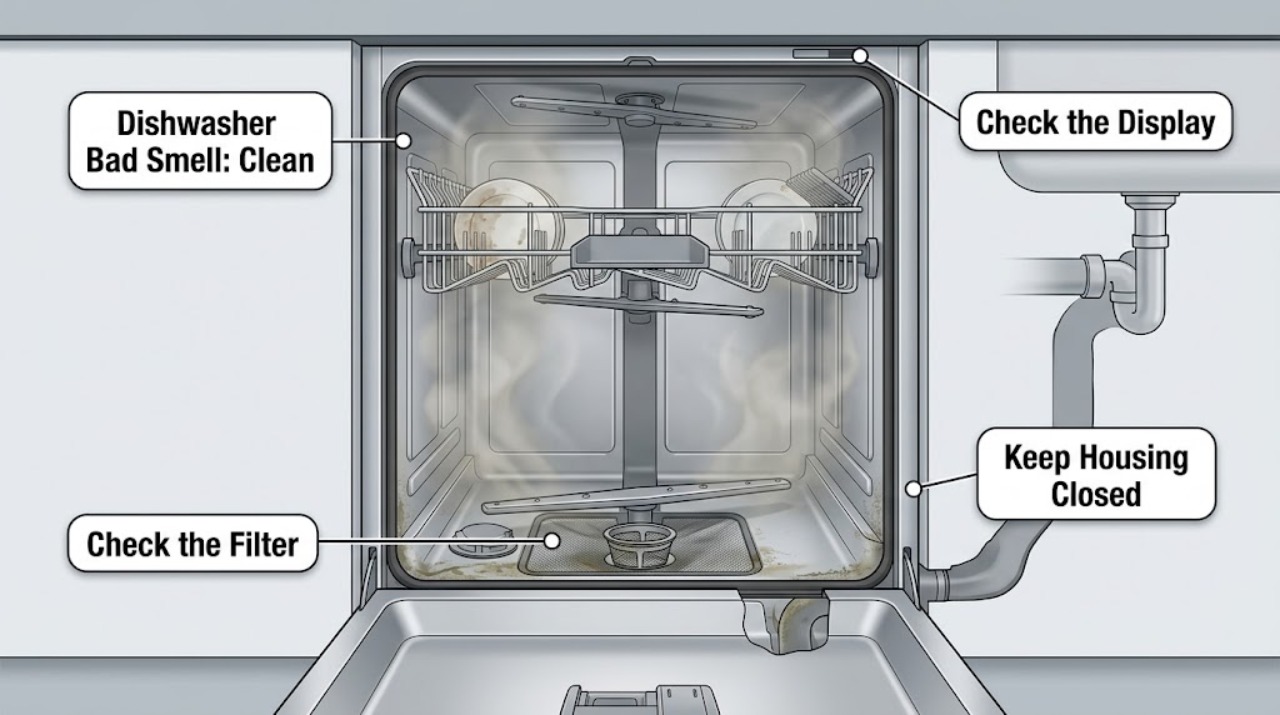
For an AEG dishwasher that smells bad, first separate a food/grease odor from a sewer-like, chemical, or burning odor. Switch the dishwasher off; disconnect the plug before cleaning filters or reaching into the tub, and do not work on a hot appliance. Remove food residue from dishes, clean the filters and accessible sump area according to the exact AEG manual, wipe the door gasket and edge with a soft damp cloth, and check the visible drain hose and sink connection for restriction without dismantling plumbing. Make sure spray arms are clean, then run the model's Machine Care or an empty long programme with a dishwasher-specific cleaner exactly as its label and manual allow. Do not mix cleaners or use sharp tools, abrasive pads, solvents, or unapproved chemicals. If the smell is burning or electrical, there is smoke, a leak, standing dirty water, an error, repeated poor draining, or the odor remains after these documented care steps, stop using the dishwasher and arrange AEG or qualified appliance service. AEG procedures vary by model, so do not assume a universal filter layout or cleaning programme.
Work through in order
Diagnostic checks
Use only checks that match the exact appliance or system and its official guide.
-
Check 1
Identify the odor from outside the dishwasher and note when it is strongest: with the door closed, when it opens, after draining, during a programme, or near the plug and controls.
Expected result: The odor is stale/food-like, sour/musty, sewer-like, chemical, burning/electrical, or accompanied by smoke, heat, leaking, standing water, an error, or poor draining.
Next step: For a burning/electrical or chemical odor, smoke, heat, or active leak, stop the dishwasher, move away from the hazard, and arrange qualified service; do not start another cycle. For a food-like or stale odor with no hazard sign, continue only after switching the appliance off and allowing hot water and surfaces to cool.
Why this matters
Why: Food-like or stale odors are more compatible with residue or moisture remaining in the wash path. A sewer-like odor makes the drain path or household plumbing more relevant. Burning, electrical, chemical, smoke, heat, or leak symptoms are not routine dishwasher odor and may be hazardous.
-
Check 2
Remove visible food particles from dishes before the next load and inspect the tub floor, filter opening, and accessible sump edge for loose food or soil without removing covers or putting hands into hidden openings.
Expected result: Food, grease, slime, or soil is visible around the filter/sump or door edge, or the accessible surfaces look clean but the smell remains.
Next step: If residue is visible, switch off and disconnect the dishwasher before cleaning the filters and sump as the exact manual directs. If no residue is visible, continue with the drain and spray-arm checks rather than guessing a replacement part.
Why this matters
Why: AEG identifies food residue and buildup in areas not reached well by wash water as common contributors to unpleasant odor. A clean visible surface does not rule out a restricted drain, hidden object, or appliance fault.
-
Check 3
With the dishwasher switched off, cool, and disconnected from the plug, remove and clean the filters only as shown in the exact AEG manual; refit every filter in its correct position and lock it before any programme.
Expected result: The filters contain food, grease, or foreign material; the sump edge has residue; a filter is damaged or does not seat/lock; or the filters are clean and correctly installed.
Next step: Remove only loose residue using the manual's permitted cleaning method; do not use sharp tools or reach into a hidden pump. Replace or service a filter that cannot be correctly fitted, and do not run the dishwasher until the filter system is secure.
Why this matters
Why: Dirty filters or sump residue can retain odor and reduce wash or drain performance. A filter that is damaged or cannot seat correctly can allow debris into the pump path and needs model-specific attention. Clean, correctly seated filters shift attention to the spray arms, gasket, drain, or a persistent fault.
-
Check 4
Clean the accessible spray-arm openings and wipe the door gasket and door edge with a soft damp cloth, following the model manual; do not use abrasive pads, sharp tools, solvents, or strong chemicals.
Expected result: Debris blocks spray-arm openings, residue or mold-like soil is on the gasket/edge, the spray arms do not move as the manual permits, or these areas are clean and the smell persists.
Next step: Clear only accessible debris using the manual-approved method and reinstall any removable arm exactly as directed. Do not poke deeply into jets, remove electrical parts, or run the unit with a guard missing; continue to the drain check only if the appliance is safe and cool.
Why this matters
Why: Blocked spray arms can leave soil behind, and the gasket or door edge can retain residue in areas the wash water does not reach well. If these accessible areas are clean, the remaining odor is more likely to involve drainage, internal buildup, or a fault that needs model-specific assessment.
-
Check 5
Check the visible drain hose, sink spigot connection, and area under the sink for kinks, crushing, leakage, or an obvious household-plumbing restriction without disconnecting hoses or dismantling the sink trap.
Expected result: Dirty water remains in the tub, the hose is kinked or leaking, the sink connection appears restricted, or the tub drains normally and the visible drain path is clear.
Next step: Do not run a cycle if water is leaking, standing dirty water remains, or the hose/connection is damaged. Arrange qualified appliance or plumbing service as appropriate; otherwise continue with the documented empty-care cycle.
Why this matters
Why: AEG notes that a blocked drain pipe or affected household plumbing can prevent soiled water from leaving quickly and can produce bad odors. Normal visible drainage does not rule out a hidden restriction or internal pump issue.
-
Check 6
After filters are secure and no leak or hazard is present, run the exact model's Machine Care programme or an empty long-duration programme with a dishwasher-specific cleaner, following the cleaner label and AEG manual.
Expected result: The odor improves after the empty care programme, returns after ordinary loads, or remains unchanged; foam, leakage, an error, or poor draining appears during the programme.
Next step: Do not add extra cleaner or combine products. Stop the programme for escaping foam, leaking, an error, or unsafe symptoms; leave the dishwasher off and request service. If it improves, use the recommended cycle, remove food residue before loading, and maintain the filters as the manual directs.
Why this matters
Why: Improvement supports removable grease, limescale, or residue buildup. Recurrence after normal use suggests loading, detergent, filter, drainage, or maintenance habits still need correction. No improvement or a new fault symptom makes an internal or installation issue more likely.
-
Check 7
If the odor persists, record the exact model number/PNC, programme used, detergent and rinse-aid products, whether water remained after draining, and any leak, error, heating, or cleaning-performance change before contacting service.
Expected result: The odor is repeatable in every programme, limited to a particular programme or load, accompanied by poor cleaning/draining, or not reproducible after documented cleaning.
Next step: Provide the model/PNC and observations to AEG or a qualified appliance servicer. Do not order a pump, heater, seal, hose, or control part based on odor alone.
Why this matters
Why: A repeatable odor with a performance symptom is more useful to a technician than a generic report of a bad smell. A non-reproducible odor still warrants the history if it was chemical, burning, electrical, or associated with a leak.
Use your observations
Decision map
Find the observation that best matches what you see, then follow the next safe action.
-
PATH 01Next step
What you see
Do this next
Disconnect power before cleaning the filters and accessible sump area as the exact AEG manual directs, clean the gasket and spray arms, and run the model-approved empty care programme with the correct cleaner.
-
PATH 02Next step
What you see
Do this next
Use the exact AEG Machine Care or long empty programme and a dishwasher-specific cleaner at the documented interval. Do not increase dosage, mix cleaners, or substitute harsh household chemicals.
-
PATH 03Next step
What you see
Do this next
Do not dismantle the plumbing or continue running cycles with standing dirty water. Arrange qualified appliance or plumbing service and report the hose/connection observation.
-
PATH 04Next step
What you see
Do this next
Stop the dishwasher. Disconnect power only if the plug and area are cool, dry, and safe to touch; otherwise move away and obtain qualified or emergency help as appropriate. Do not run a cleaning programme or open a panel.
-
PATH 05Next step
What you see
Do this next
Leave the dishwasher off if performance or safety is affected and arrange AEG or qualified appliance service with the model/PNC and cleaning history.
Helpful context
Understand the symptom
Most bad smells start with residue or restricted drainage
AEG's support guidance links dishwasher odor to food or soil residue around the filters and sump, the door edge and seal, dirty spray arms, and a drain pipe or household plumbing that is not free-draining. Short programmes can also allow grease and limescale to build up, which is why AEG recommends periodic empty maintenance programmes. These are safe, model-aware care paths—not proof that a particular pump, hose, or seal has failed.
Classify the odor before cleaning
A sour, stale, or food-like smell with residue or standing water can follow a cleaning or drainage problem. A sewer-like smell can point toward a drain connection or household plumbing issue. A burning-plastic, electrical, or chemical odor is a stop condition, not a reason to run another cleaning cycle. Do not taste, touch, or deliberately heat the residue to identify it.
Cleaning boundary for an AEG dishwasher
Keep user checks to the racks, tub, filters, sump area, spray arms, door gasket, controls, and visible drain connection described by the exact manual. Turn the dishwasher off and disconnect the plug before cleaning filters. Never reach into a running or hot appliance, remove an electrical cover, probe wiring, dismantle a pump, or use a sharp object to scrape residue.
When checks do not resolve it
Need a professional?
Stop and arrange service immediately for a burning, chemical, or electrical odor; smoke, heat, sparks, a leak near electrical parts, an error, or a dishwasher that trips protection. Arrange appliance or plumbing service for standing dirty water, repeated poor draining, a leaking or restricted drain connection, poor cleaning, or an odor that remains after the filters, sump, spray arms, gasket, visible drain path, and one exact-model care programme have been addressed. Keep the appliance off when the condition is unsafe.
Common questions
FAQ
Why does my AEG dishwasher smell bad after washing?
AEG identifies food and grease residue around filters and the sump, buildup around the gasket and door edge, dirty spray arms, and restricted drainage or household plumbing as common odor paths. Disconnect power before cleaning filters, follow the exact manual, and arrange service if the smell is persistent or paired with poor draining, leaks, errors, heat, or a burning odor.
How do I clean an AEG dishwasher filter to remove odor?
Switch the dishwasher off and disconnect the plug before cleaning. Remove, wash, and refit the filters and clean accessible sump residue exactly as the model manual shows; make sure each filter is correctly positioned and locked. Do not use sharp tools or reach into a hidden pump, and do not run the appliance until the filter system is secure.
Can I use a dishwasher cleaner or Machine Care programme for an AEG bad smell?
Yes, when the exact model provides that programme and the product is designed for dishwashers. AEG recommends a Machine Care or empty long-duration programme for interior buildup; follow the manual and cleaner label, use only the stated amount, and never mix cleaning products. Stop for foam, leakage, an error, or an unsafe odor.
Why does my AEG dishwasher smell like a drain or sewer?
A drain hose, sink connection, or household plumbing restriction can leave soiled water in or around the appliance and cause an odor. Check only the visible hose and connection for kinks or leaks. Do not dismantle plumbing; if dirty water remains or the odor continues, arrange appliance or plumbing service.
When is an AEG dishwasher smell dangerous?
Burning, electrical, chemical, or smoke odors, heat, sparks, a leak near electrical parts, or repeated protection trips are stop conditions. Do not run another cycle or open a panel. Disconnect only a cool, dry, safe plug connection; otherwise move away and obtain qualified or emergency help as appropriate.
Read the exact guide
Official sources
- How to clean and maintain your AEG dishwasherAEG Support · Direct AEG cleaning guidance; model manuals control the exact filter and spray-arm procedure.
- User ManualAEG · Model-specific manual used for examples of filter, drain, odor, and fault boundaries; it is not a universal procedure for every AEG dishwasher.
- Dishwasher repair serviceAEG Support · Official AEG service-routing guidance; local warranty and service eligibility depend on the appliance and market.
- Unpleasant odour from the dishwasherAEG Support · Direct AEG guidance for dishwasher odor; exact filter layout, programme names, and maintenance details still vary by model and locale.
Community feedback
Share a repair observation
Share a plain-text repair observation. Accepted observations are published automatically; this page may take a moment to update.