
On this page
Start here
Quick answer
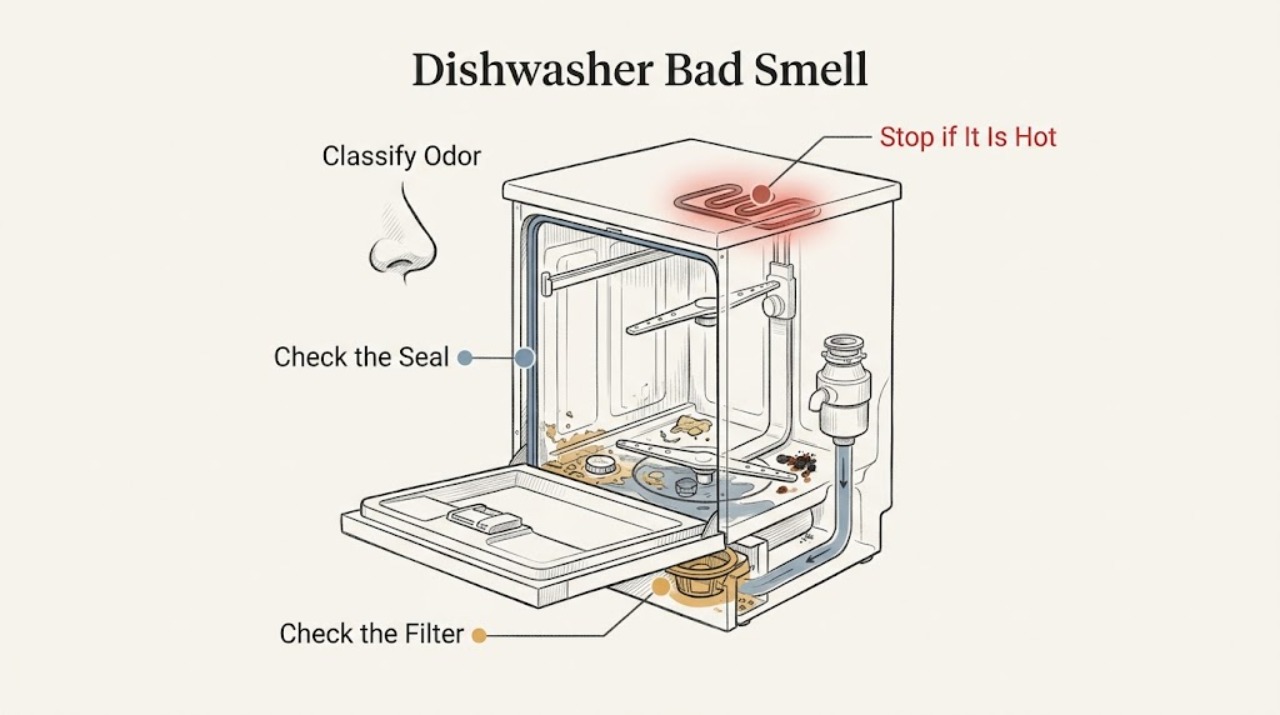
First identify whether the odor is food or musty, drain-related, a new plastic or petroleum smell, or a charred/burning smell. For a food odor, inspect the bottom of the tub and the filter system that your exact Amana model uses, wipe the door gasket and tub, and run an Amana-recommended cleaning cycle. If the dishwasher drain connects to a garbage disposal, clear debris there too. New plastic odor can dissipate in about two weeks and petroleum odor in four to six weeks, but smoke, active melting, a recurring burning smell, a leak, or odor that returns after cleaning is a reason to stop using the dishwasher and arrange qualified service.
Work through in order
Diagnostic checks
Use only checks that match the exact appliance or system and its official guide.
-
Check 1
With the dishwasher stopped and cool, note when the odor appears and what it resembles: food or musty odor after the door has been closed, odor strongest during draining, new plastic, hot-tar or petroleum, varnish-like motor odor, or charred/burning odor. Also note standing water, smoke, melting, a leak, or loss of cleaning performance.
Expected result: The smell is food-like or musty; it follows draining and the sink or disposal smells too; it is a new plastic or petroleum odor; or it is charred, smoky, or accompanied by visible melting or a leak.
Next step: Use the residue and filter checks for food or musty odor, the drain/disposal check when the odor follows draining, and the new-odor guidance for a new plastic or petroleum smell. For smoke, active melting, a strong recurring burning smell, or a leak, stop using the dishwasher and arrange qualified service.
Stop if: Do not restart the dishwasher to reproduce smoke, sparking, active melting, or a burning odor.
Why this matters
Why: Food-like or musty odor makes residue, filter, stagnant-water, or drain-path checks more likely. A disposal-linked odor points outside the tub. New plastic or petroleum odor can be a normal break-in smell on a new dishwasher. Smoke, active melting, or a recurring burning smell is a safety escalation, not a cleaning diagnosis.
-
Check 2
Turn the dishwasher off, let hot parts cool, and use the exact Amana model instructions to identify the filter style. If the model has removable filters, inspect the bottom filter area and visible sump for food soil or foreign objects and rinse the filter under running water; if it has the maintenance-free design, inspect and empty only the accessible foreign-object cup as instructed.
Expected result: Food residue or an object is present in the filter area or cup; the filter is visibly damaged or will not lock; or the filter/cup and visible sump are clean and correctly seated.
Next step: Remove only loose accessible debris, rinse a removable filter as the model instructions allow, and reinstall every filter or cup fully. Continue to the interior cleaning check. If the filter is damaged, a cover will not lock, or debris is sharp or inaccessible, stop and arrange model-specific service.
Stop if: Do not operate the dishwasher without its required filters or cover, force the filter, or reach into an area containing suspected broken glass.
Why this matters
Why: Amana says trapped food can contribute to odors and that filter designs vary. A dirty filter or full foreign-object cup supports a residue or restricted-flow cause. A clean, intact, correctly seated system makes the interior and drain-path checks more important, but does not prove an internal pump or heater fault.
-
Check 3
With the tub empty and cool, wipe the bottom front of the tub, door gasket, door edge, spray-arm area, and accessible interior surfaces with a sponge or soft cloth and warm water. Then run one model-appropriate cleaning treatment: affresh Dishwasher Cleaner according to its package, or a white-vinegar rinse using two cups in a glass or dishwasher-safe measuring cup on the lower rack, with no detergent and the dry option turned off where the model provides that option.
Expected result: Visible residue is removed and the odor is gone after one cleaning; the odor is reduced but returns; or the odor is unchanged and there is still residue or mineral buildup.
Next step: If the smell improves, keep the filter and interior on Amana's regular maintenance schedule. If it returns, check drainage and the disposal connection. If it is unchanged, do not keep repeating vinegar treatments; record the odor pattern and arrange service if the drain and new-odor checks do not explain it.
Stop if: Do not mix cleaners or use vinegar repeatedly as a substitute for diagnosis; follow the exact model and product instructions.
Why this matters
Why: Residue on the tub, gasket, spray-arm area, or hidden wash path can support a food or buildup odor. A temporary improvement suggests residue or stagnant soil remains somewhere in the system. An unchanged odor after correct cleaning makes the drain/disposal path or a non-food odor category more likely.
-
Check 4
Look for water left across the tub after a completed cycle and note whether the odor is strongest near the drain or sink. If the dishwasher drain is connected to a garbage disposal, run the disposer to clear accessible debris as Amana recommends; inspect only accessible sink-side and drain openings for an obstruction without pulling out the dishwasher or disconnecting concealed plumbing.
Expected result: Standing water remains; the sink or disposal also smells or drains slowly; debris is present at an accessible connection; or the tub is dry enough and the sink-side path is clear.
Next step: Clear only accessible debris and run one normal, model-appropriate cycle to observe whether the odor and water level improve. If standing water persists, a leak is present, or the odor returns with a clear path, stop troubleshooting and arrange qualified service for model-specific drainage diagnosis.
Stop if: Do not disassemble concealed plumbing, pull out an integrated dishwasher, or keep running cycles with a leak or substantial standing water.
Why this matters
Why: Stagnant water or a blocked filter/drain path can feed an odor. When the disposal or sink shares the smell, the source may be the connected discharge path rather than the dishwasher interior. A clear path with a persistent odor does not identify an internal component by itself.
-
Check 5
If the dishwasher is newly installed or newly used and the smell is plastic-like or hot-tar/petroleum-like rather than food-like, compare its age and odor pattern with Amana's guidance. Keep the tub clean and use the model-appropriate cleaning treatment, but do not open panels to search for sound-deadening material or motor windings.
Expected result: The dishwasher is new and the plastic smell is fading; a petroleum smell is present on a new stainless-steel-tub model; or the odor is not fading, is present on an older appliance, or is accompanied by smoke, heat, or performance changes.
Next step: Monitor a new odor only while the dishwasher operates normally and the smell is fading within Amana's stated window. If the smell is not fading, starts suddenly, or is accompanied by smoke, melting, unusual heat, a leak, or a cycle problem, stop using the dishwasher and request qualified service.
Stop if: Do not continue operation when the odor is sharp, smoky, actively burning, or linked to visible damage.
Why this matters
Why: Amana describes new plastic odor as normally dissipating in about two weeks and hot-tar/petroleum odor as normally dissipating in four to six weeks. The time window is a limited normal-odor explanation, not proof that every chemical or burning smell is safe.
-
Check 6
For a melted-plastic or charred-food odor, leave the dishwasher off until it is completely cool. Only if there is no smoke, active melting, or visible damage, inspect the accessible area around the heating element for a fallen plastic item or food particle and remove loose debris with a nonmetallic utensil; do not open panels or touch the element.
Expected result: A cooled, loose plastic item or food particle is found and removed; no debris is found; the heating element or wiring appears damaged; or the odor, smoke, or melting returns on a later cycle.
Next step: If a loose item was safely removed and there is no damage, follow Amana's model-appropriate rinse or cleaning guidance once. If no cause is visible, any damage is present, or the smell returns, stop using the dishwasher and arrange qualified service.
Stop if: Do not use a metal tool, touch a hot element, restart with visible damage, or keep testing a recurring burning smell.
Why this matters
Why: Amana's odor guidance links this pattern to plastic or food around the heating element and says to clean only after the dishwasher has cooled. A damaged element, wiring, persistent smoke, or recurring odor cannot be safely diagnosed from the outside.
Use your observations
Decision map
Find the observation that best matches what you see, then follow the next safe action.
-
PATH 01Safety boundary
What you see
The odor is food-like or musty, appears after dishes sit, and food soil is visible in the tub, filter area, spray-arm area, or door gasket.
Do this next
Clean the model-appropriate filter or foreign-object cup, wipe the tub and gasket, then run one Amana-recommended cleaning treatment. If the odor returns, check for standing water and the drain/disposal connection.
Why this path and its safety boundary
Why it matters: Decomposing food soil or trapped residue is more likely than a confirmed failed component.
Safety stop: Do not run without a correctly installed filter or cover, and do not reach into sharp debris.
-
PATH 02Safety boundary
What you see
The odor is strongest after draining, standing water remains, or the sink/disposal connection shares the smell or drains slowly.
Do this next
Run the connected garbage disposal to clear accessible debris, inspect only accessible openings, and perform one controlled retest. Escalate if water remains, a leak appears, or the smell persists with a clear path.
Why this path and its safety boundary
Why it matters: Stagnant water or an accessible obstruction in the shared discharge path is more likely than residue alone.
Safety stop: Do not pull out the dishwasher or disassemble concealed plumbing to continue a smell diagnosis.
-
PATH 03Safety boundary
What you see
The dishwasher is new and the odor is plastic-like or hot-tar/petroleum-like, with no smoke, melting, leak, or change in operation.
Do this next
Use the model-appropriate cleaning treatment and monitor whether the smell fades within about two weeks for plastic or four to six weeks for petroleum. Arrange service if it persists, intensifies, or is accompanied by a safety or performance symptom.
Why this path and its safety boundary
Why it matters: The pattern is consistent with Amana's limited normal break-in odor guidance, but it should fade rather than intensify.
Safety stop: Do not treat smoke, active burning, or visible melting as a normal new-appliance smell.
-
PATH 04Safety boundary
What you see
The smell is charred or burning, smoke or melting is visible, the heating-element area is damaged, or the odor returns after a safe cleaning and clear drain path.
Do this next
Stop using the dishwasher, keep it off, document the odor timing and any visible evidence, and arrange qualified Amana or appliance service. Do not order a heater or control board without a diagnosis and exact model fit.
Why this path and its safety boundary
Why it matters: The public checks do not establish whether the cause is a heater, wiring, motor, control, or another model-specific fault; continued operation can worsen damage.
Safety stop: Do not restart to reproduce the smell, remove panels, or handle energized or hot components.
Helpful context
Understand the symptom
The smell pattern determines the safe next check
A dishwasher that smells after sitting with food inside has a different starting point from one that smells only during a heated cycle. Amana's guidance covers decomposing food soils, stagnant water, new plastic, petroleum or hot-tar odor, and varnish-like motor odor as separate possibilities. Do not order a pump, heater, or control part from the word "smell" alone; first record when the odor occurs and whether there is standing water, visible residue, smoke, or a change in cleaning performance.
Use the exact Amana model instructions for filter access
Amana dishwashers do not all use the same filter arrangement. Some have an upper and lower removable filter, while another design uses a foreign-object cup rather than a regularly cleaned filter. Use the model manual to identify the installed design, remove only accessible debris, and do not run the dishwasher if a filter or cover is not securely installed.
Cleaning is a controlled test, not a parts diagnosis
After removing loose food debris, clean the bottom front of the tub, door gasket, and accessible interior surfaces with a sponge and warm water. Amana describes either affresh Dishwasher Cleaner or a two-cup white-vinegar rinse; follow the product or model instructions, use no detergent with the vinegar rinse, and do not use vinegar so often that its acidity damages the appliance. If the odor remains after one proper cleaning, move to the drain/disposal check and then service escalation rather than repeatedly adding chemicals.
When checks do not resolve it
Need a professional?
Smoke, active melting, a recurring charred or burning smell, visible heating-element or wiring damage, or unusual heat is present., A leak or substantial standing water remains, or the odor returns after the filter, interior, and accessible drain/disposal checks., The smell is not fading within Amana's stated new-plastic or petroleum window, or the dishwasher also has a cycle or cleaning-performance problem.
Have this ready
- The complete Amana model and serial information, if available.
- The odor description, when it occurs, whether it follows draining or heated drying, and whether smoke, melting, standing water, or a leak was observed.
- The filter style, cleaning steps completed, whether the dishwasher drain connects to a garbage disposal, and what changed after the checks.
Common questions
FAQ
Why does my Amana dishwasher smell like food or mildew?
Amana says food soils can fall into the tub or other dishwasher areas and decompose. Check the model-appropriate filter or foreign-object cup, the bottom of the tub, spray-arm area, and door gasket; then use one Amana-recommended cleaning treatment. If water remains or the odor follows draining, inspect the accessible drain/disposal path.
How do I clean an Amana dishwasher that smells bad?
Wipe the tub's bottom front, door gasket, and accessible interior with warm water. Amana describes using affresh Dishwasher Cleaner according to its instructions or a two-cup white-vinegar rinse in a glass on the lower rack; do not add detergent to the vinegar rinse and do not use vinegar too often.
Can a garbage disposal make my Amana dishwasher smell?
Yes. Amana says that when the dishwasher drain is connected to a garbage disposal, debris in the disposer can be the odor source. Run the disposer to clear accessible debris, then clean the dishwasher; persistent standing water or a recurring smell needs qualified service.
Is a plastic smell normal in a new Amana dishwasher?
Amana says a new plastic smell is normal and should dissipate in about two weeks. A hot-tar or petroleum smell in a new dishwasher may also be normal and should dissipate in four to six weeks. Stop using the appliance if the odor is smoky, actively burning, accompanied by melting, or not fading.
Should I keep running an Amana dishwasher that smells burnt?
No. Keep it off if there is smoke, active melting, visible damage, or a recurring burning smell. Once it is completely cool, Amana's guidance permits a cautious check for loose plastic or food around the heating element with a nonmetallic utensil, but persistent or unexplained burning odor requires qualified service.
Read the exact guide
Official sources
- Melted Plastic or Charred Food Odor - DishwasherAmana · Cooling before checking the heating-element area, nonmetallic removal of loose debris, and dishwasher-safe plastic placement
- Cleaning the DishwasherAmana · Tub bottom, door gaskets, warm-water cleaning, vinegar rinse, and affresh cleaner
- Food Odors - DishwasherAmana · Food soils, rinse cycle for infrequent use, vinegar rinse, and monthly affresh Dishwasher Cleaner
- Plastic Tub Odor - DishwasherAmana · Normal new plastic smell, approximate two-week dissipation, affresh and vinegar-rinse guidance
- Cleaning the Removable Filtration System - DishwasherAmana · Foreign-object removal, removable filter cleaning, maintenance-free cup, monthly cleaning, and correct filter installation
- Dishwashers Troubleshooting Cleaning IssuesAmana · Food odors, cleaning cycle, vinegar rinse, and odor from a garbage-disposal connection
- Hot tar or Petroleum Like Odor - DishwasherAmana · Normal new-dishwasher petroleum odor and approximate four-to-six-week dissipation
- Cleaning the Dishwasher InteriorAmana · Food, grease, mineral residue, affresh treatment, and measured vinegar rinse
- Odor From Garbage Disposal - DishwasherAmana · Accessible disposer debris and cleaning the dishwasher/disposer with affresh
- Removing Odors in your DishwasherAmana · Food debris in filter or spray arms, stagnant water, door seals, drain/disposer checks, and odor-maintenance guidance
Community feedback
Share a repair observation
Share a plain-text repair observation. Accepted observations are published automatically; this page may take a moment to update.