
On this page
Start here
Quick answer
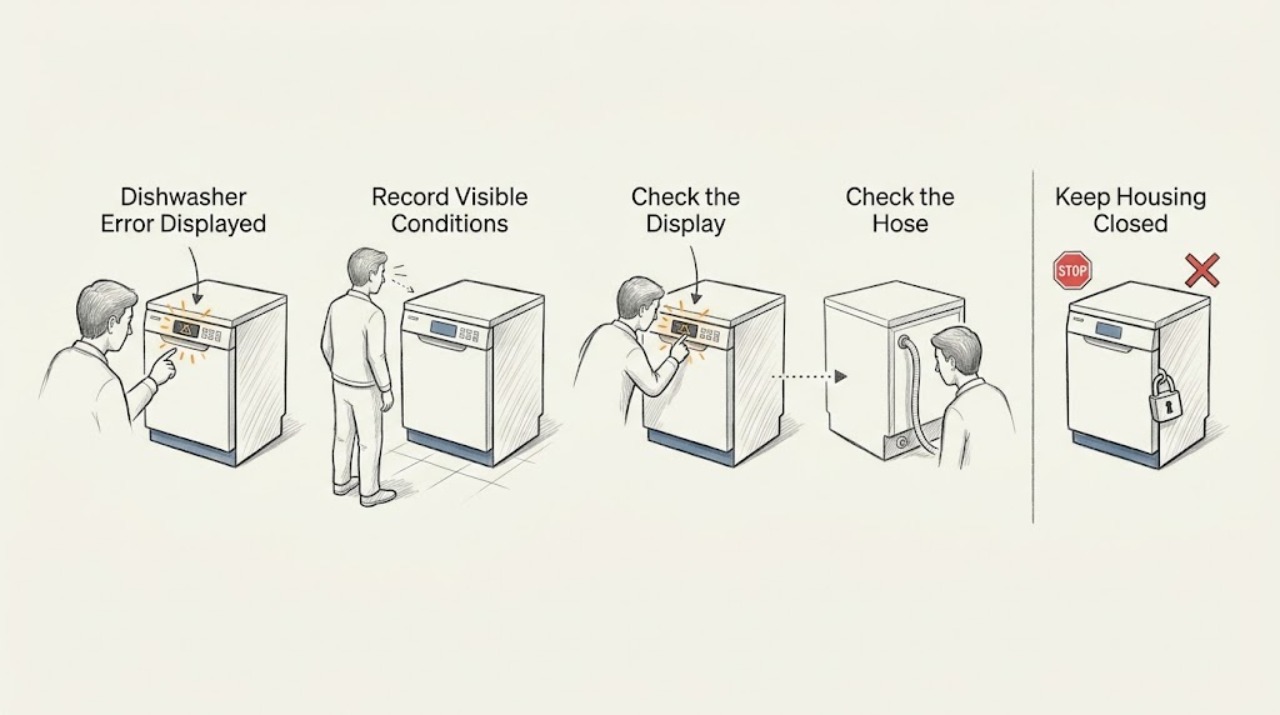
Treat a Beko dishwasher error display as a clue, not as a universal code: write down the exact characters or lights and the dishwasher model before choosing a fix, because the code table is model-specific. Check only the external power, door, and water-supply conditions described in your model manual. If the display is accompanied by overflow or a leak, stop the machine, close the accessible water supply, and arrange authorized service; if the same error returns after the documented user reset, stop repeating resets and arrange service.
Before you begin
Safety first
- Do not remove panels, probe live wiring, disconnect hidden water hoses, bypass the door latch, or restart a leaking or overflowed dishwasher.
Work through in order
Diagnostic checks
Use only checks that match the exact appliance or system and its official guide.
-
Check 1
Write down the exact error characters, blinking lights, or symbols and find the dishwasher's model or article number before clearing anything; use that identity to open the matching Beko manual.
Expected result: The display gives a complete code and the model number is available, or the display is ambiguous or the model cannot be identified.
Next step: If the code or model is unclear, photograph the panel and arrange Beko or authorized service rather than guessing at a code meaning. Do not publish or order a part from the code alone.
Why this matters
Why: A complete code tied to the correct model can narrow the next check. An incomplete code or an unknown model makes a generic code table unreliable.
-
Check 2
Check whether the dishwasher's display and controls have power; if the display is dark, check the household lights and another electrical appliance, then leave electrical repairs to a qualified electrician.
Expected result: The dishwasher display is lit and responds, or it stays dark while other household power works.
Next step: If the display remains dark, do not open the appliance or test live wiring; arrange qualified electrical or appliance service. If it is responsive, continue with the water and door checks.
Why this matters
Why: A lit, responsive display means the error can be read and investigated through the model manual. A dark display with power elsewhere points toward the appliance supply or fuse rather than a wash-program setting.
-
Check 3
For a water-related code or a dishwasher that does not fill, check that the accessible water-supply tap is fully open and that the visible inlet hose is not kinked or crushed.
Expected result: The tap is closed, the hose is visibly restricted, or both look normal but the error remains and no water enters.
Next step: Correct only an obvious external tap or hose position and retry once according to the model manual. If the warning remains, stop and arrange authorized service or a plumbing assessment; do not remove the inlet connection under the cabinet.
Why this matters
Why: A closed tap or crushed hose can explain a water-inlet warning. If the external supply looks normal but the warning persists, the cause may be inside the appliance or in the home's water supply.
-
Check 4
Check the door without forcing it: close it firmly and listen for the locking sound, then look for a visible crack or a rack or dish preventing the door from seating.
Expected result: The door closes and locks, or it remains ajar, will not latch, or shows visible damage.
Next step: Remove only visible loading interference and repeat the documented start sequence once. If the latch will not work or the door is cracked, stop using the dishwasher and contact an authorized service agent.
Why this matters
Why: A Beko dishwasher will not start when it detects an open door, so a closure problem can leave an error or warning on the display. A damaged or non-latching door is a hardware and safety issue.
-
Check 5
Look for water in or around the dishwasher before attempting a reset; if the display indicates overflow or there is active leakage, stop the program and close the accessible main water supply.
Expected result: There is no water or leak visible, or water is present in the base area or around the appliance.
Next step: Do not restart a leaking or overflowed dishwasher and do not remove panels or attempt to dry hidden components. Keep the water supply off and arrange authorized appliance service.
Why this matters
Why: An overflow or leak warning is a water-safety condition, not a normal reminder to keep restarting. Beko model documentation directs the user to shut off water and contact service for persistent chassis-fill faults.
-
Check 6
If the correct model manual provides a user reset for the displayed code, perform that reset exactly once and record whether the code disappears before starting another cycle.
Expected result: The code clears and the dishwasher completes the next start check, or the same code returns or the dishwasher remains in an error state.
Next step: Stop repeating resets when the code returns. Give the service agent the exact code, model number, visible symptoms, and the checks already completed.
Why this matters
Why: A cleared code may have been a temporary condition, but a recurring or persistent code is evidence that the underlying fault remains.
Use your observations
Decision map
Find the observation that best matches what you see, then follow the next safe action.
-
PATH 01Next step
What you see
The display is accompanied by overflow, a leak, or water collecting around the dishwasher.
Do this next
Stop the program, close the accessible main water supply, and arrange authorized appliance service. Do not open panels or restart to see whether the warning clears.
Why this path and its safety boundary
Why it matters: This is a water-safety branch, and continuing to run or reset the machine could worsen the condition.
-
PATH 02Next step
What you see
A water-related code is present, the tap is open, and the visible inlet hose is not kinked, but no water enters.
Do this next
Stop after the external check and arrange authorized appliance service or a plumbing assessment rather than disconnecting the hose under the cabinet.
Why this path and its safety boundary
Why it matters: The obvious external supply restriction is not confirmed; the remaining fault may be in the appliance or the household supply.
-
PATH 03Next step
What you see
The display is lit, there is no leak, but the door does not latch or the dishwasher reports an open-door condition.
Do this next
Remove visible rack or dish interference and retry once. If the door still will not lock, stop using the appliance and contact an authorized service agent.
Why this path and its safety boundary
Why it matters: The appliance is withholding the cycle because the door-closure condition is not satisfied; a damaged latch is not a setting problem.
-
PATH 04Next step
What you see
The display is dark while other household electrical devices work, or the breaker or fuse will not hold.
Do this next
Leave electrical diagnosis to a qualified electrician or appliance technician. Do not remove the dishwasher enclosure or probe its wiring.
Why this path and its safety boundary
Why it matters: The symptom points to the appliance supply or a technical electrical fault rather than an error-code interpretation.
-
PATH 05Next step
What you see
The code clears only temporarily, returns after the correct model reset, or cannot be matched confidently to the model.
Do this next
Stop using the dishwasher and give authorized service the photographed display, model or article number, and the observed water, door, and power conditions.
Why this path and its safety boundary
Why it matters: The machine needs a model-specific diagnosis; repeated generic resets can hide a continuing water, sensor, door, or control fault.
Helpful context
Understand the symptom
Why the exact code matters
A short code, a blinking program light, and a water or overflow symbol do not all point to the same check. Beko's published model documentation gives separate handling for water-filling, water-outage, sensor, and flow-meter warnings, so do not apply a code table from a different model. Keep the exact display and model information for the manual or service visit.
Keep error handling external and safe
Use the controls, the visible door area, the accessible water tap, and the household power check only. Do not remove panels, probe wiring, pull an integrated dishwasher out to reach hoses, or bypass a latch. A persistent error is a service decision, not a reason to keep forcing cycles.
When checks do not resolve it
Need a professional?
Contact authorized Beko service when an error returns after the correct model procedure, the code cannot be identified, the door will not latch, the display stays dark, the appliance will not fill with the external supply open, or any overflow or leak is present.
Safety scope: Do not remove panels, probe live wiring, disconnect hidden water hoses, bypass the door latch, or restart a leaking or overflowed dishwasher.
Have this ready
- Provide the exact model or article number, a photo or transcription of the display, whether the panel responds, whether the door locks, whether the tap is open, and whether any water or leak was observed.
Common questions
FAQ
Can I use any Beko dishwasher error-code list for my machine?
No. Start with the exact model or article number and its matching manual. Beko's model documentation assigns different causes and actions to different displayed codes, so an unrelated table can send you to the wrong check.
What should I check when the Beko error looks related to water?
Check that the accessible water tap is fully open and that the visible inlet hose is not kinked or crushed. If the external supply looks normal but the error remains or no water enters, stop and arrange authorized service or a plumbing assessment.
Why does a Beko dishwasher show an error and refuse to start when the door looks closed?
The appliance may not be detecting a secure closure. Close the door firmly, listen for the locking sound, and remove visible rack or dish interference. If the latch does not work or the door is damaged, contact an authorized service agent.
What if the error disappears but comes back?
Treat a returning error as an unresolved fault. Stop repeating resets, keep the exact code and model number, and contact authorized service. For an overflow or active leak, stop the machine and close the accessible water supply first.
Read the exact guide
Official sources
- How to fix a dishwasher that won’t startBeko · Beko dishwasher power, water-supply, door-closure, and service troubleshooting
- Why is my Beko dishwasher not filling with water?Beko UK · Beko dishwasher water inlet checks and service boundary
- Hata Kodları, Sebepleri ve ÇözümlerBeko · Beko dishwasher error-code examples and escalation instructions for the documented model family; do not generalize codes to another model
Community feedback
Share a repair observation
Share a plain-text repair observation. Accepted observations are published automatically; this page may take a moment to update.