
On this page
Start here
Quick answer
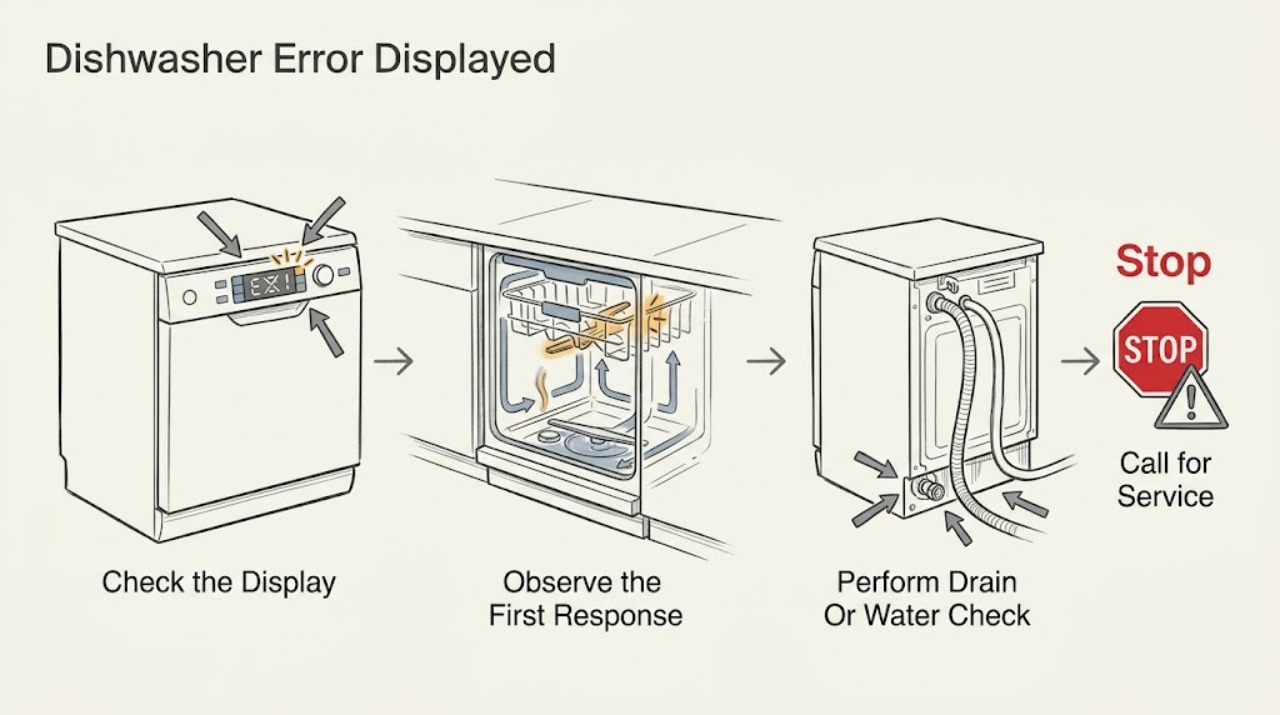
An Amana dishwasher error display is a symptom, not one universal diagnosis. Record the exact digital code or the two-part flashing pattern, then match it to the exact model manual. Amana's published examples include F9E1 for a long-drain condition, H20 for water not detected, F8E4 for water in the drip tray, and F7E2 or F6E1 for motor or user-interface/control concerns. Perform only the matching ordinary check—such as a filter, drain hose, sink disposer knockout plug, water supply, or visible leak check—and use one model-appropriate power cycle if instructed. If the code returns, the panel remains unresponsive, water is present under the unit, or electrical or wiring access is needed, stop and arrange qualified service.
Before you begin
Safety first
- This article supports reading the display or flash sequence, model-manual matching, ordinary accessible filter/hose/valve/connection checks, visible leak observation, and one documented power cycle. It does not authorize service diagnostics, live electrical testing, hidden plumbing, base access, safety bypassing, or guessed parts replacement.
Work through in order
Diagnostic checks
Use only checks that match the exact appliance or system and its official guide.
-
Check 1
With the dishwasher stopped and the door closed unless the model requires otherwise, photograph the digital error or observe the clean/status light sequence. For flashing lights, count both groups and the pauses until the pattern repeats; record whether the display is steady, flashing, or blank.
Expected result: A complete F#E# code is visible, a two-part flash pattern repeats, only a generic warning is visible, or the panel is unresponsive.
Next step: Keep the code, model number, cycle, water level, and point at which the error appeared together, then select the matching check below. If the panel is unresponsive, check Control Lock and use only the documented reset path.
Stop if: Do not open the control housing, remove wiring, or keep restarting the dishwasher while a leak, smoke, burning smell, or electrical hazard is present.
Why this matters
Why: A complete code or repeatable two-part pattern can be matched to the model manual and Amana's code categories. A partial pattern, generic warning, or unresponsive panel is not enough to identify a component.
-
Check 2
Match the complete code to the exact Amana model manual and compare it with the published code categories: F9E1 long drain, H20 water not detected, F8E4 water in the drip tray, F7E2 wash-motor error, or F6E1 user-interface/main-control concern.
Expected result: The exact model manual confirms one of those categories, gives a different meaning, or does not list the code.
Next step: Follow only the manual's user-level instruction for the confirmed category. For an unlisted or conflicting code, provide the code and model to Amana or a qualified technician.
Stop if: Do not substitute a code from another Amana series, convert a flash count into a different code, or bypass an alarm because the machine still accepts buttons.
Why this matters
Why: A confirmed model match supports the corresponding low-risk check. A different or unlisted code means the public examples cannot safely explain the fault; do not infer a part from a similar-looking code.
-
Check 3
If the confirmed code is F9E1 or another model-specific drain category, inspect the removable filter, visible drain route, sink disposer or air gap if fitted, and hose for a kink, pinch, clog, or new-installation knockout plug. If the confirmed code is H20, inspect the accessible water-supply valve and inlet hose for an off valve or kink without disconnecting a pressurized line.
Expected result: The filter or route is obstructed, the disposer knockout plug remains, the water valve is closed or hose kinked, or the accessible paths are clear.
Next step: Correct only the accessible condition allowed by the exact installation or user manual, then perform one suitable retest. If access requires moving the unit, disconnecting plumbing, or opening panels, stop and arrange service.
Stop if: Do not pull out an integrated dishwasher, cut or disconnect hoses, reach into energized parts, or run the unit with a leak or missing filter.
Why this matters
Why: The observed restriction supports a drain or fill-path cause, but clear external checks do not prove the pump, valve, sensor, or control is good or bad. An unlisted code must not be forced into an F9E1 or H20 diagnosis.
-
Check 4
If the confirmed code is F8E4 or the dishwasher shows water under the unit, inspect only visible water connections and the area the model identifies as the drip tray or float area. Do not tilt the appliance or remove its base to reach hidden water.
Expected result: Water is visible in or around the drip-tray area, a float or connection appears displaced, there is an active leak, or no visible leak is found.
Next step: Stop the cycle, shut off the water supply if accessible, disconnect power when safe, dry only the visible spill, and arrange qualified service to locate the leak or verify the float system.
Stop if: Do not tilt the dishwasher, bypass the float switch, open the base, or reconnect power while water is near electrical parts or the source is active.
Why this matters
Why: Amana associates F8E4 with water detected in the drip tray and suggests checking the tray, float-switch connection, and water connections. An active or hidden leak is a safety and damage concern, not a normal code-clearing exercise.
-
Check 5
For a code category whose manual or Amana guidance permits a reset, cancel the active cycle if possible, disconnect power for the documented interval, restore power, close the door firmly, and run one suitable test while observing the panel; Amana's general code guidance uses a 30-second power disconnection.
Expected result: The code clears and the cycle completes, the same code returns, a different code appears, or the panel remains locked or unresponsive.
Next step: Stop after one abnormal retest, record the new result, and arrange Amana or qualified appliance service with the complete code history and model information.
Stop if: Do not repeatedly power-cycle, defeat the door latch, enter service diagnostics, or run a leaking or electrically unsafe dishwasher.
Why this matters
Why: A one-time recovery can indicate a transient control state, but it does not prove the underlying condition is fixed. A recurring or changing code, or an unresponsive panel, requires the model-specific error path and likely service.
Use your observations
Decision map
Find the observation that best matches what you see, then follow the next safe action.
-
PATH 01Safety boundary
What you see
The complete code is F9E1 or the exact manual identifies a long-drain condition, and standing water or a mid-cycle stop is present.
Do this next
Perform only the accessible filter and drain-route checks, then one model-appropriate retest. If the code returns with a clear route, request service.
Why this path and its safety boundary
Why it matters: The supported first path is the filter, drain hose, disposer knockout plug, or air-gap check rather than immediate pump replacement.
Safety stop: Do not pull out the unit, cut a hose, or open the pump or control housing as a user test.
-
PATH 02Safety boundary
What you see
The complete code is H20 or the exact model manual identifies a water-not-detected condition.
Do this next
Confirm the valve is open and the accessible hose is not kinked, then follow the exact model's fill check. Arrange service if the code returns with a normal supply.
Why this path and its safety boundary
Why it matters: The water-supply valve and accessible inlet hose are the supported first checks; a water code is not evidence of a failed wash motor or control.
Safety stop: Do not disconnect a pressurized hose, alter the water inlet, or continue operating with a leak.
-
PATH 03Safety boundary
What you see
The complete code is F8E4, water is under the unit, or the model indicates water in a drip tray.
Do this next
Stop use, isolate water and power safely, and arrange service to locate and correct the leak or verify the float system.
Why this path and its safety boundary
Why it matters: Amana's code table associates this category with water in the drip tray and a float-switch or water-connection check; the immediate concern is leak protection and water damage.
Safety stop: Do not tilt, bypass, or dismantle the dishwasher base.
-
PATH 04Safety boundary
What you see
The code is F7E2, F6E1, unlisted, conflicting with the manual, or returns after one permitted power cycle and the relevant basic check.
Do this next
Stop experimenting and provide the code sequence, model, cycle stage, water level, and reset result to Amana or a qualified technician. Do not order a motor or control based on the code alone.
Why this path and its safety boundary
Why it matters: The published categories point toward wash-motor or user-interface/main-control concern for F7E2/F6E1, while an unknown code cannot be interpreted safely without the exact model.
Safety stop: Do not open the control or motor area, test live circuits, bypass a safety interlock, or keep running a machine with abnormal noise, heat, smoke, or water.
Helpful context
Understand the symptom
Read the entire code before choosing a repair path
On a digital Amana dishwasher, photograph the complete code rather than only the first letter or number. If the clean light flashes, count the first rapid group, note the short pause, count the second group, and wait for the longer pause before the sequence repeats. Amana says the first group is the function number and the second is the error number. A partial count can send you to the wrong check.
A code narrows the path but does not prove a failed part
The published Amana table uses categories and suggested checks, while also warning that exact codes vary by model. F9E1 points toward drainage checks; H20 points toward water supply; F8E4 points toward a drip-tray or leak-protection condition; F7E2 and F6E1 call for a power cycle and service if the error returns. Use the code as a branch selector, not as permission to replace a pump, motor, valve, or control by appearance.
Safety boundary
Stop conditions
- Stop and isolate the dishwasher for active leakage, water near electrical parts, smoke, burning smell, overheating, damaged wiring, or a breaker that trips again.
- Do not bypass a door latch, float switch, control lock, breaker, or other safety device; do not enter service diagnostics or test live wiring.
- Do not keep resetting a recurring code, run with a missing filter or leak, pull out an integrated unit, or disconnect hidden water or electrical connections as a generic fix.
- Arrange qualified service when the exact code is unlisted, a published code returns after one permitted reset and basic check, the panel remains unresponsive, or the suspected repair involves a motor, pump, valve, sensor, control, wiring, or water tray.
Only after diagnosis
Potential parts
- Amana dishwasher drain pump or drain assembly
Consider this category only if the exact model shows a confirmed drain code and qualified diagnosis finds the filter, hose, disposer or air gap, and accessible obstructions clear but the pump still fails.
Confirm the complete model, pump specification, connector, seal, and manufacturer's fit information; F9E1 alone does not prove pump failure. - Amana dishwasher water inlet valve
Consider this category only if a confirmed H20 or fill fault remains after the supply valve and accessible hose checks and qualified testing identifies the inlet valve.
Confirm the complete model, valve rating, connector, plumbing arrangement, and manufacturer's fit information; do not disconnect a pressurized line as a user test. - Amana dishwasher user interface or main control
Consider this category only if a confirmed F6E1 or other model-specific control fault returns after the documented power cycle and qualified diagnosis rules out supply, lock, door, and wiring causes.
Confirm the complete model, control revision, software or interface family, and manufacturer's fit information; do not substitute by connector appearance.
When checks do not resolve it
Need a professional?
Arrange Amana or qualified appliance service when an exact-model code is unlisted or returns after the documented user checks and one permitted power cycle, when F7E2/F6E1 persists, when F8E4 or a leak is present, when the panel remains unresponsive, or when diagnosis requires motor, pump, valve, sensor, control, wiring, base, or water-connection access.
Safety scope: This article supports reading the display or flash sequence, model-manual matching, ordinary accessible filter/hose/valve/connection checks, visible leak observation, and one documented power cycle. It does not authorize service diagnostics, live electrical testing, hidden plumbing, base access, safety bypassing, or guessed parts replacement.
Common questions
FAQ
How do I read an Amana dishwasher error code?
Photograph the complete digital F#E# code. If the clean light flashes, count the first rapid group, the pause, and the second rapid group until the longer pause repeats. Match the full result to the exact model manual; a partial count is not enough.
What does F9E1 mean on an Amana dishwasher?
Amana's published guide labels F9E1 as a long-drain or not-draining category. Check the filter, drain hose, sink disposer or knockout plug, and air gap if fitted, using the model instructions. If the code returns with a clear route, arrange service rather than assuming the drain pump is the failed part.
What does H20 mean on an Amana dishwasher?
The Amana code guide lists H20 as water not detected. Confirm that the water supply is on and the accessible supply hose is not kinked, then follow the exact model's fill guidance. A returning code needs service diagnosis.
Should I reset an Amana dishwasher when an error appears?
Only after recording the complete code and performing the matching ordinary check. Amana's general guide describes disconnecting power for 30 seconds, while some models also require Cancel/Drain or a particular restart. Use the exact manual and stop after one abnormal retest if the code returns.
Read the exact guide
Official sources
- Not Starting or Operating - Dishwasher - Product Help | AmanaAmana · Official Amana Product Help guide for dishwasher models with model-dependent controls and lock features; the exact owner's manual controls the sequence.
- Controls Not Responding - Dishwasher - Product Help | AmanaAmana · Official Amana Product Help guide for dishwasher controls. It warns that a locked control can look like no power and directs wiring or persistent control faults to the model installation instructions and service.
- Stops Mid Cycle - Dishwasher - Product Help | AmanaAmana · Official Amana Product Help fault tree for dishwasher cycle interruptions. Drain and control details remain model-dependent.
- Dishwasher Error Codes - Reading - Product Help | AmanaAmana · Official Amana Product Help guide for Amana dishwashers. It states that exact codes vary by model; the complete model manual controls interpretation and accessible repair steps.
Community feedback
Share a repair observation
Share a plain-text repair observation. Accepted observations are published automatically; this page may take a moment to update.