
On this page
Start here
Quick answer
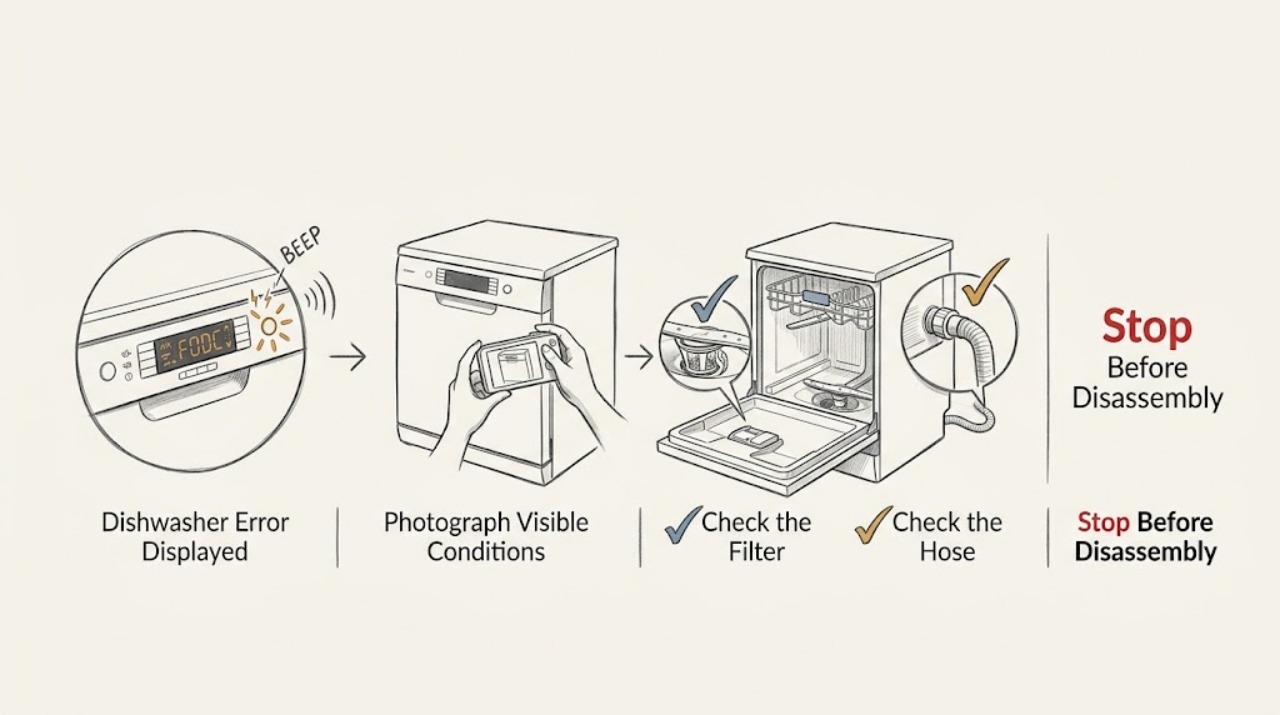
An AEG dishwasher error display is a symptom category, not one diagnosis. Record the complete code exactly as shown, or count the beeps or warning-light flashes, and note whether the dishwasher is filling, draining, washing, leaking, or heating. AEG groups common codes by monitored function: i10/i11 and similar codes indicate water-inlet trouble; i20 and similar codes indicate drainage trouble; i30 indicates a possible leak or anti-flood condition; i40-family codes point to pressure-sensor or water-level concerns; and i50-family codes point to the wash motor or pump. Use the matching AEG support article and the exact model manual. Stop and close the water tap for a leak or i30 pattern, and arrange authorised service when a code returns after the listed accessible checks or the appliance cannot be used safely.
Work through in order
Diagnostic checks
Use only checks that match the exact appliance or system and its official guide.
-
Check 1
Before clearing the display, record the complete error code, the number of beeps or LED flashes, the programme stage, and whether the dishwasher is filling, draining, washing, heating, or running its pump continuously. Photograph the panel and the rating plate showing the PNC and serial number.
Expected result: A full code is visible; only a beep or flash pattern is visible; the code is partly obscured; or several codes appear together.
Next step: If the code is readable, follow the matching branch below. If it is not readable, stop guessing and use the PNC to retrieve the exact AEG manual or support article. If multiple codes return, arrange service rather than treating one code as definitive.
Stop if: Stop using the dishwasher if water is leaking, the pump runs continuously with an i30 pattern, there is a burning smell, exposed wiring, or the appliance trips the electrical supply.
Why this matters
Why: The code or pattern selects the correct AEG troubleshooting family. A partial or mixed display cannot safely identify a component, and a repeated or multiple-code event needs the exact model information for service.
-
Check 2
For i10, i11, AL5, C1, or F1-style inlet indications, with the appliance safe to inspect, confirm that the water tap is fully open, the household supply flows, and the inlet hose is not kinked, twisted, or damaged. Close the tap before checking the small inlet-hose filter, and use the manual for its removal and cleaning instructions.
Expected result: The tap is closed or has weak supply; another water-using appliance is reducing flow; the inlet hose is kinked or damaged; the filter has scale or debris; or the inlet path appears clear.
Next step: If the tap, hose, or filter is the clear restriction, correct only that accessible issue as described by AEG and run a suitable programme once. If water does not flow at the household tap, contact the water supplier.
Stop if: If the inlet path is clear but the code returns, stop repeated cycles and arrange an approved service visit; do not replace the inlet valve without model-specific confirmation.
Why this matters
Why: AEG associates this family with insufficient water entering the dishwasher. A visible restriction is more likely than an internal valve failure, while a damaged hose requires an engineer and a clear path that still produces the code needs service diagnosis.
-
Check 3
For i20, C2, F2, or AL6-style drainage indications, check the sink spigot, dishwasher filters, sump, and the accessible drain hose. Look for a clogged connection, debris, a kink or twist, damage, or a recently moved dishwasher whose sink-trap blanking plug was never removed.
Expected result: The sink connection or filter/sump is blocked; the drain hose is kinked or incorrectly routed; the blanking plug remains in the sink trap; or the drain path is clear but the code persists.
Next step: Correct a visible blockage or installation error only when it can be done safely and according to the manual, then reconnect and run a suitable cycle. If the code returns or standing water remains, keep the appliance off and arrange service.
Stop if: Do not reach into standing water, dismantle the pump, or continue a cycle when water cannot be controlled.
Why this matters
Why: AEG defines this family as a drainage problem. A blockage or installation issue can explain the code without proving a failed drain pump; persistence after the accessible path is clear requires a technician.
-
Check 4
For an i30 pattern, or three beeps/flashes with constant low pump noise or visible leaking, close the water tap immediately. Check only the installation level, loading that could deflect a spray jet, clean filters/spray arms/sump, and the door gasket; then leave the dishwasher disconnected with the tap closed if the manual and AEG guidance permit an overnight dry-out.
Expected result: There is visible water, a wet base, a dirty gasket or sump, foam, a blocked spray arm, a large item deflecting water, or no visible cause and the i30 pattern returns.
Next step: Keep the tap closed and do not run the appliance until the source is addressed. If the code returns after the permitted dry-out and accessible checks, book an authorised repair and provide the code, leak timing, and observations.
Stop if: Do not tip the dishwasher, remove panels, or keep testing it with the water supply open when i30 or a leak recurs.
Why this matters
Why: AEG says i30 may indicate water collecting in the base and an anti-flood response. Loading, foam, or accessible contamination can contribute, but a recurring code means the underlying internal leak has not been established or repaired.
-
Check 5
For i40/i43/i44 or i50-family indications, use the exact AEG page for the code, disconnect mains power only as directed, and perform only the stated reset and accessible filter/sump cleaning. For i60-family, iF0-family, or an unlisted code, go directly to the AEG manual or model support search instead of borrowing a procedure from another family.
Expected result: The dishwasher completes a cycle after the supported reset and cleaning; the same code returns; foam or debris was present; or the code is i60/iF0-family or not listed.
Next step: If the cycle completes normally, monitor it and keep the code record. If the code returns, or the code is unlisted, stop DIY diagnosis and arrange authorised service with the PNC, serial number, and display evidence.
Stop if: Do not bypass a sensor, heater, pump protection, door interlock, or control, and do not test internal electrical parts unless qualified and the model manual explicitly supports that procedure.
Why this matters
Why: AEG links i40-family codes with pressure-sensor or water-level control and i50-family codes with wash motor/pump malfunction. A reset or clean sump can clear a temporary condition, but it cannot prove the sensor, pump, heater, or control board is sound.
Use your observations
Decision map
Find the observation that best matches what you see, then follow the next safe action.
-
PATH 01Next step
What you see
The display is readable and the programme behaviour matches a listed AEG family.
Do this next
Use the matching code branch and preserve the exact code and PNC for any service call. If the display is partial or mixed, use the manual/support search for the model instead.
Why this path and its safety boundary
Why it matters: The family narrows the next safe check: inlet, drainage, leak/anti-flood, pressure/water-level, or wash motor/pump. It does not identify a failed part by itself.
-
PATH 02Next step
What you see
The code is i10, i11, AL5, C1, or F1 and the dishwasher does not fill or fills slowly.
Do this next
Check the tap, household flow, hose, and inlet filter as AEG describes. A damaged hose or a clear path with a returning code goes to service.
Why this path and its safety boundary
Why it matters: A water-supply restriction, kinked hose, or inlet-filter blockage is more likely than a proven internal valve fault.
-
PATH 03Next step
What you see
The code is i20, C2, F2, or AL6 and water remains or the programme cannot drain.
Do this next
Clear only accessible restrictions and correct installation issues. If water remains or the code returns, leave the appliance off and arrange service.
Why this path and its safety boundary
Why it matters: The sink connection, filters/sump, hose routing, or a missing sink-trap plug can explain the result; a failed pump is not established from the code alone.
-
PATH 04Next step
What you see
The code is i30, the pump runs continuously, three beeps/flashes occur, or water is leaking.
Do this next
Close the water tap, keep the dishwasher off, and perform only the listed external checks. Arrange authorised repair if i30 returns or any leak remains.
Why this path and its safety boundary
Why it matters: AEG treats this as possible water in the base and an anti-flood response. Foam, loading, gasket, or accessible debris may contribute, but a recurring pattern points to an unresolved leak.
-
PATH 05Next step
What you see
The code is i40-family, i50-family, i60-family, iF0-family, or not listed, or it returns after the supported reset and filter/sump check.
Do this next
Record the code and PNC, stop repeated cycles, and contact an authorised AEG service provider. Do not substitute a similar-looking code or bypass a safety device.
Why this path and its safety boundary
Why it matters: The display identifies a monitored system but does not justify a part diagnosis. Persistent or unlisted errors need model-specific documentation and professional testing.
Helpful context
Understand the symptom
Start with the exact display, not a guessed code
“Error displayed” does not identify one failed part. AEG's overview covers codes, beeps, and flashing LEDs and sends each pattern to a separate troubleshooting path. Photograph or write down every character, including whether the first character is a lower-case-looking i, a capital I, a C, F, or a letter such as P. Also record the number of beeps or flashes, whether the pump is running, and where the programme stopped. If the code is not listed, use AEG's model support search rather than substituting a code that looks similar.
What the common AEG code families mean
AEG maps i10/i11 and related AL5, C1, or F1 patterns to a water-inlet problem; i20, C2, F2, or AL6 to drainage; i30 to water detected in the base or an anti-flood response; i40, i43, and i44 to pressure-sensor or water-level concerns; and the i50 family to a wash-motor or circulation-pump malfunction. The overview also lists i60-family codes for heating and iF0-family codes for water-level problems. These are diagnostic directions, not proof that a particular valve, pump, sensor, heater, or board has failed.
Keep checks within the user-accessible boundary
For water-inlet and drainage patterns, AEG's checks stay at the tap, hose, inlet filter, sink connection, drain hose, dishwasher filters, and sump. For i30, AEG says to close the water tap, check installation and loading, and inspect the filters, spray arms, sump, and door gasket before leaving the appliance off with the tap closed. For i40 and i50, AEG limits the first response to a reset and cleaning foam or debris from the filters and sump. Do not open the cabinet, test live wiring, or order a component merely because a code names a monitored function.
Use the exact model documentation for anything beyond these checks
AEG support pages apply to both freestanding and integrated dishwashers, but the display, code set, filter layout, and installation details can vary. Keep the full product number (PNC), serial number, market, and purchase information with the recorded code. AEG's own guidance directs users to the user manual or support search for unlisted patterns and to an authorised technician when the listed checks do not restore normal operation.
When checks do not resolve it
Need a professional?
An i30 pattern, visible leak, or continuous drain pump returns after the water tap is closed and the listed checks are completed., An i40-family or i50-family code returns after the supported reset and filter/sump cleaning., The code is i60-family, iF0-family, unlisted, or appears together with another code., The dishwasher has a damaged hose, standing water that cannot be controlled, burning smell, exposed wiring, or an electrical trip.
Have this ready
- The complete code or beep/flash count, a photo of the display, and the PNC and serial number from the rating plate.
- The selected programme, where it stopped, whether it filled, drained, washed, heated, or ran the pump continuously.
- Any water, foam, hose restriction, filter/sump debris, recent installation or move, and whether the code returned after a reset.
Common questions
FAQ
Can I diagnose an AEG dishwasher from the words “error displayed” alone?
No. AEG treats the displayed code, beep count, or flash pattern as the key discriminator. Record the full pattern and use the exact model support search; a generic reset or a guessed code can send the diagnosis down the wrong path.
What does an AEG i30 error usually mean?
AEG says i30 may indicate an internal leak with water collecting in the appliance base, often with three beeps or flashes, a constantly running drain pump, or visible leaking. Close the water tap, keep the dishwasher off, perform only the listed accessible checks, and arrange authorised service if the code returns.
What can I check for an AEG i10 or i20 code?
For i10/i11 and related inlet codes, check the open tap, household supply, inlet hose, and inlet filter. For i20 and related drainage codes, check the sink connection, filters and sump, drain-hose routing, and a recently installed sink-trap connection. Follow the relevant AEG page and stop for service if the code persists.
Does an i40 or i50 code prove that a part must be replaced?
No. AEG associates i40-family codes with a possible pressure-sensor or water-level-control fault and i50-family codes with a wash-motor or pump malfunction. AEG first recommends a model-appropriate reset and cleaning foam or debris from the filters and sump, then professional diagnosis if the code remains.
Read the exact guide
Official sources
- Dishwasher displays error code I20, C2, F2 or AL6, or beeps twice, not drainingAEG · AEG integrated and freestanding dishwashers with drainage errors or standing water
- Dishwasher displays error code i30AEG · AEG integrated and freestanding dishwashers showing i30, three beeps/flashes, constant pump noise, or leaking
- Dishwasher displays error code i40, i43 or i44AEG · AEG integrated and freestanding dishwashers showing i40/i41/i43/i44 or four beeps/flashes
- Dishwasher displays error code i10, i11, AL5, C1, beeps once, or the warning light flashes onceAEG · AEG integrated and freestanding dishwashers that do not fill or show the listed inlet code/beep/flash pattern
- Dishwasher displays error code i50AEG · AEG integrated and freestanding dishwashers showing i50-family codes or not washing
- Dishwasher displays an error code, how to fix it?AEG · AEG integrated and freestanding dishwashers with an error display or alert pattern
Community feedback
Share a repair observation
Share a plain-text repair observation. Accepted observations are published automatically; this page may take a moment to update.