
On this page
Start here
Quick answer
Do not diagnose from the word “error” alone: record the exact code or flashing-light pattern and the dishwasher model first. Bosch assigns different actions to different codes. E15 means the safety switch detected water in the base and calls for the water inflow to be turned off; E16/E17 point to water entering or filling; E22/E24/E25 can involve filters, the drain pump, or a kinked drain path; and some control or heater codes require a power reset or service. Follow only the matching Bosch instruction, then stop and arrange service if the code returns or indicates a leak, internal electrical fault, or unresolved pump problem.
Before you begin
Safety first
- Use the exact code-specific Bosch instruction. Turn off water for E15 or any active leak, and isolate power before cleaning an accessible filter or drain path. Do not tilt the dishwasher, open the base or control housing, probe live wiring or valves, or repeatedly run a machine with standing water, smoke, burning odor, or electrical noise.
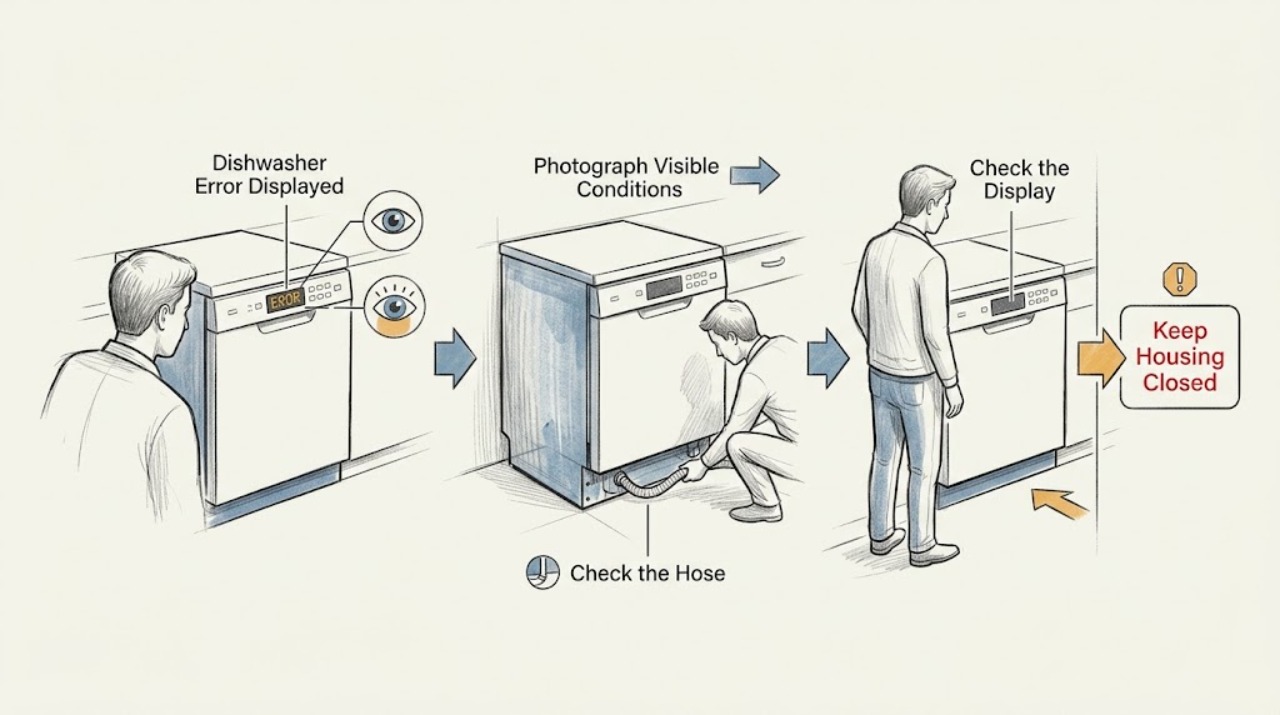
Work through in order
Diagnostic checks
Use only checks that match the exact appliance or system and its official guide.
-
Check 1
Record the exact code, punctuation, letters, numbers, or flashing-light combination, and photograph it before resetting the dishwasher. Find the model number on the rating plate or in the owner's manual and compare the code with Bosch's error-code list for that model family.
Expected result: The code matches a Bosch entry, only a generic E:XX or light pattern is visible, or the code is not listed for the model.
Next step: Use the exact model manual or Bosch's error-code support to identify the matching entry. If the code cannot be identified, leave the appliance off and contact Bosch support with the photograph and model details.
Why this matters
Why: A precise code determines whether the next safe step concerns water, draining, heating, a door sensor, or electronics. A generic or unlisted display cannot justify applying a different code's repair instructions.
-
Check 2
Check whether the display is E15, a flashing Active pattern, or another code that Bosch associates with water in the base or activated leakage protection. Do not run another cycle or remove the base; close the water inlet tap before further inspection.
Expected result: There is visible water, a leak, or an E15/leakage-protection indication, or there is no leak-related indication and the floor and connections are dry.
Next step: For E15 or a leak indication, keep the water inflow off and contact Bosch support. For a dry appliance with another code, follow that code's branch instead of assuming E15.
Why this matters
Why: Bosch says E15 means the safety switch detected water in the dishwasher base and that the leakage-protection system activated. This is a water-safety branch, not a filter-reset branch; a dry exterior does not prove the base is dry.
-
Check 3
For E16 or E17, inspect the accessible inlet hose for a kink, crush, or visible damage and confirm the water tap is open only when there is no leak. Do not disconnect a pressurised hose or access the inlet valve.
Expected result: The inlet hose is kinked or damaged, the water tap is closed, or the visible supply path is open and intact.
Next step: Restore a safe, unobstructed supply if the issue is only a closed tap or kink. If the code returns with a normal supply, stop and arrange service rather than replacing an inlet valve based on the code alone.
Why this matters
Why: Bosch describes E16/E17 as an issue with water flow into the dishwasher or filling system and specifically directs an inlet-hose check. A normal visible supply makes an internal fill or flow-sensing fault more likely.
-
Check 4
For E22, E24, E25, or a related drain indication, switch off the appliance and inspect the accessible filter for food debris and correct seating. Check the visible drain hose for a sharp kink and the air gap or sink connection for an accessible blockage, following the model manual. Do not reach into a pump with power connected.
Expected result: The filter is blocked or loose, the drain hose or air gap is obstructed, standing water remains, or the accessible drain path is clear.
Next step: Clean and refit only the accessible filter or hose path allowed by the manual, then use one test rinse if Bosch's code instructions permit it. If the code remains, leave the dishwasher isolated and arrange service; do not open the pump housing unless the exact manual explicitly makes that a safe user step.
Why this matters
Why: Bosch lists blocked filters, a blocked pump or loose pump cover, a kinked drain hose, and a clogged air gap or drain hose among causes for several drain codes. A clear accessible path with persistent code makes a hidden pump or control fault more likely.
-
Check 5
For a code that Bosch describes as a control, heater, heat-pump, door-sensor, low-voltage, or other technical fault, check the exact code instructions for a permitted breaker reset. If Bosch specifies a reset, switch off the breaker for the stated interval and restore power once; do not repeatedly reset a code accompanied by water, burning odor, or electrical symptoms.
Expected result: The code clears after the permitted reset, returns immediately, or Bosch's entry directs immediate support without a reset.
Next step: If the code returns or the appliance will not complete a cycle, turn off the water when appropriate, isolate power, and contact Bosch-authorised service with the code and reset result.
Why this matters
Why: A code that clears once may have been a temporary control state, but recurrence points to the underlying circuit, sensor, heater, or heat-pump fault. A code with an immediate service instruction should not be converted into a user repair.
Use your observations
Decision map
Find the observation that best matches what you see, then follow the next safe action.
-
PATH 01Next step
What you see
The display is E15 or a water-in-base/leakage-protection indication, especially with visible water or a leak.
Do this next
Keep the water supply off and do not tilt, open, or repeatedly run the dishwasher. Arrange Bosch service and report where water was observed.
Why this path and its safety boundary
Why it matters: This pattern indicates activated leakage protection rather than an ordinary filter reminder. Bosch specifically directs the water inflow to be turned off and support to be contacted.
-
PATH 02Next step
What you see
The code is E16/E17 and the inlet hose or water tap is visibly obstructed, or the water path is normal but the code returns.
Do this next
Use the machine only if the code clears and there is no leak. Otherwise leave it off and arrange service rather than disconnecting the inlet valve or changing parts.
Why this path and its safety boundary
Why it matters: Clearing a kink or opening a safe, closed tap supports a supply-path cause. Recurrence with normal supply makes an internal filling or flow-sensing problem more likely.
-
PATH 03Next step
What you see
The code is a drain family code such as E22/E24/E25 and the filter, visible hose, and accessible air gap are blocked or incorrectly fitted.
Do this next
Stop at the accessible checks and arrange service when the code remains. Do not run repeated cycles with standing water or open the pump area without model-specific authorization.
Why this path and its safety boundary
Why it matters: Improvement after the accessible correction supports a restricted drain path. Persistent standing water or a returning code makes a pump, pump-cover, hose, or control fault more likely.
-
PATH 04Next step
What you see
The code indicates a control, heater, heat-pump, door-sensor, or low-voltage fault, or the same error returns after Bosch's permitted reset.
Do this next
Isolate power and water as appropriate, do not open the control housing, and contact Bosch-authorised service with the exact code, model, and reset result.
Why this path and its safety boundary
Why it matters: This pattern is not safely distinguishable from an internal electronics, sensor, heater, or motor fault through user checks. A reset can clear a temporary state but does not establish that the component is sound.
Helpful context
Understand the symptom
An error display is a routing clue, not a diagnosis that can be safely guessed. Some Bosch codes identify water in the base or a filling problem, while others point to draining, heating, the door sensor, the heat pump, or the control board. Photograph the display before switching anything off, and use the exact model manual because code formats and available features vary by series.
Keep the first checks narrow and safe: turn off the water for a leak-related code, inspect only accessible hoses and filters, and use a breaker reset only when Bosch lists it for that code. Do not tilt the dishwasher, remove the base, probe a valve, or open the control housing to clear an error.
Only after diagnosis
Potential parts
- dishwasher drain pump assembly
Consider this only when a technician confirms a drain-family code persists after the filter, pump-cover, hose, and air-gap checks and identifies the drain pump as the failed component.
Confirm the full Bosch dishwasher model and the manufacturer's fit information before ordering; drain pumps are not interchangeable across all Bosch series.
When checks do not resolve it
Need a professional?
Arrange Bosch-authorised service for E15 or any water-in-base indication, for a code that returns after the permitted reset or accessible hose/filter check, for heater, heat-pump, control, door-sensor, or voltage faults, or whenever the appliance leaks, trips power, or cannot complete a programme.
Safety scope: Use the exact code-specific Bosch instruction. Turn off water for E15 or any active leak, and isolate power before cleaning an accessible filter or drain path. Do not tilt the dishwasher, open the base or control housing, probe live wiring or valves, or repeatedly run a machine with standing water, smoke, burning odor, or electrical noise.
Have this ready
- Provide the exact model and serial details, a photograph or transcription of the full code or flashing-light pattern, when it appears in the cycle, whether water remains or is leaking, the inlet and drain observations, and whether a Bosch-permitted reset changed the symptom.
Common questions
FAQ
What should I do when my Bosch dishwasher displays an error code?
Photograph the exact code and identify the dishwasher model before resetting anything. Match the code with Bosch's error-code list or the model manual, because E15, E16/E17, drain codes, and technical codes require different responses.
What does E15 mean on a Bosch dishwasher?
Bosch says E15 means the safety switch detected water in the base and activated leakage protection. Turn off the water inflow and contact Bosch support; do not tilt the dishwasher or keep running cycles to clear the code.
What do E16 and E17 mean on a Bosch dishwasher?
Bosch associates E16 and E17 with water flow into the dishwasher or its filling system. Check the accessible inlet hose for a kink or damage and seek support if the code returns with a normal water supply.
Can I reset a Bosch dishwasher error code at the breaker?
Only when Bosch's entry for that exact code specifies a reset, and follow the stated interval once. A reset that clears temporarily does not prove the fault is repaired; if the code returns, isolate the appliance as appropriate and arrange service.
Read the exact guide
Official sources
- E16 and E17 Bosch Dishwasher Error Codes - Dishwasher TroubleshootingBosch · Bosch E16/E17 water-inlet and filling-system response
- Use and Care Manual SHX4AEF5NBosch · Bosch dishwasher generic E:XX display explanation, filter/spray-arm checks, and model-specific manual boundary
- Dishwasher Error CodesBosch · Bosch dishwasher error-code meanings, code-specific checks, resets, water shutoff, and service boundaries
- Dishwasher Troubleshooting: E15 Bosch Dishwasher Error CodeBosch · Bosch E15 water-in-base and leakage-protection response
Community feedback
Share a repair observation
Share a plain-text repair observation. Accepted observations are published automatically; this page may take a moment to update.