
On this page
Start here
Quick answer
A grinding sound from a Frigidaire FFCD2413US3A during the cleaning cycle needs to be separated by timing and result before anyone names a pump. Frigidaire says a normal wash-pump hum starts and stops as spray arms alternate, a drain-pump hum is steady at first and changes as water leaves, and a tall dish, pan handle, or utensil can strike a spray arm. Start by listening from outside and recording whether the sound occurs during fill, spray/wash, draining, or a documented drying phase. After the appliance is off, cool, and safe, check rack clearance, the accessible filter or glass trap, standing water, and the visible drain hose for an obvious restriction or backup. If the sound is harsh, persists with a correctly loaded tub and clear visible path, or occurs with scraping, a leak, smoke, burning odor, sparks, a hot cord or plug, or repeated breaker operation, keep the dishwasher off and arrange qualified Frigidaire service. Do not open the cabinet, inspect the pump while energized, run the machine with the door open, lubricate a motor, or infer a pump replacement from sound alone.
Before you begin
Safety first
- Keep the dishwasher off for persistent grinding, retained water, an unresolved installation condition, or any leak, smoke, odor, heat, spark, or power symptom. Do not open panels, work on energized or wet parts, reach into the sump, or bypass a door safety control.
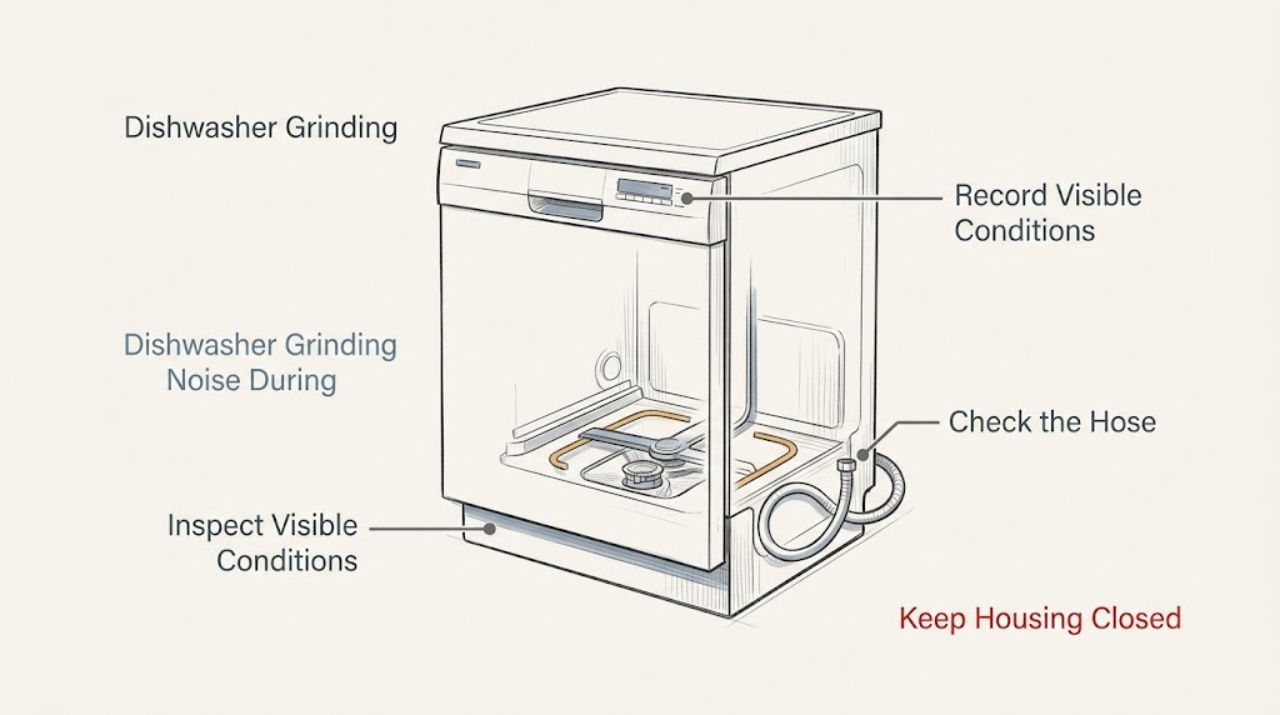
Work through in order
Diagnostic checks
Use only checks that match the exact appliance or system and its official guide.
-
Check 1
With the dishwasher closed, listen from outside during one non-hazardous observation and note when the grinding begins: fill, wash/spray, drain-out, dispenser release, or drying. Record whether it starts and stops with the stage, whether it is a hum/whoosh/knock or a harsh scrape, and whether water remains in the tub. Do not open the door while the machine is spraying or hot.
Expected result: The sound is a phase-linked hum or whoosh, a single knock during spray, a steady or fluctuating drain sound, or a continuous scraping/grinding sound unrelated to a phase.
Next step: Continue only with the appliance stopped and no leak or electrical hazard for a phase-linked, non-harsh sound. Keep the dishwasher off and arrange service for continuous, scraping, electrical, progressively louder, or hazardous noise.
Stop if: Do not open the door during a running or hot cycle, put hands or tools into the tub, or restart a dishwasher that is leaking, sparking, smoking, or tripping power.
Why this matters
Why: Frigidaire describes wash-pump hum as starting and stopping when spray arms alternate, drain-pump hum as changing as water is pumped out, and spray-arm whoosh as changing when levels switch. A persistent harsh sound is not explained by those normal descriptions and needs a stop-and-service path.
-
Check 2
After the cycle is stopped, spraying has settled, and the dishwasher is cool, pull the racks only as the FFCD2413US3A manual permits. Look for a tall plate, pan handle, utensil, or loose item protruding into a spray arm's path; with power off and no standing water hazard, turn each accessible spray arm gently by hand to check for obvious contact without forcing it.
Expected result: A rack item contacts or blocks an arm, an arm does not move freely, the arm and rack clear each other, or the noise persists despite clear clearance.
Next step: Remove or reposition only the accessible interfering item, keep handles within the rack profile, and run no more than one monitored normal cycle if the appliance is otherwise safe. Stop repeated tests when clear clearance does not change the sound.
Stop if: Do not force or remove a spray-arm hub, reach into the sump, check clearance while energized or hot, or use a utensil to dislodge an obstruction.
Why this matters
Why: Frigidaire identifies a tall dish, pot, pan, or utensil striking the spray arm as a cause of knocking or banging. Clear contact makes a load explanation more likely; free clearance with continued grinding shifts attention to the filter, drain result, installation, or qualified service rather than proving a pump fault.
-
Check 3
With the appliance off, cool, and safely isolated from use, inspect the tub bottom for standing water and clean only the user-accessible filter or glass trap identified by the exact model manual. Rinse and reinstall it correctly, and from outside inspect the visible drain hose for a kink, crushed section, dislodged connection, or household sink/standpipe backup. Do not disconnect the hose or remove a pump cover.
Expected result: Food debris, glass, or another visible object is in the filter/trap; the drain hose is visibly restricted or the household drain backs up; water remains after a cycle; or the filter and visible path are clear and the tub is empty.
Next step: Remove only safe accessible debris, refit the filter, and correct an obvious external hose position when the area is dry. Use plumbing help for an independent backup and appliance service for retained water, a leak, or recurring noise.
Stop if: Do not handle broken glass with bare hands, reach into the sump or pump, disconnect wet plumbing, or work where water could contact electrical parts.
Why this matters
Why: Frigidaire says debris can be trapped in the filter, glass trap, and spray arms, and its drain guidance says a clear drainage system matters when water covers the filter screen. Cleaning an accessible obstruction can change a drain-related sound, but an empty tub and clear path do not identify a pump or motor.
-
Check 4
Check the full model label and the exact manual for the FFCD2413US3A rack, spray-arm, filter, and drying layout. Note whether the noise occurs only during a documented drying or fan phase; do not assume Even Dry or Perfect Dry is installed just because another Frigidaire model has it. Also look from outside for cabinet movement or an installation condition that could amplify vibration without pulling the built-in unit out.
Expected result: The model manual confirms a phase-specific fan or drying sound, the unit shifts or vibrates, or the grinding persists through wash and drain despite stable visible installation.
Next step: Monitor only the documented phase if the sound is mild and no hazard is present. Have a qualified installer or appliance technician correct built-in stability or assess persistent noise; do not assign a fan, pump, or motor part from sound alone.
Stop if: Do not pull the dishwasher from its enclosure, loosen water or electrical connections, remove mounting panels, or conduct live measurements.
Why this matters
Why: Frigidaire limits fan-assisted Even Dry or Perfect Dry sounds to models equipped with those systems. A feature-specific sound can be normal for the matching model, while persistent grinding across phases is not explained by a drying feature and remains an internal or installation diagnosis.
-
Check 5
After the safe stage, rack, filter, drain, and model checks, keep the door closed and make at most one monitored cycle observation from outside if the noise is not hazardous. Record a short sound clip, stage and elapsed time, whether water was draining, final tub condition, load changes, filter findings, and any code, leak, odor, heat, sparks, or breaker event.
Expected result: The sound clears after reloading or accessible cleaning, remains as a harsh grind with a clear tub and path, changes with draining, or is accompanied by a leak or electrical/overheating sign.
Next step: Keep the dishwasher off and arrange qualified Frigidaire service for persistent noise, retained water, or any recurring abnormality. Provide the model, recording, stage, water result, load status, filter result, and hazard observations.
Stop if: Do not run with the door open, open the cabinet, test live parts, lubricate a motor, bypass a door safety control, or restart after smoke, sparks, burning odor, hot cord, leak near electrical parts, or repeated breaker operation.
Why this matters
Why: A corrected rack item or visible drain restriction can explain a knock or drain-related sound. A persistent harsh sound after those checks is a model-specific service problem; the pattern alone cannot distinguish a pump, motor, valve, bearing, fan, control, wiring, or installation issue.
Use your observations
Decision map
Find the observation that best matches what you see, then follow the next safe action.
-
PATH 01Next step
What you see
The sound is a mild hum or whoosh that follows wash spray or drain-out, with no scraping, leak, electrical symptom, or standing water.
Do this next
Monitor from outside and check rack clearance only after the appliance is stopped and cool. Arrange service if the sound becomes harsh, continuous, or progressively louder.
Why this path and its safety boundary
Why it matters: This matches Frigidaire's documented operating-sound patterns more closely than a proven failed pump.
-
PATH 02Next step
What you see
A tall dish, pan handle, utensil, or loose item contacts a spray arm and the noise clears after safe reloading.
Do this next
Keep items within the rack profile and run no more than one normal monitored cycle. Stop if the sound returns with clear arm travel or any hazard appears.
Why this path and its safety boundary
Why it matters: The load interference is the leading observable explanation; the sound did not establish a damaged spray arm or pump.
-
PATH 03Next step
What you see
The filter or glass trap contains debris, the visible drain hose is kinked, the household drain backs up, or water remains in the tub and the sound changes as water leaves.
Do this next
Clean and refit the accessible filter and correct only an obvious safe external hose condition. Use plumbing help for an independent backup and appliance service for retained water or recurring noise.
Why this path and its safety boundary
Why it matters: A user-level drain restriction or plumbing condition is more likely than a normal drain sound, although the pump itself cannot be diagnosed from this pattern.
-
PATH 04Next step
What you see
The FFCD2413US3A manual confirms a fan-assisted drying phase and the sound occurs only in that phase without harsh mechanical or electrical symptoms.
Do this next
Follow the exact manual and monitor only the documented phase. Escalate if the sound occurs outside it, becomes scraping or electrical, or grows louder.
Why this path and its safety boundary
Why it matters: A phase-specific fan sound may be normal for the equipped model, but a similar-looking Frigidaire dishwasher may use another design.
-
PATH 05Next step
What you see
Grinding or scraping persists with clear rack travel, clean accessible filter, empty tub or correct drain result, and a matched model manual, or it occurs with a leak, smoke, burning odor, hot cord, sparks, or repeated breaker operation.
Do this next
Keep the dishwasher off, isolate power only from a dry safe location when needed, and arrange qualified Frigidaire service with the recording and observations.
Why this path and its safety boundary
Why it matters: The ordinary load and visible drain explanations are insufficient; an internal pump, motor, valve, fan, bearing, control, wiring, or installation issue remains possible and cannot be safely isolated by sound alone.
Helpful context
Understand the symptom
Do not diagnose a dishwasher from the word grinding alone. The useful first split is whether the sound follows spray-arm movement or draining, whether it is caused by something in the rack, and whether water remains afterward. Frigidaire documents several normal sounds, but a harsh or worsening grinding pattern is outside that simple normal-sound description and should not be chased by repeatedly running cycles.
FFCD2413US3A is the assigned model identity. Frigidaire's Owner Center is the official model-based route for the correct manual; use the complete label before assuming that a filter, spray-arm mount, drying feature, or drain arrangement from another Frigidaire dishwasher applies. The checks below remain external and stop before a pump cover, wiring, or built-in installation is disturbed.
When checks do not resolve it
Need a professional?
Call qualified Frigidaire service for persistent harsh noise after the external checks, recurring drain trouble, an unidentified model-specific feature, or any electrical, water, or mechanical hazard. Call plumbing help for an independent household drain backup.
Safety scope: Keep the dishwasher off for persistent grinding, retained water, an unresolved installation condition, or any leak, smoke, odor, heat, spark, or power symptom. Do not open panels, work on energized or wet parts, reach into the sump, or bypass a door safety control.
Have this ready
- Provide Frigidaire FFCD2413US3A, a short sound recording, cycle stage and elapsed time, load and rack observations, filter or glass-trap findings, drain-hose and standing-water results, exact manual/feature match, and any leak, odor, heat, spark, or breaker observation.
Common questions
FAQ
Is grinding noise normal on a Frigidaire FFCD2413US3A dishwasher?
Some hum, whoosh, hiss, and changing drain sounds are documented normal operations, but a harsh or persistent grinding sound is not identified as normal by the Frigidaire noise guides. First separate spray-arm contact and visible drain debris; arrange service if the sound remains or becomes louder.
Could a dish cause the grinding sound?
A tall dish, pan, or utensil can strike a spray arm and cause knocking or banging. Stop the dishwasher, wait for heat and spray to settle, reload within the rack profile, and run no more than one safe monitored cycle. Do not force the arm or reach into a hot or energized tub.
Should I remove the drain pump to find the noise?
No. Frigidaire's public guidance supports external sound, load, filter, glass-trap, and visible drain checks, not a homeowner pump-removal or live test. A clear filter and empty tub do not prove which internal part is responsible; have qualified service assess persistent grinding.
What if the grinding happens only while draining?
Frigidaire says drain-pump hum is usually steady at first and fluctuates as water is pumped out. Check the final tub water level and only the accessible filter and visible drain route after the dishwasher is off and cool. If water remains or the harsh sound returns, stop and arrange appliance or plumbing service.
When should I stop using the FFCD2413US3A?
Stop for persistent grinding after the safe external checks, retained water, a failed rack or spray-arm condition, or any leak, smoke, burning odor, sparks, hot cord or plug, abnormal heat, or repeated breaker operation. Keep the dishwasher off and provide the service technician with the model and sound record.
Read the exact guide
Official sources
- Owner Center Resource LibraryFrigidaire · Opened Frigidaire's official Owner Center. It provides model/product support and an owner-resource search; use it to retrieve the FFCD2413US3A manual before assuming filter access, rack layout, or drying-feature behavior.
- Dishwashers - What are normal dishwasher operations sounds?Frigidaire · Opened official Frigidaire normal-sounds guidance. It states that filling, circulating water, and motor sounds can be normal and directs owners to check a dish, pot, pan, or utensil that interferes with a spray arm; fan guidance is limited to models equipped with Even Dry or Perfect Dry.
- Dishwasher - Not CleaningFrigidaire · Opened official Frigidaire dishwasher support article. It identifies debris trapped in the filter, glass trap, and spray arms and directs cleaning of those user-accessible areas; it does not authorize pump removal or a part diagnosis.
- Dishwasher - Noise GuideFrigidaire · Opened official Frigidaire dishwasher noise guide. It distinguishes fill hiss, wash-pump hum, drain-pump hum, dispenser/ball-valve clunks, spray-arm clunks, and spray-arm whoosh; it is a general guide and does not diagnose an FFCD2413US3A pump from sound alone.
- Why is water in the dishwasher after it runs?Frigidaire · Opened official Frigidaire water-after-cycle article. It distinguishes a small normal amount of water from water covering the filter screen and directs owners to check the drainage system for debris and consult the owner manual.
Community feedback
Share a repair observation
Share a plain-text repair observation. Accepted observations are published automatically; this page may take a moment to update.