
On this page
Start here
Quick answer
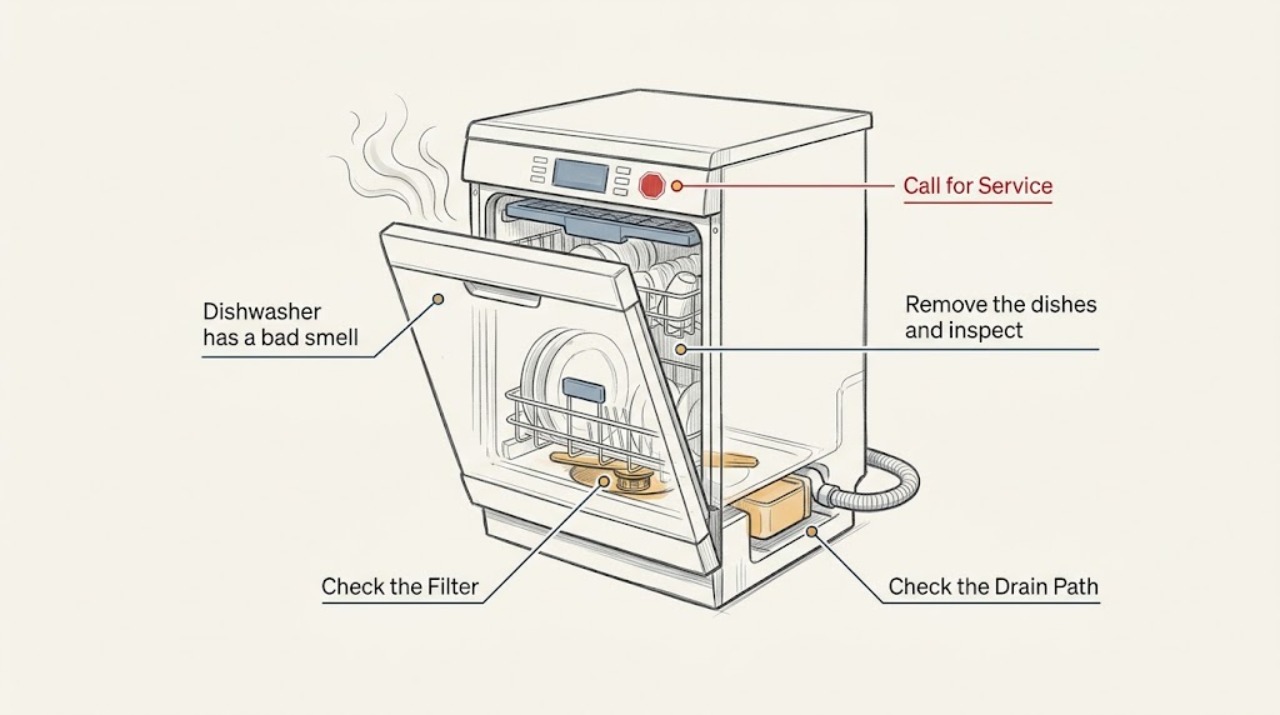
A bad smell from a Frigidaire dishwasher is commonly separated by timing, location, and whether water or food soil remains: a new-installation smell may be temporary, while odor from the filter, glass trap, sump area, or standing water points to trapped residue or a drainage issue. Remove dishes and visible loose debris, then with the dishwasher off and cool, clean the model-approved filter and glass trap. Check the visible drain hose, air gap if fitted, and disposer connection for a kink, backup, or installation problem. If the manual permits it, run the manufacturer’s empty cleaning method, such as the specified heavy cycle with sanitize or the stated vinegar method; do not mix cleaners. Persistent sewage, burning, smoke, leaking, standing water, or an odor that remains after safe cleaning needs qualified appliance or plumbing service.
Before you begin
Safety first
- Homeowner-safe checks are classifying the odor, removing dishes, looking for standing water, cleaning an accessible filter and glass trap only with the appliance isolated as directed, and inspecting visible drain routing. Internal pump, seal, wiring, control, plumbing disconnection, live testing, and moving the dishwasher belong to a qualified professional.
Work through in order
Diagnostic checks
Use only checks that match the exact appliance or system and its official guide.
-
Check 1
Run no further load yet; open the dishwasher from a safe position and note when the smell appears, whether it is sour/food-like, sewage-like, chemical, burning, or electrical, and whether it is strongest at the tub bottom, filter area, drain connection, or outside the machine.
Expected result: The smell is present only after a new installation, follows dishes left soiled, is concentrated near the filter with residue, occurs with standing water or a drain backup, or is sharp/burning/electrical.
Next step: For a mild new-unit or food-soil odor, continue with the safe residue and drain checks. For sewage odor with backup, burning/electrical odor, smoke, or heat damage, stop using the dishwasher and use the service boundary below.
Why this matters
Why: Timing and location separate a temporary new-unit or food-soil odor from trapped residue, poor drainage, or a hazard that should not be tested by another cycle.
-
Check 2
Remove the dishes and inspect the tub bottom for standing water, food particles, labels, or other loose debris without reaching blindly into the sump; keep the dishwasher off and avoid touching suspected glass or sharp fragments.
Expected result: The tub is dry with little residue, the filter area has food soil, standing water remains, or sharp debris is visible.
Next step: Remove only loose, safe-to-handle debris with suitable protection. Do not reach into a trap containing possible glass; continue to the model-approved filter procedure or arrange service if debris is lodged or the sump cannot be safely inspected.
Why this matters
Why: Food soil near the filter can create odor, while standing water makes a drain-path problem more likely. Sharp debris can injure someone or damage the pump if another cycle is started.
-
Check 3
With the dishwasher switched off, cool, and isolated from power as the exact manual directs, remove and inspect the accessible filter and glass trap; rinse them with warm water and use a soft brush only where the Frigidaire guide permits, then reinstall them fully.
Expected result: The filter or trap contains grease, food, scale, or fragments; it is clean; it is damaged or missing; or it will not seat correctly.
Next step: Refit a clean filter exactly as shown and check for a secure fit. Do not pry, puncture, discard, or bypass a filter; stop and arrange service if glass, damage, or an inaccessible obstruction remains.
Why this matters
Why: A dirty filter or trap can hold odor-causing residue. A missing, damaged, or poorly seated part can allow debris into the drain system and is not a reason to operate without filtration.
-
Check 4
Inspect the visible drain hose routing and, if the installation has one, the drain air gap and disposer connection without moving the appliance: look for a kink, crushing, standing-water backup, a blocked air gap, or a disposer knockout plug that was never removed.
Expected result: The hose is kinked or low, the air gap is blocked, the disposer connection is new or recently changed, a backup is present, or the visible drain setup looks correctly routed.
Next step: Correct only an obvious external routing issue using the installation instructions. Do not pull the dishwasher out alone or disconnect plumbing; arrange plumbing help for a backup and appliance service for an internal drain fault.
Why this matters
Why: Restricted or incorrectly installed drainage can leave water and odor in the dishwasher. A normal visible setup makes an internal pump, valve, or plumbing issue more likely, but the smell alone cannot identify a failed part.
-
Check 5
After the filter is secure and the visible drain setup is safe, follow the exact Frigidaire odor-cleaning method for the model with the dishwasher empty: use the specified heavy or sanitize cycle, or the stated one-cup white-vinegar method with no detergent, never combining cleaners.
Expected result: The cleaning cycle removes the odor, reduces it temporarily, leaves standing water, produces a new chemical or burning smell, or cannot complete normally.
Next step: Ventilate and wipe accessible moisture after the cycle, then test one normal load. Stop using the unit and arrange service if the odor returns quickly, the cycle fails, or any leak, smoke, or abnormal heat appears.
Why this matters
Why: A lasting improvement supports residue as the source. A return of odor, persistent water, abnormal cycle behavior, or a chemical/burning smell points beyond a simple cleaning need.
-
Check 6
If a normal cycle is attempted, observe from outside for complete draining, a new odor, unusual noise, error lights, leakage, or water left in the tub; do not repeatedly reset the dishwasher or start another cycle to mask the smell.
Expected result: The tub drains fully and stays odor-free, the smell returns with standing water, a drain-related light or code appears, water leaks, or the dishwasher makes an abnormal sound.
Next step: Record the model number, cycle, smell timing, filter condition, standing-water result, and any code. Leave the appliance off for recurring symptoms and arrange qualified appliance or plumbing service.
Why this matters
Why: A clean, complete drain with no returning odor supports a residue issue. Recurring water, a drain indication, leaks, or unusual noise can involve the drain path or an internal component and need diagnosis rather than repeated cleaning.
-
Check 7
If the smell remains after one model-approved cleaning and the drain setup is normal, document whether it is from the tub, drain connection, underside, or electrical area; do not open panels, test live wiring, or replace a pump based on odor alone.
Expected result: The smell persists with no visible residue, is sewage-like, comes from the underside or wiring area, or is accompanied by a leak, smoke, tripped breaker, or repeated drain failure.
Next step: Stop using the dishwasher, isolate water or power only when safe, and arrange qualified service. Provide the technician with the exact model, smell description, filter and drain findings, cycle behavior, and any error indication.
Why this matters
Why: Persistent odor can involve hidden residue, a plumbing connection, a drain pump or hose, a seal, or an electrical fault. The odor cannot safely identify which component failed.
Use your observations
Decision map
Find the observation that best matches what you see, then follow the next safe action.
-
PATH 01Next step
What you see
The dishwasher is newly installed or the odor occurred after dishes sat soiled, with no standing water, leak, or abnormal heat.
Do this next
Use a rinse-only cycle when a full load must wait, then follow the model-approved empty cleaning method and monitor one normal cycle.
Why this path and its safety boundary
Why it matters: A temporary new-unit or food-soil odor is more likely than a failed component.
-
PATH 02Next step
What you see
Food residue or odor is concentrated around a dirty filter or glass trap and the dishwasher drains normally.
Do this next
Isolate the appliance as directed, clean and fully reseat the filter and trap, then run one approved empty cleaning cycle; service any damaged or inaccessible part.
Why this path and its safety boundary
Why it matters: The filter or trap is the leading accessible source of the smell.
-
PATH 03Next step
What you see
Standing water, a drain backup, a blocked air gap, or a kinked/incorrectly routed hose accompanies the odor.
Do this next
Correct only a safe visible routing issue from the installation guide. Use plumbing or appliance service for a backup, disposer connection, internal blockage, or any need to move the unit.
Why this path and its safety boundary
Why it matters: The drain path or connected plumbing is more likely than surface residue alone.
-
PATH 04Next step
What you see
The smell is burning, electrical, or chemical, or there is smoke, arcing, a hot spot, a leak near wiring, or a repeated breaker trip.
Do this next
Stop use and leave the area for smoke, fire, or immediate danger. Disconnect power or close the water supply only if it can be done without contact with water or energized equipment, then arrange qualified help.
Why this path and its safety boundary
Why it matters: This may be an electrical, water, or chemical hazard and is outside homeowner cleaning checks.
-
PATH 05Next step
What you see
The filter is clean, the visible drain setup is normal, and the odor returns after the exact Frigidaire cleaning method or the dishwasher will not complete a drain.
Do this next
Leave the dishwasher off and arrange appliance service, or plumbing service if the household drain backs up. Do not select a replacement pump, hose, or seal from the odor symptom alone.
Why this path and its safety boundary
Why it matters: A hidden drain, seal, pump, plumbing, or control issue is possible; repeated cleaning is unlikely to establish the cause.
Helpful context
Understand the symptom
Identify the kind of smell before choosing a fix
A smell after a new installation or the first few cycles can differ from a sour or rotting-food odor that returns after every load. Odor concentrated at the filter or bottom of the tub suggests residue; odor with standing water or a drain backup points to the drain path. A sharp burning or electrical smell is a stop-use warning, not a cleaning problem. Frigidaire also notes that dishes left soiled for too long can create odor, and a rinse-only cycle can help when a full cycle must wait.
Clean the food-trapping areas carefully
The filter and glass trap are designed to catch food particles and hard debris, so they can smell when residue accumulates. Remove power before any work allowed by the manual, wait for hot water and parts to cool, and use care because the trap may contain broken glass, bones, or pits. Rinse and refit every filter exactly as the model guide shows; do not run the dishwasher with a filter missing or loose.
Treat drainage and cleaning chemicals as separate checks
Standing water can keep producing odor even after the tub is wiped. Check only the visible drain setup for kinks, a blocked air gap if present, or an unremoved disposer knockout plug; do not pull out the appliance alone. For an empty cleaning cycle, follow the exact Frigidaire instructions for the model. The odor guide gives either a specified heavy/sanitize cycle or one cup of white vinegar directly in the empty tub without detergent. Never combine vinegar, bleach, detergent, or other cleaners.
Safety boundary
Stop conditions
- Do not reach into the filter, glass trap, or sump when broken glass, bones, pits, or another sharp obstruction may be present. Do not run the dishwasher with a filter missing, damaged, or improperly seated.
- Do not mix vinegar, bleach, detergent, descaler, or other cleaning products, and do not add a cleaner unless the exact Frigidaire instructions permit it. Stop if a cleaning cycle creates a chemical, burning, or electrical smell.
- Stop use for standing water that will not drain, a household drain backup, a leaking hose or seal, water near electrical parts, repeated drain errors, or a breaker that trips again. Isolate water or power only when safe.
- Do not pull the dishwasher out alone, disconnect plumbing, open panels, test live wiring, or replace a pump, control, hose, or seal based only on an odor. These checks belong to qualified appliance or plumbing service.
- For smoke, fire, arcing, or immediate danger, leave the area and use emergency assistance from a safe location.
Only after diagnosis
Potential parts
- dishwasher filter and glass trap assembly
Consider this only if the exact model’s filter or glass trap is missing, cracked, warped, or will not seat after cleaning; odor alone does not prove replacement is needed.
Filter shape, trap design, locking tabs, and model fit vary. Confirm the complete Frigidaire model number and the manufacturer’s fit information before ordering or installing. - dishwasher drain hose
Consider this only when the hose is visibly kinked, crushed, leaking, or damaged and a model-specific diagnosis confirms the hose rather than the household drain is responsible.
Routing, connection ends, clamps, and installation requirements are model-specific; do not move or disconnect the dishwasher without appropriate help. - dishwasher drain pump
Consider this only after safe filter, drain-routing, and plumbing checks and a qualified diagnosis of incomplete draining or pump failure; a bad smell alone cannot identify a pump.
Pump geometry, wiring, seals, and control compatibility vary by model. Confirm fitment and electrical requirements from the exact manufacturer information.
When checks do not resolve it
Need a professional?
Safety scope: Homeowner-safe checks are classifying the odor, removing dishes, looking for standing water, cleaning an accessible filter and glass trap only with the appliance isolated as directed, and inspecting visible drain routing. Internal pump, seal, wiring, control, plumbing disconnection, live testing, and moving the dishwasher belong to a qualified professional.
Common questions
FAQ
Why does my Frigidaire dishwasher smell bad even after I run a cycle?
A dirty filter or glass trap, food left in the sump area, standing water, or a drain-routing problem can make odor return after a cycle. Clean the model-approved filter and check visible drainage before trying one manufacturer-approved empty cleaning method.
Is a smell from a new Frigidaire dishwasher normal?
Frigidaire says a smell during the first few cycles after installation can be normal. If it persists, becomes sewage-like, appears with standing water, or is accompanied by heat, smoke, or a leak, stop relying on repeated cycles and arrange service.
How do I clean the filter and glass trap in a Frigidaire dishwasher?
Use the exact model guide: isolate the dishwasher as directed, let hot parts cool, remove only the accessible filter and glass trap, rinse and gently brush away residue, then reinstall every piece securely. Use care because the trap can contain broken glass or other sharp debris, and never operate without the filter installed.
Can a drain problem cause a bad dishwasher smell?
Yes. Standing water, a kinked or incorrectly routed hose, a blocked air gap, a disposer knockout plug, or a household drain backup can leave odor in the machine. Check visible routing only; use plumbing or appliance service for a blockage, backup, or internal drain fault.
Can I use vinegar or bleach to remove the smell?
Follow the exact Frigidaire instructions for your model. The odor guide describes one cup of white vinegar in an empty tub with no detergent as one option, but cleaners must not be mixed, and bleach or other products should not be added unless the model instructions specifically allow them.
When should a bad-smelling dishwasher be serviced?
Arrange service when the odor returns after safe filter, drain, and model-approved cleaning checks, when standing water or a drain error remains, or when a pump, hose, seal, control, or wiring fault is possible. Stop immediately for smoke, burning or electrical odor, a leak near wiring, repeated breaker trips, or a household drain backup.
Read the exact guide
Official sources
- Dishwasher Glass Trap and Filter GuideFrigidaire Support · Frigidaire filter and glass-trap guide; component location and removal steps vary by model.
- Dishwashers - Not DrainingFrigidaire Support · Frigidaire dishwasher drainage guidance; hose routing, disposer connections, codes, and reset behavior vary by model and installation.
- Dishwasher - Why does my dishwasher have an odor and how do I fix it?Frigidaire Support · Frigidaire odor troubleshooting; new-unit behavior and exact cycle controls vary by model.
- Dishwasher - OdorsFrigidaire Support · Frigidaire dishwasher guidance; cycle names, filter access, and cleaning instructions vary by model.
Community feedback
Share a repair observation
Share a plain-text repair observation. Accepted observations are published automatically; this page may take a moment to update.