
On this page
Start here
Quick answer
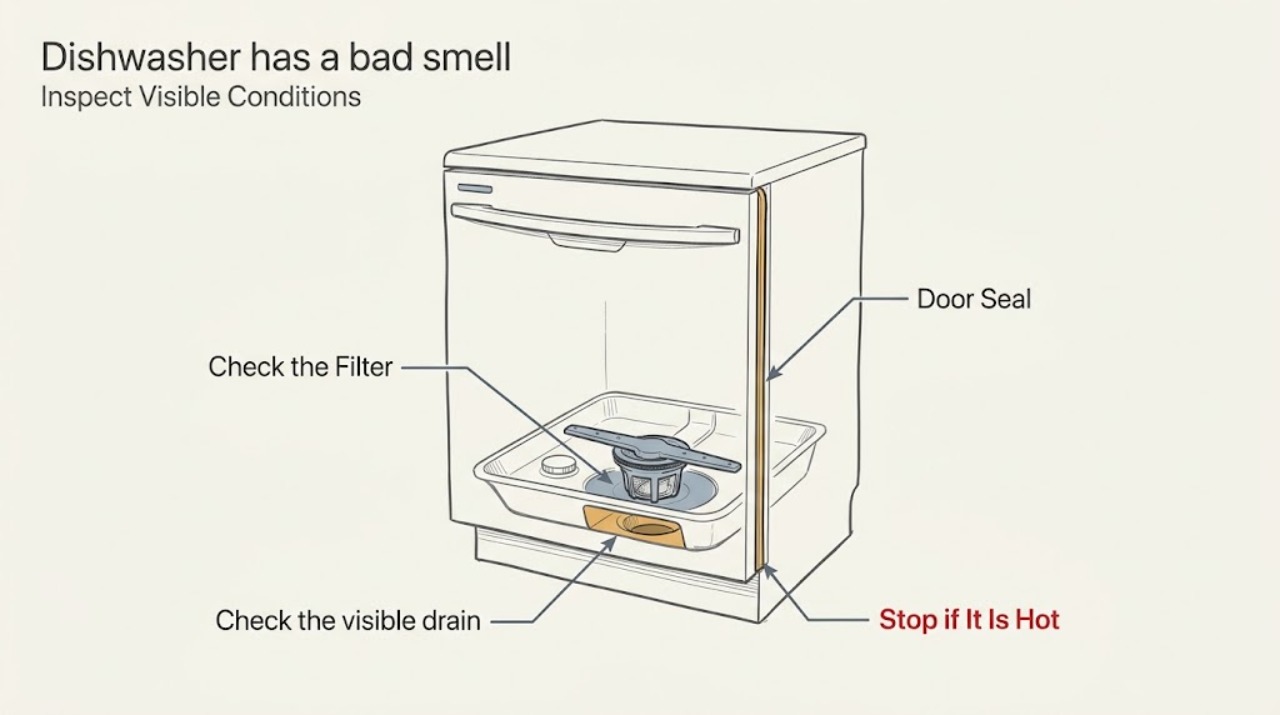
A bad dishwasher smell most often comes from food debris, stagnant water, a dirty filter or spray area, a door seal, or a drain path that is not clearing. Start with safe observations: note whether water remains in the filter area after a cycle, inspect the filter only if it is owner-accessible and the appliance is safely disconnected, look for visible debris at the bottom and door seal, and check the under-sink drain connection without disconnecting plumbing. Improve loading and cycle habits according to the manual. Do not mix chemicals, use drain opener, reach into an unverified pump area, open internal panels, or perform live electrical work. If odor persists, water remains, the unit smells burnt, leaks, trips a breaker, or the drain path needs disassembly, stop and arrange qualified appliance service.
Work through in order
Diagnostic checks
Use only checks that match the exact appliance or system and its official guide.
-
Observe standing water and where the odor is strongest
After a completed cycle and once the dishwasher is cool, look at the tub floor and filter area without reaching into the sump. Note whether water is absent, a small amount remains in the filter area, or water is broadly pooled; also note whether the odor is strongest at the tub, door seal, or under-sink area.
Expected result: A small model-specific amount in a filter area may be normal, while broad pooling, dirty water, or water returning between cycles suggests a drain restriction, hose issue, or pump problem. Odor concentrated at the door or tub points toward residue or seal maintenance but does not prove the source.
Next step: Photograph the water level and note whether dishes remain gritty, wet, or dirty. If water is broadly pooled, leaks, or returns, stop before running more cycles and arrange service.
Stop if: Stop for burning, solvent, sewage, or electrical odor; a leak; hot water where it should not be; repeated breaker trips; or any need to touch the sump, pump, wiring, or standing water.
Why this matters
Why: The water pattern determines whether safe cleaning and loading checks are reasonable or whether the dishwasher needs drainage service. Do not assume every visible water amount is a fault without the model manual.
-
Inspect the filter only when the model allows owner access
With the appliance safely disconnected from power according to the model manual, remove only the owner-accessible filter assembly if the manual identifies it as removable. Observe food particles, grease, mineral film, broken glass, or a filter that is damaged, missing, or not locking. Rinse or clean only as the manual directs; do not open the pump or use wire tools.
Expected result: Food debris or film supports a filter-maintenance branch; a damaged, missing, or freely turning filter assembly, or debris below the filter, supports service rather than repeated cleaning. A clean filter with persistent odor shifts attention to drainage, seals, cycle habits, or an internal fault.
Next step: Reinstall the filter exactly as the manual shows and confirm it is locked before operating. If removal is not clearly owner-accessible or the filter will not seat, leave the unit off and contact service.
Stop if: Do not access the filter while power is connected, reach toward blades or the pump, remove internal covers, use abrasive or wire tools, or continue after finding glass, wiring damage, or a sharp obstruction that cannot be safely lifted from the accessible area.
Why this matters
Why: Manufacturer guidance links filter debris with odors and drainage performance, but filter access and design vary by model. Correct seating matters because operating without a properly installed filter can damage the appliance.
-
Check the visible drain and garbage-disposal context under the sink
From a dry position under the sink, use a light to observe the dishwasher drain hose, its visible connection, clamps, high loop or air-gap area if present, and the garbage-disposal inlet if the dishwasher drains there. Look for kinks, disconnection, leaks, residue, or a hose that is pulled tight. Do not disconnect plumbing or put a hand into the disposer.
Expected result: A kink, loose connection, leak, or disposal-side obstruction can leave dirty water and odor; a normal-looking visible route does not rule out a hidden blockage, check-valve issue, or pump fault. If the disposer or sink was recently changed, the timing is useful evidence for service.
Next step: Photograph the visible hose route and note recent sink, disposer, or plumbing work. Keep the dishwasher off if water leaks or returns, and arrange appliance or plumbing service instead of forcing a connection.
Stop if: Do not open the disposer, disconnect hoses, use drain-opening chemicals, work near energized wiring, or enter standing water. Stop for sewage odor, active leaks, or a damaged hose.
Why this matters
Why: The drain path determines whether the odor is being renewed by retained water rather than only by tub residue. Plumbing changes and internal restrictions require qualified diagnosis when they are not accessible without disassembly.
-
Review loading, spray coverage, and cycle habits
With the dishwasher empty and power off when inspecting, look at the visible spray-arm openings and note whether a large item could block their rotation or whether racks are overloaded. Review whether food is scraped as the manual recommends, whether dishes sit closed for long periods, and whether the selected cycle matches the load. Do not force an arm or remove internal components.
Expected result: Blocked spray paths, overloaded racks, or long periods with damp food residue can leave soils behind and contribute to odor. If loading is reasonable and the smell returns with pooled water or poor cleaning, a drain or internal service issue becomes more likely.
Next step: Correct one loading or cycle issue at a time and observe the next normal cycle according to the manual. Do not run repeated test cycles if the unit leaks, smells burnt, or fails to drain.
Stop if: Stop for a spray arm that is cracked or loose, sharp debris, unusual noise, burning odor, leakage, or any need to reach behind guards or operate with panels removed.
Why this matters
Why: Cycle habits can explain recurring food residue without proving a component fault. The result helps separate a low-risk use adjustment from an odor that needs service.
-
Decide whether safe maintenance was enough
Answer yes or no: after the model-approved filter check, visible seal and loading observations, and a normal cycle, is the odor gone and is the dishwasher draining without leaks or unusual electrical behavior?
Expected result: Yes supports continuing the model's routine care schedule; no means the remaining odor or water pattern needs qualified diagnosis rather than stronger cleaning or internal access.
Next step: For no, provide service with the odor description, water pattern, filter condition, recent disposer or plumbing work, and any burning smell, noise, leak, or breaker event. Keep the appliance off if a safety symptom is present.
Stop if: Do not continue troubleshooting by mixing cleaners, using drain opener, disassembling the dishwasher, testing live wiring, or bypassing a safety device.
Why this matters
Why: A persistent odor may come from a drain hose, pump, check valve, leak, seal, or internal residue that cannot be safely identified from user-accessible areas.
Use your observations
Decision map
Find the observation that best matches what you see, then follow the next safe action.
-
PATH 01Safety boundary
What you see
The filter or visible tub area has food residue, grease, mineral film, or a door seal has removable surface buildup, with no leak or electrical symptom.
Do this next
Follow the model manual for safe filter, seal, and interior care, reinstall removable filters correctly, and review loading and cycle habits. Use only one approved cleaner procedure at a time.
Why this path and its safety boundary
Safety stop: Do not reach into the pump, remove panels, use drain chemicals, or mix cleaning products.
-
PATH 02Safety boundary
What you see
Water is broadly pooled, returns between cycles, leaks under the sink, smells like sewage, or the visible hose/disposer context changed before the odor began.
Do this next
Stop running cycles and arrange appliance or plumbing service. Share photos of the water level, filter area, hose route, and disposer connection without disconnecting anything.
Why this path and its safety boundary
Safety stop: Do not use drain-opening chemicals, open the disposer, disconnect hoses, or work around wet electrical parts.
-
PATH 03Safety boundary
What you see
The smell remains after safe maintenance, or there is burning/solvent odor, unusual noise, a leak, repeated breaker trips, damaged wiring, or an internal obstruction.
Do this next
Leave the appliance off and request qualified appliance service. Include the model information, symptom timing, recent plumbing or disposer work, and the checks already completed.
Why this path and its safety boundary
Safety stop: Do not perform live electrical testing, internal disassembly, chemical experiments, or repeated test cycles.
Helpful context
Understand the symptom
Start with where the odor and water are located
A smell at the tub opening after a cycle points the inspection toward food residue, filter condition, spray coverage, seals, or retained water. A smell that returns with standing water or appears under the sink points toward drainage or a leak. A burning or solvent-like smell is a stop condition, not a cleaning invitation.
Use the model manual for access
Filter styles and removable parts vary. Whirlpool and Bosch manufacturer guidance both direct owners to use model-specific instructions and to reinstall filters correctly. A user-accessible filter check is different from opening the pump, removing panels, or probing internal wiring.
Do not combine cleaners
If a manufacturer-approved cleaning product is used, follow its label and the appliance manual as a single procedure. Never mix cleaners or use drain-opening chemicals inside the dishwasher. Persistent odor after safe maintenance is a reason for service diagnosis, not stronger chemicals.
Only after diagnosis
Potential parts
- dishwasher filter
Consider a filter only when the model has an owner-replaceable filter that is damaged, missing, or will not seat after cleaning; odor alone does not prove the filter needs replacement.
Confirm the dishwasher model, filter style, locking method, and manufacturer fit information before ordering. - dishwasher door gasket
Consider a gasket only when the model-specific inspection shows a damaged or deformed seal associated with moisture or residue; a surface odor does not establish gasket failure.
Confirm the model, gasket profile, door design, and installation requirements; do not remove a seal if doing so would expose an unsafe condition. - dishwasher drain hose
Consider a hose only after service or model-specific diagnosis identifies a kinked, split, leaking, or incompatible hose; a normal visible hose does not rule out an internal drain fault.
Confirm the appliance model, hose routing, connection style, and required high-loop or air-gap arrangement before ordering or installation.
When checks do not resolve it
Need a professional?
Call qualified appliance service when odor persists after safe model-approved maintenance, water remains or returns, drainage is poor, a hose or gasket leaks, the disposer connection changed, the smell is burning or solvent-like, the breaker trips, or internal access would be required.
Have this ready
- Provide the model information, odor description and timing, water level after a cycle, filter and seal observations, visible drain-hose and disposer context, loading or cycle changes, recent plumbing work, noises, leaks, and electrical symptoms.
Common questions
FAQ
Is a small amount of water in the dishwasher filter area always a problem?
Not necessarily; some models retain a small amount in the filter area. Broad pooling, dirty water, returning water, poor drainage, or odor together need model-specific evaluation rather than a guess.
Can I clean the dishwasher filter myself?
Only if the model manual identifies it as owner-accessible and the appliance is safely disconnected before access. Reinstall and lock it exactly as specified; do not open the pump or internal panels.
Could the garbage-disposal connection cause dishwasher odor?
Yes, a visible kink, leak, obstruction, or recent disposer work can change drainage. Observe the connection without disconnecting it and have a professional diagnose anything beyond the visible route.
When should I stop cleaning and call for service?
Stop for persistent odor, standing or returning water, leaks, burning or solvent smell, repeated breaker trips, unusual noise, sharp debris, or any need for internal disassembly, drain chemicals, chemical mixing, or live electrical work.
Read the exact guide
Official sources
- How to Clean a Smelly Dishwasher | What Causes The Bad Smell?Bosch Home Appliances · manufacturer dishwasher odor, filter, spray-arm, and model-manual guidance
- Removing Odors in your DishwasherWhirlpool Product Help · dishwasher odor causes, standing water, filter, seal, drain, disposer, and loading context
- How to Clean the Dishwasher FiltersWhirlpool Product Help · Whirlpool dishwasher filter access, cleaning, odor clues, and correct reinstallation
Community feedback
Share a repair observation
Share a plain-text repair observation. Accepted observations are published automatically; this page may take a moment to update.