
On this page
Start here
Quick answer
A Bosch dishwasher that smells usually has food debris in the filter or spray arms, residue on the door seal or inner door, or deposits and standing water caused by incomplete draining. Start by identifying whether the odor is food-like, sour or drain-like, chemical, or burning, and whether water remains in the tub. With the dishwasher stopped and safe to access, clean the filter with mild soap and a soft brush, inspect the model-documented pump area only if necessary, clear spray-arm holes, and wipe the door seal and inner door edges. Run the Bosch Machine Care program or the model-approved cleaner or descaler exactly as its manual directs, without mixing cleaning chemicals. Leave the door slightly ajar when the idle appliance will not be used for a while. Stop and arrange service for water in the base, a leak, a returning drain fault, smoke, or an electrical or burning odor.
Before you begin
Safety first
- Keep the dishwasher off for smoke, burning or electrical odor, unusual heat, arcing, a hot plug, a leak, water near electrical parts, or a water-in-base safety code. Do not open the cabinet, bypass safety devices, or repeat cycles to test a hazardous odor.
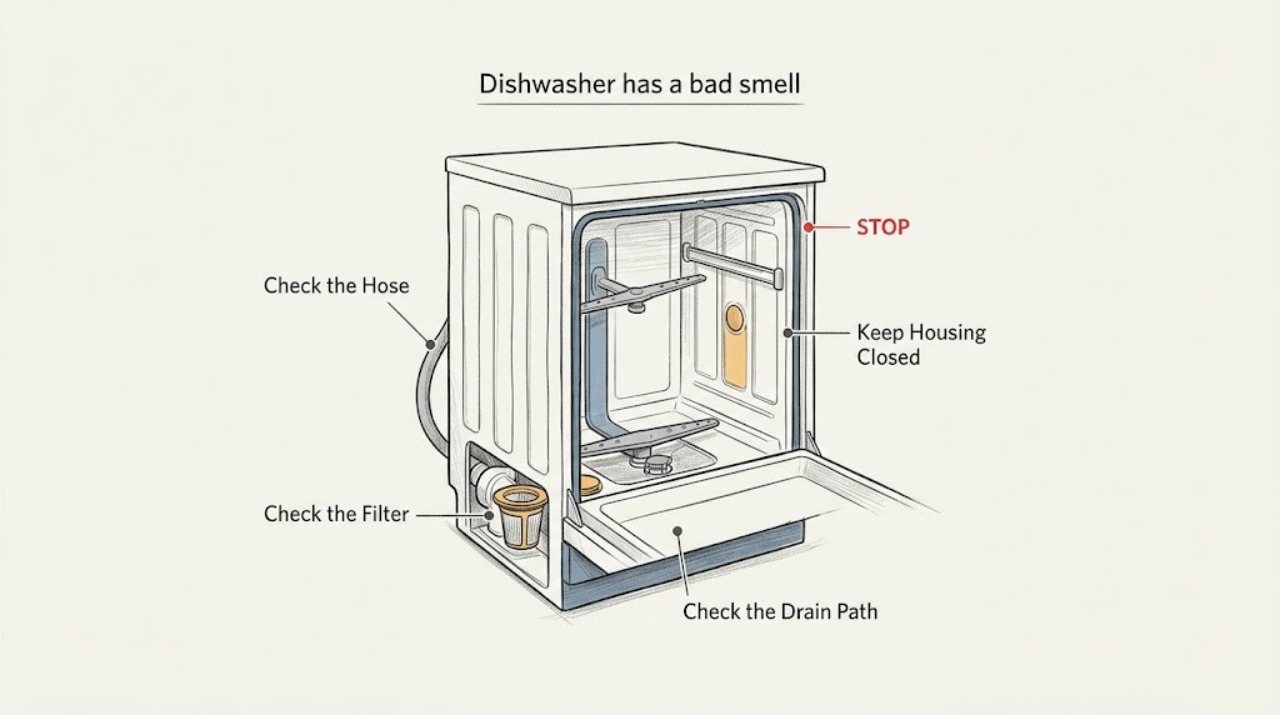
Work through in order
Diagnostic checks
Use only checks that match the exact appliance or system and its official guide.
-
Check 1
Stop the cycle and note when the smell appears, whether it is food-like, sour or drain-like, chemical, or burning, and whether clean water or dirty water remains in the bottom. Look from a dry, safe position for a leak, water in the base, smoke, scorching, a hot plug, or a displayed fault; do not restart if any of those signs are present.
Expected result: The odor is food-like with no standing water, it is drain-like with water remaining, it is chemical or burning, or there is a leak, water in the base, smoke, heat, or a fault code.
Next step: For a leak, water in the base, burning or electrical odor, smoke, or a water-safety code, stop, keep clear, turn off the water inflow if safe, and arrange qualified service. Otherwise continue with the matching cleaning checks.
Stop if: Do not run another cycle to test a burning smell, smoke, leak, or water near electrical parts.
Why this matters
Why: The first pattern supports a residue-maintenance path; the second suggests a drain-path issue; the last patterns can indicate a chemical, water, or electrical hazard rather than ordinary odor.
-
Check 2
With the dishwasher off, cool, and safe to open, remove the lower rack and clean the filter using the removal method in the exact Bosch owner manual. Rinse it under running water with mild soap and a soft brush, then reinstall and lock it fully; use care because trapped debris can be sharp.
Expected result: The filter contains food, grease, or a gritty film; the filter is clear; or the filter cannot be removed, is damaged, or will not lock back into place.
Next step: If debris was present, run the next branch only after the filter is seated. If the filter is damaged, missing, inaccessible, or will not lock, leave the dishwasher off and arrange model-specific service rather than forcing it.
Stop if: Do not use abrasive brushes, steel wool, tools that can puncture the filter, or a loose filter during a wash cycle.
Why this matters
Why: A soiled filter can retain odor-causing particles and restrict the pump. A clear or damaged filter makes a filter-only explanation less likely and can leave a filtration or fit problem unresolved.
-
Check 3
If water remains or the smell is sour or drain-like, follow the exact Bosch manual to inspect the visible drain filter and pump-cover area. Disconnect power from a safe dry location before any pump access, sponge out standing water, and remove only visible foreign material without reaching blindly into the compartment.
Expected result: Standing water or food fragments are under the filter, the pump cover is loose or not fully engaged, the drain path looks clear, or water returns after one supervised drain attempt.
Next step: Correct only a model-documented pump-cover position and visible blockage. If water returns, a drain fault appears, the cover will not latch, or access is unclear, keep the appliance off and arrange appliance or plumbing service.
Stop if: Do not work in the pump area with power connected, put a hand into standing water, or force a cover or impeller.
Why this matters
Why: Debris or a pump-cover problem can prevent proper draining and leave stagnant water. A clear compartment with recurring water points toward a hose, pump, installation, or plumbing problem that cannot be confirmed by odor alone.
-
Check 4
Inspect both spray arms outside the dishwasher. Rinse them with warm water and use a toothpick to loosen buildup from blocked holes, then reinstall each arm and the lower rack as the Bosch instructions show.
Expected result: One or more spray-arm holes contain food or mineral buildup, the arms do not rotate freely after refitting, or the arms are clear and rotate normally.
Next step: Clear only the holes that are visibly blocked and confirm the arms are seated before the next cycle. If an arm is cracked, warped, or will not seat, stop using it and obtain model-specific service or a confirmed replacement.
Stop if: Do not enlarge holes, run the dishwasher with an unseated spray arm, or use a sharp tool toward the tub or pump.
Why this matters
Why: Blocked spray arms can retain food soil and reduce washing circulation, while clear, freely rotating arms make them a less likely source of the odor.
-
Check 5
Wipe the door seal, the inside door edges, and accessible tub surfaces with a damp soft cloth and mild soap, then check for food particles, greasy film, limescale, or a seal that is torn or no longer contacting evenly.
Expected result: Residue is concentrated on the seal or inner door, mineral or greasy deposits cover the tub, the seal is damaged, or these surfaces are clean and intact.
Next step: Remove only loose residue with the damp cloth. If the seal is torn, distorted, or associated with a leak, stop using the dishwasher and arrange service; if intact, continue to the empty-care cycle.
Stop if: Do not use a steam cleaner, abrasive cleaner, chlorine-based cleaner, or abrasive sponge on the dishwasher.
Why this matters
Why: Bosch states that food particles on a soiled door seal can cause odor, and that deposits from food and limescale require regular care. A damaged seal can also permit leakage and is not a cleaning-only condition.
-
Check 6
After the filter, spray arms, pump area if needed, seal, and door edges are clean and reassembled, run the Bosch Machine Care program or the model-approved dishwasher cleaner or descaler exactly as the owner manual directs, with the dishwasher empty. Follow the product directions and never combine cleaning agents.
Expected result: The odor is gone after the empty care cycle, it improves but returns, or the odor remains unchanged or becomes chemical or burning.
Next step: If clean, allow the interior to dry and use the prevention step. If the smell returns or remains, document the pattern and arrange Bosch or qualified appliance service. Stop immediately for chemical fumes, burning odor, smoke, or heat.
Stop if: Remove all dishes and foreign material before a cleaning-agent cycle, and do not mix products or repeat a cycle to mask a hazardous odor.
Why this matters
Why: Improvement supports removable food, grease, or mineral deposits. Recurrence suggests a continuing drain, moisture, seal, detergent, or appliance fault; an unchanged or burning odor is not evidence that more cleaner is needed.
-
Check 7
For an appliance that is clean, drains normally, and will sit unused, leave the door slightly ajar only when the installation and household conditions make that safe. Scrape large food soil from dishes before loading and keep the filter and spray arms on the model's maintenance schedule.
Expected result: The smell stays away when the door is left slightly ajar between periods of nonuse, or it returns despite drying and regular maintenance.
Next step: Keep the door position within the model's safe-use guidance. If odor recurs with standing water, a leak, a fault code, poor cleaning, or a damaged seal, leave the dishwasher off and arrange service.
Stop if: Do not leave the door open where it creates a trip, child, pet, or cabinet-clearance hazard.
Why this matters
Why: Ventilation during nonuse can reduce retained moisture and unpleasant odors. A returning odor despite clean components and normal drainage points to a persistent source that needs diagnosis rather than a stronger household chemical.
Use your observations
Decision map
Find the observation that best matches what you see, then follow the next safe action.
-
PATH 01Next step
What you see
The smell is food-like, the filter or spray arms contain residue, and there is no standing water or leak.
Do this next
Clean and reseat the filter, clear the spray arms, wipe the seal and inner door, then run one model-approved empty care cycle. If the odor persists, arrange service rather than adding more chemicals.
Why this path and its safety boundary
Why it matters: Retained food soil is the leading explanation supported by Bosch's odor and maintenance guidance.
-
PATH 02Next step
What you see
The odor is sour or drain-like and dirty water remains at the bottom or returns after draining.
Do this next
Power off safely, follow the model manual for filter and pump-cover access, and clear only visible debris. Stop and arrange appliance or plumbing service for recurring water, a drain code, a loose cover, or uncertain access.
Why this path and its safety boundary
Why it matters: Incomplete drainage or debris in the pump path is more likely than a surface-only residue.
-
PATH 03Next step
What you see
Residue is concentrated on the door seal or inner door edges while the filter and spray arms are reasonably clean.
Do this next
Wipe those areas with a damp soft cloth and mild soap. A torn, loose, or leaking seal needs model-specific service and should not be treated as a detergent problem.
Why this path and its safety boundary
Why it matters: Food particles trapped at the seal or door edge can maintain an odor even when the wash chamber looks clean.
-
PATH 04Next step
What you see
The tub has greasy film or limescale, and the odor improves after a correctly run empty Machine Care, cleaner, or descaler cycle.
Do this next
Use only the model-approved maintenance interval and product directions. Do not combine agents. Escalate if the odor returns quickly, cleaning performance falls, or a code or leak appears.
Why this path and its safety boundary
Why it matters: Removable deposits are likely contributing to the odor; the result does not prove a particular heater or pump part is faulty.
-
PATH 05Next step
What you see
The odor is chemical, solvent-like, burning, or accompanied by smoke, unusual heat, a hot plug, water near electrical parts, a leak, or an error indicating water in the base.
Do this next
Stop using the dishwasher, keep clear, turn off water inflow if safe, and arrange qualified service. For a Bosch water-in-base safety code, Bosch directs the user to turn off water inflow and contact support.
Why this path and its safety boundary
Why it matters: This is a potential chemical, fire, electrical, or water-safety event, not a routine dishwasher-cleaning branch.
-
PATH 06Next step
What you see
The filter, pump area, spray arms, seal, and empty care cycle are clean, drainage is normal, but the odor returns.
Do this next
Leave the dishwasher off if the odor is strong or abnormal and arrange Bosch or qualified appliance service. Provide the model, odor description, timing, standing-water result, maintenance performed, and any code or leak evidence.
Why this path and its safety boundary
Why it matters: A continuing moisture, drain-hose, seal, detergent, ventilation, or internal appliance issue remains possible and cannot be identified safely from smell alone.
Helpful context
Understand the symptom
Classify the odor before cleaning
A stale food smell after a normal cycle points first toward retained soil in the filter, spray arms, seal, or interior. A sour or drain-like smell together with standing water changes the path toward incomplete draining and the pump area. A chemical or burning odor is not a routine cleaning result: keep the appliance off and arrange qualified help, especially if there is heat, smoke, a leak, or an electrical symptom. Record the Bosch model number before following a removal step because filter and pump access vary by model.
Use Bosch cleaning guidance without mixing products
Bosch describes Machine Care as an empty program for removing deposits and reducing odors, with cleaners placed in the locations specified by the manual. Its care guidance also distinguishes greasy or limescale deposits from food remnants. Use only a cleaner or descaler approved for the model and the directions on its manual; do not improvise a mixture or run cleaning agents with cookware, utensils, or other material left in the tub.
Drain symptoms need a separate decision
Standing water is not explained by a dirty door seal alone. Bosch links incomplete draining to food debris in the filter or pump and describes removing standing water with a sponge and checking the pump cover only as the model instructions allow. Water detected in the base or a leak-protection code calls for the water supply to be turned off and service, not repeated cleaning cycles.
Safety boundary
Stop conditions
- Stop immediately for smoke, a burning or electrical odor, a hot plug or outlet, arcing, a leak, or water near electrical parts. Keep clear, turn off the water supply if safe, and arrange qualified help.
- If a water-in-base safety code appears, follow Bosch's direction to turn off the water inflow and arrange service; do not keep running cleaning cycles.
- Disconnect power from a safe dry location before filter or pump-area access. Do not reach into standing water, force a pump cover, or handle sharp debris without suitable caution.
- Do not use chlorine, abrasive cleaners, steam, steel wool, or mixed chemicals. Remove all dishes and foreign material before any cleaning-agent cycle and use the exact model manual for product placement.
- Do not open the cabinet, bypass a safety device, test energized wiring, or keep using a dishwasher with a damaged seal, loose filter, recurring drain fault, or visible leak.
Only after diagnosis
Potential parts
- dishwasher filter
Consider this only if the filter is damaged, missing, or cannot be cleaned and locked correctly after the model-specific inspection; odor alone does not prove replacement is needed.
Bosch filters vary by dishwasher model and region. Confirm the exact model and the service diagnosis before selecting a replacement. - dishwasher door gasket
Consider this only if the seal is torn, distorted, no longer contacts evenly, or is confirmed to be leaking after cleaning the seal and door edges.
Door seals are model-specific and may differ by series and installation. Confirm fit using the exact model and qualified diagnosis. - dishwasher drain hose
Consider this only when recurring standing water or a confirmed drain restriction remains after the filter and pump-area checks and a technician identifies the hose or connection as the cause.
Drain hose routing and connections vary by Bosch model and installation. Do not select a hose by appearance alone; confirm the model and connection requirements.
When checks do not resolve it
Need a professional?
Request service for a persistent or returning odor after cleaning, incomplete drainage, a damaged door seal, a loose or damaged filter or pump cover, a recurring water-safety code, a leak, or any chemical, burning, or electrical odor.
Safety scope: Keep the dishwasher off for smoke, burning or electrical odor, unusual heat, arcing, a hot plug, a leak, water near electrical parts, or a water-in-base safety code. Do not open the cabinet, bypass safety devices, or repeat cycles to test a hazardous odor.
Common questions
FAQ
Why does my Bosch dishwasher smell bad after a cycle?
Start with food particles in the filter or spray arms, then check the door seal and inner door edges. If the smell is drain-like and water remains, inspect the model-documented drain and pump path instead. A chemical or burning odor, smoke, leak, or water near electrics is a stop-and-service condition.
How do I clean the filter in a Bosch dishwasher?
Use the exact owner manual to remove the lower rack, spray arm, and filter. Wash the filter under running water with mild soap and a soft brush, then reinstall and lock it fully. Do not force removal or use abrasive brushes, and take care because debris can be sharp.
What if my Bosch dishwasher smells like a drain and has standing water?
Treat that as a drainage branch. Disconnect power from a safe dry location, follow the model manual for filter and pump-cover access, and clear only visible debris. If water returns, a drain fault appears, or access is uncertain, leave the dishwasher off and arrange appliance or plumbing service.
Can I use a cleaner or descaler to remove a Bosch dishwasher odor?
Use the Bosch Machine Care program or a model-approved cleaner or descaler only as the exact manual directs. Run the appliance empty when the instructions require it, remove all foreign material, and never mix cleaning agents. If the odor is chemical or burning, do not run a cleaning cycle.
Should I leave a Bosch dishwasher door open to prevent odor?
Bosch's manual recommends leaving the door slightly ajar when the appliance will not be used for a while. Keep that position safe for children, pets, walkways, and cabinetry, and do not use it as a substitute for fixing standing water, a leak, or a damaged seal.
When should a bad smell from a Bosch dishwasher be serviced?
Arrange service when the odor returns after model-specific filter, spray-arm, seal, drain, and empty-care checks, or when there is recurring standing water, a leak, a damaged seal or filter, a returning code, or a loose pump cover. Stop immediately for smoke, burning or electrical odor, unusual heat, arcing, or water near electrical parts.
Read the exact guide
Official sources
- How to Clean & Descale Bosch Dishwashers: A Complete GuideBosch · Bosch US cleaning and maintenance guide; use the exact owner manual for model-specific access and products.
- How to Clean your Dishwasher Spray ArmsBosch · Bosch spray-arm care article; use the exact model manual where arm removal differs.
- Bosch Dishwasher Troubleshooting & Repair GuideBosch · Bosch US dishwasher owner-support troubleshooting page; exact controls and access depend on model.
- Use and Care Manual SPX68B55UCBosch · SPX68B55UC manual; use the matching Bosch manual for another model.
- Care and MaintenanceBosch · Bosch dishwasher care manual for specified models; access and intervals must be checked against the exact model.
- Bosch Dishwasher Error Codes: Troubleshooting GuideBosch · Bosch US error-code guide; code meanings and available actions can vary by model.
- How to Properly Clean Your Dishwasher FilterBosch · Bosch US filter guidance; follow the exact owner manual for the dishwasher model.
Community feedback
Share a repair observation
Share a plain-text repair observation. Accepted observations are published automatically; this page may take a moment to update.