
On this page
Start here
Quick answer
A small amount of clean water in a dishwasher's filter area or sump can be normal because it helps keep seals from drying, but dirty water that builds up, smells, returns after a cycle, or sits across the tub points to a drainage or backflow problem. First distinguish the normal filter-area water from excess or dirty water, then inspect and clean the model-approved filter and accessible sump area. Check for food debris, a blocked drain path, a kinked or sagging hose, an incorrect high loop or air gap, and a sink or disposer connection that can send wastewater back. Never use drain-opening chemicals or run the dishwasher without its required filters. Stop for water near electrical parts, a burning odor, repeated pump failure, a leak, or any drain connection that needs disassembly, and arrange qualified appliance or plumbing service.
Before you begin
Safety first
- This article supports distinguishing normal sump water, cleaning an accessible model-approved filter, observing the drain, and inspecting visible hose routing. Do not use drain chemicals, probe or disassemble the pump, disconnect plumbing, open panels, mix cleaners, or alter drainage installation without qualified guidance.
Work through in order
Diagnostic checks
Use only checks that match the exact appliance or system and its official guide.
-
Check 1
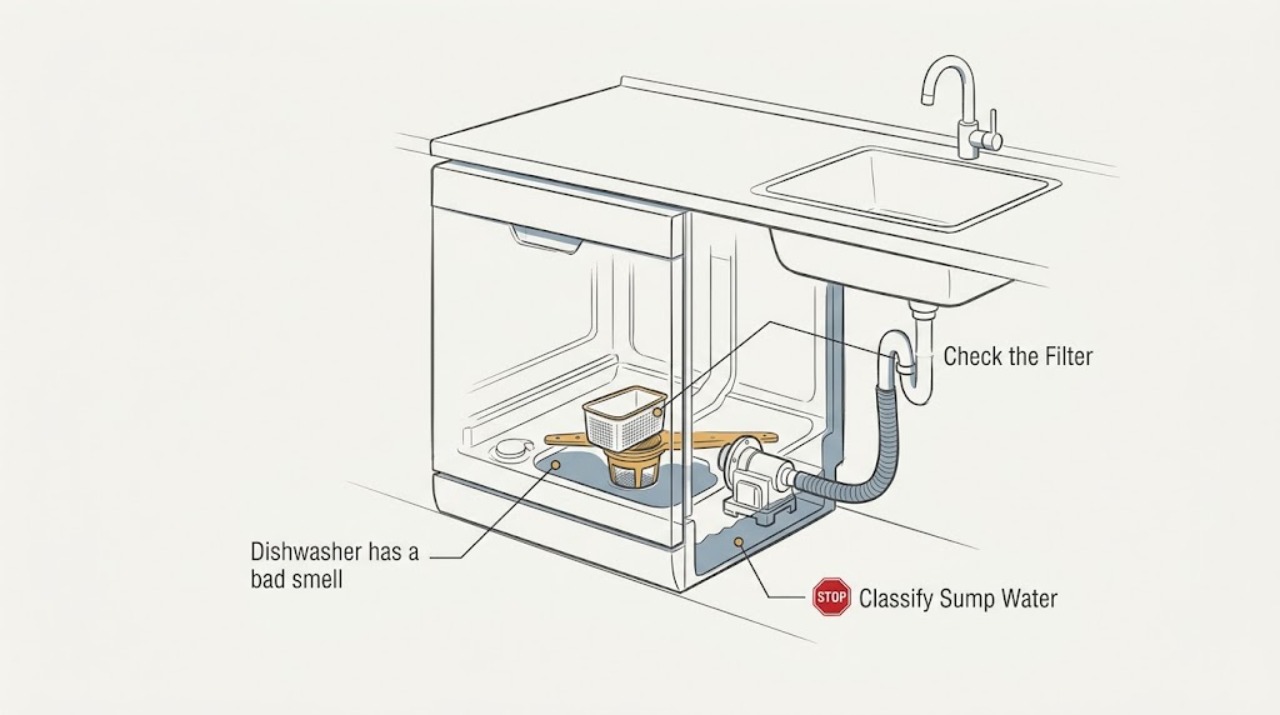
After the dishwasher has completed its cycle and is safe to open, inspect the water in the filter area and tub without touching electrical parts. Note its amount, clarity, smell, and whether it is confined to the recessed sump or spread across the tub.
Expected result: A small amount of clean water is confined to the filter area, dirty water is building up, water reaches the tub bottom or door area, or the sump is dry but the odor persists.
Next step: Photograph the water level and residue pattern, then use the matching filter and drain checks; do not repeatedly run cycles to see whether dirty water will clear itself.
Stop if: Stop for water near wiring, a leak onto the floor or cabinets, hot water, smoke, burning odor, or any need to reach into a concealed pump.
Why this matters
Why: A small clean amount in the filter area can be normal. Dirty water, water that rises across the tub, or water that returns between cycles supports a filter, drain, pump, hose, sink connection, or backflow problem. A dry sump with odor points toward filter, seal, interior, or hidden residue instead.
-
Check 2
Use the exact model manual to remove the lower rack and filter assembly. Rinse the filter under warm running water, gently brush food residue with a soft brush, and remove only loose visible debris from the accessible sump area; then lock all filters back into place.
Expected result: The filter is dirty, loose, damaged, or missing; food or foreign objects are in the sump; or the filter and accessible sump are clean and correctly restored.
Next step: Run a short model-approved rinse or drain observation only after the filters are secure, then check whether the water level and odor improve.
Stop if: Do not operate without required filters, use wire or abrasive tools, probe the pump, or remove hard or sharp debris without gloves and safe access.
Why this matters
Why: A dirty filter or sump can restrict drainage and let food remain wet, creating odor. A clean, intact, locked filter with dirty water still present shifts attention to the drain hose, sink connection, air gap, pump, or controls.
-
Check 3
During one normal drain observation from a safe position, note whether the drain pump engages, water moves out, a hum occurs without movement, grinding occurs, or no pump sound is present. Do not open panels or reach into the sump while powered.
Expected result: Water drains normally, a steady hum occurs without movement, grinding or hard debris noise occurs, the pump is silent, or water returns after the drain completes.
Next step: Stop for abnormal pump sounds, no movement, repeated failures, or return flow and arrange service; limit the inspection to the filter and visible drain path.
Stop if: Do not disassemble the pump, turn an impeller, bypass a door switch, remove electrical covers, or keep running the unit with grinding or a non-running pump.
Why this matters
Why: Normal movement makes a complete pump blockage less likely. A hum without movement can indicate an obstruction or jammed impeller; grinding can indicate hard debris. A silent drain event can be electrical or control-related, while return flow points toward hose routing, air gap, disposer, or sink plumbing.
-
Check 4
With the dishwasher off, inspect the visible drain hose under the sink for a kink, crush, sag, loose clamp, or low routing. Check whether the installation has the model-required high loop or air gap and whether the sink or disposer connection shows food blockage, without disconnecting plumbing as a first test.
Expected result: The hose is kinked or sagging, the high loop or air gap is missing or unclear, the sink or disposer connection is blocked, or the visible drain path appears correct.
Next step: Correct only an obvious loose routing issue that can be addressed without disconnecting a line; otherwise leave water isolated and arrange appliance or plumbing service for the hose and sink connection.
Stop if: Do not detach a hose, remove a disposer plug, loosen a clamp, use sharp tools, or alter a high loop or air gap without the exact installation procedure and water containment.
Why this matters
Why: Restricted flow can leave dirty water in the tub; incorrect routing or a blocked air gap can allow wastewater to siphon or flow back into the dishwasher. A clear visible path keeps the pump, valve, control, or hidden blockage in consideration.
-
Check 5
After the sump and drain path are functioning, wipe the door seal, lower door edge, tub corners, and accessible interior with a soft cloth and the model-approved mild method. If the manual permits, run one maintenance cycle with one approved dishwasher cleaner and no dishes.
Expected result: The odor improves, residue remains in the seal or corners, odor remains despite a clear drain, or a chemical, burning, or electrical odor appears.
Next step: Continue only the model's routine filter and maintenance guidance when the odor clears; arrange service for recurring odor, a damaged seal, or an unexplained non-food smell.
Stop if: Never mix cleaners, use drain opener or concentrated chemicals, touch a hot element, or continue operation for smoke or burning odor.
Why this matters
Why: Improvement supports residual food or grease after the drainage issue. Persistent odor with normal drainage points toward hidden pump, hose, filter, gasket, vent, or material issues. A non-food odor is not a sump-cleaning problem.
-
Check 6
Record the dishwasher model, normal-versus-excess water result, filter and sump condition, pump sound, hose routing, air gap or high loop, sink or disposer connection, cleaning method, and whether water or odor returns.
Expected result: The water remains at a normal small level and the odor clears, or dirty water and odor return after the filter and visible drain checks.
Next step: Provide the record and photographs to a qualified appliance technician or plumber, keeping the dishwasher off if water accumulates or a leak or electrical concern is present.
Stop if: Do not order a pump, hose, filter, gasket, valve, or control board from the water level alone, and do not open panels to search for the fault.
Why this matters
Why: A normal water level with no returning odor supports expected sump water plus surface residue. Repeated dirty water or odor indicates unresolved filtration, pump, drain, backflow, seal, or control trouble that cannot be identified safely from the sump alone.
Use your observations
Decision map
Find the observation that best matches what you see, then follow the next safe action.
-
PATH 01Safety boundary
What you see
Only a small amount of clean water remains in the recessed filter area, the tub drains normally, and no dirty water or odor returns between cycles.
Do this next
Leave the filter correctly installed, maintain it according to the model guide, wipe accessible residue, and monitor the odor after normal use.
Why this path and its safety boundary
Why it matters: The retained sump water is likely normal for the dishwasher design and is not evidence of a failed drain pump.
Safety stop: Do not remove the sump seal, bail out normal water repeatedly, or add drain chemicals to eliminate clean retained water.
-
PATH 02Safety boundary
What you see
Food residue is on a dirty or loose filter or around the accessible sump, and water is not building up across the tub.
Do this next
Clean the filter and accessible sump using the model procedure, lock the filters, and compare the next drain and odor result.
Why this path and its safety boundary
Why it matters: Trapped food and a restricted filter are the leading odor contributors, with the drain pump and hose still worth checking if the result returns.
Safety stop: Do not operate without the filters, scrape the mesh with metal, or probe the pump for a hidden blockage.
-
PATH 03Safety boundary
What you see
Dirty water returns or builds up between cycles, the drain hose is kinked, sagging, or low, or the required high loop or air gap is missing or blocked.
Do this next
Stop using the dishwasher if water is accumulating, preserve the visible hose and sink connection arrangement, and arrange appliance or plumbing service to correct the drain path.
Why this path and its safety boundary
Why it matters: Backflow, restricted drainage, a sink-side blockage, or drain installation is more likely than normal sump water.
Safety stop: Do not detach the hose, use drain opener, alter the high loop, or reconnect a drain line without exact installation guidance and water containment.
-
PATH 04Safety boundary
What you see
The filter and visible sump are clean, but the pump hums without moving water, grinds, remains silent during drain, or water stays across the tub.
Do this next
Keep power and water isolated as appropriate and arrange qualified appliance service for pump, drain, valve, wiring, and control diagnosis.
Why this path and its safety boundary
Why it matters: A pump obstruction, impeller, pump motor, valve, wiring, or control fault is more likely and cannot be distinguished safely from the exterior.
Safety stop: Do not reach into the pump, bypass a switch, open panels, or continue cycles with grinding, no drain movement, or electrical symptoms.
-
PATH 05Safety boundary
What you see
The water level is normal or drainage has been corrected, but a bad odor persists, or the smell is burning, electrical, chemical, or accompanied by smoke, heat, or a leak.
Do this next
Stop the dishwasher, isolate power and water through normal accessible controls when safe, ventilate the area, and arrange qualified appliance or plumbing service.
Why this path and its safety boundary
Why it matters: The source may be a hidden residue, gasket, pump, vent, heating, wiring, product material, or installation fault rather than food in the sump.
Safety stop: Do not run additional cleaning cycles, mix chemicals, touch a hot element, or open panels to locate a non-food odor.
Helpful context
Understand the symptom
A sump can contain normal water without being the odor source
The recessed filter area is designed to retain some clean water in many dishwashers. That water helps keep seals from drying and may be replaced during the next cycle. The useful distinction is whether the water is a small, clean amount confined to the filter area or dirty, foul-smelling water that rises across the tub, accumulates between cycles, or flows back from the sink. The latter is a drain or backflow clue, not a reason to pour cleaner into the sump.
Start at the filter and sump before the drain hose
Food debris in a neglected filter or sump can restrict the drain path and create an odor. Follow the exact model manual to remove the filter, rinse it with warm water, and use a soft brush for residue. Inspect the accessible sump for loose food or foreign objects without reaching into the pump. Reinstall every filter securely before any cycle; an unlocked or missing filter can worsen circulation and allow debris to enter the pump.
Dirty water that returns points toward routing or a downstream blockage
A dishwasher drains through a hose to a sink drain, air gap, or disposer. A kinked, crushed, sagging, or incorrectly looped hose, a clogged air gap, a sink-side obstruction, or a disposer connection problem can leave water behind or let wastewater return. Inspect the visible routing and connection only; disconnecting a hose, clearing a disposer, or changing its installation should follow the model instructions and proper power and water isolation.
Clean the odor only after drainage is working
Once the filter, sump, and drain path are clear and the dishwasher drains normally, wipe accessible seals and interior surfaces with the model-approved method. A manufacturer-approved maintenance cleaner can address remaining grease or film, but it cannot repair a blocked pump, failed drain, or backflow installation. Never mix cleaners, and treat burning, solvent, electrical, or smoke odors as a stop-use condition.
Safety boundary
Stop conditions
- Stop and isolate the dishwasher through normal accessible controls for water near wiring, an active leak, smoke, burning or electrical odor, unusual heat, or repeated breaker trips.
- Do not operate without all required filters correctly seated and locked, and do not use wire brushes, scouring pads, sharp tools, or drain-opening chemicals inside the dishwasher.
- Do not reach into or disassemble a pump, bypass a door switch, remove panels, disconnect a drain hose, or alter a high loop or air gap as a first troubleshooting step.
- Treat a small amount of clean water confined to the filter area differently from dirty water that builds up, smells, returns, or reaches the tub or door area.
- Stop and arrange appliance or plumbing service when drainage does not improve, dirty water returns, the drain installation is wrong or unknown, the pump is abnormal, or the odor persists.
Only after diagnosis
Potential parts
- dishwasher filter assembly
Consider this category only when the exact model uses a replaceable filter and inspection confirms it is cracked, warped, missing, or cannot be restored by approved cleaning.
Confirm the dishwasher model, filter style, sealing and locking arrangement, and manufacturer fit information before ordering; do not operate without required filters. - dishwasher drain pump
Consider this category only when a qualified diagnosis confirms a non-running, noisy, jammed, or failed drain pump after filter, sump, hose, and sink-path checks.
Confirm the exact model, pump design, electrical specification, seal, and manufacturer fit information; pump access and testing may require appliance service. - dishwasher drain hose or air-gap component
Consider this category only when inspection confirms a kinked, split, blocked, incorrectly routed, or model-specific drain component that is causing retained or returning water.
Confirm the dishwasher model, hose ends, routing, clamp, air-gap design, and local installation requirements before ordering or changing plumbing. - dishwasher door gasket
Consider this category only when the door seal is torn, deformed, soil-retaining, or leaking after the sump and drain issue is resolved.
Confirm the model, gasket profile, orientation, and manufacturer fit information before ordering; do not use sealant to compensate for a mismatch.
When checks do not resolve it
Need a professional?
Arrange qualified appliance or plumbing service when dirty water builds up or returns, water remains across the tub, the drain hose or air-gap/high-loop installation is kinked or unclear, the pump hums without draining or remains silent, a filter or sump cannot be safely cleared, or odor persists after approved filter, drain, seal, and interior care. Seek urgent help for smoke, fire, electrical danger, or an active leak near wiring.
Safety scope: This article supports distinguishing normal sump water, cleaning an accessible model-approved filter, observing the drain, and inspecting visible hose routing. Do not use drain chemicals, probe or disassemble the pump, disconnect plumbing, open panels, mix cleaners, or alter drainage installation without qualified guidance.
Common questions
FAQ
Is water in the dishwasher sump always a problem?
No. A small amount of clean water confined to the filter area can be normal on some dishwashers because it helps keep seals from drying. Dirty water that smells, builds up across the tub, returns between cycles, or reaches the door area indicates a drain or backflow problem.
Why does water sitting in the sump make the dishwasher smell?
If the water is dirty or food is trapped in the filter or sump, residue can remain wet and create odor. A blocked filter, pump-inlet restriction, drain hose problem, or sink backflow can keep that water from leaving or allow wastewater to return.
Should I remove all water from the dishwasher sump?
Do not repeatedly remove a small, clean amount that the model normally retains. If excess or dirty water is present, use only the model-approved safe removal method and inspect the filter and visible drain path; do not probe the pump or use drain chemicals.
Can a drain hose cause dishwasher odor even if the filter is clean?
Yes. A kinked, sagging, blocked, or incorrectly routed hose, missing high loop or air gap, or sink-side blockage can leave dirty water or let it flow back. Preserve the visible routing and arrange appliance or plumbing service when the installation is unclear or water returns.
Read the exact guide
Official sources
- Drain Line InstallationWhirlpool Product Help · Official installation guidance used for visible drain-hose kinks, connections, high-loop routing, leaks, and the service boundary for plumbing changes.
- Cleaning the Dishwasher InteriorWhirlpool Product Help · Official care guidance used for food, grease, and mineral residue, door seals, interior cleaning, and the caution to follow approved cleaning methods.
- Dishwasher - Water in the Bottom of the TubGE Appliances · Official cross-brand guidance used to distinguish normal small standing water from dirty-water accumulation and sink backflow caused by drain routing.
- Dishwasher Not DrainingWhirlpool Product Help · Official guidance used for dirty water in the tub, food in the sump, pump and drain observations, hose routing, air gaps, high loops, and electrical safety.
- Water Remains In Filter Area - DishwasherWhirlpool Product Help · Official guidance used to distinguish a small normal amount of water in the filter area from odor, visible soil, and filter conditions requiring cleaning or service.
- Removing Odors in your DishwasherWhirlpool Product Help · Official odor guidance used for food debris, stagnant water, filter and spray-arm cleaning, seals, interior maintenance, drainage, and recurring-odor escalation.
Community feedback
Share a repair observation
Share a plain-text repair observation. Accepted observations are published automatically; this page may take a moment to update.