
On this page
Start here
Quick answer
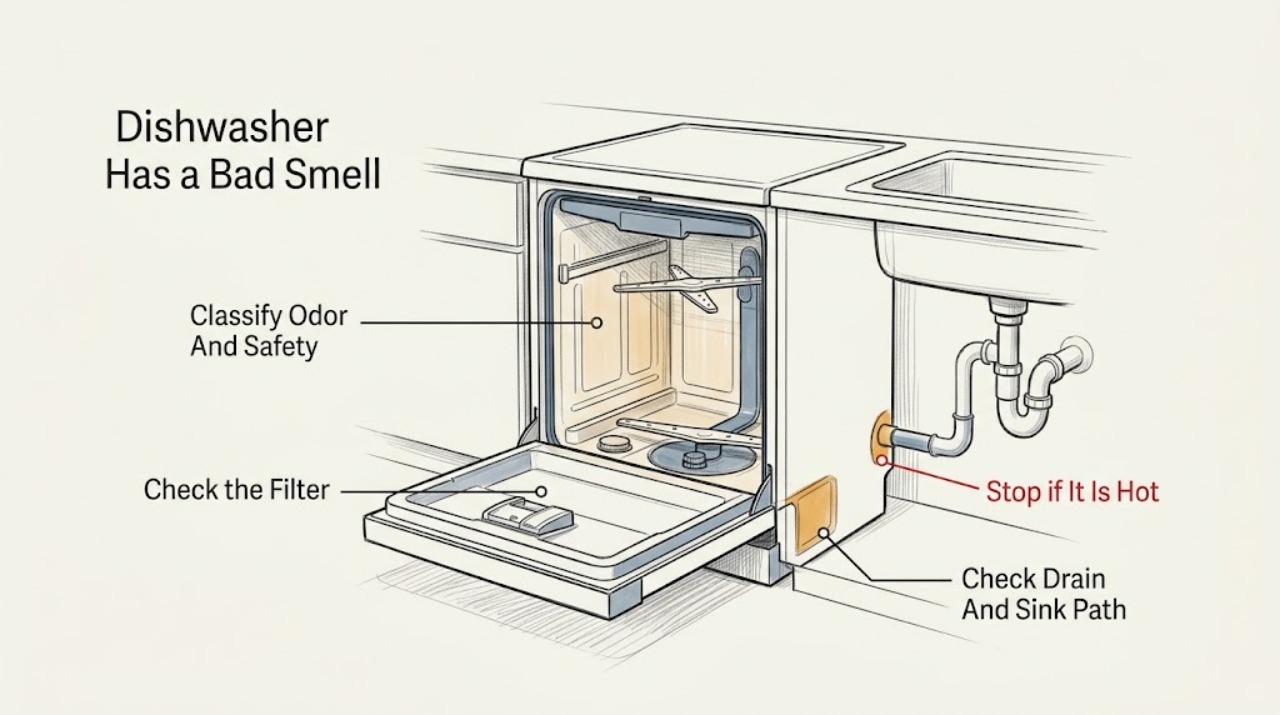
A dishwasher odor that returns between cycles is most often held by food soil, a dirty filter or drain area, moisture in the tub and door seal, or water that is not draining or is backing up from the sink connection. First distinguish a musty or food odor from burning, chemical, sewage, or gas-like odors, then inspect the accessible filter, drain area, spray arms, tub, and door seal with the dishwasher off. Clean and reassemble removable parts only as the model manual directs, run one manufacturer-approved empty cleaning cycle without mixing cleaners, and leave the door slightly open afterward if the model permits. Check for abnormal standing water and the sink, disposal, and drain hose. Stop using the machine for smoke, melting, active leaks, or a persistent sewage or chemical odor; arrange appliance or plumbing service when the smell remains after a correct cleaning and drainage check.
Work through in order
Diagnostic checks
Use only checks that match the exact appliance or system and its official guide.
-
Check 1
Stop the dishwasher, let any hot surfaces cool, and identify the odor from a normal standing position without placing your face inside the tub. Note whether it is musty or food-like, sewage-like, chemical, hot plastic, burning, or accompanied by smoke, sparking, or an active leak.
Expected result: The odor is a recurring musty or food smell with no visible hazard, or it is a burning, melting-plastic, chemical, gas-like, sewage-like, smoke-related, or leak-related smell.
Next step: For a routine odor, continue with the accessible checks below. For smoke, burning, melting, sparking, or an active leak, stop using the dishwasher, keep clear of the hazard, and arrange qualified appliance service; use plumbing help for a strong sewage odor or drain backup.
Stop if: Do not run another cycle to test a burning, melting, smoke-related, gas-like, or active-leak condition, and do not mix cleaning chemicals.
Why this matters
Why: Musty or food odor supports a cleaning, moisture, or drainage investigation. Burning, smoke, melting, an active leak, or a strong chemical or sewage odor is not a routine cleaning condition and may involve electrical, plumbing, or product-safety risk.
-
Check 2
With the dishwasher off, remove the lower rack and inspect the bottom filter or foreign-object cup, accessible drain area, spray-arm openings, lower tub, door gasket, and bottom edge of the door. Clean only the parts your model manual allows, using warm water and a soft brush or cloth; wear gloves because sharp debris may be present.
Expected result: You find food soil, grease, scale, blocked spray holes, debris in the drain area, a dirty gasket, an improperly seated filter, or no visible buildup; note any large amount of water left in the tub.
Next step: Rinse and reinstall removable parts exactly as the manual shows, confirming the filter is locked or seated. If there is standing water, sharp debris beyond safe access, or a pump cover or filter that the manual does not identify as removable, stop cleaning and continue with the drain-service branch.
Stop if: Do not reach into an inaccessible pump, pry a filter or pump cover, run the dishwasher without required filters, or handle sharp debris with bare hands.
Why this matters
Why: Food and grease trapped in the filter, spray arms, or tub can decompose and smell between cycles. A dirty or incorrectly assembled filter can also impair drainage, while a clean accessible interior makes the connected drain or hidden pump path more important to check.
-
Check 3
After the accessible filter area is reassembled, check whether the dishwasher leaves more than the small amount of water the manual describes as normal. Inspect the visible drain hose for a kink, pinch, damage, or a changed connection, and check the connected sink drain or garbage disposal for visible blockage without disassembling plumbing.
Expected result: The tub has substantial leftover water, the sink or disposal drains slowly, the hose is kinked or lacks the model-required routing, or the dishwasher drains normally and the odor is isolated to the tub.
Next step: Straighten only an accessible hose that is visibly kinked and follow the installation manual for any required high loop or air-gap arrangement; contact a plumber when the sink or disposal backs up. If drainage is normal, run the cleaning branch once and monitor the recurrence.
Stop if: Do not cut, pull out, or disconnect the drain hose, remove a disposal connection, or reach into a drain opening with standing water or sharp debris.
Why this matters
Why: Standing water or a slow sink drain can sustain odor and points toward a dishwasher drain path or household plumbing issue. A normal drain result shifts attention back to soil, moisture, cleaning chemistry, or a non-dishwasher odor source.
-
Check 4
Once the filter is correctly installed and the dishwasher can drain, run one empty cleaning cycle using the model manual's approved cycle and one compatible cleaner or cleaning method. Do not combine detergent, vinegar, bleach, or other products, and follow the cleaner's own instructions.
Expected result: The odor and visible residue clear, the odor lessens but returns between cycles, the machine cannot complete or drain the cycle, or a new chemical, burning, or leak symptom appears.
Next step: Wipe residual moisture or cleaner only as the manual directs and leave the door slightly open when the dishwasher is idle if that is allowed. If the odor persists, use the recurrence branch and arrange service when the drainage or interior path cannot be safely accessed.
Stop if: Do not run another chemical cycle to compensate, mix products, or continue operating if the cycle produces smoke, burning odor, visible leak, or an error related to drain or overflow.
Why this matters
Why: Improvement after an empty cleaning cycle supports removable soil or residue as the source. A quick recurrence indicates trapped moisture, an unresolved drain or sink issue, repeated food loading, or buildup beyond the accessible areas. Failure to drain or a new hazardous smell is not a cleaning success.
-
Check 5
After the cleaning and drain check, keep the tub and door interior dry between uses: scrape large food particles, use a rinse or hold cycle if a partial load will sit and the model offers one, wipe the accessible door seal and lower door edge, and leave the door slightly open when safe and permitted.
Expected result: The smell stays away when the dishwasher is dried and used regularly, or it returns even though the filter, tub, door seal, sink drain, and hose path are clean and draining normally.
Next step: Record when the odor returns, whether it is strongest at the tub, sink, or cabinet, and any standing-water or error symptoms. Arrange appliance service for hidden dishwasher components and plumbing service for a drain or sewage source.
Stop if: Do not remove the dishwasher, access energized parts, use a drain chemical in the dishwasher, or continue using it if water damage, electrical risk, or a hazardous odor develops.
Why this matters
Why: Improvement with drying and shorter idle time supports retained moisture or food residue. Persistent odor after those checks suggests hidden buildup, a pump or drain component problem, a connected plumbing source, or an odor that is not being generated by the dishwasher.
Use your observations
Decision map
Find the observation that best matches what you see, then follow the next safe action.
-
PATH 01Next step
What you see
The odor is musty or food-like and cleaning finds residue in the filter, drain area, spray arms, door seal, or lower tub; drainage is otherwise normal.
Do this next
Clean and reinstall the model-approved parts, run one compatible empty cleaning cycle, dry the interior, and monitor whether the odor stays away between cycles.
Why this path and its safety boundary
Why it matters: Trapped soil and moisture are more likely than a failed appliance component.
-
PATH 02Next step
What you see
A substantial amount of water remains after a cycle, the sink or disposal drains slowly, or the visible drain hose is kinked, pinched, damaged, or incorrectly routed.
Do this next
Use the model installation guidance for an accessible hose-routing correction and contact a plumber for a slow or blocked sink drain; obtain appliance service if the dishwasher still will not drain.
Why this path and its safety boundary
Why it matters: A drain restriction, backflow, or household plumbing problem can keep odor-producing water in or near the dishwasher.
-
PATH 03Next step
What you see
The dishwasher interior is clean and draining normally, but the smell is strongest at the connected sink, disposal, air gap, or under-sink drain connection.
Do this next
Stop treating the dishwasher with additional cleaners and have the sink or disposal drain checked and cleaned safely; use a plumber if the odor or backup remains.
Why this path and its safety boundary
Why it matters: The connected household drain is more likely to be producing or transmitting the odor than the dishwasher tub.
-
PATH 04Next step
What you see
The smell improves after cleaning but returns after the dishwasher sits closed, while drainage is normal and no hazardous odor or leak is present.
Do this next
Use a rinse or hold cycle for a waiting partial load when available, wipe and dry the accessible tub and seal, and leave the door slightly open if permitted; arrange service if the smell persists despite those measures.
Why this path and its safety boundary
Why it matters: Residual moisture, infrequent use, food left in the tub, or buildup beyond the visible surfaces remains more likely than a one-time spill.
-
PATH 05Next step
What you see
The odor is burning, melting-plastic, chemical, gas-like, or sewage-like; smoke, sparking, active leakage, error codes, or inaccessible debris is present; or cleaning and drainage checks do not change it.
Do this next
Stop using the dishwasher. Arrange qualified appliance service for electrical, heating, pump, or leak symptoms and plumbing service for sewage odor, drain backup, or a household drain source.
Why this path and its safety boundary
Why it matters: The symptom has crossed from routine odor maintenance into a potential appliance, plumbing, or safety fault.
Helpful context
Understand the symptom
Persistent odor is a source-and-drain problem first
A dishwasher can smell clean immediately after a cycle and still retain food soil or moisture in the filter, drain area, spray arms, door seal, or lower tub. Water left because of a drain restriction can intensify the smell between cycles. The sink or garbage disposal can also be the odor source because the dishwasher shares that drainage path. Identify where the smell is strongest before buying a cleaner or part.
Use one compatible cleaning method and preserve the filter assembly
Filter and pump designs differ by model. Remove, clean, and reinstall only parts the owner's manual identifies as removable, and check that they lock back into place. Use one approved dishwasher-cleaning method at a time; do not mix vinegar, detergent, bleach, or other cleaners. If the interior is stainless steel, check the manual before using any chlorine product because some manufacturers warn it can damage or discolor the interior.
Only after diagnosis
Potential parts
- dishwasher filter or foreign-object cup
Only consider this category when the model has a removable filter or cup that is damaged, missing, or cannot be secured after cleaning and the odor or drainage symptom follows that finding.
Confirm the exact dishwasher model and the manufacturer's parts information; some models use a maintenance-free filter system. - dishwasher drain hose
Only consider a replacement hose when the visible hose is damaged or cannot be safely restored to the model-required routing and drainage or backflow symptoms are present.
Verify the exact model, connection points, length, and local installation requirements before ordering or installing. - dishwasher drain pump or pump cover
Only consider this category after standing water persists with a clear sink drain, correct hose routing, and a clean filter, and the model manual or technician identifies the pump path as serviceable.
Pump access and removability vary by model; hidden pump work should be confirmed by qualified appliance service.
When checks do not resolve it
Need a professional?
Stop using the dishwasher and arrange qualified appliance service for smoke, sparking, burning or melting-plastic odor, active leakage, repeated drain or overflow errors, inaccessible sharp debris, or any repair requiring the machine to be removed or energized parts to be accessed. Use a plumber when the sink or disposal backs up, the odor is sewage-like and comes from the household drain, or the drain connection cannot be safely corrected. If a musty or food odor persists after model-approved cleaning, correct filter reassembly, normal drainage, drying, and a single compatible cleaning cycle, service is appropriate to check hidden pump, drain, heating, or buildup conditions.
Common questions
FAQ
Why does my dishwasher smell bad between cycles even after it washes dishes?
Food soil or moisture can remain in the filter, drain area, spray arms, door seal, or lower tub, and a drainage or sink connection issue can leave odor-producing water behind. Clean only model-approved parts, check drainage, and let the interior dry between uses.
Can I use vinegar or bleach to remove dishwasher odor?
Use only a cleaning method the dishwasher and cleaner instructions allow, and never mix vinegar, detergent, bleach, or other products. Samsung specifically cautions against bleach in stainless-steel interiors; Whirlpool describes a vinegar rinse or compatible dishwasher cleaner as separate methods.
Is a small amount of water in the dishwasher normal?
Some models can retain a small amount of water, but a large amount after a cycle, a slow sink or disposal, a kinked drain hose, or an odor that tracks the drain path points to a drainage or plumbing check. Follow the model manual and arrange service when the machine still will not drain.
Read the exact guide
Official sources
- Samsung Dishwasher stinks or has a musty smellSamsung · Samsung dishwasher odor, filter, cleaning-cycle, sink-drain, and moisture guidance
- Food Odors - DishwasherWhirlpool Product Help · Whirlpool dishwasher food odor, rinse-cycle, cleaning, and recurrence guidance
- Cleaning the Filter - DishwasherWhirlpool Product Help · Whirlpool dishwasher filter cleaning, reassembly, and odor prevention
- Routine and deep clean your Samsung dishwasherSamsung · Samsung dishwasher interior, filter, drain pump, and model-specific cleaning instructions
- Cleaning the DishwasherWhirlpool Product Help · Whirlpool dishwasher interior and odor cleaning guidance
- Samsung dishwasher is not drainingSamsung · Samsung dishwasher drain, sink, hose routing, filter, and service troubleshooting
- Removing Odors in your DishwasherWhirlpool Product Help · Whirlpool dishwasher odor causes, cleaning, drainage, and prevention
Community feedback
Share a repair observation
Share a plain-text repair observation. Accepted observations are published automatically; this page may take a moment to update.