
On this page
Start here
Quick answer
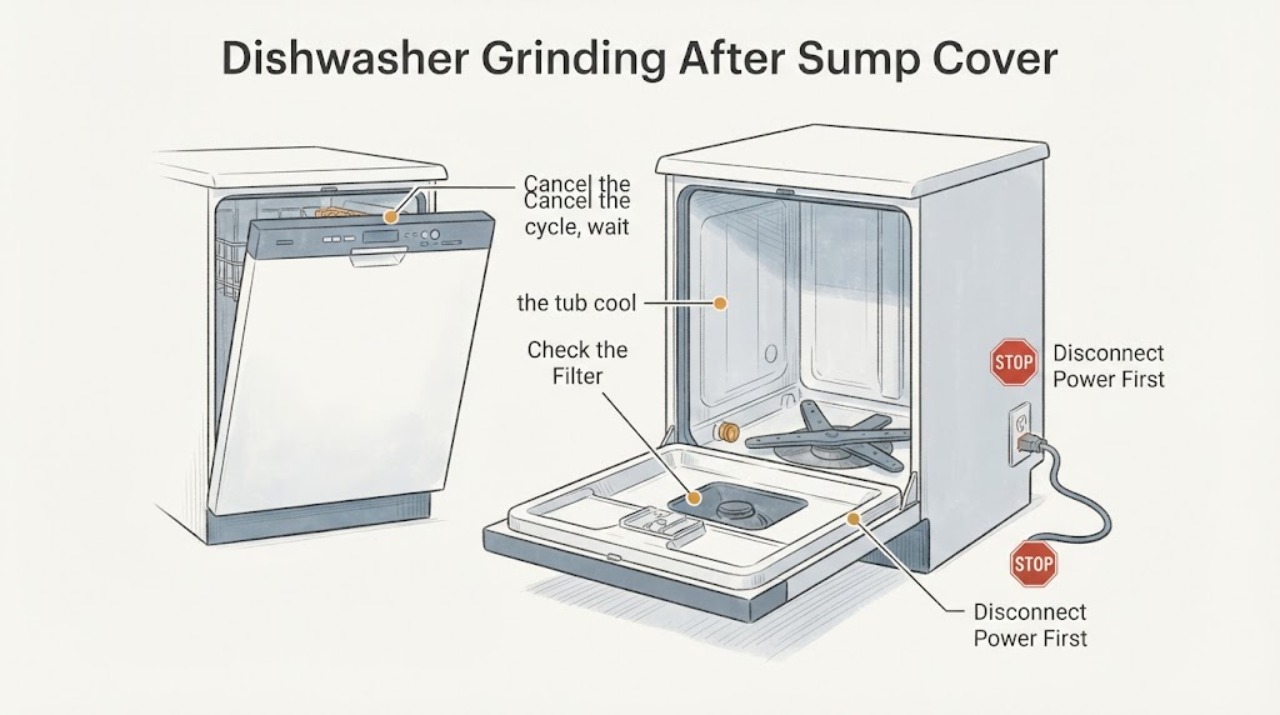
Stop the GE dishwasher and do not keep running cycles to see whether the grinding goes away. GE says a grinding sound can occur when the circulation pump runs without water, while a spray arm can make a different tapping or knocking sound when it contacts a load; neither explanation proves that a newly replaced sump cover is seated correctly. With the dishwasher stopped, power disconnected, and the tub cool, check only the model-permitted visible areas for a loose utensil, rack interference, spray-arm obstruction, or visible filter debris. Record the full model number and the exact phase when the noise starts. Because the noise began immediately after work around the sump, do not transfer another GE model's sump-cover screws, seal, pump, or disassembly sequence. Have the exact GE literature or a qualified appliance technician verify the cover, fasteners, pump inlet, and clearance before using the dishwasher again, especially if there is a leak, standing water, scraping, or breaker trip.
Work through in order
Diagnostic checks
Use only checks that match the exact appliance or system and its official guide.
-
Check 1
Cancel the cycle, wait for all motion and water flow to stop, and disconnect the dishwasher from power before any permitted inspection. If the plug, floor, wiring area, or cabinet is wet or damaged, keep clear and use the household disconnect only when it is safe; do not reach through standing water.
Expected result: The grinding persists, the dishwasher leaks, there is standing water outside the tub, the breaker trips, or the appliance has exposed or wet electrical parts.
Next step: Leave the dishwasher out of service and arrange qualified GE or appliance service. Do not run another cycle, remove the sump cover, or open the cabinet to identify a pump or motor.
Why this matters
Why: GE identifies abnormal grinding as a service concern when the published checks do not resolve it, and its safety guidance requires power disconnection before maintenance and qualified servicing for repairs outside the manual.
-
Check 2
With power off, the tub cool, and the racks stationary, remove only loose dishes and utensils from the racks. Check whether a utensil, pan, cutting board, or item hanging below a rack can touch the lower spray arm; turn the spray arm by hand only if the exact model's manual permits that check and it turns freely without force.
Expected result: The spray arm is blocked, a rack item is in its path, the arm will not complete a free revolution, or the arm and load have clearances and the grinding area is below the tub.
Next step: Correct only an obvious rack or spray-arm obstruction using the exact model instructions. If the grinding remains with the racks and spray arm clear, stop testing and use the post-repair service branch.
Why this matters
Why: GE lists large utensils, boards, pots, and items below a rack as common spray-arm obstructions and says a tapping or knocking noise can result; this does not explain a grinding noise that began after sump work.
-
Check 3
Inspect the visible tub-bottom filter and pump-inlet area for loose food, plastic, metal, or a fragment of the replaced rubber part, but remove or clean a filter only when the exact GE manual identifies it as owner-removable. Do not pry at the sump cover, insert tools into the pump inlet, or search for an impeller obstruction.
Expected result: Visible debris is present in an owner-accessible filter or inlet area, the filter is not seated as the exact manual shows, or there is no accessible debris and the sound began only after the sump-cover replacement.
Next step: Remove only loose visible debris or clean and re-seat only the model-permitted filter. If the noise remains, do not reopen the repaired sump area; provide the model and observations to qualified service.
Why this matters
Why: GE says filter design varies by model and that the specific Owner's Manual governs what can be removed and cleaned. Visible debris can be documented, but it does not prove that debris, the rubber cover, or a pump is responsible for this post-repair grinding.
-
Check 4
Find and record the complete GE model number from the left front inner edge, right front inner edge, or right side of the door. Record whether the noise starts during fill, circulation, or drain, whether water is present when it starts, whether it is a steady grind or rhythmic tap, and whether any leak appeared after the repair.
Expected result: The model number is available and the exact repair or installation literature can be opened, or the model remains unknown and only generic GE noise guidance is available.
Next step: Use the exact GE literature for any further permitted check. If the model cannot be confirmed, keep the post-repair appliance out of service and request a technician rather than using a generic sump-cover procedure.
Why this matters
Why: GE identifies the inner door edges as model-label locations and directs owners to model-specific manuals and installation literature. Without the model, the correct sump-cover fit, seal, fasteners, and lower-assembly procedure remain unresolved.
-
Check 5
Tell the technician that the rubber sump cover was replaced immediately before the first grinding sound, and provide the cover source, model number, sound timing, water level, visible debris result, and any leak or breaker event. Ask for model-matched verification of the cover seating, fasteners, gasket/boot, pump inlet, and clearance rather than ordering a guessed pump or cover.
Expected result: Grinding remains after accessible load, spray-arm, and model-permitted filter checks, or the sound is clearly coming from the lower sump/pump area.
Next step: Leave the appliance disconnected or otherwise out of service until qualified service verifies the repair. Do not energize an open-panel dishwasher or continue running it to compare sounds.
Why this matters
Why: GE routes unresolved abnormal dishwasher noises to service and does not provide one universal sump-cover or pump procedure for every dishwasher model.
Use your observations
Decision map
Find the observation that best matches what you see, then follow the next safe action.
-
PATH 01Next step
What you see
The grinding begins before water enters, or the tub is empty while the circulation pump is operating.
Do this next
Stop the dishwasher and check only the model-permitted fill and visible filter conditions. If water supply and accessible checks are normal, arrange service rather than running repeated dry tests.
Why this path and its safety boundary
Why it matters: GE identifies this pattern as an abnormal grinding condition associated with a circulation pump running without water; it does not establish whether the recent sump-cover work caused it.
-
PATH 02Next step
What you see
The sound is a rhythmic tap or knock and disappears when the rack is unloaded or the spray arm has clear clearance.
Do this next
Reload only as the exact manual permits and stop if any grinding from the lower sump remains. Do not use this result to justify reopening the repaired cover.
Why this path and its safety boundary
Why it matters: GE says rack items or an obstructed spray arm can cause rattling, tapping, or rhythmic knocking; that result points to a loading or clearance issue rather than proving a sump-cover fault.
-
PATH 03Next step
What you see
The filter or visible inlet area is clear, the spray arm and racks are clear, and the grinding started immediately after the sump-cover replacement.
Do this next
Keep the dishwasher out of service and have qualified service use the full model and exact repair literature to inspect the sump-cover assembly and pump path.
Why this path and its safety boundary
Why it matters: The remaining timing makes a repair-area inspection necessary, but no public GE source opened for this task supports a universal diagnosis of cover seating, fastener placement, seal fit, or pump damage without a model.
-
PATH 04Next step
What you see
A leak, standing water outside the tub, a breaker trip, scraping that continues with the appliance stopped, or visible damage appears.
Do this next
Do not operate the dishwasher. Keep power disconnected when safe and arrange qualified appliance service; do not remove panels, bypass interlocks, or probe the pump area.
Why this path and its safety boundary
Why it matters: The issue exceeds a loading or normal-sound check, and the source evidence does not support safe user diagnosis of the sump or pump assembly.
Helpful context
Understand the symptom
Treat the timing after the repair as a stop signal
The reported model is unknown, and the new grinding sound began after a rubber sump cover was replaced. That timing makes cover seating, a missing or misplaced fastener, trapped debris, or contact in the pump area possibilities, but it does not identify any one of them. GE's general noise guide says service may be needed when its checks do not resolve an abnormal noise. Do not run repeated cycles, reach into the sump, or reopen the repaired area using a different GE model's instructions.
Separate a dry-pump grind from a mechanical contact sound
GE describes grinding when the circulation pump is running with no water in the dishwasher. It separately describes rhythmic knocking or thumping from a spray arm striking an item, and rattling from dishes or utensils. If the appliance was not filling, or if the grinding starts during circulation before water enters, record that fact and stop; it does not prove that the sump cover is the cause. If the sound is a regular tap that changes with rack loading, the accessible load and spray-arm checks are the appropriate first branch.
Use the exact GE model literature before touching the lower assembly
GE's literature service asks for the appliance model number, and its filter guidance warns that older dishwashers may have self-cleaning filtration while other models have removable filters. A model number is printed on the dishwasher's inner door edges. This matters here because the assignment contains no model and the repair involved a sump cover: a filter, lower spray arm, cover, seal, and fastener arrangement cannot be assumed from a different GE family. A model-matched manual or qualified service visit should decide whether any lower-area part is owner-removable.
When checks do not resolve it
Need a professional?
Arrange qualified GE or appliance service before further use when grinding remains after the model-permitted external checks, begins immediately after sump-cover work, comes from the lower sump area, or is accompanied by a leak, standing water, a breaker trip, scraping, or visible damage. Do not order a pump, sump cover, seal, or fasteners from the symptom alone.
Common questions
FAQ
Does a grinding noise after replacing a GE dishwasher sump cover prove the cover is installed incorrectly?
No. The timing makes the repaired area important to inspect, but no model was supplied and GE does not publish one universal sump-cover procedure for every dishwasher. First rule out an accessible rack or spray-arm obstruction and record whether the pump runs without water; then have the exact model literature or a qualified technician verify the cover, fasteners, seal, and pump clearance.
Can I run the dishwasher empty to see if the grinding goes away?
Do not keep repeating cycles after a new grinding sound began immediately after sump work. GE's published noise checks distinguish loading and spray-arm sounds from an abnormal dry-pump grind and route unresolved abnormal noise to service. Use only a safe, model-permitted visual or hand check with power disconnected and the tub cool.
Can I remove the filter or lower spray arm to reach the sump?
Only if the exact GE Owner's Manual says that part is owner-removable. GE notes that filtration and spray-arm designs vary; if the manual does not give removal instructions, stop at the visible check and use service. Do not pry off the sump cover or insert tools into the pump area.
Read the exact guide
Official sources
- Dishwasher – Not Filling with WaterGE Appliances · Opened GE Appliances family-level guidance used only to interpret a pump running without water and to keep fill checks external; it does not establish a fault in the assigned dishwasher.
- Dishwasher - How to Clean Fine and Ultra Fine FiltersGE Appliances · Opened GE Appliances guidance. It expressly distinguishes removable filters from self-cleaning designs and is used to gate any filter check by the exact model manual.
- GE Dishwasher Owner's Manual 49-5795GE Appliances · Opened official GE PDF and used only for the general safety boundary: the task has no model, so its model-specific operation is not generalized. The PDF states that servicing outside manual procedures belongs to a qualified technician.
- Dishwasher - Standard Lower Spray Arm RemovalGE Appliances · Opened GE Appliances family-level guidance. It says to use the exact Owner's Manual and that a spray arm is not owner-removable when the manual gives no procedure; no sump-cover procedure is inferred.
- Owner's Manual & Installation InstructionsGE Appliances · Opened official GE literature portal. It supports retrieving the exact manual once the missing model is found; it is not evidence for any unseen sump-cover procedure.
- Dishwasher - Lower Spray Arm Not SpinningGE Appliances · Opened GE Appliances family-level guidance used only for an accessible spray-arm and loading branch. It does not support sump-cover or pump disassembly.
- Dishwasher - Normal and Abnormal NoisesGE Appliances · Opened GE Appliances family-level support guidance. It supports symptom classification and external checks, but does not diagnose this unidentified dishwasher or the post-repair sump assembly.
- Find Your GE Dishwasher Model & Serial NumbersGE Appliances · Opened official GE model-locator page. It supports identifying the missing model before any model-specific maintenance or parts decision.
- Dishwasher - Burning Odor, Removing Plastic from ElementGE Appliances · Opened GE Appliances support guidance. It is used only for the electrical isolation and cool-before-cleaning boundary, not as evidence that this grinding is caused by the heater.
Community feedback
Share a repair observation
Share a plain-text repair observation. Accepted observations are published automatically; this page may take a moment to update.