
On this page
Start here
Quick answer
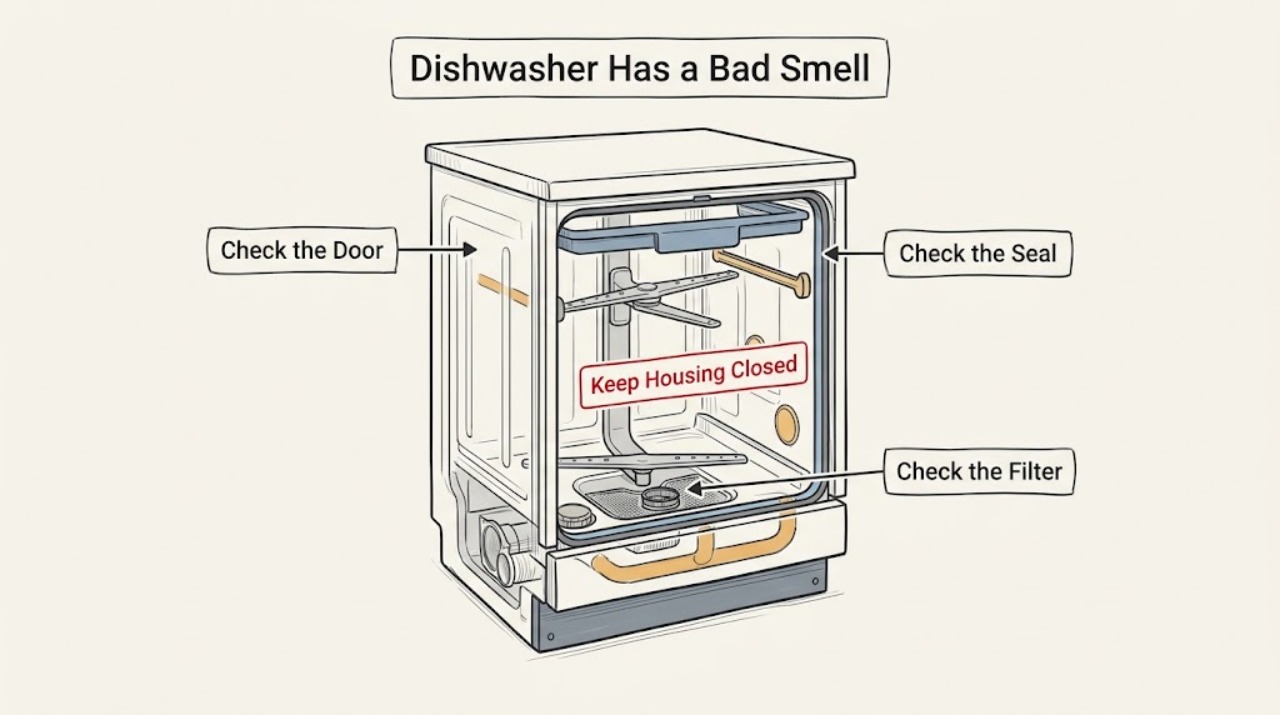
A bad smell in a GE dishwasher usually comes from food residue, a dirty or restricted filter, buildup near the pump inlet or spray-arm jets, mildew on the gasket, or dirty water returning through an incorrectly routed drain hose. A small amount of clean water near the sump may be normal, but dirty water that builds up between cycles is not. With the dishwasher off and cool, remove visible food from the tub, inspect the pump-inlet area and spray arms, and clean only the filters your exact model identifies as removable. Check the visible drain hose for a missing high loop or air gap and arrange plumbing help if the sink or drain backs up. Run an empty cleaning cycle only with the product and procedure allowed by the manual; never mix cleaning chemicals. Stop for smoke, a burning or electrical odor, a leak near electrical parts, damaged wiring, or water that cannot be safely contained, and arrange qualified service if the odor persists after the documented cleaning and drainage checks.
Before you begin
Safety first
- Keep the dishwasher off for smoke, burning or electrical odor, arcing, hot connections, leaks near electrical parts, wastewater backup, or unsafe filter or pump access. Do not open the cabinet, force components, disconnect wet plumbing, or mix cleaning chemicals.
Work through in order
Diagnostic checks
Use only checks that match the exact appliance or system and its official guide.
-
Check 1
Stop the dishwasher, let hot components cool, and identify whether the smell is food-like, sour or musty, sewage-like, plastic-like, or burning or electrical. Open the door only when safe and note whether the empty tub smells, whether dirty water covers the bottom, and whether the sink or disposal backs up.
Expected result: The odor is strongest in the empty tub, only dishes smell, dirty water remains, a small amount of clear water is near the sump, or smoke, burning odor, heat, or a leak is present.
Next step: Follow the matching branch. Stop for smoke, burning or electrical odor, a leak near electrical parts, or abnormal heat; otherwise continue only after the dishwasher is cool and safe to inspect.
Why this matters
Why: An empty-tub odor favors residue, moisture, or drainage. Odor only on dishes may involve soil or detergent handling. Clear water near the outlet can be normal, while dirty buildup suggests backflow or poor drainage. Burning, smoke, heat, and leaks are safety events.
-
Check 2
With the dishwasher off and cool, remove the lower rack if it can be removed normally and inspect the tub bottom, sump or pump-inlet area, door gasket, and accessible corners for food scraps, paper, plastic, grease, or mildew. Remove only loose debris that is plainly reachable without tools or panel removal.
Expected result: Food or foreign debris is present, mildew or residue is visible at the gasket, the sump looks clear, or a sharp, loose, or inaccessible object is present.
Next step: Remove safe loose debris and wipe accessible surfaces as the manual allows. Stop for a damaged gasket, an inaccessible object, a leak, or anything requiring the sump or cabinet to be opened.
Why this matters
Why: GE links tub residue, pump-inlet debris, and gasket mildew with odor. A sharp, loose, or inaccessible object may damage the pump or require service rather than more probing.
-
Check 3
Inspect the spray-arm jets for visible food or mineral blockage and check the exact GE manual to see whether the dishwasher has removable fine or ultra-fine filters. If the filters are documented as user-removable, remove, rinse, and reinstall them exactly as instructed; do not force a self-cleaning or fixed filter.
Expected result: Jets or filters contain soil, the filters are clear, the model uses self-cleaning filtration, or a filter will not release or lock correctly.
Next step: Clean only the documented filter and jets with a non-abrasive method, then secure every part. Request service if access is unclear, a filter is damaged, or odor persists after the safe cleaning path.
Why this matters
Why: Blocked jets and dirty filters can retain food and reduce wash performance. GE models differ in filter design, so resistance, misalignment, or an undocumented filter is an access and service boundary.
-
Check 4
Look under the sink or behind the dishwasher only from an accessible, dry position and compare the visible drain-hose route with the exact installation instructions. Check for a missing high loop or air gap, a kink, a loose visible connection, or a sink or disposal that drains slowly; do not disconnect plumbing.
Expected result: Dirty water returns between cycles, the drain hose lacks the model-required high loop or air gap, the sink or disposal backs up, the hose is kinked, or the visible route appears correct.
Next step: Correct only an obvious, documented routing issue without moving the appliance or opening a wet connection. Stop repeated dishwasher cycles and arrange plumbing or appliance service for dirty backflow, leaks, or an unclear drain path.
Why this matters
Why: GE identifies an absent high loop or air gap as a route for dirty water to flow back into the dishwasher. A sink or disposal backup points toward household plumbing; a normal visible route does not rule out an internal drain fault.
-
Check 5
Run the exact GE model's approved empty cleaning or rinse procedure using only the product and instructions identified by the owner's manual. Do not use laundry detergent, dish soap, abrasive cleaners, concentrated chemicals, or mixed bleach and ammonia, and do not run the cycle if a leak or electrical warning is present.
Expected result: The cycle completes and the odor improves, the odor returns quickly, suds appear, the cycle cannot drain, or a leak, smoke, abnormal sound, or error occurs.
Next step: After a successful cycle, leave the interior able to dry and scrape heavy food from dishes before loading. Stop for recurrence, water retention, leaks, or any safety symptom and arrange qualified service.
Why this matters
Why: Improvement supports removable residue or mildew. A quick return, excess suds, incomplete drain, leak, abnormal sound, or error indicates the cleaning cycle did not resolve the underlying condition.
-
Check 6
After the dishwasher is empty, clean, and dry, run one normal supervised load only if no safety symptom or drain backup exists. Note whether the odor returns in the empty machine, only after dishes are loaded, or with standing dirty water, and record any new noise or error.
Expected result: The odor stays gone, returns only with food-heavy loads, returns in the empty machine, or returns with dirty water, poor draining, a leak, or abnormal operation.
Next step: Continue the model's maintenance guidance when the smell is resolved. Otherwise stop user-level troubleshooting and give service the complete symptom history and cleaning results.
Why this matters
Why: A lasting improvement supports residue or loading as the main contributor. An empty-machine odor or odor with dirty water, leak, or poor drainage indicates hidden buildup, a drain or sump issue, or another fault.
Use your observations
Decision map
Find the observation that best matches what you see, then follow the next safe action.
-
PATH 01Next step
What you see
The smell is food-like and food or debris is visible on the tub bottom, pump-inlet area, spray arms, or filters.
Do this next
Remove safe loose residue, clean only the model-documented filters and accessible jets, and run the approved empty cleaning procedure. Request service if debris is inaccessible or odor persists.
Why this path and its safety boundary
Why it matters: Retained food residue or restricted wash circulation is more likely than a sealed internal failure.
-
PATH 02Next step
What you see
The smell is musty or sour and mildew or damp residue is visible on the gasket or interior, with no dirty-water backflow.
Do this next
Clean the accessible gasket and interior using the exact GE guidance, avoid mixed or abrasive cleaners, and run the approved cleaning cycle. Arrange service for damaged seals or persistent odor.
Why this path and its safety boundary
Why it matters: Moisture and mildew in the gasket or tub are more likely than a drain installation issue.
-
PATH 03Next step
What you see
The odor is sewage-like and dirty water builds up between cycles, returns from the sink, or the drain route lacks a high loop or air gap.
Do this next
Stop repeated cycles and have the visible route or household drain corrected by the installer or plumber. Use appliance service if the hose route is correct but dirty water still returns.
Why this path and its safety boundary
Why it matters: Drain-hose installation or a household drain restriction is more likely than ordinary food residue.
-
PATH 04Next step
What you see
Only a small amount of clear water remains near the tub outlet, the dishwasher drains normally, and there is no widespread dirty buildup.
Do this next
Do not scoop or dismantle the sump merely because a small clear amount is visible. Continue the accessible residue, filter, gasket, and model-approved cleaning checks.
Why this path and its safety boundary
Why it matters: The water may be normal sump water rather than the source of the odor; food, gasket, filter, or loading residue remains more likely.
-
PATH 05Next step
What you see
The empty dishwasher still smells after the documented cleaning and filter path, or odor returns with poor draining, a leak, abnormal sound, a code, or inaccessible buildup.
Do this next
Keep the dishwasher off if water, leaking, or abnormal operation is present and arrange qualified appliance or plumbing service. Do not open the pump or cabinet to chase the odor.
Why this path and its safety boundary
Why it matters: A hidden sump, pump, drain, gasket, filter, or household plumbing condition may be involved.
-
PATH 06Next step
What you see
The odor is burning or electrical, smoke appears, a plug or wiring is hot, or water reaches electrical components.
Do this next
Stop immediately, keep clear, isolate power only from a safe dry location if possible, and obtain qualified or emergency help. Do not run a cleaning cycle or open the appliance.
Why this path and its safety boundary
Why it matters: Continued operation could cause shock, fire, or water damage.
Helpful context
Understand the symptom
Identify the smell and where it is coming from
Food or sour smells usually point toward residue in the tub, sump, filter, pump-inlet area, or spray arms. A musty smell can involve the gasket or damp interior. A sewage-like smell with dirty water returning makes the drain hose, air gap, high loop, or sink drain more important. A new plastic smell may fade during initial use, but an odor that remains for an extended period is abnormal. Burning or electrical odor is a stop condition, not a cleaning task.
Do not mistake normal sump water for dirty backflow
GE notes that a small amount of clean water around the tub outlet can remain to protect the water seal. That is different from dirty water spreading across the bottom or building up between cycles. Compare the water's appearance and timing, and check whether the nearby sink drains normally. If the dishwasher or sink backs up, avoid repeated cycles until the drain path is evaluated.
Clean only what the model allows
With power off and the interior cool, remove visible food and inspect the bottom of the tub, pump-inlet area, spray-arm openings, gasket, and any filters described by the owner's manual. Filter construction differs across GE dishwasher generations, so never twist out a part that the manual does not identify. Use a soft, non-abrasive method and do not mix chemicals or add laundry or dish soap to a dishwasher-cleaning procedure.
Persistent odor needs a service boundary
If an empty dishwasher still smells after the model's cleaning path and the drain installation appears correct, hidden sump residue, an inaccessible filter, a pump or drain fault, a gasket, or a household plumbing issue may be involved. Do not remove the pump, dismantle the sump, or continue running cycles to mask the smell. Give service the odor type, water appearance, cleaning steps, and drainage observations.
Safety boundary
Stop conditions
- Stop immediately for smoke, burning or electrical odor, a hot plug or connection, arcing, water near electrical parts, or repeated breaker trips. Keep clear and isolate power only from a safe dry location if possible.
- Stop for a leak, wastewater backup, dirty water covering the tub, a damaged gasket or hose, a filter or cover that will not close, or water that cannot be safely contained. Arrange qualified appliance or plumbing service.
- Do not open the pump or cabinet, force a filter, probe a sump with metal, disconnect wet plumbing, pour drain cleaner into the dishwasher, or use the dishwasher while the glass or interior is damaged.
- Do not mix bleach and ammonia, use concentrated or abrasive cleaners, add laundry or hand dish soap, or repeat cleaning cycles to mask an odor that persists after the model-approved path.
Only after diagnosis
Potential parts
- fine or ultra-fine filter
Consider this category only when the exact model has a removable filter and inspection or qualified diagnosis finds a damaged or non-sealing filter after cleaning.
GE dishwasher filter design varies by model and generation; confirm the exact model and filter style before any part decision. - pump inlet or drain pump
Consider this category only when qualified diagnosis links persistent odor, poor draining, or a blocked pump path to a damaged or failed pump assembly after safe filter and hose checks.
Pump assemblies and access differ by model. Do not select a pump from odor or a humming sound alone. - door gasket
Consider this category only when inspection confirms a damaged, leaking, or persistently contaminated gasket after accessible cleaning.
Gasket shape and fit are model-specific. Confirm the exact model and service diagnosis before ordering or installing.
When checks do not resolve it
Need a professional?
Arrange qualified appliance service when the GE dishwasher still smells in an empty tub after the model-approved cleaning and filter checks, when dirty water returns despite a correct visible drain route, when drainage is poor, a gasket or filter is damaged, or hidden sump, pump, or control access is needed. Arrange plumbing service when the sink, disposal, air gap, or household drain backs up. Treat smoke, burning or electrical odor, hot connections, leaks near electrical parts, and repeated breaker trips as immediate safety issues.
Safety scope: Keep the dishwasher off for smoke, burning or electrical odor, arcing, hot connections, leaks near electrical parts, wastewater backup, or unsafe filter or pump access. Do not open the cabinet, force components, disconnect wet plumbing, or mix cleaning chemicals.
Common questions
FAQ
Why does my GE dishwasher smell bad?
Common paths include food residue in the tub or pump-inlet area, dirty filters or spray arms, mildew at the gasket, and dirty water returning through an incorrect drain-hose setup. Identify whether the empty tub smells and whether the water is clear or dirty before cleaning.
Is standing water in a GE dishwasher normal?
A small amount of clean water near the tub outlet can be normal. Dirty water that spreads or builds up between cycles is different and can indicate drain backflow, a missing high loop or air gap, or a drain restriction.
How do I clean the GE dishwasher filter for an odor?
First check the exact owner manual: some GE models have removable fine and ultra-fine filters, while others use self-cleaning filtration. Clean and reinstall only the documented filters, and do not force a filter or use abrasive tools.
Can a drain hose cause a sewage smell in a dishwasher?
Yes. GE links dirty water that builds up between uses with drain-hose installation lacking the required high loop or air gap. If the sink or disposal backs up, stop repeated cycles and arrange plumbing help.
Can I use bleach and ammonia together to remove dishwasher odor?
No. Never mix bleach and ammonia because toxic fumes can result. Use only a product and cleaning procedure allowed by the exact GE manual, and request service when odor persists after the safe cleaning path.
When should a bad-smelling GE dishwasher be serviced?
Arrange service when an empty dishwasher still smells after the documented cleaning and filter checks, dirty water returns, drainage is poor, a gasket or filter is damaged, or the pump or sump needs access. Stop immediately for smoke, burning odor, electrical heat, leaks near electrics, or repeated breaker trips.
Read the exact guide
Official sources
- How to Clean Your DishwasherGE Appliances · GE general cleaning article; consult the exact owner manual for removable filters, cleaners, and model-specific cycles.
- Dishwasher - Water in the Bottom of the TubGE Appliances · GE manufacturer drainage guidance; exact installation manual controls hose routing for the model.
- Dishwasher - How to Clean Fine and Ultra Fine FiltersGE Appliances · GE filter guidance; model-specific owner manual determines whether a dishwasher has removable fine or ultra-fine filters.
- Dishwasher - OdorsGE Appliances · GE manufacturer odor guidance; exact dishwasher model and owner manual control cleaning products and removable parts.
Community feedback
Share a repair observation
Share a plain-text repair observation. Accepted observations are published automatically; this page may take a moment to update.