
On this page
Start here
Quick answer
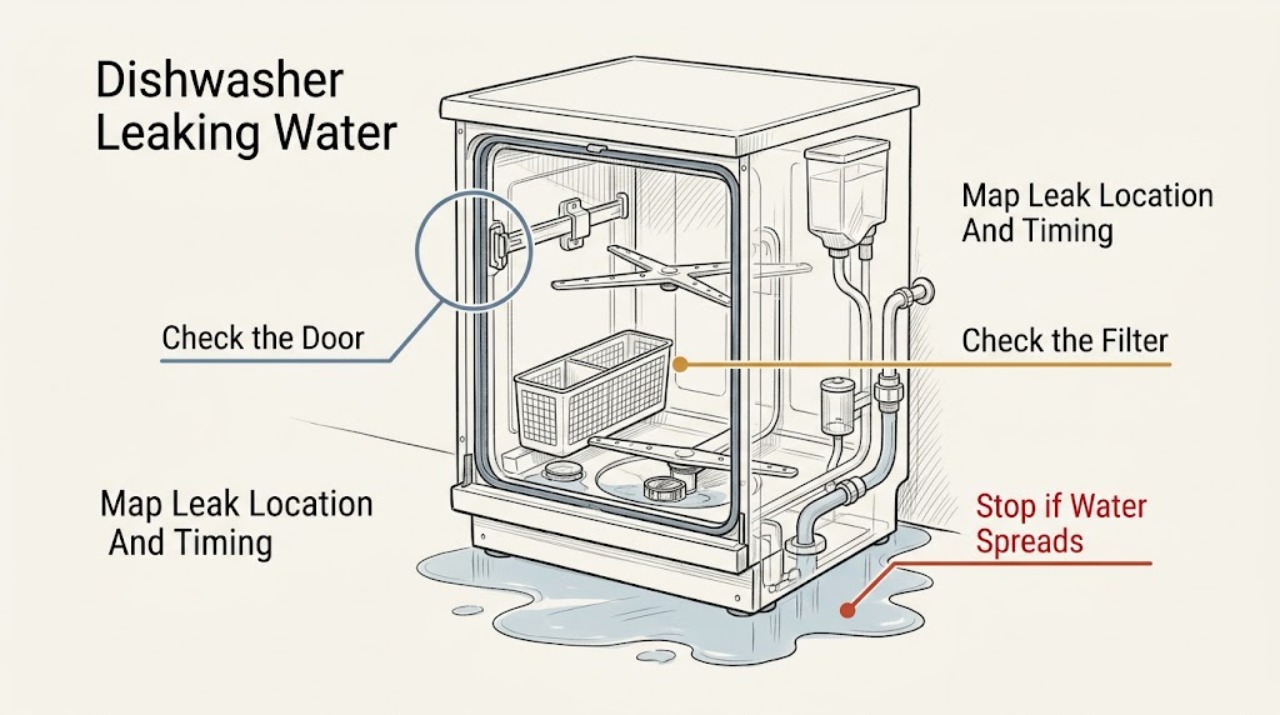
Stop the cycle and first identify where the water starts: at the door or front edge, beneath the tub, at a visible supply connection, or at the drain side. If water is near electrical parts, the leak is active, or the machine is overflowing, keep clear and arrange service; only shut off water or power from a dry, safe position. For an ordinary visible check, confirm the door closes fully and the kick plate is not interfering, look for food or debris at the accessible filter, glass trap, and spray arms, and check for non-dishwasher soap, excess detergent, or spilled rinse aid that can create foam. On a new installation, the drain hose and a garbage-disposal knockout plug also need to be checked against the installation instructions. Some water below the filter after a cycle can be normal, but water covering the filter, backing up, or appearing outside the tub is not a reason to keep running the dishwasher.
Before you begin
Safety first
- This article supports dry, ordinary-access observation and model-approved cleaning of accessible parts only. It does not authorize cabinet or sump access, concealed plumbing work, live electrical testing, chemical drain treatment, or operation of a leaking appliance.
Work through in order
Diagnostic checks
Use only checks that match the exact appliance or system and its official guide.
-
Check 1
Stop the dishwasher and, from a dry and stable position, note the first visible wet point without reaching under the machine or touching wet electrical components. Record whether water appears at the door or front edge, below the tub, at a visible supply connection, at the drain side, during filling, during washing, while draining, or after the cycle.
Expected result: The leak is localized to the front, underside, a hose connection, or the drain area; or its timing cannot be observed because the leak is active or unsafe.
Next step: Photograph the first wet point and keep the appliance off while completing only the safe visible checks below; arrange service immediately for pooling, overflow, electrical exposure, or an inaccessible source.
Stop if: Do not reach under the dishwasher, move it, remove panels, or handle wet plugs, cords, valves, or wiring.
Why this matters
Why: A front-edge pattern makes door closure, gasket, latch, loading, or kick-plate interference more likely. A connection pattern points to supply or drain plumbing. Water from beneath the tub or an unsafe active leak needs professional diagnosis rather than repeated cycles.
-
Check 2
With the dishwasher stopped, inspect the visible door edge, gasket, latch area, rack loading, and kick plate. Confirm that no tall dish or rack item holds the door open and that the kick plate is not preventing the door from closing fully; do not remove the inner door or force the latch.
Expected result: The door closes evenly and seals at the front, or it catches, remains visibly proud, has a contaminated or damaged gasket, or is blocked by the kick plate or load.
Next step: Correct only a clearly visible loading or kick-plate interference according to the installation or use guide, then leave the machine off if the gasket, latch, or alignment remains questionable.
Stop if: Do not bend the door, pry the latch, remove the gasket to experiment, or run a cycle when the door cannot seal.
Why this matters
Why: A closure or loading problem can explain water escaping at the front edge. A clean, aligned door with water beginning elsewhere makes a door-only cause less likely; a torn gasket, damaged latch, or misalignment needs model-specific service.
-
Check 3
After the machine is stopped and the interior is safe to handle, inspect the model-designated accessible filter, glass trap, and spray arms for food, glass, or other debris. Rinse or clean them only by the exact Frigidaire model instructions and do not reach into a concealed sump or pump.
Expected result: The filter or glass trap is visibly clogged, a spray arm opening is blocked, the components are clear, or the parts cannot be accessed without tools or force.
Next step: Restore only correctly seated, undamaged user-serviceable parts; if water covered the filter, remains in the tub, or the leak returns after the safe cleaning, arrange service and provide photos of the debris and water level.
Stop if: Do not pick up broken glass with bare hands, remove the sump cover, dismantle the pump, or use chemical drain cleaner.
Why this matters
Why: Debris can impair drainage or spray and may contribute to water escaping, while clear accessible parts make a hidden drain or mechanical fault more likely. Inaccessible or damaged parts are not a DIY disassembly invitation.
-
Check 4
Review the last load for dish or hand soap, excess automatic detergent, detergent placed directly in the tub, a blocked dispenser, or rinse aid spilled inside. From a safe position, note whether foam is present; do not add more chemicals to cancel the foam.
Expected result: There is visible foam or a recent detergent or rinse-aid mistake, or the correct fresh automatic detergent was used in the dispenser with no unusual foam.
Next step: Do not use more soap; follow the exact model manual's safe procedure for clearing an oversudsing event, wipe visible rinse-aid spills as instructed, and seek service if the leak recurs with correct detergent.
Stop if: Do not mix cleaners, pour drain chemicals into the dishwasher, or keep running the unit while foam or water is escaping.
Why this matters
Why: Non-dishwasher soap, too much detergent, or spilled rinse aid can cause oversudsing and push water out. No foam makes a suds-related leak less likely and shifts attention to closure, drainage, supply, or an internal component.
-
Check 5
If the machine is newly installed or was recently moved, compare the visible drain-hose routing, high-loop arrangement, and supply-hose connection with the Frigidaire installation instructions. If connected to a new garbage disposal, verify from the installation documentation that the drain knockout plug was removed; inspect for kinks or a visibly loose connection without disconnecting plumbing.
Expected result: A hose is kinked or incorrectly routed, a supply connection is visibly loose or wet, a disposal knockout-plug question remains, or the visible installation looks correct.
Next step: Keep the water supply closed if a connection is actively leaking and contact the installer or a qualified appliance technician; do not pull the appliance out or loosen a wet fitting to investigate.
Stop if: Do not disconnect hoses, remove the disposal, move the appliance, or work in pooled water or near an electrical connection.
Why this matters
Why: A drain-routing or disposal connection issue can cause pooling or backflow, while a supply connection can leak independently of the wash system. If visible installation is correct, the cause may be an internal valve, pump, seal, or concealed hose.
-
Check 6
Only after no active leak or safety hazard remains and a clearly visible loading, debris, detergent, or installation issue has been corrected according to the model instructions, run one short model-approved cycle while remaining nearby and observing the previously wet location.
Expected result: No water appears, the same leak returns, the leak shifts to another location, or the machine stops with standing water or an abnormal condition.
Next step: Stop the cycle at the first recurrence, close the water supply if safe, document the timing and location, and arrange qualified service rather than repeating test cycles.
Stop if: Do not perform this test after electrical exposure, overflow, a cracked hose, a door that cannot seal, smoke, burning odor, or any active leak.
Why this matters
Why: A dry supervised cycle supports that the visible issue was corrected but does not prove an internal part is sound. A recurring or changing leak, standing water covering the filter, or abnormal stop needs professional diagnosis.
Use your observations
Decision map
Find the observation that best matches what you see, then follow the next safe action.
-
PATH 01Safety boundary
What you see
Water starts at the door or front edge, and the door catches, a rack load protrudes, or the kick plate interferes with closure.
Do this next
Correct only the visible load or kick-plate interference using the model guidance. If the door still will not seal or the gasket or latch is damaged, stop using the dishwasher and request service.
Why this path and its safety boundary
Why it matters: Incomplete closure or a front seal problem is more likely than a drain-hose problem.
Safety stop: Do not force the door or latch, remove the gasket, or run the appliance with a visible front leak.
-
PATH 02Safety boundary
What you see
Foam is present after dish or hand soap, too much detergent, direct-tub detergent, or a rinse-aid spill.
Do this next
Stop adding detergent, follow the exact model instructions for safely clearing the event, and request service if foaming or leaking returns with fresh automatic dishwasher detergent used in the dispenser.
Why this path and its safety boundary
Why it matters: Oversudsing is a plausible reason for water to escape even when the door and hoses appear intact.
Safety stop: Do not mix cleaners, use drain chemicals, or continue the cycle while foam is escaping.
-
PATH 03Safety boundary
What you see
Water appears beneath the tub or at a supply connection, especially when the dishwasher is filling, and the source is not reachable from ordinary access.
Do this next
Keep the appliance off, close the water supply from a dry safe position if possible, and arrange qualified appliance service; share the leak timing and exact wet point.
Why this path and its safety boundary
Why it matters: A supply fitting, inlet valve, pump, sump seal, or concealed hose is more likely than a simple door-loading issue.
Safety stop: Do not pull out the dishwasher, disconnect plumbing, remove panels, or handle wet electrical parts.
-
PATH 04Safety boundary
What you see
The leak or pooling began after installation or after a new garbage disposal was fitted, and the drain hose is kinked, routing is uncertain, or the knockout plug was not verified.
Do this next
Give the installer the exact model and the observed routing or disposal connection and have the installation checked against the Frigidaire instructions. Do not dismantle the connection yourself.
Why this path and its safety boundary
Why it matters: An installation drain-path problem can cause backflow or pooling independently of the dishwasher's internal components.
Safety stop: Do not remove the disposal, cut or disconnect the drain hose, or run repeated cycles to test an uncertain installation.
-
PATH 05Safety boundary
What you see
A small amount of water remains below the filter after a cycle, but it does not cover the filter, reach the floor, or back up during draining.
Do this next
Monitor for water covering the filter, dirty-water backup, water outside the tub, or a change in the level; consult the model manual or request service if those signs appear.
Why this path and its safety boundary
Why it matters: Some residual water at the bottom can be normal and is not by itself proof of a leaking dishwasher.
Safety stop: Do not insert tools into the sump or add drain chemicals to remove normal residual water.
-
PATH 06Safety boundary
What you see
The leak returns after visible checks, comes from beneath the tub or an inaccessible connection, or is accompanied by overflow, electrical exposure, smoke, burning odor, a damaged cord, or a cracked hose.
Do this next
Leave the dishwasher off, isolate water and power only when this can be done from a dry safe position, and arrange qualified appliance service or urgent help for active water and electrical danger.
Why this path and its safety boundary
Why it matters: The cause may be an internal seal, pump, valve, hose, control, or a broader water or electrical hazard that ordinary checks cannot establish safely.
Safety stop: Do not run another cycle, open the cabinet, bypass a safety feature, or attempt live electrical or concealed plumbing work.
Helpful context
Understand the symptom
Locate the first wet point before guessing at a part
A dishwasher can look as though it is leaking from the center while the first wet point is at the door edge, a hose connection, or the drain path. Dry the surrounding floor only after the cycle is stopped and it is safe to do so, then note whether water appears during filling, washing, draining, or after the cycle. Water that remains only below the filter is a different observation from water that reaches the floor or covers the filter screen. Frigidaire's support guidance uses these distinctions to direct the next check.
Start with visible closure, loading, and accessible debris
A door that is not fully shut can release water at the front, and Frigidaire notes that the kick plate can sometimes prevent full closure. Check the door edge, gasket, latch area, and kick plate from ordinary access, and make sure a rack or tall item is not holding the door open. Separately, food or debris at the filter, glass trap, or spray arms can contribute to poor draining or a leak. Clean only the components the exact model manual identifies as user-serviceable; do not open the tub base or cabinet to reach a hidden pump.
Foam and new-installation details change the diagnosis
Dish or hand soap, too much automatic detergent, detergent put directly in the tub, or spilled rinse aid can create oversudsing and push water out. Frigidaire's detergent guide says to use fresh automatic dishwasher detergent and the dispenser as directed. On a newly installed machine, a kinked or incorrectly routed drain hose, a loose supply connection, or a garbage-disposal knockout plug left in place can produce a different leak or drainage pattern. Check only visible, dry connections and use the model installation guide for the exact arrangement.
Know when a leak needs service
A gasket, valve, pump, sump seal, or concealed hose cannot be identified reliably from a wet floor alone. If the visible checks do not stop the leak, if water comes from beneath the tub or an inaccessible connection, or if the appliance has an electrical or water-damage hazard, stop using it and arrange qualified appliance service. Save the leak location, timing, model information, and any installation or detergent change for the technician.
Safety boundary
Stop conditions
- Stop immediately for active overflow, water near electrical components, smoke, burning odor, a damaged cord, a cracked hose, or a leak that cannot be isolated from a dry safe position.
- Do not reach under, move, or open the dishwasher, remove panels, disconnect wet plumbing, or perform live electrical testing.
- Do not use chemical drain cleaner, mix cleaning products, or keep running the appliance while foam or water is escaping.
- Do not force the door or latch, dismantle the sump or pump, or bypass a safety feature.
- Stop testing and arrange qualified appliance service when a visible correction does not prevent recurrence or the leak is beneath the tub or at an inaccessible connection.
Only after diagnosis
Potential parts
- door gasket or door-latch assembly
Consider this category only when inspection confirms a persistent front-edge leak with correct loading and full door closure and qualified diagnosis identifies a worn gasket or latch problem.
Confirm the complete Frigidaire model and the exact seal or latch design before ordering; do not force the door or substitute a visual match. - dishwasher inlet valve or supply hose
Consider this category only when the leak is isolated to the fill connection or inlet path after the visible hose routing and connection have been checked by a qualified person.
Verify the exact model, connection type, and installation instructions; supply-side work should be performed with water isolated by a qualified technician. - dishwasher circulation or drain pump and sump seal
Consider this category only when a technician isolates an underside leak or drainage-related fault to the pump, sump seal, or associated model-specific assembly.
Confirm exact model and revision and use qualified installation; do not open the cabinet or sump based only on a wet floor.
When checks do not resolve it
Need a professional?
Arrange qualified appliance service when water comes from beneath the tub or an inaccessible hose, a gasket, latch, valve, pump, or seal appears damaged, the leak returns after visible checks, water covers the filter or backs up, or the dishwasher has an electrical or water-damage hazard. For a recent installation or new garbage disposal connection, contact the installer when drain routing or the knockout plug is uncertain. Provide the exact model, first wet point, cycle timing, photos, installation history, detergent used, and any observed water level or error indication.
Safety scope: This article supports dry, ordinary-access observation and model-approved cleaning of accessible parts only. It does not authorize cabinet or sump access, concealed plumbing work, live electrical testing, chemical drain treatment, or operation of a leaking appliance.
Common questions
FAQ
Where should I look first when a Frigidaire dishwasher leaks?
Stop the cycle and identify the first wet point and when it appears. A front-edge leak focuses the check on door closure, loading, the gasket, latch, and kick plate; water beneath the tub or at a hose connection needs service-oriented handling.
Can the kick plate make a dishwasher leak at the door?
Yes. Frigidaire notes that the kick plate can sometimes prevent the door from closing completely. Check for visible interference and a protruding load, but do not force the door or run it when the gasket or latch will not seal.
Can the wrong detergent cause water to leak out?
Yes. Dish or hand soap, excess automatic detergent, detergent placed directly in the tub, or spilled rinse aid can create oversudsing. Stop adding soap, follow the model instructions for clearing the event, and arrange service if foaming or leaking returns with correct detergent.
Is a little water at the bottom of a dishwasher normal?
Frigidaire says some water below the filter after a completed wash can be normal. Water that covers the filter, backs up, reaches the floor, or appears outside the tub is a different condition and calls for drainage or leak checks.
Why does a new dishwasher leak after a garbage disposal was installed?
The drain hose may be kinked or incorrectly routed, or the disposal knockout plug may still be in place. Check the visible arrangement against the Frigidaire installation instructions and have the installer correct an uncertain or actively leaking connection.
When should I stop troubleshooting and call for service?
Stop for active overflow, water near electrical parts, a damaged cord or hose, smoke, burning odor, or a leak beneath the tub or at an inaccessible connection. Also arrange service when the leak returns after safe visible checks instead of repeating test cycles.
Read the exact guide
Official sources
- Dishwasher - Water LeakingFrigidaire · Official Frigidaire owner-support article for dishwashers; exact model installation and use instructions control where they differ.
- Why is water in the dishwasher after it runs?Frigidaire · Official Frigidaire owner-support article for dishwashers; it distinguishes normal residual water from water covering the filter screen.
- Dishwashers - Not DrainingFrigidaire · Official Frigidaire owner-support article for dishwasher drainage issues and water left in the unit; use the exact model manual for controls and access.
- Dishwasher - Dispenser and Detergents GuideFrigidaire · Official Frigidaire owner-support article for dishwasher detergent dispensing; model-specific manuals govern differences in dispenser design.
Community feedback
Share a repair observation
Share a plain-text repair observation. Accepted observations are published automatically; this page may take a moment to update.