
On this page
Start here
Quick answer
Water leaking from a Bosch dishwasher door gasket is most likely related to food or detergent residue on the sealing surfaces, a gasket that has pulled out of its track, a door that is not closing or aligning correctly, excess suds, an obstructed condensation vent on applicable models, or improper installation. Stop the cycle, keep clear of hot water, and note whether the first water appears below the door, at a corner, or from beneath the machine. With the dishwasher off and cool, wipe the door and gasket with a damp cloth and check only that the gasket is seated in its track; do not stretch, cut, glue, or force it. Turn off the water supply and isolate power only from a dry, safe location for a continuing leak, water near electrical parts, smoke, burning odor, sparks, or a damaged cord. If cleaning and a model-appropriate gasket seating check do not stop the leak, leave the Bosch dishwasher out of use and arrange qualified service.
Before you begin
Safety first
- Do not open the cabinet or base, defeat the latch, operate with an active leak, or perform energized checks. Turn off water and isolate power only from a dry safe location.
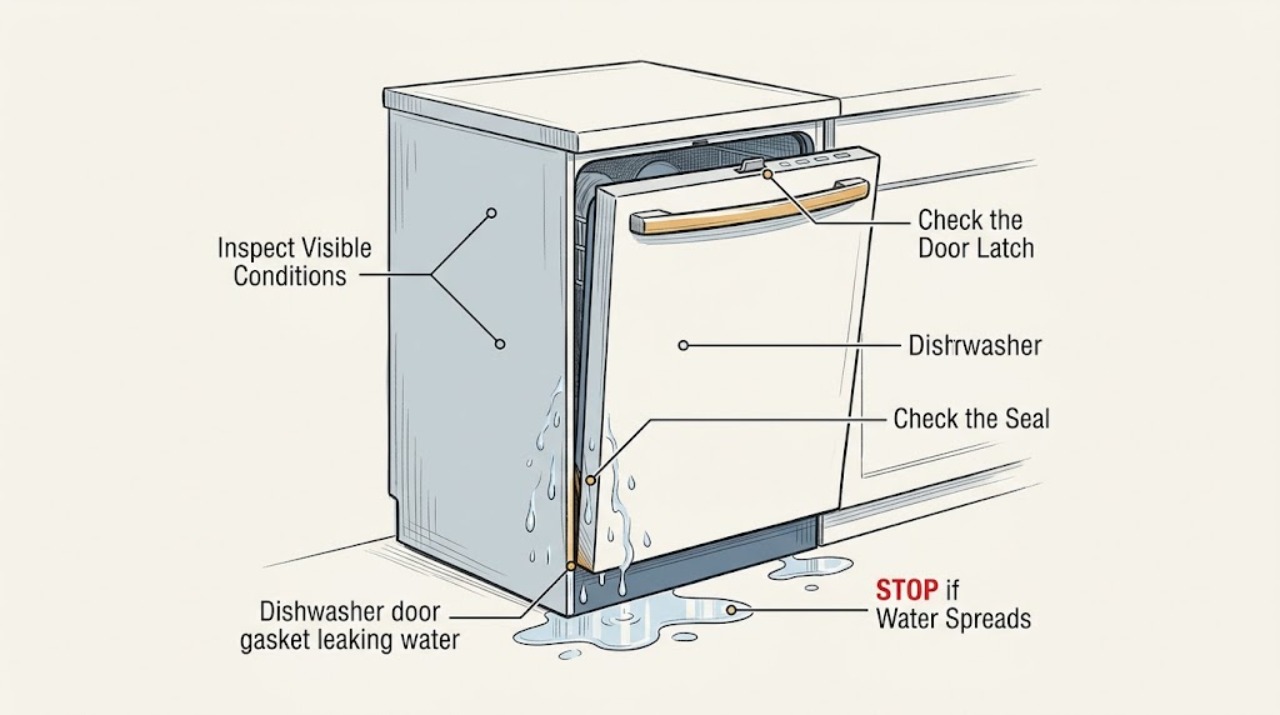
Work through in order
Diagnostic checks
Use only checks that match the exact appliance or system and its official guide.
-
Check 1
Cancel or pause the Bosch dishwasher as the model permits and observe from outside until spray and movement stop. Record where the first water appears, when it starts, whether it is below the door or from underneath, and any display code or leakage-protection indication.
Expected result: Water starts at the lower door edge, a corner, the side or underside, the base remains wet after a cycle, or a safety code appears.
Next step: Stop immediately for water near electrical parts, smoke, burning odor, sparks, a hot connection, or uncontrolled spreading. Otherwise let hot water cool, keep the unit out of service, and continue only with a visible door and gasket check.
Why this matters
Why: A lower-door leak makes the gasket, door contact, suds, or vent path worth checking; an underside or base leak may involve a hose, pump, tub, or safety switch instead. Timing separates fill, wash, and drain paths.
-
Check 2
With the dishwasher off and cool, inspect the full door gasket and the mating door edge for food particles, detergent residue, a fold, gap, tear, hard spot, or gasket section pulled out of its track. Do not pull the gasket forcefully or use glue.
Expected result: Debris is present, the seal is visibly displaced, the gasket is torn or hardened, or the gasket and door edge appear clean and evenly seated.
Next step: Wipe away only loose surface debris with a damp cloth and reseat a visibly displaced section only if the exact manual permits it. Stop using a torn or damaged seal and arrange service; do not remove the inner door or replace the gasket by appearance alone.
Why this matters
Why: Bosch links dirt and a seal pulled away from its track with leaks. A torn or deformed gasket cannot be made reliable by wiping it, while a clean seated seal shifts attention to door alignment, suds, vent, installation, or an internal leak.
-
Check 3
Close the empty, cool dishwasher gently and inspect whether the door meets the gasket evenly without rubbing, springing back, or requiring force. Check only visible hinges, latch contact, and cabinet alignment; do not defeat the latch or adjust hinge hardware without the exact model instructions.
Expected result: The door is skewed, latch contact is uneven, the gasket is pinched, the door requires force, or it closes evenly with no visible gap.
Next step: Keep the dishwasher off if the latch, hinge, or door is damaged or cannot close squarely. Arrange qualified service for alignment or hardware work; do not bend the door or force a cycle to test it.
Why this matters
Why: Uneven door contact can leave a gasket gap even when the rubber is intact. A door that closes normally makes residue, suds, vent, installation, or an internal water path more likely than a simple alignment issue.
-
Check 4
Review the detergent used and the last load without adding more product. Look for persistent foam at the door edge, detergent intended for hand washing, an overfilled dispenser, or a recent detergent change. For an applicable model, inspect only the visible condensation-vent area described by the manual.
Expected result: Excess suds are present, the wrong detergent was used, the vent is visibly blocked, or there is no suds or vent clue.
Next step: Stop using the wrong detergent and follow the exact Bosch manual for clearing a detergent condition; do not add household chemicals or run repeated cycles to flush foam. Arrange service for a blocked or inaccessible vent or a returning leak.
Why this matters
Why: Bosch lists wrong detergent and excessive suds, a blocked condensation vent on applicable models, and improper installation as leak causes. No suds or vent clue makes gasket seating, alignment, plumbing, or internal components more likely.
-
Check 5
Inspect the visible installation around the dishwasher without removing it: look for a unit that has shifted, a door or cabinet that is no longer square, or water appearing at the supply, drain, or underside rather than at the gasket. Do not pull a built-in unit across a wet floor or reach beneath it while powered.
Expected result: The leak is at a hose or underside, the dishwasher is visibly misaligned, the base is wet, or the installation and visible connections are dry and stable.
Next step: Turn off the water supply and isolate power from a dry, safe location for a base or underside leak. Do not remove panels; arrange qualified appliance or plumbing service for any leak outside the door seal path.
Why this matters
Why: A gasket can be blamed incorrectly when a hose, pump, tub, installation, or base leak is the real source. Bosch identifies water in the base as a condition that can activate leakage protection and require water shutoff and assistance.
-
Check 6
After cleaning only visible debris and confirming a model-appropriate gasket position, document the full Bosch model, leak location, cycle stage, detergent, door alignment, and whether the leak returns without running repeated cycles. Keep the dishwasher out of use while an active leak remains.
Expected result: The leak stops after debris removal, returns with a clean seated gasket, appears only during a particular phase, or remains unexplained from outside.
Next step: Arrange qualified Bosch appliance service for a recurring leak, damaged gasket, door hardware issue, base water, or any internal hose, pump, tub, or vent concern. Provide the recorded model and phase information.
Why this matters
Why: A one-time residue obstruction supports a sealing-surface cause. A recurring leak with clean even contact, a phase-specific underside leak, or an unexplained base leak needs model-specific service diagnosis.
Use your observations
Decision map
Find the observation that best matches what you see, then follow the next safe action.
-
PATH 01Next step
What you see
Do this next
After the dishwasher is off and cool, clean the door and gasket gently and make one supervised check only if the seal is intact and evenly seated. Stop if water returns.
-
PATH 02Next step
What you see
Do this next
Keep the dishwasher off and use the exact Bosch model instructions or qualified service for reseating or replacement; do not glue, cut, or force the seal.
-
PATH 03Next step
What you see
Do this next
Stop using the dishwasher and arrange model-specific service for door or installation alignment; do not bend the door or adjust hidden hardware without the manual.
-
PATH 04Next step
What you see
Do this next
Stop adding detergent and follow the exact Bosch guidance for the affected model; do not add household chemicals or keep cycling to clear foam.
-
PATH 05Next step
What you see
Do this next
Turn off the water inflow and isolate power only from a dry safe location; leave the dishwasher off and arrange qualified service.
-
PATH 06Next step
What you see
Do this next
Keep the Bosch dishwasher out of use and arrange qualified service with the model, phase, detergent, and leak location; do not open the cabinet.
-
PATH 07Next step
What you see
Do this next
Keep clear, isolate water and power only from a dry safe location, and obtain qualified appliance or electrical service. Do not restart the dishwasher.
Helpful context
Understand the symptom
Classify the leak before touching the seal
A wet spot below the door does not prove that the gasket is the only source. Observe the first location and cycle stage from a safe position: filling, washing, draining, or the end of a cycle. Water can travel along the inner door or floor, and a base leak can trigger a safety switch. Do not keep running cycles to make a small leak easier to see.
The door gasket needs a clean, even sealing surface
Food particles, detergent residue, or a gasket folded out of its track can leave a gap. Once the appliance is off and cool, clean the door and gasket gently with a damp cloth and look for visible displacement. Bosch manuals differ by model; do not apply adhesive, trim the gasket, or remove the inner door without the exact manual.
Suds, alignment, and installation can mimic a gasket failure
The correct seal can still leak if the dishwasher is producing excess suds, the door is not closing squarely, an applicable vent is blocked, or the unit is not installed correctly. Use only the detergent type and amount specified for the model. A recurring leak from a corner, underneath, or the base after a clean and seated gasket check belongs with qualified service.
Water and electricity require a hard stop
Stop for water near wiring, the outlet, or controls; smoke; burning odor; sparks; a hot or damaged cord; or an active leak that is spreading. Turn off the water supply and isolate power only from a dry, safe location. Do not reach under the dishwasher, bypass a door latch, or open the cabinet as an ordinary gasket check.
Safety boundary
Stop conditions
- Stop immediately for water near the outlet, cord, plug, controls, or wiring; smoke, burning odor, sparks, a hot or damaged connection, repeated breaker trips, or an active leak that is spreading. Isolate water and power only from a dry, safe location and arrange qualified service.
- Do not reach beneath a built-in dishwasher on a wet floor, defeat the door latch, force the door closed, or run repeated cycles to reproduce a leak.
- Do not stretch, cut, glue, or chemically treat the door gasket; do not open the inner door, cabinet, or base without the exact Bosch model instructions and safe isolation.
- Turn off the water inflow for water in the base, a leak from underneath, or any Bosch leakage-protection indication. Do not operate the dishwasher until the cause is diagnosed.
- If cleaning and a model-appropriate visible gasket seating check do not stop the leak, leave the dishwasher out of use and arrange qualified appliance service.
Only after diagnosis
Potential parts
- dishwasher door gasket
Consider only when the exact model's gasket is torn, hardened, permanently deformed, or repeatedly pulls out of its track after the door and sealing surfaces are clean.
Confirm the Bosch E-Nr. or full model number and the exact parts information before ordering; door gaskets are not universal by appearance. - door latch or hinge hardware
Consider only after qualified diagnosis finds that the door cannot close squarely or maintain even gasket contact because of model-specific latch or hinge hardware.
Confirm the full Bosch model and installation configuration; do not infer a hardware fit from a similar-looking dishwasher. - dishwasher leak-path component
Consider only after service identifies an internal hose, pump, vent, tub, or related leak path rather than the door gasket itself.
Use the exact model diagnosis and Bosch parts information before any part decision; the symptom alone does not identify a component.
When checks do not resolve it
Need a professional?
Arrange qualified Bosch appliance service when the gasket is torn, hardened, repeatedly displaced, or not the only leak path; the door is misaligned; water appears beneath the dishwasher or in its base; a vent, pump, hose, tub, or installation issue is suspected; or cleaning does not stop the leak. Use urgent service for electrical hazards, uncontrolled water, smoke, sparks, or repeated breaker trips.
Safety scope: Do not open the cabinet or base, defeat the latch, operate with an active leak, or perform energized checks. Turn off water and isolate power only from a dry safe location.
Common questions
FAQ
Why is my Bosch dishwasher leaking from the door gasket?
Bosch identifies debris on the door or seal, a seal pulled from its track, suds, an obstructed vent on applicable models, and improper installation as possible leak causes. Clean only a cool, visible seal and stop if the leak returns.
Can food or detergent residue cause a Bosch dishwasher door leak?
Yes. Bosch guidance says dirt or food particles on the door or seal can prevent proper sealing. Turn the dishwasher off and cool, then wipe the door and gasket gently with a damp cloth; do not use glue or abrasive treatment.
What if the Bosch dishwasher gasket is pulled out of its track?
Bosch lists a seal pulled away from its track as a leak cause. Do not force or trim it; use the exact model instructions for a safe reseating check, and arrange service if it will not stay seated or is damaged.
Can too much suds look like a Bosch door-gasket leak?
Yes. Bosch lists wrong detergent and suds among water-leak causes. Stop adding detergent and follow the exact model guidance; do not add household chemicals or repeatedly run cycles to clear foam.
Why is water under my Bosch dishwasher if the door gasket looks fine?
Water beneath the unit can come from a hose, pump, tub, vent, installation, or another internal path. Bosch treats water in the base as a leakage-protection condition: turn off the water inflow, isolate power safely, and arrange service.
When should I stop using a Bosch dishwasher with a leaking gasket?
Stop for a recurring leak, a torn or displaced gasket, water in the base, water near electrical parts, smoke, burning odor, sparks, a hot connection, or repeated breaker trips. Leave the dishwasher off and arrange qualified service.
Read the exact guide
Official sources
- Bosch Dishwasher Error Codes: Troubleshooting GuideBosch · Error meanings and available checks vary by Bosch model and generation.
- 9000391168.inddBosch Home Appliances · Manual is model-family specific; use the exact Bosch dishwasher manual where procedures differ.
- untitledBosch Home Appliances · Specific Bosch dishwasher manual; door-seal location and care can vary by model.
Community feedback
Share a repair observation
Share a plain-text repair observation. Accepted observations are published automatically; this page may take a moment to update.