
On this page
Start here
Quick answer
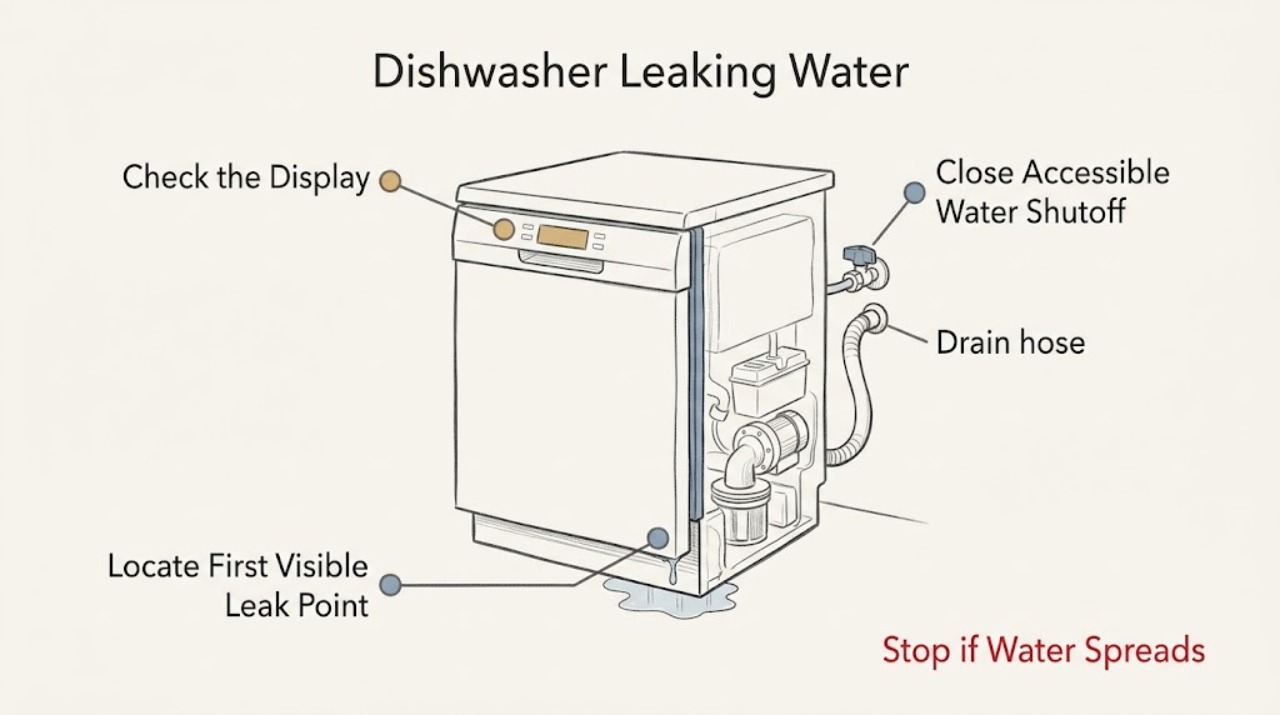
If a Bosch dishwasher is actively leaking, stop the cycle and keep people away from the wet area. From a dry, safe position, turn the dishwasher off and close the nearby water shutoff valve if it is clearly accessible; disconnect power only by a safe external method and never by opening the appliance. Note where the water first appears: at the door, under the unit, near the inlet connection, or during draining. Bosch identifies water at the base as a leakage-protection condition and directs the owner to stop the water inflow and obtain assistance. After the area is safe, inspect only the visible door seal and loading clearance, detergent or foam history, and accessible hose connections; do not pull the dishwasher out or run repeated cycles. A persistent leak, water in the base, damaged hose or seal, electrical exposure, or an unknown source needs qualified dishwasher service.
Before you begin
Safety first
- This article supports only stopping the cycle, safe external observation, documenting the leak, and closing a clearly accessible water shutoff or external power disconnect when dry and safe. Do not move the dishwasher, open panels, disconnect hoses, reach into the base, touch wiring, or re-energize an active leak.
Work through in order
Diagnostic checks
Use only checks that match the exact appliance or system and its official guide.
-
Check 1
From a dry position, stop the dishwasher, keep hands away from wet electrical areas, and look for an active stream, pooling water, smoke, burning smell, sparking, hot water or steam, and whether the water is spreading toward an outlet or cabinet wiring.
Expected result: Record whether the leak is still flowing, only a small wet area remains, the source is hot or pressurized, or the area cannot be approached safely.
Next step: If there is smoke, sparking, burning smell, hot water or steam, or water near electrical connections, leave the area and seek appropriate urgent help. Otherwise turn the appliance off and continue only from a dry, safe position.
Stop if: Do not touch pooled water near electrical parts, open the door into escaping steam, or continue a cycle to locate the leak.
Why this matters
Why: An active or spreading leak can damage flooring and cabinets and can create shock or scald hazards near electrical parts. Bosch treats water detected in the base as a leakage-protection condition rather than permission to continue the cycle.
-
Check 2
If it is clearly visible, dry, and reachable without moving the dishwasher, close the nearby dishwasher water shutoff valve; use the exact model instructions for stopping a cycle and use only a safe external power disconnect if one is accessible.
Expected result: Note whether water stops when the accessible supply is closed, whether the dishwasher remains powered, and whether the shutoff requires reaching behind the unit or into a wet cabinet.
Next step: Leave the water supply closed and the appliance unused while arranging service; tell the technician whether the valve could be closed and whether water continued afterward.
Stop if: Do not pull the dishwasher out, disconnect hoses, touch wiring, or reach through pooled water to find a valve or outlet.
Why this matters
Why: A leak that stops after the water supply is closed remains a plumbing or appliance inlet diagnosis, but this observation does not identify the failed connection. A valve or disconnect that is hidden or unsafe to reach is outside ordinary troubleshooting.
-
Check 3
With the appliance off and the outside area safe, use a dry cloth or paper towel only on the surrounding floor and cabinet face, not inside the machine, to identify where new moisture first appears: door edges, under the center, near a visible side connection, or at the drain-plumbing route.
Expected result: Record the first wet location and when it appeared: while filling, during washing, when the door was opened, during draining, or after the cycle ended.
Next step: Photograph the location and keep the dishwasher off. Inspect only visible door and loading conditions next; leave under-unit connections and internal areas to service.
Stop if: Do not remove toe panels, slide the dishwasher out, insert tools, or reach below the machine to feel for a connection.
Why this matters
Why: Door-edge moisture makes door closure, seal condition, or projecting dishware more likely; under-unit moisture makes inlet, sump, pump, drain hose, or internal leakage more likely. Timing narrows the path but cannot safely confirm an internal part.
-
Check 4
With the dishwasher unused and the door cool, inspect the visible door gasket for a displaced, torn, hardened, or dirty section and check whether any dish or rack item projects into the door path; do not remove the seal or latch.
Expected result: Record whether the door closes evenly and latches, whether a dish was pressing against it, and whether the gasket has visible damage or an obstruction.
Next step: Remove only the obstruction from the rack if the area is dry and safe, then keep the machine off until the leak is resolved; do not run a test cycle if the gasket or latch is damaged.
Stop if: Do not force the door, bend the gasket, adjust hinges, or continue operation with a damaged latch or seal.
Why this matters
Why: A projecting dish can hold the door open enough for steam and water to escape, while a visibly damaged or displaced gasket makes a door-seal problem more likely. A clean-looking gasket does not rule out an internal leak or door alignment issue.
-
Check 5
Record whether hand soap, excess rinse aid, an unsuitable cleaner, or unusually heavy foam was present, and inspect only the visible dispenser area after the dishwasher is off; do not add chemicals or run another cycle to flush it.
Expected result: Note whether foam escaped at the door, whether rinse aid was spilled, whether a non-dishwasher product was used, or whether no detergent event occurred.
Next step: Tell service exactly what product and amount were used. Keep the water supply closed and do not attempt a chemical neutralization or repeated rinse cycle unless the exact manual and a technician direct it.
Stop if: Do not pour more detergent, bleach, hand soap, or cleaner into the dishwasher, and do not use a wet hand to inspect electrical or under-unit areas.
Why this matters
Why: Bosch says hand soap in the rinse-aid dispenser, spilled rinse aid, and unsuitable detergent or machine-care products can create excessive foam. Foam can mimic or worsen a door leak, but a leak without foam still needs a water-path diagnosis.
-
Check 6
Read and photograph any displayed error, faucet symbol, flashing light, or repeated beep pattern, then record the model identity from the rating plate inside the door without pulling the dishwasher out.
Expected result: Note whether Bosch shows E15 or another leakage, water-flow, or drain indication; whether the base-protection symptom returns; and the exact E-Nr., FD, or other model identifiers that are safely visible.
Next step: Keep the water supply closed and arrange qualified service for any persistent leak, base-water indication, damaged connection, or unresolved source. Provide photographs, timing, location, detergent history, and model information.
Stop if: Do not repeatedly reset the dishwasher, remove the filter or pump cover while water is uncontrolled, open electrical panels, or reconnect the supply to test an active leak.
Why this matters
Why: Bosch associates water in the base with leakage protection, while other messages can point toward inlet flow, drainage, or a different fault. The code and model identity help service select the correct diagnostic path but do not authorize internal repair.
Use your observations
Decision map
Find the observation that best matches what you see, then follow the next safe action.
-
PATH 01Safety boundary
What you see
Moisture first appears at the door edge during washing, and the load or gasket shows an obstruction or visible damage.
Do this next
Keep the dishwasher off, document the load and gasket, and arrange service if the latch or seal is damaged or the leak returns after the obstruction is removed.
Why this path and its safety boundary
Why it matters: Projecting dishware, incomplete latching, or a damaged or displaced door seal is more likely than a drain-hose leak; Bosch warns that items can push the door open and let water escape.
Safety stop: Do not force the door, adjust hinges, or run another cycle with a damaged seal or latch.
-
PATH 02Safety boundary
What you see
Foam escapes at the door and there is a history of hand soap, spilled rinse aid, or an unsuitable product.
Do this next
Stop using the dishwasher, record the product and event, and follow only the exact manual or qualified service instructions for recovery; do not add another chemical or run repeated cycles.
Why this path and its safety boundary
Why it matters: Excessive foaming is more likely to be contributing to the apparent leak, but it does not rule out a seal or internal water-path fault.
Safety stop: Do not use hand soap, bleach, or improvised foam suppressants in the dishwasher.
-
PATH 03Safety boundary
What you see
Water appears under the dishwasher, the leak source is not visible from the door, or a Bosch leakage-protection indication appears.
Do this next
Close the accessible water shutoff, keep power and the appliance unused, do not pull it out, and arrange qualified service.
Why this path and its safety boundary
Why it matters: An inlet, sump, pump, drain hose, internal seal, or other concealed water path is more likely; Bosch treats water in the base as an activated leakage-protection condition.
Safety stop: Do not remove panels, reach into the base, loosen hoses, or re-energize the machine to locate the source.
-
PATH 04Safety boundary
What you see
The floor becomes wet during draining or just after the cycle, with standing water or a drain-related indication.
Do this next
Keep the appliance off and photograph the accessible plumbing area. Have service determine whether a filter, pump cover, hose, or internal pump requires attention unless the exact manual clearly authorizes a safe user check.
Why this path and its safety boundary
Why it matters: A blocked or loose pump cover, drain path, hose, air gap, or plumbing connection becomes more likely than a fill-side leak; Bosch lists drain-path checks for relevant error conditions.
Safety stop: Do not disconnect a drain hose, reach into standing water, or run a rinse cycle while the leak remains unexplained.
-
PATH 05Safety boundary
What you see
The source remains unclear, the leak continues after the supply is closed, or the dishwasher leaks again after a visible load or foam issue is absent.
Do this next
Leave the water supply closed and arrange qualified dishwasher service with the model, timing, location, photos, and any displayed message.
Why this path and its safety boundary
Why it matters: A concealed appliance or plumbing fault is more likely than a simple loading or detergent issue, and external observations cannot identify the part safely.
Safety stop: Do not keep cycling the dishwasher, move it from the cabinet, or open the base to search for the leak.
Helpful context
Understand the symptom
Start with the location and timing of the leak
Water at the front edge during washing points toward the door, seal, latch, or a load that prevents the door from closing. Water under the machine or near a cabinet connection can instead involve the inlet or drain path. Water that appears during or after draining makes the drain hose, pump area, filter, or plumbing connection more relevant. This pattern is a direction for safe inspection, not proof that a particular part has failed.
Door clearance and detergent can create a false seal diagnosis
Bosch warns that projecting dishes can push the door open during a program and allow steam and water to escape around it. Excessive foam can also come from hand soap in the rinse-aid dispenser, spilled rinse aid, or an unsuitable product. Record the load and detergent history before replacing a seal; do not use non-dishwasher detergent or keep running cycles to see whether the leak stops.
Know the service boundary
A built-in dishwasher has water and electrical connections behind the cabinet. Bosch's installation instructions are written for qualified installers and require water and electrical supplies to be shut off before installation or service. The owner can document the leak and operate a clearly accessible shutoff, but should not pull out the appliance, loosen plumbing, open panels, or reach into a wet base.
Safety boundary
Stop conditions
- Stop the dishwasher and close the clearly accessible water shutoff for an active or unexplained leak; keep the appliance unused until the source is addressed.
- Do not pull out the built-in dishwasher, remove toe panels or enclosure panels, loosen water or drain connections, reach into the base, or touch wiring near water.
- Do not open the door into escaping hot water or steam, and leave the area for smoke, sparking, burning smell, or water approaching electrical connections.
- Do not add hand soap, bleach, unsuitable cleaner, or another detergent to manage foam, and do not run repeated cycles to test whether a leak stops.
- A persistent leak, water-in-base or leakage-protection indication, damaged seal or hose, recurring error, or unknown source requires qualified appliance service.
Only after diagnosis
Potential parts
- dishwasher door seal or gasket
Consider only if service confirms a door-edge leak caused by a damaged, displaced, hardened, or model-specific seal after load and latch conditions are assessed.
Match the exact Bosch model and revision through qualified service; do not substitute a gasket based on length or appearance. - inlet or drain hose connection
Consider only when inspection identifies a leaking hose, adapter, clamp, or connection and the source is confirmed rather than inferred from water location.
Water-line work and connection fit must follow the exact installation instructions and qualified service procedure. - pump cover, drain pump, or internal seal
Consider only when a drain-related leak or water-in-base condition is diagnosed at the pump or sump area; standing water alone does not identify the part.
Confirm the exact model, pump assembly, seal arrangement, and service procedure before ordering or replacing a component.
When checks do not resolve it
Need a professional?
Arrange qualified dishwasher service for any persistent or recurring leak, water under the appliance, water in the base, a Bosch leakage-protection indication, a damaged door seal or hose, or a source that cannot be identified from safe external observation. Seek urgent help for smoke, sparking, burning smell, hot water or steam that cannot be safely avoided, or water near electrical connections. Provide the exact E-Nr. and production information if safely visible inside the door, leak location and timing, error messages, photos, load and detergent history, and whether the accessible water shutoff was closed.
Safety scope: This article supports only stopping the cycle, safe external observation, documenting the leak, and closing a clearly accessible water shutoff or external power disconnect when dry and safe. Do not move the dishwasher, open panels, disconnect hoses, reach into the base, touch wiring, or re-energize an active leak.
Common questions
FAQ
What should I do first if my Bosch dishwasher is actively leaking?
Stop the cycle from a dry, safe position, keep away from water near electrical parts, and close the clearly accessible dishwasher water shutoff. Do not pull the dishwasher out or run another cycle to find the source.
Why is water leaking from the front door of my Bosch dishwasher?
A projecting dish can prevent the door from closing and let water escape, or the gasket, latch, or door alignment may be involved. Check only visible loading and seal conditions with the appliance off; a damaged seal or recurring leak needs service.
Can too much soap make a Bosch dishwasher leak?
Yes. Bosch identifies hand soap in the rinse-aid dispenser, spilled rinse aid, and unsuitable products as causes of excessive foam. Stop using the dishwasher, record the product used, and do not add another chemical or repeatedly run cycles.
What does E15 mean on a Bosch dishwasher?
Bosch says E15 means the safety switch detected water in the dishwasher base and the leakage-protection system activated. Turn off the water inflow and arrange assistance; do not open the base or keep resetting the machine.
Should I pull out my Bosch dishwasher to find the leak?
No. A built-in dishwasher has water and electrical connections behind the cabinet. Document the visible location and timing, close an accessible water shutoff, and have qualified service inspect concealed hoses, pumps, seals, and connections.
Read the exact guide
Official sources
- Dishwasher not pumping waterBosch · Bosch US guidance for dishwashers not pumping or draining; it supports a drain-related branch but does not authorize internal work on every model.
- Bosch Dishwasher Troubleshooting & Repair GuideBosch · Bosch US dishwasher owner-support troubleshooting overview; exact appliance model and manual govern any model-specific action.
- Installation InstructionsBosch · Bosch dishwasher installation instructions; they are intended for qualified installers and support service-boundary and visible connection guidance.
- Use and Care Manual SHP65CC5UCBosch · Bosch use-and-care manual for the SHP65CC5UC dishwasher; the installed model's manual controls exact parts and procedures.
- Bosch Dishwasher Error Codes: Troubleshooting GuideBosch · Bosch US owner-support guidance for dishwasher error codes and leak-related indicators; exact model documentation controls model-specific controls and service steps.
Community feedback
Share a repair observation
Share a plain-text repair observation. Accepted observations are published automatically; this page may take a moment to update.