
On this page
Start here
Quick answer
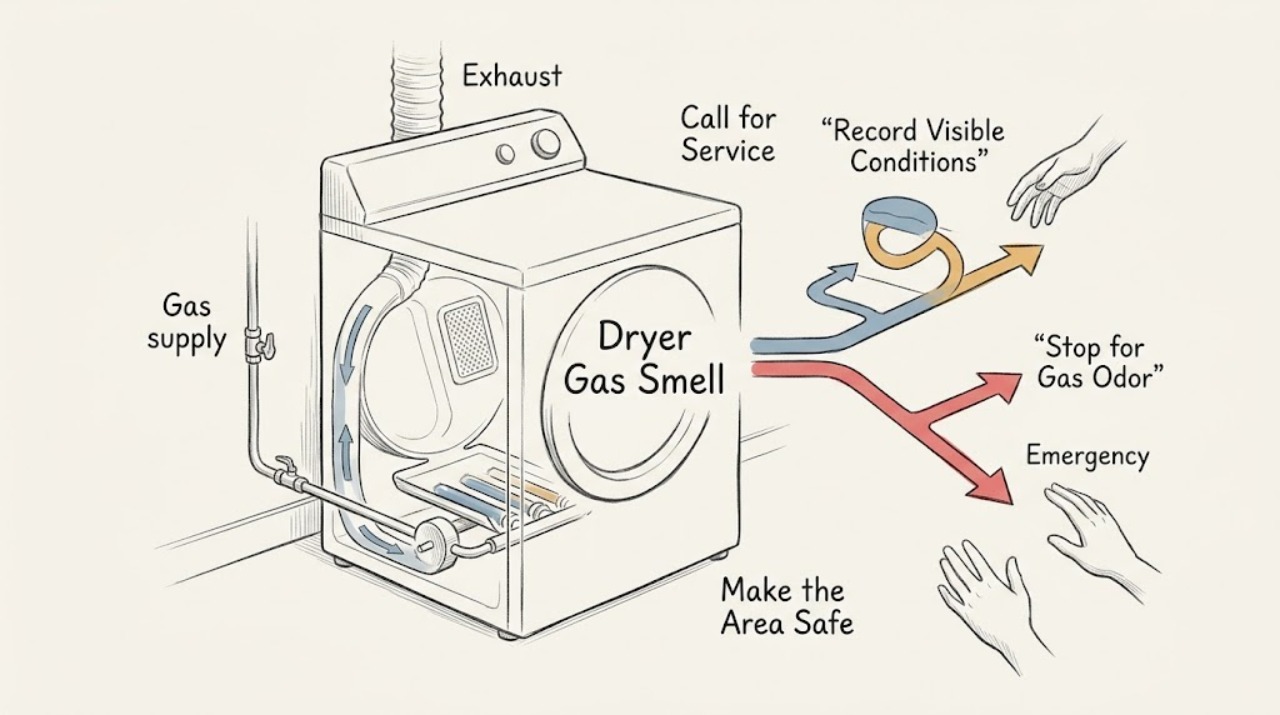
If a Speed Queen dryer smells strongly or continuously of gas, stop using it, do not touch switches or controls, avoid flames and ignition sources, leave the building with people and pets, and contact the local gas utility or emergency services from a safe location. Do not try to find the leak, test a connection with a flame, relight the dryer, or run another cycle. Speed Queen gas-dryer installation instructions require the gas type to match the appliance and say tool-based disassembly belongs to a qualified service person. A brief odor during a first installation or ignition event may be confused with exhaust or a hot-lint smell, but it should never be confirmed by operating the dryer; a recurring odor, hissing, abnormal flame, soot, headache, dizziness or a carbon-monoxide alarm requires immediate evacuation and qualified inspection.
Work through in order
Diagnostic checks
Use only checks that match the exact appliance or system and its official guide.
-
Check 1
If you smell gas now, stop operating the dryer and do not touch its controls, light switches, plugs or other electrical devices in the area. Do not light anything, smoke, use a flashlight or try to locate the source. Leave the building with everyone and pets, then contact the local gas utility or emergency services from a safe location.
Expected result: The odor is strong, continuous, spreading beyond the dryer, accompanied by hissing, or present while anyone has headache, dizziness, nausea, confusion or a carbon-monoxide alarm.
Next step: Remain outside and do not re-enter or operate the dryer until emergency responders, the gas utility or a qualified professional says it is safe. Do not continue with appliance diagnosis from inside the affected area.
Why this matters
Why: These signs are consistent with a possible gas leak or combustion hazard. Carbon monoxide cannot be smelled, so an alarm or symptoms must not be dismissed because the gas odor is faint or absent.
-
Check 2
After the emergency has been handled and the area is declared safe, confirm from the appliance label and records whether the Speed Queen dryer is a gas model, what fuel it is configured for, and whether it was recently installed, moved or converted. Do not remove a panel, loosen a gas fitting or change an orifice to make the label and supply agree.
Expected result: The dryer is gas-fired and the fuel matches the nameplate, the fuel type is uncertain, the unit was converted or moved, or the appliance is electric despite the reported smell.
Next step: Provide the exact model and fuel information to a qualified appliance technician or gas professional. If the source is not clearly the dryer, ask the gas utility or emergency service to evaluate the area rather than assuming the appliance is responsible.
Why this matters
Why: A mismatched or uncertain fuel configuration needs professional verification. An electric dryer cannot create a gas flame, so a smell around it may come from another appliance, a room leak, exhaust contamination or burning material; it still should not be tested by running it.
-
Check 3
Do not run a confirmation cycle. Instead, write down whether the odor was first noticed at the start of ignition, during heat, after the dryer stopped, near the front door, behind the appliance, at the gas shutoff area or at the exhaust outlet. Only from a safe distance and after clearance, note whether the odor is sulfur-like, hot-lint-like, solvent-like or unexplained.
Expected result: The odor was a one-time brief whiff at first installation or ignition, returns during heat, is strongest behind the dryer or at a connection, comes from the exhaust, or is accompanied by soot, yellow or unstable flame, smoke or unusual heat.
Next step: Keep the dryer off for every recurring or unexplained odor. Ask qualified service to inspect gas connections, burner operation, ventilation and exhaust; never use an open flame or improvised leak test.
Why this matters
Why: Timing and location help a professional distinguish a supply or connection concern from combustion, exhaust backflow or burning lint. A brief event is not proof of safety, and soot, abnormal flame, smoke or heat suggests improper combustion or fire risk.
-
Check 4
Once no gas or carbon-monoxide emergency remains and the dryer is not operating, inspect only the visible exhaust outlet and surrounding laundry area for lint buildup, crushed ducting, blocked discharge or air being pushed back indoors. Do not reach into the duct, remove the rear panel, alter the vent or operate the dryer to compare airflow.
Expected result: The exhaust is blocked or discharging into the room, the duct is crushed or disconnected, lint is accumulating, or the visible exhaust path looks normal.
Next step: Keep the dryer off and arrange qualified correction for a blocked, damaged or disconnected exhaust. If the odor persists with the dryer off, leave the area and contact the gas utility or emergency service rather than investigating further.
Why this matters
Why: Poor exhaust can bring hot, contaminated air back into the room and increase fire risk, but a clear outlet does not rule out a gas leak or combustion fault. Exhaust observations cannot certify safe burner operation.
-
Check 5
Check the household safety signals without approaching a suspected leak: determine whether a carbon-monoxide alarm sounded and whether anyone developed headache, dizziness, nausea, weakness or confusion while the dryer or another fuel-burning appliance operated. Do not silence an alarm and remain inside to compare the dryer with another appliance.
Expected result: A carbon-monoxide alarm sounded, symptoms are present, the alarm reactivates, or there is no alarm and no symptom but the gas odor was repeated.
Next step: Move outside immediately for an alarm or symptoms, contact emergency services and do not re-enter until cleared. For repeated odor without an alarm, contact the gas utility or qualified gas appliance service from a safe location.
Why this matters
Why: An alarm or symptoms indicate a potentially deadly exposure and cannot be diagnosed by smell. A repeated gas odor still requires the same stop boundary even when a CO alarm is quiet, because CO and fuel gas are different hazards.
-
Check 6
Prepare a service report without reconnecting or testing the dryer: exact Speed Queen model, gas or electric configuration, fuel type, installation or conversion history, odor description, location, timing, exhaust condition, display message, soot or flame observation made from a safe distance, alarm or symptom history, and whether the smell remains with the dryer off.
Expected result: The information points to the gas supply or connection, burner or combustion, exhaust or another room source, or the source remains uncertain.
Next step: Keep the dryer out of service until qualified personnel inspect and clear it. Do not relight, adjust, leak-test, open the cabinet or resume drying because the odor temporarily disappeared.
Why this matters
Why: This evidence lets the gas utility, appliance technician or electrician choose the correct inspection without asking the user to reproduce a gas or fire hazard. Uncertainty is a reason to keep the appliance off, not to perform another cycle.
Use your observations
Decision map
Find the observation that best matches what you see, then follow the next safe action.
-
PATH 01Next step
What you see
The odor is strong or continuous, gas is heard hissing, or the smell spreads beyond the dryer.
Do this next
Do not operate switches, appliances or flames, do not search for the leak, leave immediately and contact the gas utility or emergency services from a safe location.
Why this path and its safety boundary
Why it matters: Treat it as a possible gas leak rather than a normal ignition odor or vent issue.
-
PATH 02Next step
What you see
The odor is linked to the dryer but the exact gas model, fuel type or conversion history is uncertain.
Do this next
Keep the dryer off and provide the nameplate and installation history to qualified appliance or gas service; do not alter the gas valve or fitting.
Why this path and its safety boundary
Why it matters: The appliance may not match its gas supply or may have an installation or conversion problem that cannot be confirmed by a homeowner.
-
PATH 03Next step
What you see
The odor was noticed only briefly at ignition or first installation and there is no current smell, alarm, soot, smoke, heat or abnormal flame observation.
Do this next
Record the event and have qualified service confirm the installation and combustion path before using the dryer again if the odor returns or its source is uncertain.
Why this path and its safety boundary
Why it matters: A transient event is possible, but it has not been proven harmless and should not be recreated.
-
PATH 04Next step
What you see
The smell is strongest at the exhaust or the vent is visibly blocked, crushed, disconnected or discharging indoors.
Do this next
Keep the dryer off and arrange qualified vent correction and appliance inspection. Do not run the unit to compare the exhaust or attempt to seal a gas connection.
Why this path and its safety boundary
Why it matters: Exhaust or airflow can be returning hot combustion products or lint-contaminated air, but it does not rule out a gas leak.
-
PATH 05Next step
What you see
A carbon-monoxide alarm sounds, anyone has compatible symptoms, or there is soot, an unstable or abnormal flame, smoke or unusual heat.
Do this next
Move outside immediately, contact emergency services and do not re-enter or use the dryer until responders and qualified service personnel clear the appliance and area.
Why this path and its safety boundary
Why it matters: This is a combustion and life-safety emergency, not a dryer troubleshooting branch.
Helpful context
Understand the symptom
Gas odor is an emergency boundary before it is a repair clue
Natural gas is odorized so a leak may be noticed, but smell strength is not a safe leak measurement. A strong, spreading or recurring odor, hissing, visible flame or a gas or carbon-monoxide alarm means leave immediately. Do not operate the dryer, turn a switch on or off, use a phone inside the area, or stay to identify whether the smell comes from the hose, burner or exhaust.
Do not assume the dryer is gas-capable or correctly converted
Speed Queen makes gas and electric dryer configurations. The official installation guide says the gas type must match the nameplate and that a conversion for a different fuel must be performed by authorized or qualified personnel. Without an exact model and installation history, do not infer whether a brief odor is normal, whether a valve is correctly adjusted, or whether a conversion is complete.
A hot-lint smell and a gas leak need different help, but neither justifies a test cycle
Acrid hot-lint or burning odor may come from restricted airflow or fabric, while a sulfur-like odor, hissing or an alarm raises gas or combustion concerns. From outside and only after the area is safe, record where the smell was noticed and whether it happened at ignition, during heating or near the exhaust. Do not use that observation to restart the appliance.
When checks do not resolve it
Need a professional?
Contact emergency services or the local gas utility immediately for a strong or spreading gas odor, hissing, a suspected leak, a carbon-monoxide alarm or symptoms. Contact qualified appliance or gas service before reuse for any recurring or unexplained dryer odor, abnormal flame, soot, exhaust concern, fuel mismatch or installation or conversion uncertainty.
Common questions
FAQ
Is a brief gas smell when a Speed Queen dryer starts normal?
Do not assume it is normal or run another cycle to check. Record whether it occurred at first installation, ignition or exhaust, keep the dryer off, and have qualified gas-appliance service verify the installation if the odor returns or its source is unclear.
Can I test a Speed Queen dryer gas connection with a flame?
No. The Speed Queen installation instructions prohibit open-flame leak checks, and a suspected gas leak requires leaving the area rather than searching for its source. Contact the gas utility or qualified service from a safe location.
Does a carbon-monoxide alarm detect a gas leak?
No. Carbon monoxide is odorless and is a different hazard from the odorant added to natural gas. Treat a gas odor and a carbon-monoxide alarm separately: leave for either emergency, and never operate the dryer until trained personnel clear a suspected combustion problem.
What information should I give the Speed Queen technician?
Give the exact model, gas or electric configuration, fuel type, installation or conversion history, odor description and timing, location, exhaust condition, safe observations of soot or flame, any alarm or symptoms, and whether the smell remains when the dryer is off. Do not reconnect the dryer to collect more evidence.
Read the exact guide
Official sources
- Carbon Monoxide Fact SheetU.S. Consumer Product Safety Commission · General fuel-burning appliance and carbon-monoxide safety guidance; it does not diagnose a Speed Queen dryer.
- GasIllinois Emergency Management Agency and Office of Homeland Security · General public gas-leak emergency guidance; it is not a Speed Queen dryer repair manual.
- Installation InstructionsSpeed Queen · Official Speed Queen regional installation manual covering gas-dryer configuration and safety; exact model and local code still control the installation.
Community feedback
Share a repair observation
Share a plain-text repair observation. Accepted observations are published automatically; this page may take a moment to update.