
On this page
Start here
Quick answer
For a garment steamer that will not turn on, verify the outlet and plug, then check the tank seating and whether the light is blinking in a heat-up or auto-shutoff state. A steamer that remains dead after a dry power check should be serviced; do not open a hot or powered housing.
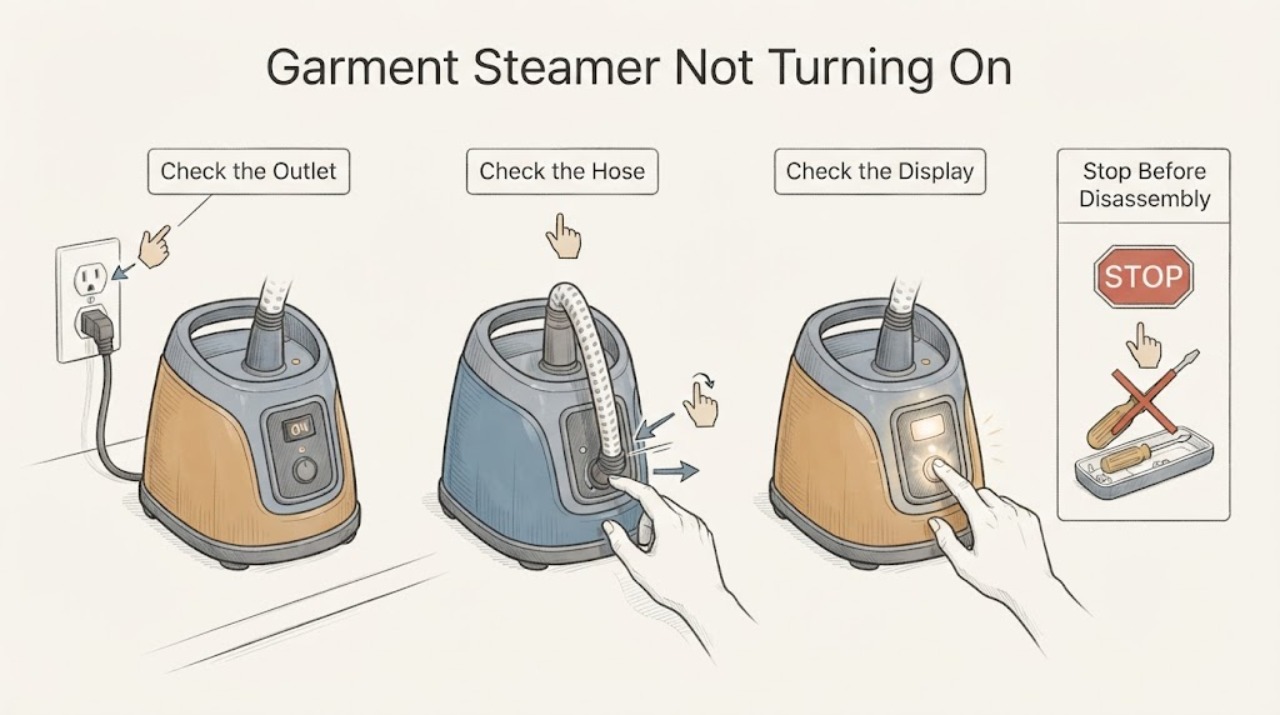
Work through in order
Diagnostic checks
Use only checks that match the exact appliance or system and its official guide.
-
Check 1
Check the outlet and plug: use a known-working wall outlet, make sure the cord and plug are dry and fully seated, and inspect for cuts or heat damage.
Expected result: Record the visible result of this check and whether the reported symptom changes.
Next step: If the result is normal, continue to the next check; if it is abnormal, correct only the documented condition or stop for service.
Why this matters
Why: This result separates an accessible operating condition from a fault that requires model-specific diagnosis.
-
Check 2
Check the water tank and position: with the unit unplugged and cool, reseat the tank and place a handheld head or stand hose in the manufacturer’s intended upright position.
Expected result: Record the visible result of this check and whether the reported symptom changes.
Next step: If the result is normal, continue to the next check; if it is abnormal, correct only the documented condition or stop for service.
Why this matters
Why: This result separates an accessible operating condition from a fault that requires model-specific diagnosis.
-
Check 3
Read the indicator: a blinking ready or power light can mean the steamer is still heating or has entered auto shutoff, rather than having no power.
Expected result: Record the visible result of this check and whether the reported symptom changes.
Next step: If the result is normal, continue to the next check; if it is abnormal, correct only the documented condition or stop for service.
Why this matters
Why: This result separates an accessible operating condition from a fault that requires model-specific diagnosis.
-
Check 4
After the manufacturer’s heat-up interval, press the power or steam control once and observe whether any light, heat, or steam returns; stop if the result is smoke, odor, leakage, or repeated cutout.
Expected result: Record the visible result of this check and whether the reported symptom changes.
Next step: If the result is normal, continue to the next check; if it is abnormal, correct only the documented condition or stop for service.
Why this matters
Why: This result separates an accessible operating condition from a fault that requires model-specific diagnosis.
Use your observations
Decision map
Find the observation that best matches what you see, then follow the next safe action.
-
PATH 01Next step
What you see
The outlet works, the plug is sound, and the steamer shows no light or response at all.
Do this next
Unplug it and contact the manufacturer or a qualified small-appliance technician.
Why this path and its safety boundary
Why it matters: The fault is beyond the normal tank, warm-up, or position checks and may involve the cord, switch, thermal protection, or internal control.
-
PATH 02Next step
What you see
The power light blinks and becomes steady after the documented warm-up, but steam is still absent.
Do this next
Refill and reseat the tank, hold the head upright, and follow the model’s descaling procedure.
Why this path and its safety boundary
Why it matters: Power is present; low water, poor tank seating, scale, hose condensation, or a trigger state is more likely than a no-power fault.
-
PATH 03Next step
What you see
The steamer turns on briefly and then cuts out, especially while tilted or after extended use.
Do this next
Allow it to cool, keep it upright, and use only the documented maintenance procedure before one retest.
Why this path and its safety boundary
Why it matters: Auto shutoff, restricted steam flow, scale, or thermal protection is more likely than a failed wall outlet.
Helpful context
Understand the symptom
Use the ordered checks below to separate normal operating states from a fault for this appliance.
When checks do not resolve it
Need a professional?
Stop using the steamer for smoke, burning odor, sparks, damaged cord, water at the base, or repeated cutout; unplug it when cool and seek qualified service.
Common questions
FAQ
Does no steam prove the steamer is not turning on?
No. A blinking light can indicate warm-up or auto shutoff, and a low or mis-seated tank can stop steam while power remains present.
Can I use vinegar or another chemical to restore power?
No. Use only the model-approved water and descaling instructions; chemicals can damage the steamer and do not diagnose an electrical fault.
When should I stop testing?
Stop for smoke, burning odor, damaged insulation, water entering the base, electric sparking, or repeated thermal cutout, then arrange service.
Read the exact guide
Official sources
- My Philips Garment Steamer does not produce steamPhilips · garment steamer startup, heating, tank, position, and scale troubleshooting
Community feedback
Share a repair observation
Share a plain-text repair observation. Accepted observations are published automatically; this page may take a moment to update.