
On this page
Start here
Quick answer
For a steamer that is not working, separate no power or no heat from no steam. Check the outlet and controls, fill and seat the tank, allow the model’s heat-up period, and keep a standing steamer upright so condensation can return through the hose. Unplug and cool it before descaling or handling the tank.
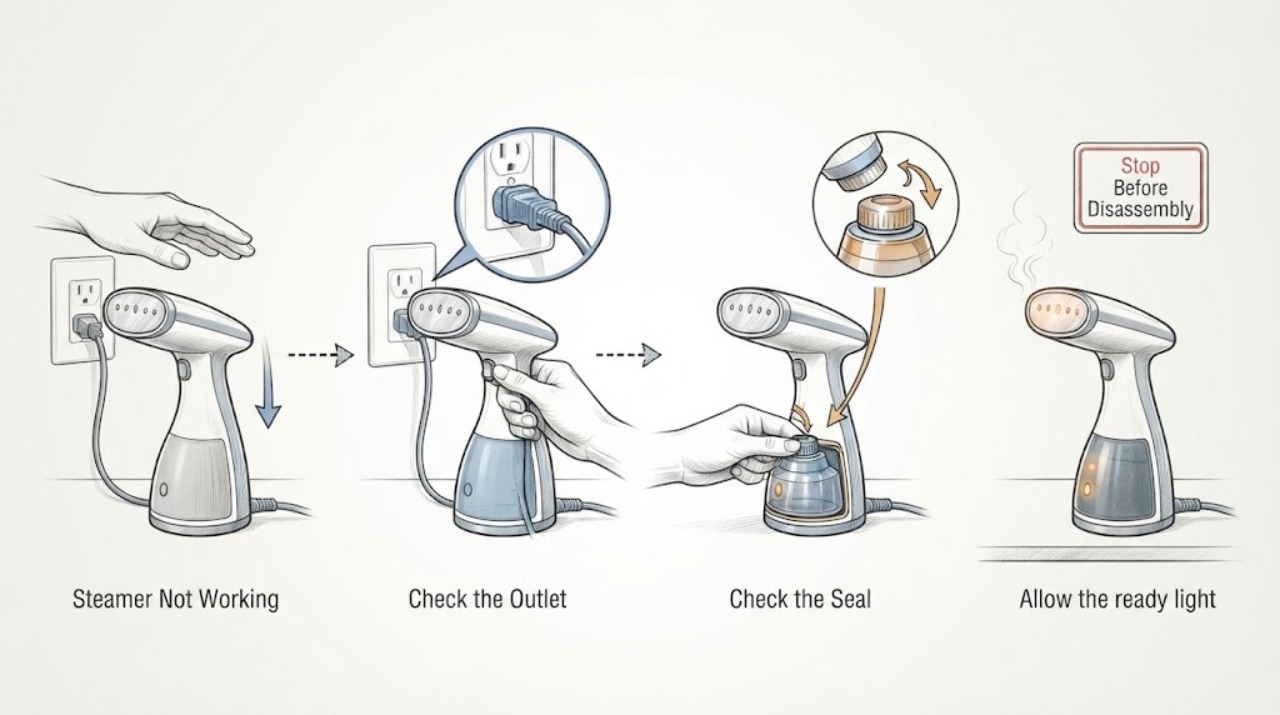
Work through in order
Diagnostic checks
Use only checks that match the exact appliance or system and its official guide.
-
Check 1
Check the plug, outlet, power light, and on/off control from outside the appliance.
Expected result: The light is off, the outlet is dead, or the light is on but the steamer stays cold.
Next step: Use a known working outlet once; stop using the steamer if the cord or plug is damaged.
Why this matters
Why: Philips lists connection and switch state as causes of no heat; a powered cold unit needs service-level diagnosis.
-
Check 2
Check the water level and remove and reinsert the tank so it seats fully and seals.
Expected result: The tank is empty, incorrectly seated, or correctly seated with adequate water.
Next step: Refill and seat the tank using the manual, then allow the normal heat-up period.
Why this matters
Why: Philips says low water or a poorly inserted tank can stop steam production.
-
Check 3
Allow the ready light or model heat-up period to complete, then hold the steam trigger with the head upright.
Expected result: Steam begins, the light continues flashing, or no steam appears after heating.
Next step: Do not keep pressing a cold or leaking steamer; continue only with the hose and scale checks.
Why this matters
Why: No steam before heat-up can be normal; persistent no steam keeps tank, hose condensation, scale, or control causes in scope.
-
Check 4
For a standing model, lift the head to straighten the hose vertically; if scale is suspected, unplug, cool, and perform only the documented de-calc process.
Expected result: Steam returns after straightening the hose, or remains absent after a documented de-calc.
Next step: Keep the unit upright during use and arrange service if the symptom returns or the de-calc process does not help.
Why this matters
Why: Condensation can block flow, and scale can reduce steam; these are different from a dead heater.
Use your observations
Decision map
Find the observation that best matches what you see, then follow the next safe action.
-
PATH 01Next step
What you see
The power light is off and the outlet is confirmed good, or the cord is damaged.
Do this next
Keep it unplugged and arrange qualified service.
Why this path and its safety boundary
Why it matters: An internal power fault or unsafe cord condition is possible.
-
PATH 02Next step
What you see
The tank was empty or unseated and steam returns after correction.
Do this next
Continue using the model’s fill and heat-up procedure.
Why this path and its safety boundary
Why it matters: The symptom was a water-supply setup condition.
-
PATH 03Next step
What you see
The unit heats but produces no steam after tank, hose, and scale checks.
Do this next
Stop use and arrange service; do not open the housing.
Why this path and its safety boundary
Why it matters: A pump, heater, sensor, or control fault needs model-specific diagnosis.
Helpful context
Understand the symptom
This guide focuses on whether the steamer heats, produces steam, or leaks water. The symptom is a starting point, not a part diagnosis; each result changes the next safe check.
The cited manufacturer guidance supports these external checks. Confirm model-specific controls, parts, and service procedures in the appliance manual.
Only after diagnosis
Potential parts
- water tank seal, hose, or pump
Relevant only when the matching tank, hose, or steam-flow observation supports it.
Confirm the exact appliance model and manufacturer instructions before ordering.
When checks do not resolve it
Need a professional?
Call qualified appliance service when a good outlet and correctly seated tank do not restore heat or steam, or when internal access is needed.
Common questions
FAQ
How long should I wait before steam appears?
Use the exact manual; Philips support notes that the ready light or a model-specific heat-up period must complete first.
Can I hold a standing steamer horizontally?
No. Philips explains that a horizontal hose can collect condensation and block steam flow; keep the head and hose upright.
Read the exact guide
Official sources
- My Philips Garment Steamer does not produce steamPhilips · garment steamer power, water tank, heat-up, hose condensation, scale, and upright use
Community feedback
Share a repair observation
Share a plain-text repair observation. Accepted observations are published automatically; this page may take a moment to update.