
On this page
Start here
Quick answer
For a steamer that overheats, stop using it and let it cool before checking the water tank, upright position, and accessible steam path. Philips also calls out warm-up and scale, with descaling done only after unplugging and cooling. If the tank is seated, the unit is upright and clear, and it still becomes abnormally hot or repeatedly shuts down, leave it unplugged and arrange qualified service.
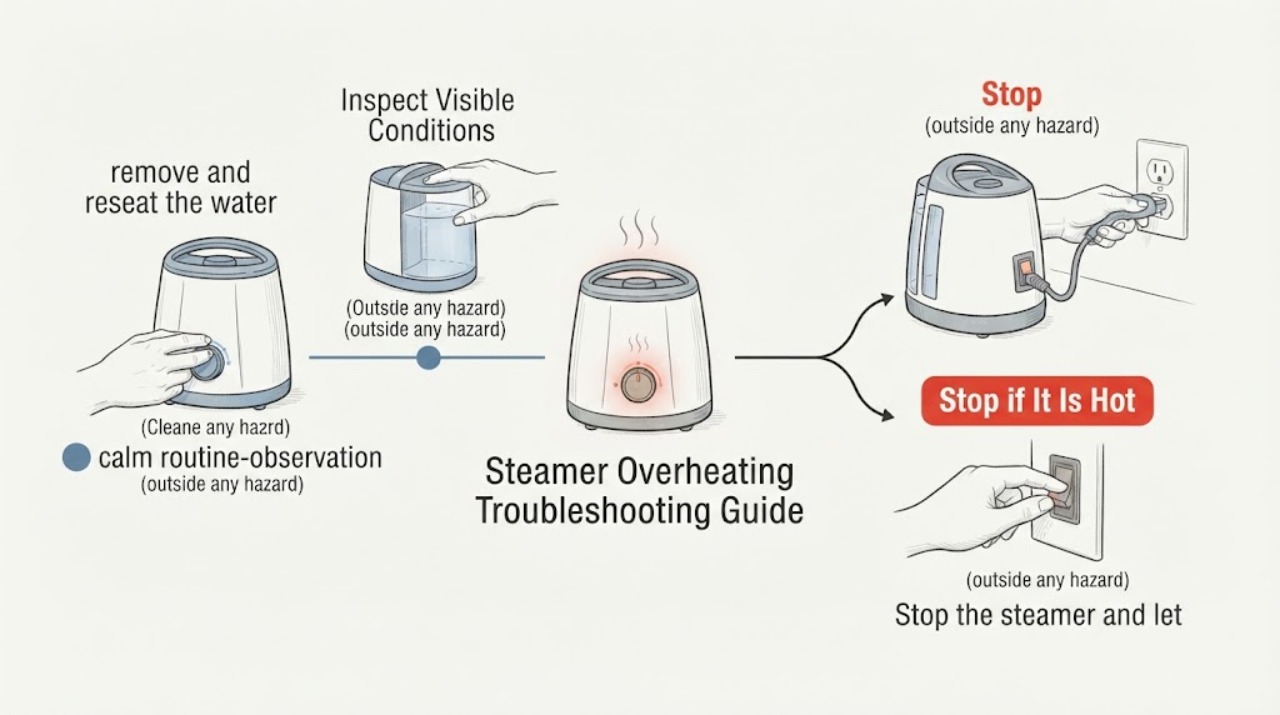
Work through in order
Diagnostic checks
Use only checks that match the exact appliance or system and its official guide.
-
Check 1
Stop the steamer and let it cool in a stable position. Note whether overheating means the housing becomes unusually hot, steam stops after warm-up, or an automatic shutoff or warning appears. Do not keep operating it to reproduce heat.
Expected result: The body remains abnormally hot, steam cuts out, or the unit cools and resumes only after its protection acts.
Next step: If the housing, plug, or cord is unusually hot, keep it unplugged. Otherwise continue only after it is cool and the tank and position checks are safe.
Why this matters
Why: A protective stop or heat buildup means continued testing can add risk; a brief warm-up is different from overheating that persists or disables steam.
-
Check 2
With the unit unplugged and cool, remove and reseat the water tank exactly as the model allows. Confirm the tank has water, the cap is closed, and the tank sits fully in its socket; wipe only accessible spills before reconnecting.
Expected result: The tank is empty or mis-seated, or it is full, correctly seated, and the steamer still overheats.
Next step: Correct the tank condition and perform one supervised test after the unit is cool. Do not bypass a tank sensor or open the heater housing.
Why this matters
Why: A missing water supply can stop steam and leave the heater operating without the expected cooling effect. A correctly seated tank shifts attention to scale, airflow, sensor, or heater service.
-
Check 3
Use the steamer only in the model's intended upright or vertical position and keep the steam head and accessible vents clear of fabric. Observe whether the heat problem appears only when the unit is tilted, covered, or held against material.
Expected result: Heat or steam loss follows an incorrect position or blocked accessible opening, or it occurs even when the unit is upright and clear.
Next step: Restore the documented position and clear only accessible obstructions. If overheating remains upright and clear, stop testing and arrange service.
Why this matters
Why: Philips identifies position and scale as causes of poor steam; correcting position can distinguish an operating condition from a persistent heater or control fault.
-
Check 4
When the steamer is unplugged and fully cool, follow only the model-approved descaling procedure. Record whether scale or residue is visible and whether the next supervised cycle produces normal steam without abnormal heat.
Expected result: Scale is visible and steam improves after the documented maintenance, or the symptom is unchanged or the unit overheats again.
Next step: Do not substitute chemicals or dismantle the appliance. Keep it out of use for recurrent overheating or any damaged cord, odor, smoke, or leak.
Why this matters
Why: Improvement supports a scale-related steam restriction; recurrence after proper maintenance makes a sensor, heater, pump, or control issue more likely without identifying which part.
Use your observations
Decision map
Find the observation that best matches what you see, then follow the next safe action.
-
PATH 01Next step
What you see
The steamer was empty, mis-seated, or used outside its documented upright position, and the heat or steam symptom clears after correction.
Do this next
Use the model's fill and position instructions and monitor one normal session; stop if overheating returns.
Why this path and its safety boundary
Why it matters: An operating condition or water-supply problem is more likely than a confirmed heater failure.
-
PATH 02Next step
What you see
The tank and position are correct, but the steamer repeatedly becomes abnormally hot or stops producing steam after warm-up.
Do this next
Unplug it when cool and arrange manufacturer or qualified appliance service.
Why this path and its safety boundary
Why it matters: Scale, a pump or heater restriction, sensor, or control fault remains possible and cannot be separated safely without model-specific diagnosis.
Helpful context
Understand the symptom
A garment steamer needs the correct water supply and position for its heater and steam path. Separate a normal warm-up from a housing or plug that stays unusually hot, a steam interruption after warm-up, or a protective shutoff. The last group should be treated as a safety boundary rather than tested repeatedly.
When checks do not resolve it
Need a professional?
Stop and arrange qualified service for abnormal housing or plug heat, smoke, burning odor, a damaged cord, a recurring protective shutoff, a leak near electrical parts, or any internal heater, sensor, pump, or control work.
Common questions
FAQ
Can I keep steaming until it cools?
No. Stop for abnormal housing, plug, or cord heat, a warning or protective shutoff, smoke, odor, or a leak. Unplug only when safe and arrange service if the condition recurs.
Does scale prove the heater is bad?
No. Scale can restrict steam, but improvement after the exact approved maintenance is the useful result. Recurrence needs model-specific diagnosis.
Should I replace a thermostat or heater?
Not from the symptom alone. Use the model manual or a qualified technician to establish the part and fit.
Read the exact guide
Official sources
- My Philips Garment Steamer does not produce steamPhilips · garment steamer warm-up, tank seating, scale, positioning, and cool-down checks
Community feedback
Share a repair observation
Share a plain-text repair observation. Accepted observations are published automatically; this page may take a moment to update.