
On this page
Start here
Quick answer
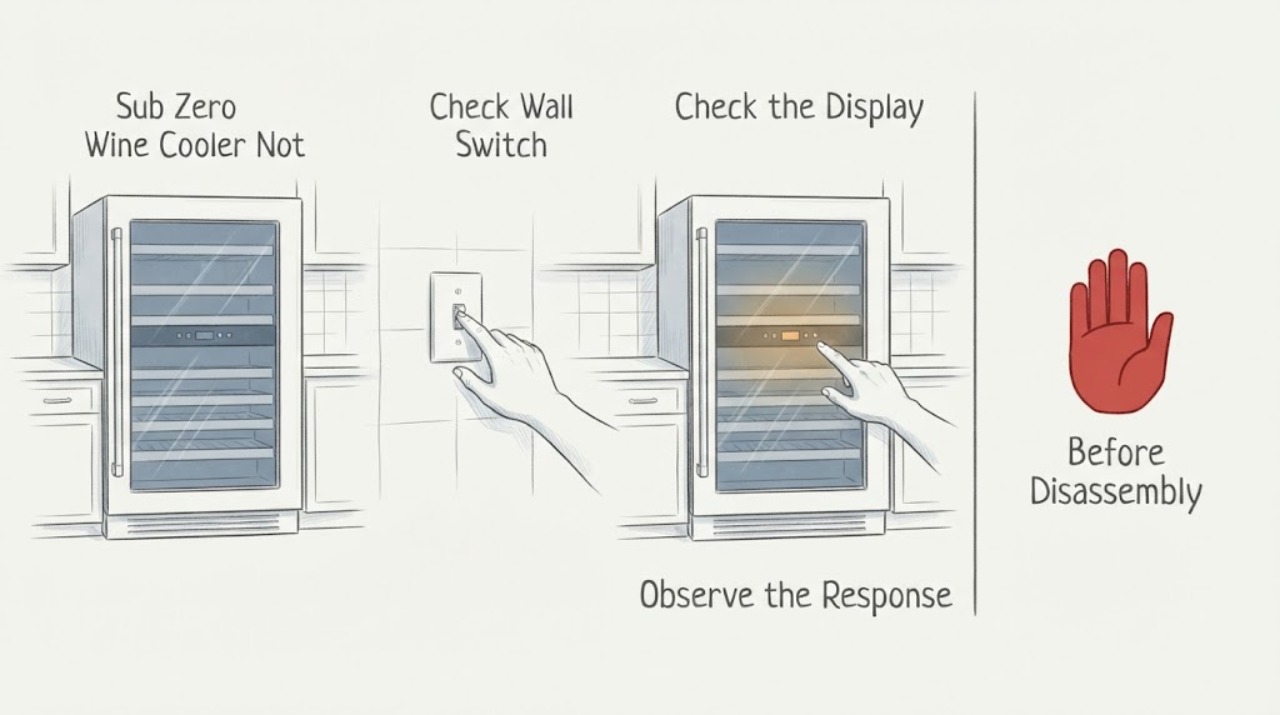
A Sub-Zero wine cooler that will not turn on should be checked from outside: confirm the outlet, switch, breaker, display, and door closure. Leave it off if a breaker trips again or there is electrical damage, and arrange Factory Certified Service.
Work through in order
Diagnostic checks
Use only checks that match the exact appliance or system and its official guide.
-
Check 1
Verify the unit has power: Check the nearby appliance switch, plug connection, and household breaker from a dry position; do not open the cabinet.
Expected result: The switch or breaker is off, or the unit still has no response.
Next step: Restore a tripped breaker only once; if it trips again, leave the unit off and call service.
Why this matters
Why: A simple supply interruption is possible when power is restored; continued silence points to the unit or its control circuit.
-
Check 2
Check the control display: Use the normal power control and note whether the display, interior light, or any service indicator responds.
Expected result: The display responds, or the display and light remain dark.
Next step: Use the model manual for the exact control sequence and record any code.
Why this matters
Why: A responding display suggests a control or setting issue; no indicators suggest power delivery or control service is needed.
-
Check 3
Check door position and obstruction: Open the door only after confirming power is safe, remove an obstruction, and close it firmly so the door switch can engage.
Expected result: The door closes and the light/control responds, or everything remains dark.
Next step: Do not bypass a door switch; request service if the condition persists.
Why this matters
Why: A misaligned or obstructed door can affect operation; no response after a firm closure points away from that simple cause.
-
Check 4
Allow a normal restart: After a brief power reset using the appliance control or household disconnect, restore power and observe the response without repeated rapid cycling.
Expected result: The unit starts, or it remains inactive or repeatedly trips power.
Next step: Leave it disconnected and arrange qualified service for repeated trips.
Why this matters
Why: A successful restart suggests a transient control state; repeated trip or no response is an electrical fault boundary.
-
Check 5
Prepare model information: Locate the model identification label without removing panels and note the symptom, indicator state, and breaker behavior.
Expected result: The label and observations are available for support, or the label cannot be located safely.
Next step: Contact Sub-Zero Factory Certified Service for a nonresponsive unit.
Why this matters
Why: Those details let the service team select the correct manual and parts; missing details should not lead to guessed repairs.
Use your observations
Decision map
Find the observation that best matches what you see, then follow the next safe action.
-
PATH 01Next step
What you see
The control shows a delay, pause, or unfinished previous cycle.
Do this next
Cancel or reset it using the model manual, then observe one controlled restart.
Why this path and its safety boundary
Why it matters: The dishwasher or appliance may be waiting for a control action rather than failing at the reported component.
-
PATH 02Next step
What you see
The external path is restricted, the door or gasket is not sealing, or the filter is visibly blocked.
Do this next
Correct only the accessible condition described by the manufacturer and retest once.
Why this path and its safety boundary
Why it matters: An accessible installation, sealing, or maintenance condition is more likely than an internal part failure.
-
PATH 03Next step
What you see
Controls are ready, accessible paths are clear, and the same symptom returns during a repeat cycle.
Do this next
Stop using the appliance when the symptom can cause damage and contact the manufacturer or an authorized servicer with the recorded observations.
Why this path and its safety boundary
Why it matters: The remaining possibilities include an internal valve, pump, sensor, heater, or control fault that cannot be identified safely without the model manual and service tools.
Helpful context
Understand the symptom
This guide keeps the sub-zero wine-cooler diagnosis at the accessible checks supported by the manufacturer source. Work in order and use each observation to choose the next branch.
When checks do not resolve it
Need a professional?
Stop and contact the manufacturer or an authorized technician if the symptom persists after the accessible checks, water reaches electrical parts, a breaker trips again, smoke or burning smell appears, or any wiring, sealed system, pump, valve, or control requires access.
Common questions
FAQ
Should I keep running it while I troubleshoot?
Stop if water is near electrical parts, a breaker trips, there is smoke or a burning smell, or the appliance is sparking. Otherwise perform only the external checks in the sequence and stop if the symptom returns.
Do I need the exact model number?
Yes. Controls, filters, drain routing, and service procedures vary by model. Record the model label and any displayed code before ordering a part or requesting service.
When is a replacement part justified?
Only after the model manual or an authorized technician links the observed result to that part. A similar symptom alone does not establish fit or compatibility.
Read the exact guide
Official sources
- Sub Zero Warm Wine Storage Troubleshooting | How to GuideSub-Zero · Sub-Zero wine storage units
Community feedback
Share a repair observation
Share a plain-text repair observation. Accepted observations are published automatically; this page may take a moment to update.