
On this page
Start here
Quick answer
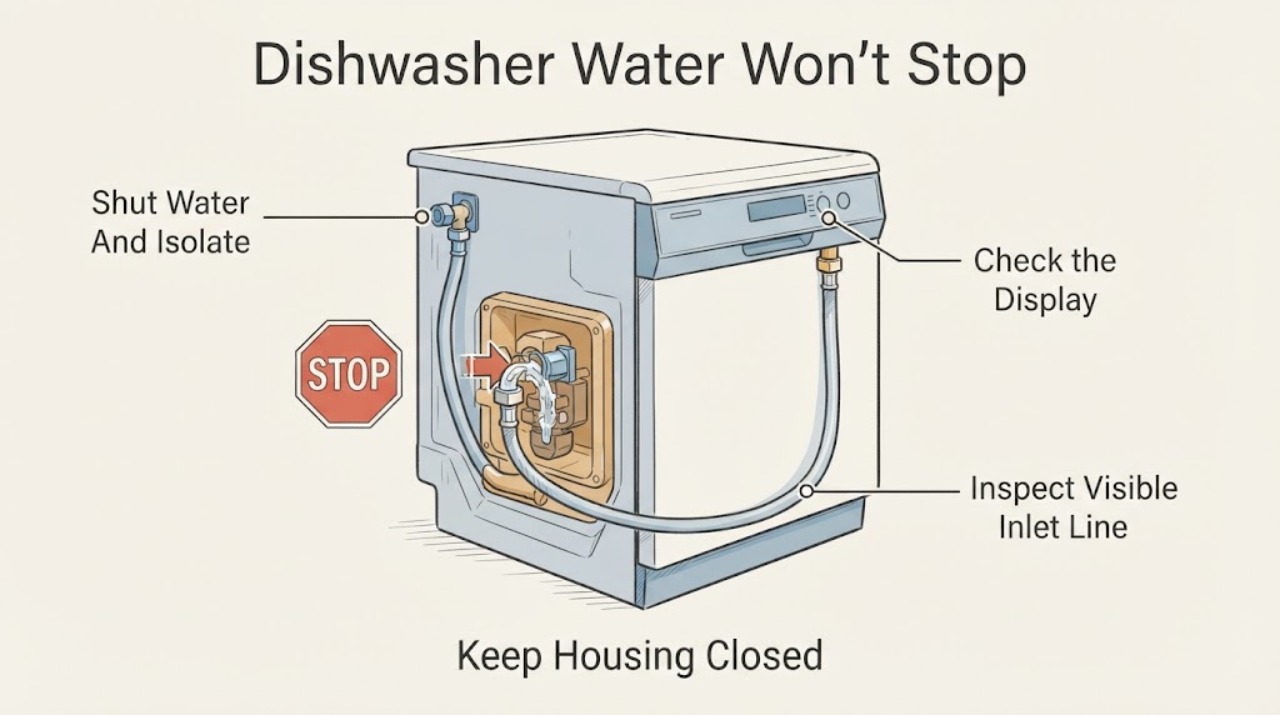
If water is still entering a Thermador dishwasher when it should be off, stop the water first: close the dishwasher's water-supply valve under the sink, and disconnect electrical power only when it is safe to do so and no water is contacting electrical connections. Do not keep running a cycle to prove that the intake valve is stuck. Check for standing water or an active leak, photograph the display/code, and inspect only the visible inlet hose for kinks or damage. Thermador's official code guidance treats base water and filling-system indications as service conditions; E15/E3100 specifically calls for turning off the water inflow. Keep the supply closed and arrange Thermador or qualified dishwasher service for an internal inlet-valve, flow-meter, safety-switch or control diagnosis. Do not open the cabinet, jumper a valve, or order a generic valve without the exact model.
Before you begin
Safety first
- Limit owner work to closing the water supply, safe external power isolation, photographing the state/code, reading the model, and inspecting the visible inlet hose without disconnecting it. Do not reopen water to reproduce the fault, open the cabinet, probe live wiring, bypass the inlet valve or safety switch, or order an unverified part.
Work through in order
Diagnostic checks
Use only checks that match the exact appliance or system and its official guide.
-
Check 1
Close the dishwasher's water-supply valve under the sink as soon as unexpected filling is observed; if there is standing water, isolate electrical power only through a safe dry method and do not reach through water.
Expected result: Water stops after the supply valve is closed, or water continues/there is visible leakage or a wet electrical area.
Next step: Keep the supply closed and use qualified service for any continued water, leak or unsafe electrical condition.
Why this matters
Why: Closing the supply controls the immediate overflow risk; it does not prove whether an internal inlet valve, flow control or another part caused the symptom.
-
Check 2
Without restarting the dishwasher, photograph the display/code, note whether filling occurred while off or after cancellation, record the water level and identify any base or floor leak.
Expected result: A listed water-flow/leakage code appears, an unknown code appears, or no code is shown.
Next step: Use only the exact code/manual branch; for unknown or persistent filling, keep water closed and request service.
Why this matters
Why: Thermador assigns different meanings to E14/E3000, E15/E3100 and other codes; no-code water intake still does not establish a stuck valve.
-
Check 3
With water closed, inspect the visible inlet hose and connections for kinks, crushing, damage or an obvious leak; do not disconnect the line or access the valve housing.
Expected result: The hose is damaged/kinked, or it appears intact while the dishwasher still had an unexpected-fill symptom.
Next step: Leave a damaged hose or continuing filling to qualified service; do not restore pressure to repeat the test.
Why this matters
Why: Thermador supports inlet-hose checks for water-flow conditions, but an intact hose cannot confirm or exclude an internal valve or flow-control fault.
-
Check 4
Record the complete Thermador model/E-Nr and retrieve its owner manual and model-specific parts view; compare the observed panel/code only with that exact documentation.
Expected result: The exact manual and parts list are available, or the model is missing/unclear.
Next step: Follow only documented external steps; otherwise provide the model and photos to service without ordering a part.
Why this matters
Why: Thermador requires the appliance model to identify compatible parts and tells owners to use the manual for model-specific procedures; a generic intake-valve match is unsupported.
-
Check 5
Give Thermador or a qualified servicer the model, code/photo, water-valve position, whether water stopped when supply was closed, water level/base leak, hose condition and cycle timing.
Expected result: Water intake recurs when service restores supply, a base-water/filling code is present, or any diagnosis requires the cabinet, valve or wiring to be opened.
Next step: Keep water and power isolated as safe, do not run another cycle, and arrange model-qualified service.
Why this matters
Why: The public Thermador guidance routes filling-system and leakage-protection conditions to support and does not authorize internal valve testing or bypass.
Use your observations
Decision map
Find the observation that best matches what you see, then follow the next safe action.
-
PATH 01Next step
What you see
Water stops after the under-sink supply valve is closed and there is no standing water or electrical danger.
Do this next
Keep the supply closed, document the code/model and arrange qualified service before restoring water.
Why this path and its safety boundary
Why it matters: The immediate overflow risk is controlled, but the observation alone cannot distinguish a stuck inlet valve from another filling-system cause.
-
PATH 02Next step
What you see
The display shows E15/E3100 or there is water in the dishwasher base.
Do this next
Keep the water supply closed and contact Thermador or qualified service; do not reset and run the dishwasher to test it.
Why this path and its safety boundary
Why it matters: Thermador identifies the leakage-protection safety switch as having detected base water and directs the user to turn off water inflow.
-
PATH 03Next step
What you see
A water-flow/filling code such as E14/E3000, E16/E17, E3300/E3400 or another code appears, with no confirmed external hose obstruction.
Do this next
Photograph the code, keep water closed if filling was uncontrolled and arrange model-qualified service; do not replace a generic valve.
Why this path and its safety boundary
Why it matters: Thermador treats these as filling-system or water-flow conditions, and the code does not establish a specific valve failure without model diagnosis.
-
PATH 04Next step
What you see
The visible inlet hose is kinked or damaged, with the water supply already closed.
Do this next
Do not disconnect a pressurized line or restore water to test it; provide the hose/model information to service.
Why this path and its safety boundary
Why it matters: The external line is a supported check and may explain a water-flow symptom, but the page does not support a user repair of an internal intake valve from that observation.
-
PATH 05Next step
What you see
Water still enters when the supply is reopened, the symptom recurs, the model/code is unknown or the next step would require removing the cabinet or valve wiring.
Do this next
Keep the water supply closed, isolate power only when safe and arrange Thermador or qualified dishwasher service. Do not bypass, jumper or bench-test the valve.
Why this path and its safety boundary
Why it matters: The condition is outside safe owner checks; the symptom alone does not identify the inlet valve, flow meter, safety switch, wiring or control.
Helpful context
Understand the symptom
Stop the water before diagnosing the valve
A dishwasher that continues to fill can overflow even if its controls are off. Close the dedicated water-supply valve under the sink. If there is standing water or wet electrical equipment, do not reach through it; isolate power only by a safe method and use qualified help. Thermador's leakage-protection guidance specifically tells owners to turn off water inflow when the base-water safety switch is reported.
Record the visible state without restarting the cycle
Note whether water was entering while the dishwasher was off, after a cycle was cancelled, or only during a programmed fill. Photograph any display or code, the water level, visible leak path and the supply-valve position. Do not reopen the valve just to repeat the symptom; the observation cannot prove that an internal inlet valve is mechanically stuck.
Inspect only the external inlet line
With the water supply closed, look at the visible inlet hose and connections for a kink, crushed section, damage or obvious leak. Thermador lists inlet-hose checks for some filling-system codes. Do not disconnect a pressurized line, remove the kick plate or probe the valve, float, flow meter or control wiring.
Use the exact code and model manual
Thermador distinguishes filling-system/flow-meter indications such as E14 or E3000, base-water safety indications such as E15 or E3100, and other water-flow codes. Capture the exact code and find the matching owner manual; do not map an unrecognized code to a stuck valve. Thermador's parts lookup also requires the model before compatible parts can be identified.
Hand off an internal filling fault
Keep the water supply closed and arrange Thermador or qualified dishwasher service when water continues to enter, the base contains water, the hose is damaged, a filling-system code returns or the next step would require cabinet access. A technician can determine whether the observed symptom involves the inlet valve, flow sensing, safety switch, wiring or another cause. Do not bypass the valve or run another cycle to test it.
When checks do not resolve it
Need a professional?
Use Thermador or qualified service for uncontrolled filling, base water, water-flow codes, recurring symptoms, hose damage or any internal filling-system diagnosis.
Safety scope: Limit owner work to closing the water supply, safe external power isolation, photographing the state/code, reading the model, and inspecting the visible inlet hose without disconnecting it. Do not reopen water to reproduce the fault, open the cabinet, probe live wiring, bypass the inlet valve or safety switch, or order an unverified part.
Common questions
FAQ
What should I do first if a Thermador dishwasher keeps filling?
Close the dishwasher's water-supply valve under the sink immediately. If there is standing water, isolate power only through a safe dry method. Keep the supply closed and arrange service instead of restarting the cycle or testing the valve.
Does continuous water prove the Thermador inlet valve is stuck open?
No. It identifies an uncontrolled filling symptom, but Thermador's public guidance also covers flow-meter, filling-system and leakage-protection conditions. The exact model/code and a qualified diagnosis are needed before naming the failed component.
Can I buy a generic replacement intake valve?
Do not. Thermador's parts guidance requires the appliance model to find compatible parts. Keep the water supply closed and provide the model, code and photos to qualified service.
Read the exact guide
Official sources
- Dishwashers - TroubleshootingThermador · Official Thermador family-level dishwasher guidance without an exact model; it covers water-supply line checks, owner-manual reset and service boundaries.
- Customer Support, Service, Repair & PartsThermador · Official Thermador service page for dishwasher support, manuals, troubleshooting and servicer routing; it does not diagnose a specific valve.
- Dishwashers - Error CodesThermador · Official Thermador dishwasher error-code guidance across supported families; exact code/model context still controls the applicable branch.
- Dishwashers - Parts & AccessoriesThermador · Official Thermador parts guidance; it says the appliance model is required to view compatible parts and does not establish an inlet-valve fit for an unspecified dishwasher.
Community feedback
Share a repair observation
Share a plain-text repair observation. Accepted observations are published automatically; this page may take a moment to update.