
On this page
Start here
Quick answer
A Thermador dishwasher with leaking should be checked through its display and current cycle state, then the accessible water or drain path and clean filter. Use the model manual for reset steps and arrange authorized service when the symptom returns or a safety condition appears.
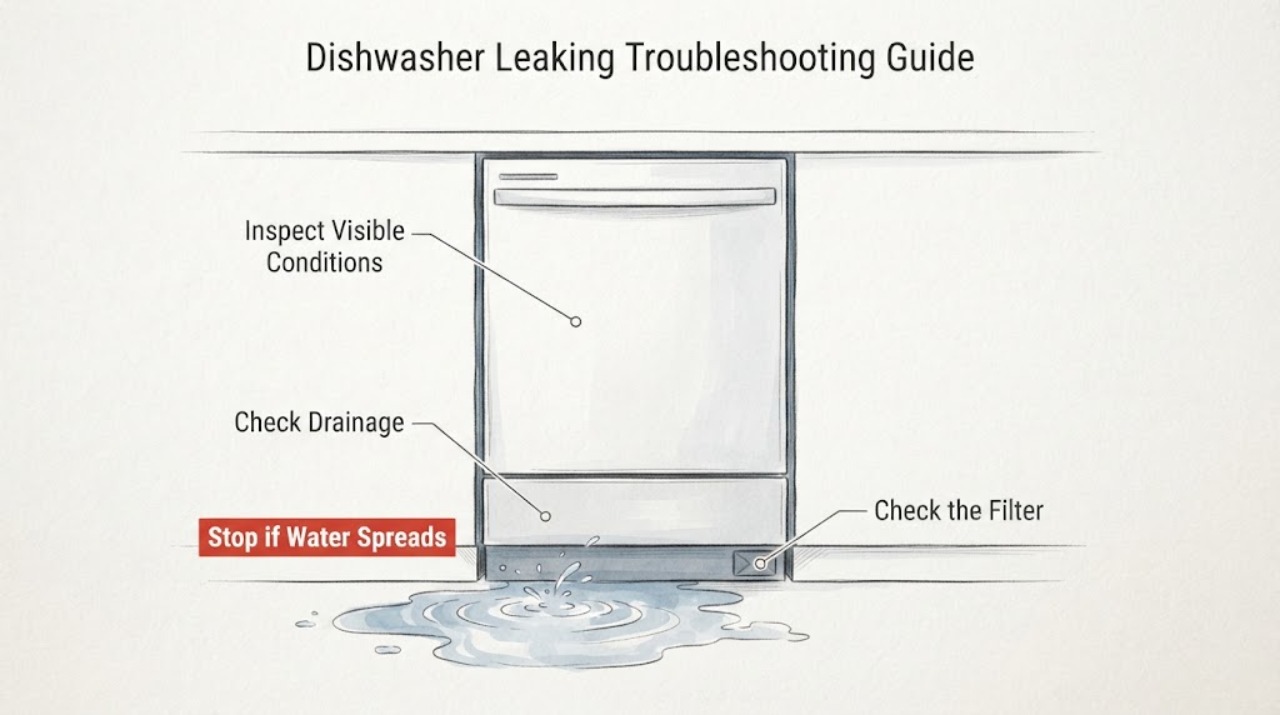
Work through in order
Diagnostic checks
Use only checks that match the exact appliance or system and its official guide.
-
Check 1
Check the control state: Observe the display, selected program, delay indicator, and whether the previous cycle appears incomplete.
Expected result: A delay or unfinished cycle is shown, or the controls appear ready.
Next step: Follow the owner manual reset or cancel sequence for the exact model.
Why this matters
Why: Delay or an unfinished prior cycle can prevent the expected next action; ready controls shift the diagnosis to the reported symptom.
-
Check 2
Inspect the accessible water and drain path: Check the under-sink water valve and hoses for an open connection, kink, or visible leak; for drain symptoms inspect the air gap, disposal connection, and hose.
Expected result: A valve is closed, a hose is kinked, or the accessible path is clear.
Next step: Correct only an accessible connection and stop if it leaks.
Why this matters
Why: A restricted supply or drain path can stop or extend a cycle; a clear path points toward an internal component or control.
-
Check 3
Check the filter and spray area: With the dishwasher off, remove and rinse the filter as the owner manual directs and ensure dishes do not block spray arms.
Expected result: The filter is blocked, spray arms are obstructed, or the area is clear.
Next step: Reinstall the filter correctly and never run the appliance without it.
Why this matters
Why: Debris can reduce wash performance and contribute to odor or drainage symptoms; a clear assembly points to a different branch.
-
Check 4
Run a controlled retest: Use the model manual to cancel or reset, then run a suitable empty or lightly loaded cycle while noting the phase at which the symptom returns.
Expected result: The cycle completes, or the same symptom returns at fill, wash, drain, or end.
Next step: Do not repeat a cycle if water is overflowing, electrical damage is visible, or the unit is sparking.
Why this matters
Why: A phase-specific recurrence narrows the service diagnosis; completion after cleaning or reset supports an accessible cause.
-
Check 5
Record the exact symptom: Write down any displayed code, beep pattern, water level, unusual sound, and whether the door or controls responded.
Expected result: The symptom repeats with a clear pattern, or it is intermittent.
Next step: Contact Thermador support or an authorized servicer when the condition persists.
Why this matters
Why: A repeatable pattern can be matched to the model manual; intermittent faults still need the full history rather than guessed parts.
Use your observations
Decision map
Find the observation that best matches what you see, then follow the next safe action.
-
PATH 01Next step
What you see
The control shows a delay, pause, or unfinished previous cycle.
Do this next
Cancel or reset it using the model manual, then observe one controlled restart.
Why this path and its safety boundary
Why it matters: The dishwasher or appliance may be waiting for a control action rather than failing at the reported component.
-
PATH 02Next step
What you see
The external path is restricted, the door or gasket is not sealing, or the filter is visibly blocked.
Do this next
Correct only the accessible condition described by the manufacturer and retest once.
Why this path and its safety boundary
Why it matters: An accessible installation, sealing, or maintenance condition is more likely than an internal part failure.
-
PATH 03Next step
What you see
Controls are ready, accessible paths are clear, and the same symptom returns during a repeat cycle.
Do this next
Stop using the appliance when the symptom can cause damage and contact the manufacturer or an authorized servicer with the recorded observations.
Why this path and its safety boundary
Why it matters: The remaining possibilities include an internal valve, pump, sensor, heater, or control fault that cannot be identified safely without the model manual and service tools.
Helpful context
Understand the symptom
This guide keeps the thermador dishwasher diagnosis at the accessible checks supported by the manufacturer source. Work in order and use each observation to choose the next branch.
When checks do not resolve it
Need a professional?
Stop and contact the manufacturer or an authorized technician if the symptom persists after the accessible checks, water reaches electrical parts, a breaker trips again, smoke or burning smell appears, or any wiring, sealed system, pump, valve, or control requires access.
Common questions
FAQ
Should I keep running it while I troubleshoot?
Stop if water is near electrical parts, a breaker trips, there is smoke or a burning smell, or the appliance is sparking. Otherwise perform only the external checks in the sequence and stop if the symptom returns.
Do I need the exact model number?
Yes. Controls, filters, drain routing, and service procedures vary by model. Record the model label and any displayed code before ordering a part or requesting service.
When is a replacement part justified?
Only after the model manual or an authorized technician links the observed result to that part. A similar symptom alone does not establish fit or compatibility.
Read the exact guide
Official sources
- Troubleshooting | Dishwashers Support | ThermadorThermador · Thermador dishwashers
Community feedback
Share a repair observation
Share a plain-text repair observation. Accepted observations are published automatically; this page may take a moment to update.